One-on-One Tutoring: Benefits, Effectiveness & How It Works
reviewed by Jo-ann Caballes
Updated on July 21, 2026
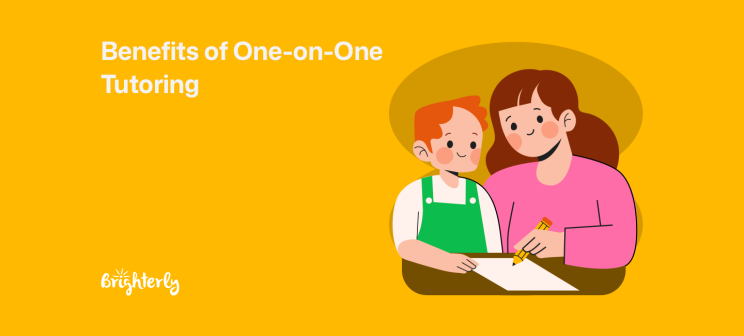
Key Points: One teacher cannot pay equal attention to every child in a school class. One-on-one tutoring solves this issue — a student gets the undivided attention of a dedicated professional who adjusts the learning process and program according to this student’s needs. One-on-one tutoring is a teaching format that involves one educator (private tutor) teaching one student in person or online. Because learning sessions in this teaching format are dedicated to one learner, it’s also called private tutoring, individualized instruction, and one to one tuition. In contrast to a traditional classroom or a small group tutoring format, a private tutor pays all their attention to a single child, which means the educator can tailor the lesson pace, the learning materials, and explanations to that student’s particular needs. Before providing the one to one instruction, a private tutor usually starts with a short grade-level knowledge diagnostic, which allows the educator to spot the learning gaps and build a personalized learning plan accordingly. In-person one on one tutoring is when the lessons happen in real life, face-to-face, usually at a tutoring center, a library, or at a student’s home. In contrast, online tutoring implies the lessons happen with the use of technology — computer, tablet, and internet access to reach the platform where the student and the tutor connect through a video meeting. In general, comparing online tutoring vs. in person tutoring comes down to which format fits your child best and how much flexibility your family needs.
Personalized learning plan for your child
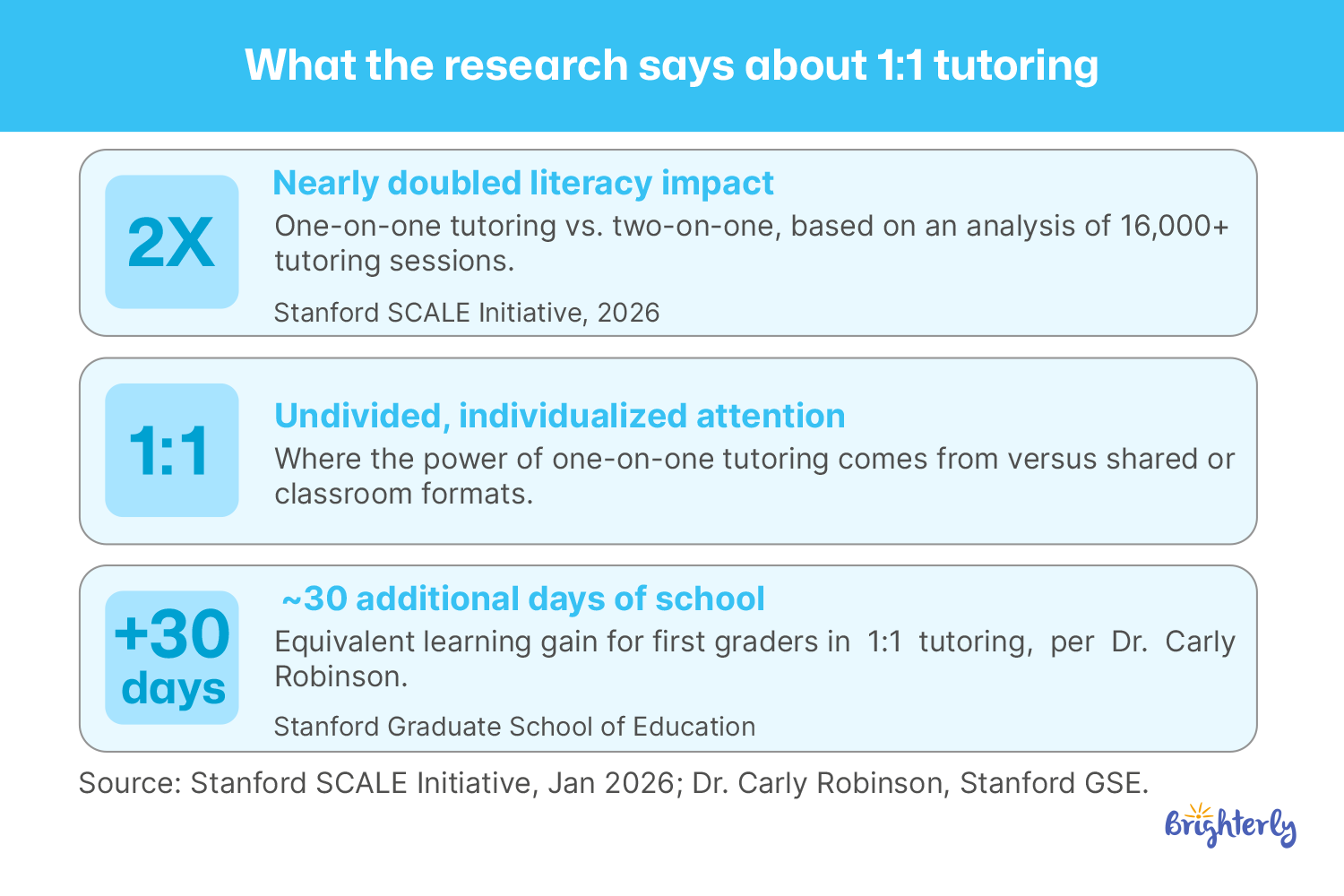
Brighterly online private tutors teach lessons based on the needs of each student. Explore Brighterly Learning Experience Learn exactly how Brighterly helps students thrive through expert sessions, online tools, and proven feedback from thousands of satisfied parents One to one tutoring format is effective due to providing a personalized, safe, and dedicated learning experience. Proving private tutoring effectiveness, the Stanford SCALE Initiative’s January 2026 research found that students involved in this tutoring format show nearly double the literacy gains compared to children involved in two-on-one learning sessions. In the same Stanford research, Dr. Carly Robinson, Senior Researcher at Stanford Graduate School of Education, shares more insight into the effectiveness of private tutoring compared to two-to-one tutoring. “For example, one study of more than 2,000 elementary school children in Texas tested the difference between one-to-one and two-to-one online tutoring during the 2022-23 school year” However, not every private tutoring session can be effective — the format alone doesn’t guarantee a successful outcome. For one to one teaching to work, the teacher should be able to: For example, if the kid has challenges with the overall understanding of the subject, the tutor should be able to brainstorm possible reasons for that. After, they can create a curriculum that is carefully tailored to a child’s abilities and educational needs. Comparing one-on-one, small group, and traditional classroom teaching formats, 1 on 1 tutoring provides room for personalizing the learning, small group tutoring combines personalization with peer collaboration, and traditional classroom instruction delivers a standard learning experience (for free in public schools). One-on-One Tutoring Small Group Tutoring School classroom Teacher’s attention Undivided Shared among 2–5 students Shared among 25–30 students Learning pace Fully personalized Semi-personalized One for all Teacher’s feedback Instant and personalized Occasional For the whole-class/can be delayed Cost Hourly rate/depends on tutoring platform or a tutor Rate per class/depends on class size Per semester or learning year/depends on school Best for Personalized learning, closing specific knowledge gaps Collaborative learning General instruction In terms of pros and cons of one on one learning, its main advantage is that it pairs a student with a dedicated professional who tailors a learning plan according to the specific needs of this student. However, this learning format typically costs more than group or traditional school options. Pros of one-on-one tutoring Cons of one-on-one tutoring The benefits of one on one tutoring include undivided teacher’s attention, instant teacher’s feedback, safe learning environment, flexibility, convenience, targeted practice aimed at closing learning gaps, development of positive study habits, broader learning opportunities, and higher sense of accountability a teacher feels when teaching one student. As each private tutoring session focuses on one kid at a time, the tutors make sure their students achieve their learning objectives — they are personally interested in your kid’s success and eager to adjust their one-on-one teaching strategies to make it happen. While school educators rarely have time to play with different tactics and strategies for cracking a problem, one-on-one tutors allow plenty of time to experiment — they teach students to understand the subject fully rather than mimic what the teacher does. Tailored instruction that private tutors provide also give kids the time and freedom to think differently, directing them towards unique solutions. When kids don’t have to stress over following the standard curriculum pacing, they develop interest and deeper understanding of the subject easier, achieving a better academic performance. Besides, personal tutors can adapt a given class to a neurodivergent kid who may experience a shorter attention span compared to peers. For example, for kids struggling with ADHD and math, tutoring is one of the helping strategies. Melissa Tract, Psychotherapist, Child and Young Adult Behavioral/Mental Health Therapist, LCSW at Mindful with Mel, says that children with slower processing speed achieve better results if they have the classroom and then one-on-one tutoring in addition. “A child who has a short attention span can miss a lot of the information being taught in the main classroom and could zone out if they need a break from the classroom and are denied one.” One of the key tasks of one to one instruction is to establish a safe learning space where kids can feel more relaxed, confident, and motivated to learn. Compared to a traditional classroom, there are fewer distractions and stressors like fear, social shame, or math anxiety in private sessions. Chanelle Pough, Executive Director of the Florida Early Learning Corps (FELC), says one-on-one tutoring increases teachers’ instructional capacity by providing extra academic support and encouragement for students. “It builds students’ confidence.” Compared to a traditional school or studying in a private group, private tutoring means your kid can ask as many questions as they have, without the fear of experiencing peer pressure. As the child can easily clarify everything that confuses them, they start understanding the topic much better, naturally becoming more confident in their knowledge and learning abilities. One on one lessons also allow for a more pleasant relationship between the tutor and the student — private educators are more motivated to make the learning atmosphere secure and provide all the support needed for your kid to excel in the chosen subject. In traditional classrooms, kids usually get any kind of feedback after completing tests and projects. With private tutoring, children have the opportunity to receive immediate and frequent suggestions and guidance during one-on-one sessions. For example, online one-on-one tutors can share general feedback monthly and provide instant comments after classes, highlighting the kids’ strengths and areas for improvement. This helps you and your kid focus on what really matters and adjust the learning process based on this information. One on one intervention is a great way of deepening the kids’ knowledge on a specific subject, which doesn’t end with giving children the tools to understand this subject better — the main objective is to boost the kid’s critical thinking skills and self-esteem so they can confidently grasp different concepts and topics that they need to fill their knowledge gaps. With private lessons, students and their parents have more flexibility when building a learning schedule — private tutors adapt to their students’ needs. In case of online sessions, neither students nor tutors have to leave their houses to hold a session, which allows for even more flexibility and convenience. When a kid gets sick and can’t properly catch up with a study program, having an online tutor is a solution. A teacher available online from any location can help quickly explore the new material and not worry about the gaps in knowledge when a kid gets back to school. 1 on 1 teaching can help your child develop healthy study habits by providing children with executive function skills, such as time management, organization, and prioritization. The kids become independent faster and don’t struggle with the increasing amount of homework as they switch to a higher grade. As for accountability, while schools offer it too, it’s not on the same level as private tutoring. Given that your kid’s success is the tutor’s success, tutors try their best to improve your kid’s skills with all the teaching methods they possess. Private tutors work closely with children and families, so they understand they are answerable to them as clients. This accountability motivates tutors to dedicate their efforts so that their students’ real potential shines. Based on their subject of interest, kids can find a learning opportunity they will actually love and be eager to follow. This way, one-on-one tutoring can broaden their horizons and boost their natural talents. Once you go for one-on-one tutoring, your kid can learn something faster and better than their peers attending group classes. This approach works great both for school classes and new hobbies that support your kid’s interests in other out-of-school activities. The range of subjects available through online tutoring has grown significantly — kids who want to go beyond their school curriculum can now find one-on-one support in areas like engineering, coding, or advanced science, not just core subjects. Private tutoring rates in the U.S. vary widely by subject, location, format (online or in-person), and tutor experience. According to the Brighterly article reviewing tutoring rates per hour in 2026 private tutors charge from $25 to $80 for an hour, with online lessons costing lower than in-person lessons. Our lesson pricing starts at $17.70 (20% discount applied) for a 45 minute long lesson. The standard amount of lessons is 2 per week but the schedule can be tailored to your family’s needs. The first session is completely free. Our one-on-one math tutoring or reading tutoring includes skilled educators who offer online private sessions for K-12 kids. Our one-on-one teaching strategies are based on Common Core principles to help each student keep up with their school program and feel more confident during classes. After the demo lesson, our tutor one on one creates a personalized math program or a reading program for a kid. To develop this program, the tutor offers your child a diagnostic test to determine their current level compared to the grade standards, identify their key strengths and weaknesses, and adjust the structure of private lessons accordingly. This way, your kid will get a personalized curriculum that is fully aligned with the US school standards yet adjusted to your kid’s needs and learning style. For kids who struggle with reading and writing, our online reading tutor or an ELA tutor can help with building reading and writing skills, covering skills from phonics and vocabulary building to fluency and analytical thinking.
Get a one-on-one professional educator online
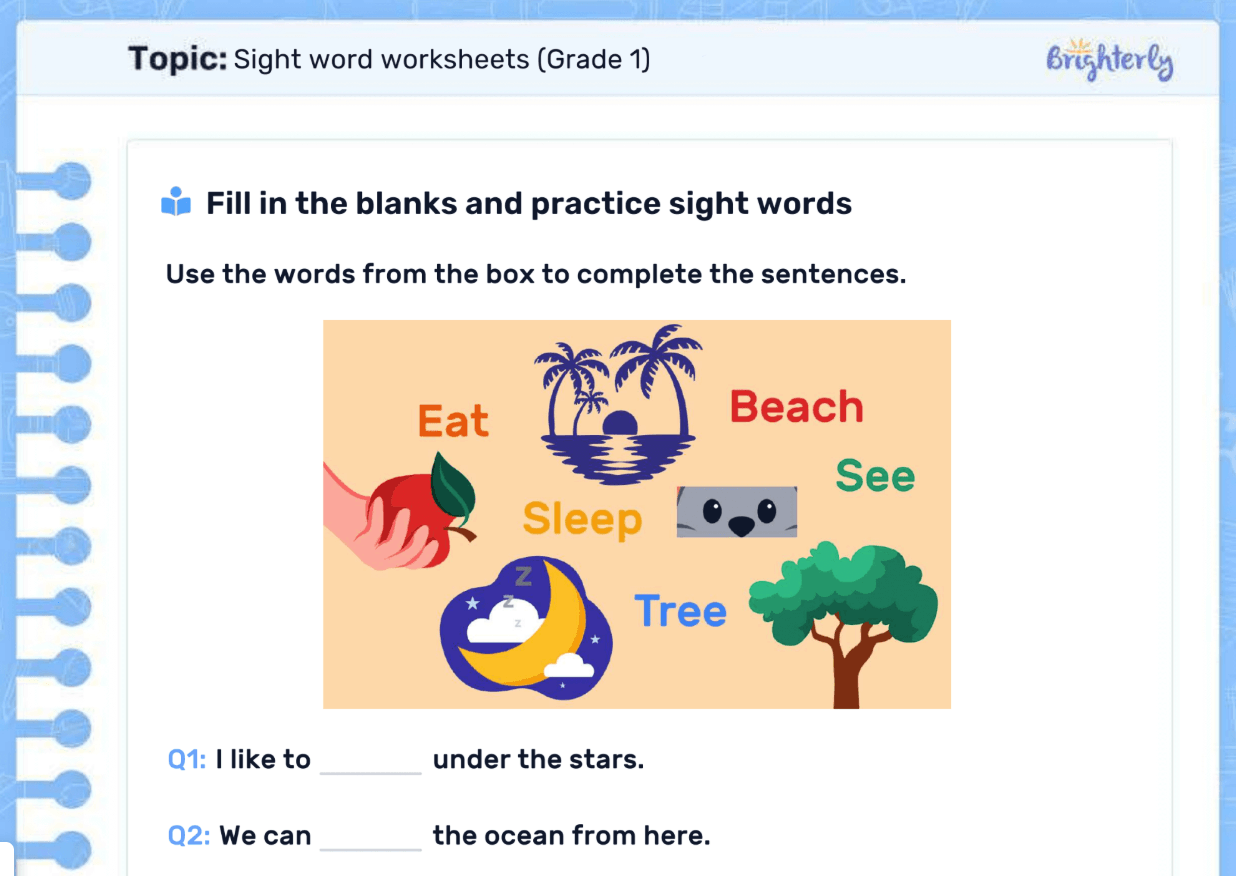
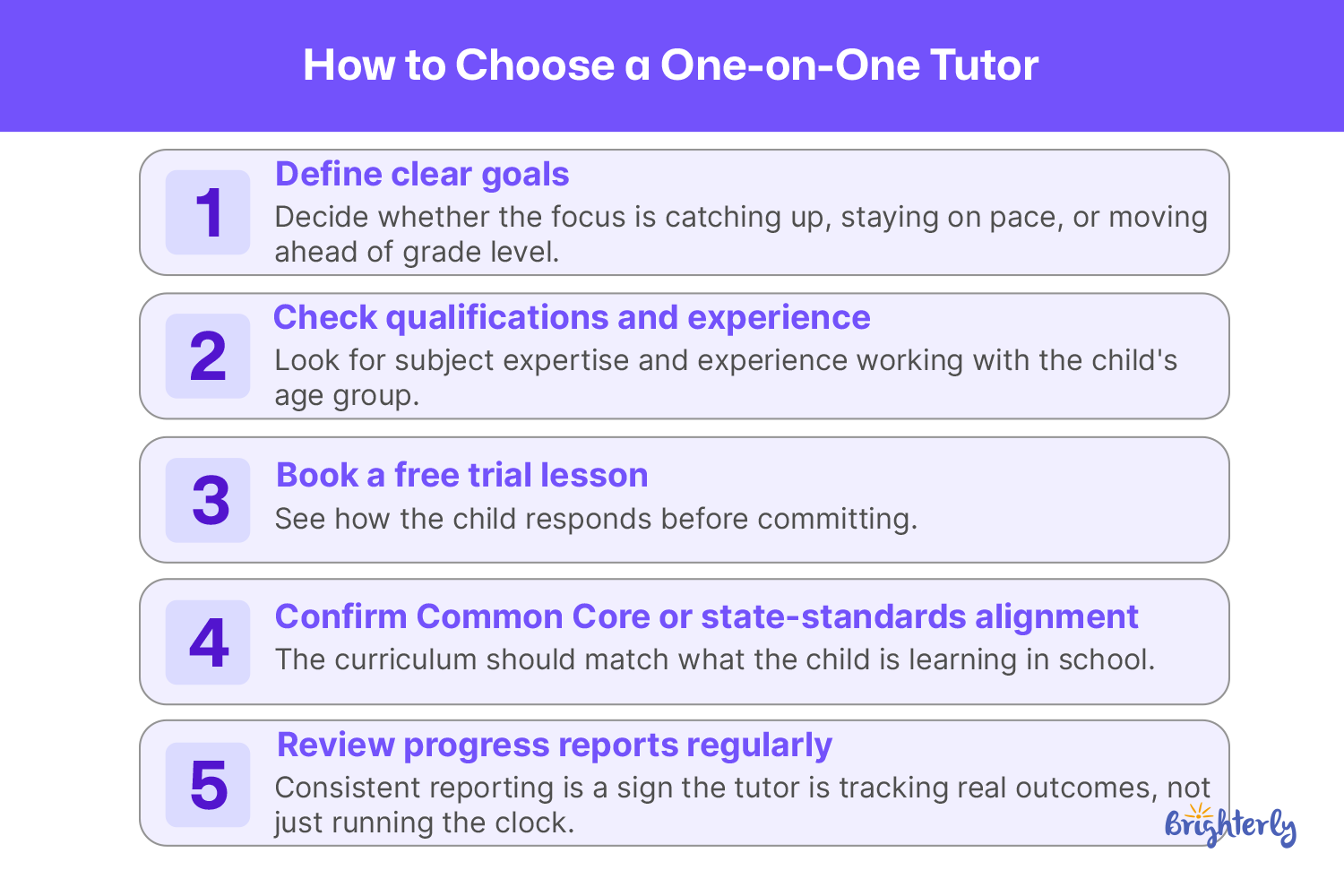
A tutor will determine your child’s knowledge gaps and personalize the lessons accordingly. You can also access plenty of our learning materials for free. In particular, our math and reading worksheets for kids are sets of exercises that improve kids’ math skills in a diversified, interactive manner. Separated by topics, they include text questions and bright visuals to make the learning process more controlled, enjoyable, and engaging. To choose a one-on-one tutor for your kid, search for a trusted online tutoring platform; filter your tutor by subject, price, academic level, and mention the special needs of your kid. Once you get a tutor, take a free lesson to see how your kid feels and whether there’s a good connection between them and the tutor. Consult your kid’s school teachers and see if the offered learning plan is effective. One-on-one tutoring can be better in cases when your goal is to target specific learning gaps. Unlike small group tutoring, private tutoring means a teacher’s attention is on one kid, which means the teacher can give personalized feedback and customize the learning program according to this kid’s needs. Besides, private tutoring can be better for kids who prefer studying outside of the classroom due to peer pressure and anxiety they experience at school. Most private tutoring programs include 2–3 sessions per week, however the amount of sessions a particular child needs per week to see results depends on this child’s level of knowledge and the goals of tutoring. For kids who need just homework support, fewer sessions can be enough, while struggling kids may need 3 or more private lessons per week to see progress. There’s no particular age at which a child should start one-on-one tutoring. However, based on Stanford SCALE Initiative January 2026 research, one-on-one tutoring, especially for reading in kindergarten through 2nd grade, can help kids produce substantially larger gains than two-on-one tutoring. This data proves that early private tutoring can be beneficial. Yes, both one-on-one and in-person tutoring are effective. The choice between the two depends on your needs. If you’re looking for flexibility and the ability for your child to learn from anywhere, online tutoring is probably the best option for you. If your child prefers learning with hands-on materials and focuses better when a teacher is in the room, consider in-person format. To see if one-on-one tutoring is working, look for signs you can measure — improving grades, faster homework completion, and fewer signs of stress related to the subject. Also, online tutors usually provide regular progress reports that can point to specific skills gained or knowledge gaps filled. Yes, one-on-one tutoring can help children with ADHD or learning differences since private tutors can customize the curriculum and learning pace according to the child’s needs, including ones connected to specific conditions. For example, tutors can implement movement breaks, adjust session length, and use materials suited to how the particular child processes information. Getting a teacher one on one can be a great solution for children who need additional help on their educational journey. When the classroom environment doesn’t seem to yield results, a personalized approach and individual attention from a professional private educator can be exactly what your kid lacks to thrive. If you need high-quality tutoring services, our team can assist with providing a custom program that will be fully aligned with school demands, consider your child’s learning habits, and come at an affordable price. For teachers, classroom management strategies are key for setting structure and supporting a productive environment. With them, you can affect performance and behavior. And as it’s about rules and expectations, the techniques you adopt in September shape how students learn throughout the year. This guide covers 25+ best classroom management strategies, techniques, and ideas you […] May 20, 2022 The most important math skill? Addition! It’s the very first step kids take, and a strong grasp of it sets the stage for success in all future math topics. As a teacher, I’ve put together this article with practical ways to help your child master addition facts at home. Key points The first steps in […] May 25, 2022
What Is One-on-One Tutoring?
In-Person vs. Online One-on-One Tutoring
Is One-on-One Tutoring Effective?


One-on-One vs. Small Group vs. Classroom
Pros and Cons of One-on-One Tutoring
What Are the Benefits of One-on-One Tutoring?
Personalized Attention and Pace

A Safe Space That Builds Confidence
Instant, Personalized Feedback
Closing Learning Gaps and Mastering Concepts
Flexibility and Convenience
Stronger Study Habits and Accountability
Broader Learning Opportunities
How Much Does One-on-One Tutoring Cost?
One-on-One Tutoring with Brighterly
How to Choose a One-on-One Tutor
Frequently Asked Questions
Is One-on-One Tutoring Better Than Group Tutoring?
How Many Sessions per Week Does a Child Need to See Results?
At What Age Should a Child Start One-on-One Tutoring?
Is Online One-on-One Tutoring as Effective as In-Person?
How Do I Know If One-on-One Tutoring is Working?
Can One-on-One Tutoring Help Children with ADHD or Learning Differences?
Conclusion





Math & reading from 1st to 12th grade
Looking for homework support for your child?
Choose kid's grade

Math & Reading for Grades 1–12
Build real confidence for your child with a Brighterly math or reading tutor.