Plane Geometry – Definition With Examples
Updated on November 29, 2025
The topic of today’s Brighterly journey is plane geometry, a branch of mathematics that is often overlooked. As a child, you may have drawn flat shapes when you first picked up a crayon or piece of chalk. Lines, angles, triangles, rectangles, and circles all belong to this group. As well as lines and shapes, plane geometry considers the relationships between figures and their attributes.
What is plane geometry?
The plane in geometry definition states that a plane is a flat, two-dimensional surface that extends infinitely, which is what makes these shapes lie flat rather than in three dimensions. In contrast to solid geometry, it is concerned solely with flat shapes and their characteristics, rather than three-dimensional shapes.
How to identify a plane in geometry?
The simplest way to identify a plane in three dimensions is as an infinitely long sheet of paper floating in the air. This plane is always flat and extends indefinitely, but it can tilt, move side to side, or go up and down.
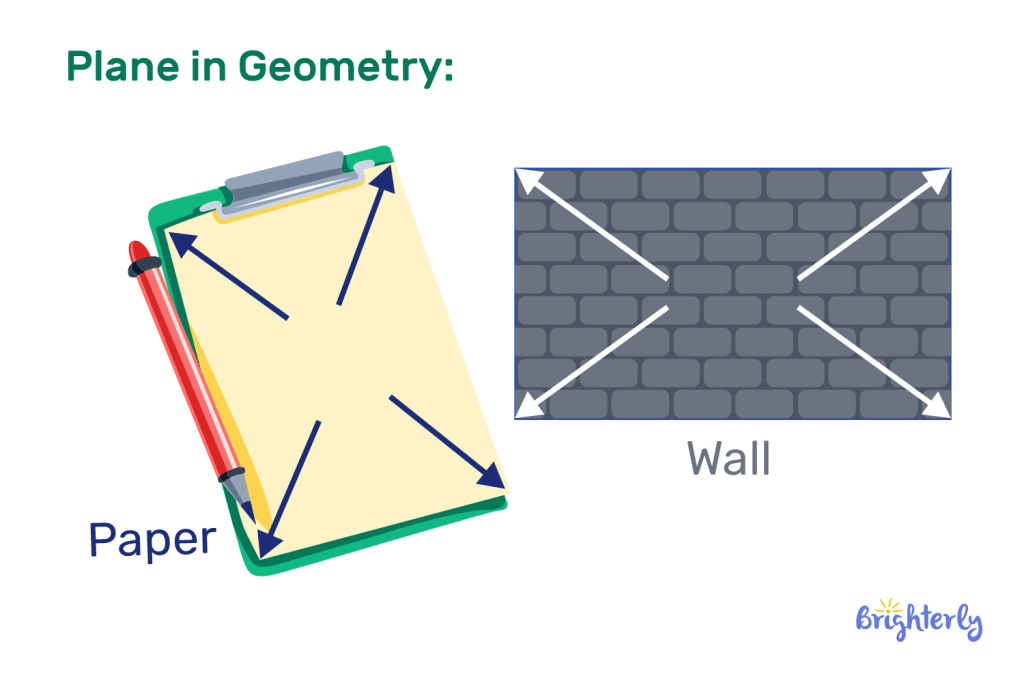
Plane in math definition
In two dimensions, it is a flat surface that can extend infinitely in any direction. Plane geometry definition describes everything flat, including lines, angles, and shapes. In a plane, two parallel lines can be infinitely extended, or three points can be non-collinear (not parallel).
What are planes in geometry? Example: Points A, B, and C that don’t lie on a single line form a plane, often labeled as Plane P. Similarly, a tabletop or a sheet of paper can represent part of a geometric plane in real life.
How do you make a plane in math?
A plane in math can be defined in several ways:
- Three non-collinear points (points not on the same line) determine a unique plane.
- Two intersecting lines lie in exactly one plane.
- Two parallel lines also determine a single plane, as long as both lie in that plane.
- A line and a point not on the line determine a unique plane.
Plane example geometry: think of a sheet of paper on a table. It’s flat, has no thickness, and could extend in any direction. That’s basically what a plane is in geometry.
Basic terminologies in plane geometry
Before you can work with plane meaning in geometry, it is important to know the key elements: points, lines, angles, and circles. These basics are the building blocks for describing and working with all flat shapes.
Point in plane geometry
On a plane, a point indicates a precise location. It has no dimensions, including height, width, or length. Points are typically represented by tiny dots and capital letters like A, B, or C. A point, for instance, is similar to the tip of a pencil coming into contact with paper.
Line in plane geometry
A line is a one-dimensional, straight figure that can go in both directions indefinitely. Any two points define it, and every point that lies between them is on the line. Despite their lack of thickness, lines give shapes their fundamental structure. A tightly stretched string, the horizon in a landscape, and the edge of a ruler are a few examples.
Angles in plane geometry
In a geometry plane, an angle is formed when two lines meet at a common point called the vertex. It is expressed in degrees and illustrates how much one line rotates in relation to the other.
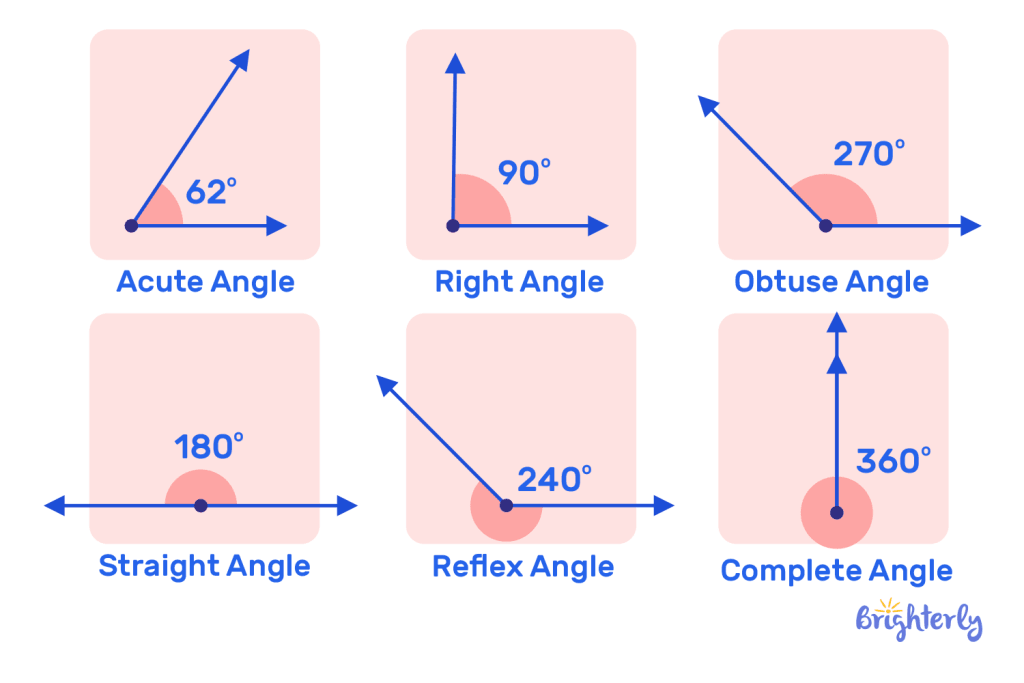
Examples: Corners of books, hands of a clock, or slices of pizza.
Circle in plane geometry
A circle is a plane figure with equal distances between each point and the center. The diameter is the longest distance across the circle that goes through the center, whereas the radius is the fixed distance between any point on the circle and the center.
Parallel planes
Intersecting planes are two flat surfaces that meet at exactly one line. This line is called their line of intersection. A helpful way to imagine this is to picture two sheets of paper tilted toward each other so that they touch along one straight edge — that shared edge represents the line where the planes intersect.
Intersecting planes
A plane intersecting two flat surfaces is called an intersecting plane. There is a straight line formed by their intersection. Imagine two sheets of paper leaning together with one edge touching-that is the intersection.
Properties of a plane geometry
A plane contains an infinite number of lines and points. A unique plane can always be defined by any three points that are not on the same line (non-collinear points). It is also true that two planes that are not exactly the same will either run parallel to one another or cross (intersect) without making contact. This is the essence of the definition of a plane in geometry.


Plane geometry examples
Planes geometry deals with flat, two-dimensional shapes. You encounter these shapes in many everyday objects, such as:
- A triangle on a notebook page
- The circular face of a clock
- A rectangular window
- A square floor tile
Plane in geometry importance
The use of plane geometry allows us to measure areas, design structures, read maps, and even produce digital graphics. In order to create a solid foundation for more complex math and science, you must understand the relationship between points, lines, angles, and shapes. This is why understanding the importance of plane geometry is our first step to observing patterns and relationships.
Solved examples on plane geometry
1. What type of angle is this?
Angle: ∠ABC = 120°
Solution: Angles between 90° and 180° are called obtuse.
2. Determine if two planes are parallel or intersecting.
- Plane X: a flat desk surface
- Plane Y: a flat whiteboard on the wall
Solution: The desk surface and the whiteboard are flat, non-intersecting surfaces, so they form parallel planes.
3. Name a real-life plane example of planes in geometry.
(soccer field, sheet of paper, computer screen, flat surface)
Practice questions on plane geometry
- Identify polygons in shapes you draw.
- Measure the angle in the corner of a book or room to determine the type of angle.
- Analyze whether your classroom’s two planes intersect or are parallel.
- What are three real-world items that represent planes geometrically?
Conclusion
Using plane geometry, we can better understand flat shapes, their properties, and how they interact on surfaces. It is possible to uncover patterns in everyday objects by examining points, lines, angles, and circles. The plane geometry definition and example demonstrate how basic shapes adhere to clear mathematical principles, making geometry both useful and entertaining to learn.
Frequently asked questions on plane geometry
What is a plane in geometry?
A plane in geometry is a flat, two-dimensional surface that extends infinitely in all directions. It has no thickness and can be defined by three points that are not in a straight line.
How do you define a plane in three-dimensional space?
A plane can be defined by three non-collinear points or by a line and a point not on that line.
What are the rules for plane geometry?
Rules of plane geometry involve understanding points, lines, angles, and shapes.


Troubles with Geometry?
- Does your child need additional support with grasping geometry concepts?
- Start lessons with an online tutor.
Choose kid's grade

Is your child finding it challenging to understand the concept of geometry? An online tutor could be the answer.
Book FREE lesson