Unit Circle With Tangent – Definition With Examples
Updated on March 10, 2026
On the unit circle, the tangent of an angle equals the slope of the line forming the terminal side of the angle when the angle is drawn from the origin.
What is tan on the unit circle?
The unit circle has a single unit as its radius. The tangent, on the other hand, is one of the three basic trigonometric functions (sine, cosine, and tangent) that help us understand and solve problems relating to an angle.
Definition of the unit circle
The unit circle has a radius of one unit. This means that if we draw a line from the center of the circle to any point on the circle, that line has a length of one. Because the radius is fixed at 1, every point on the unit circle is exactly one unit away from the center.
The unit circle is usually centered at the origin (0, 0) on the coordinate plane, and we can use it to define sine and cosine using coordinates.
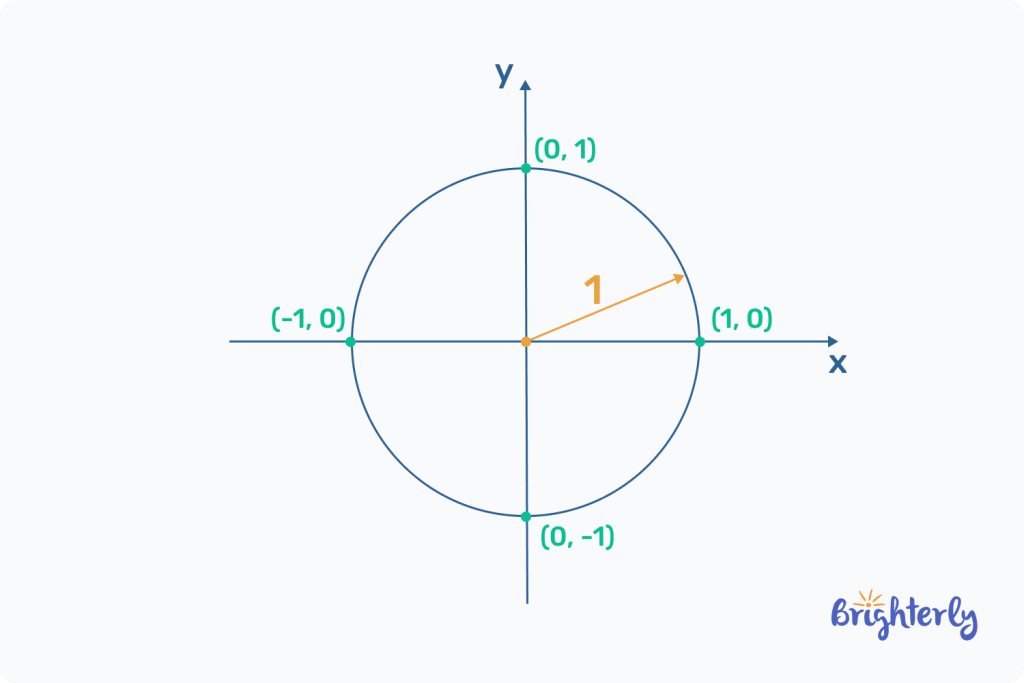
Definition of tangent
In geometry, a tangent is a line that touches a circle at exactly one point. In trigonometry, however, tangent is a function defined as the ratio of sine to cosine.
How to find tan on unit circle?
To find tan of unit circle, you need to first remember that it is not a separate coordinate but a ratio of two familiar ones. On the unit circle, cos(θ) represents the x-coordinate of a point, and sin(θ) represents the y-coordinate. Since tangent is the ratio of sine to cosine, we get tan(θ) = sin(θ) / cos(θ).
In other words, if the point on the unit circle corresponding to angle θ is written as (x, y), then tan(θ) = y/x. We use the tangent to measure the steepness of an angle. When the x-coordinate (cos θ) equals zero, we cannot calculate this ratio, which is why the tangent is undefined at 90° and 270°.
Properties of the tan unit circle
Let’s explore the properties of each concept to understand its relationship better.
Properties of the unit circle
The properties of the unit circle include:
- The circle has a single unit for the radius
- Every point on the circle corresponds to coordinates (cos θ, sin θ)
- The x-coordinate is the cosine of the angle, and the y-coordinate is the sine of the angle
- One full rotation equals 360° or 2π radians
Properties of tangent
- The tangent is a line that touches the circle at a single point
- At the point of contact of the line and the circle, a right angle is formed


Relationship between the unit circle and tangent
We may express the standard angles from 0° to 360° of the unit circle, including the tangent. This is a different way of measuring the unit circle from the typical use of sine and cosine. We arrive at the tan value by dividing the sine by the cosine, or the y-coordinate by the x-coordinate.
Chart of the unit circle with tangent
You can make the conversion process easier by using the tangent values on unit circle table below. It contains the values of sine and cosine as they are converted from degrees and radians, so you don’t have to do it manually every time.
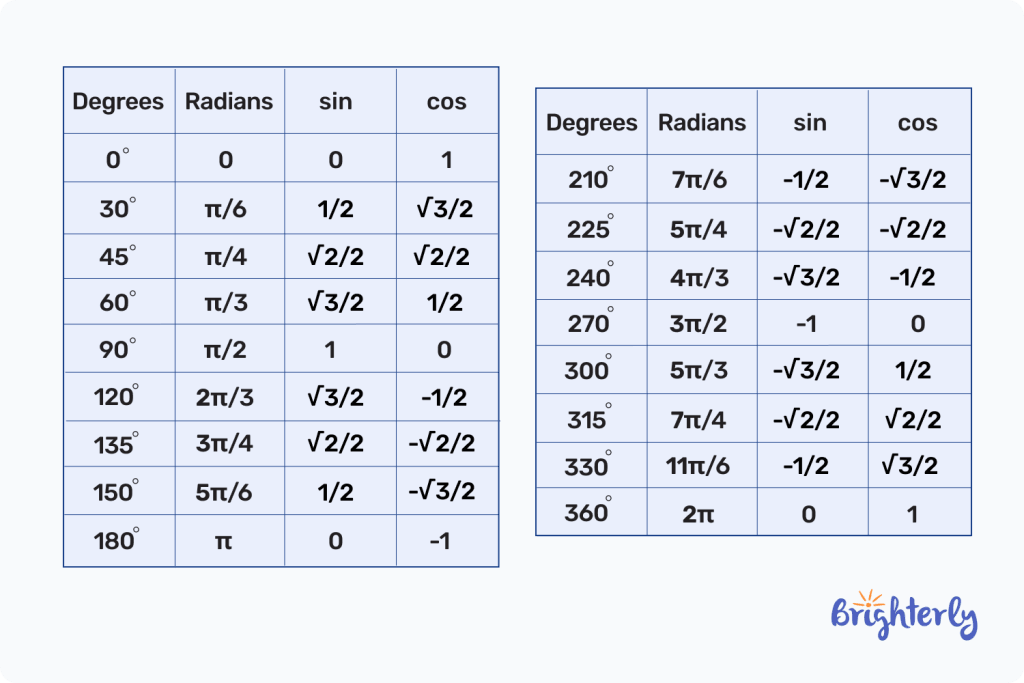
Next, we convert the sine and cosine to tangent by dividing the values of both. Here is the tan values unit circle chart. It contains details about the unit circle with tangent values:
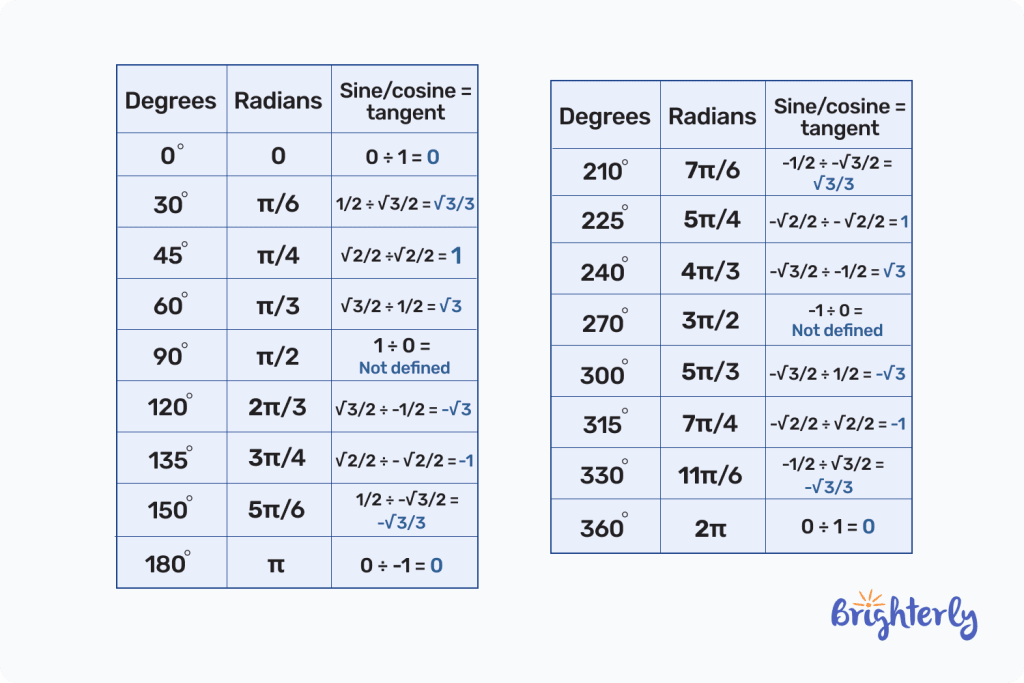
Therefore, the tangent unit circle in a tabular form is:
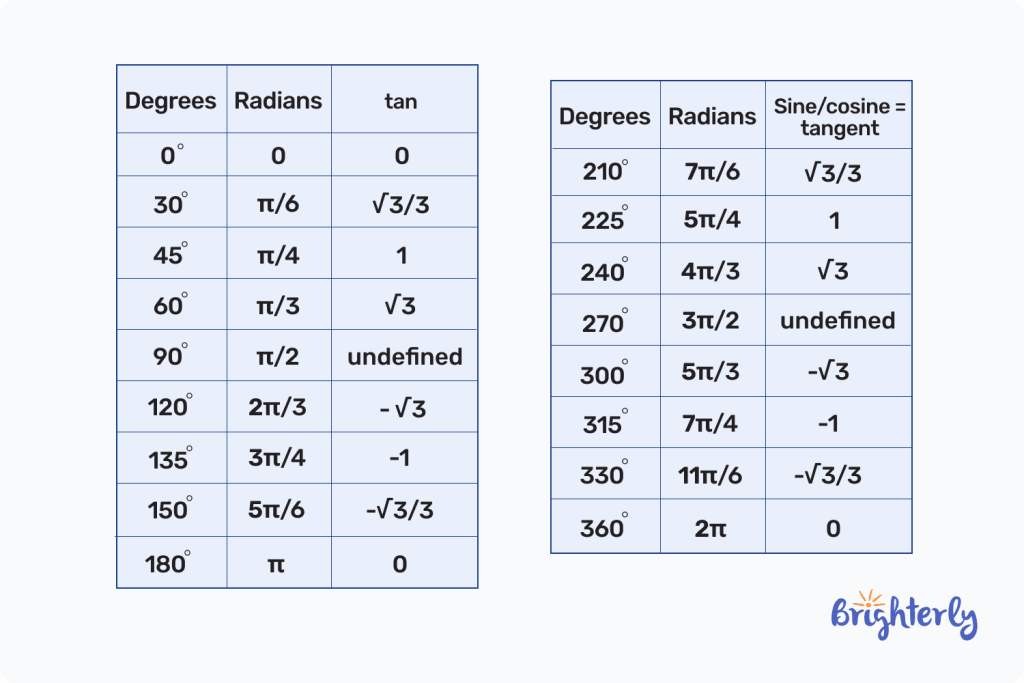
Tan values on unit circle also often come in a chart that is a circle. So, if you come across a chart that looks like the image below, don’t be surprised: it’s the same chart.
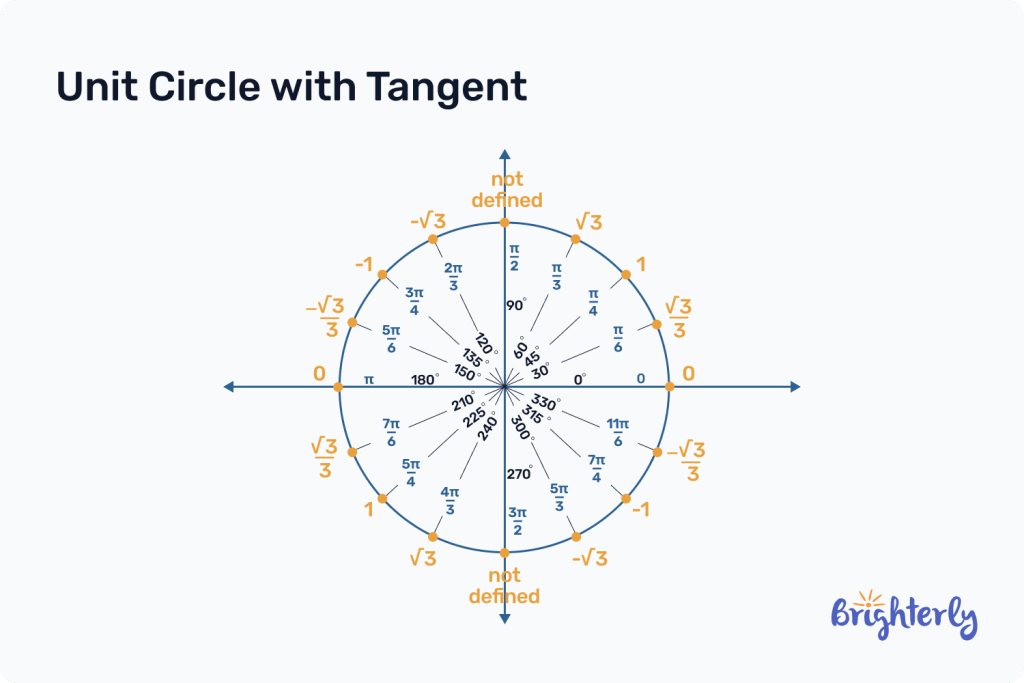
Thus, we can interpret the filled-out unit circle with tangent as follows: when the angle is 120° or the radian is 2π/3, the corresponding tangent is -√3. Likewise, if the angle is at 90° or the radian is π/2, the unit circle tan will be undefined, and so on.
This unit circle tangent chart also helps us identify that the unit circle with values can be divided into four quadrants:
- The first quadrant contains the angles 0 to 90 degrees (0 to π/2 radians) and all the unit circle values are positive, i.e., sine, cosine, and tangent.
- The second quadrant contains the angles from 90 to 180 degrees (π/2 to π radians). Here, sine is positive, and cosine is negative, making tangent negative.
- The third quadrant contains angles 180 to 270 degrees (π to 3π/2 radians).
- The fourth quadrant contains angles 270 to 360 degrees (3π/2 to 2π radians).
Tangent is not defined at 90° (π/2) and 270° (3π/2) because the cosine value at both points is 0. Since dividing by 0 is not possible in math, the tangent does not exist there. Tangent is found by dividing sine by cosine, and at these angles, the circle’s coordinates are (0,1) for 90° (π/2) and (0, –1) for 270° (3π/2).
Equations of the unit circle and tangent
The equations below are the individual formulas for calculating the tangent unit and circle values, respectively.
Writing equations of the unit circle
Derived from the Pythagoras theorem, the unit circle equation: x² + y² = 1, is used to find the points (x- and y- coordinates) that are a unit away from the center of the circle.
Writing equations of tangent
The tangent equation is tan(θ) = sin(θ) / cos(θ). Remember that the sine is the y-coordinate and the cosine is the x-coordinate for the unit circle. This is because the point of the circle is expressed in (x, y).
How to remember the unit circle with tangents?
There are a few shortcuts for remembering tangent values without memorizing the massive tangent on unit circle chart. For this, you only need to master the first quadrant and apply the formula tan(θ) = sin(θ) / cos(θ), which simplifies to the ratio of the y-coordinate over the x-coordinate.
In the first quadrant, the values follow a logical “small, middle, large” progression: at 30° (π/6), the tangent is the “small” value of (30°) = √3/3. At 45° (π/4), tan is exactly (45°) = 1. And lastly, at 60° (π/3), tan has the “large” value of (60°) = √3.
For the rest of the circle, these values repeat their numerical sequence, but you must apply the ASTC (All-Sine-Tangent-Cosine) rule to determine the sign, since tangent is only positive in Quadrants I and III.
Finally, remember that tan(0°) = 0 and tan(180°) = 0, since the slope is flat on the horizontal axis. Also, tan(90°) is undefined, and tan(270°) is undefined, since the “run” (cos θ) is zero on the vertical axis.
Practice problems on the unit circle and tangent
Solved math problems 1
Which statement correctly describes where a 45° angle with a tangent value of 1 is located?
- It is located in the first quadrant
- It is located in the second quadrant
- It is located in the third quadrant
- It is located in the fourth quadrant
Solution
| It is located in the first quadrant. |
Unit circle with tangent: practice math problems
Frequently asked questions on the unit circle and tangent
Why is the unit circle important in trigonometry?
The unit circle is important in trigonometry because it teaches learners about the trigonometric functions sin, cos, and tan, which are some of the most important concepts in geometry. It also helps the students identify the exact points of a circle that correspond to an angle.
Where is tangent undefined on the unit circle?
Tangent is undefined at 90 degrees(π/2 radians) and 270 degrees (3π/2 radians) in the filled-in unit circle because the cosine (the x-coordinate) is 0.
How is the tangent related to the unit circle?
The tangent is related to the unit circle because it describes the relationship between the length of a line and the angle it forms with the circle at right angles.



Math & reading from 1st to 9th grade
Looking for homework support for your child?

Choose kid's grade

Math & Reading for Grades 1–9
Build real confidence for your child with a Brighterly math or reading tutor.