Counting Money Worksheets 2nd Grade
Updated on October 19, 2026
Counting money worksheets for 2nd grade help students practice finding the total value of coins and bills. Brighterly’s printable worksheets give children hands-on practice counting pennies, nickels, dimes, and quarters, combining different coin values, and working with simple dollar amounts.
Counting money also reinforces skip counting, addition, place value, and mental math. For broader Grade 2 money practice that includes comparing amounts, money word problems, and making change, use money worksheets for 2nd grade.
Counting Money Worksheets 2nd Grade PDF: Examples
Brighterly’s counting money worksheets use pictures of familiar US coins and bills so students can practice identifying denominations and calculating their total value.
Activities can begin with groups containing the same type of coin and progress to combinations of pennies, nickels, dimes, quarters, and dollar bills. This helps students move from simple skip counting to adding mixed money amounts.
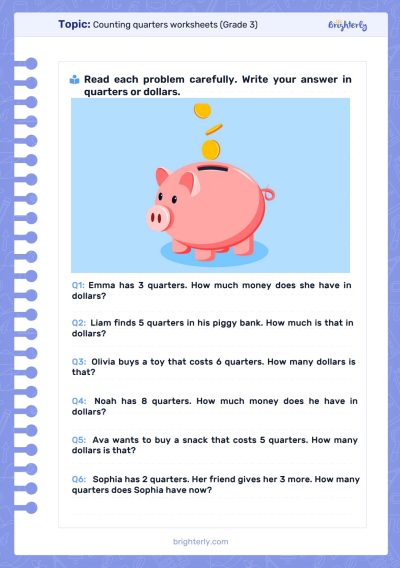
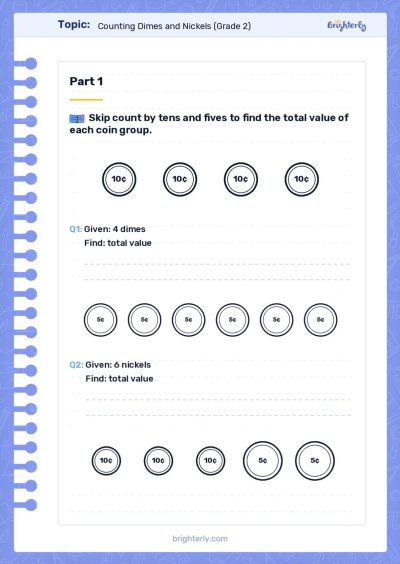
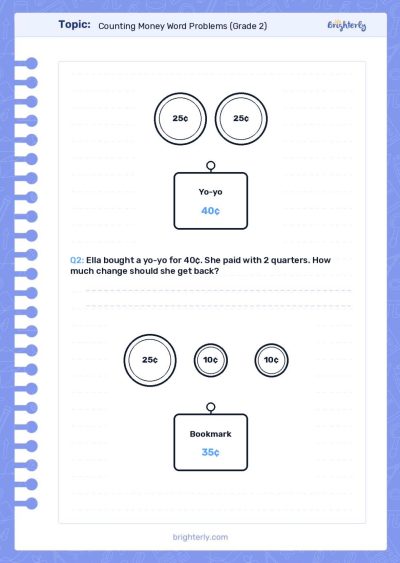
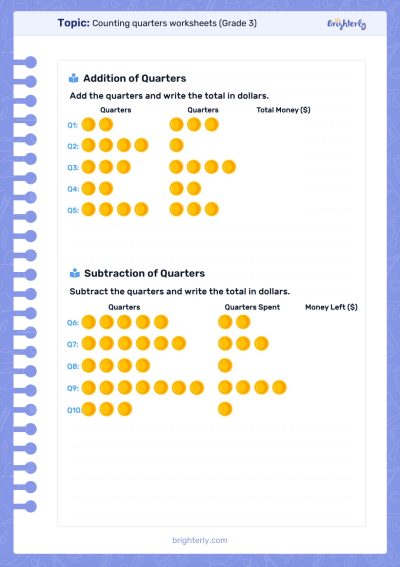
2nd Grade Counting Money Worksheets [Download for Free]
Download and print Brighterly’s free counting money worksheets for 2nd grade for practice at home or in class. Students can use the activities to recognize coins, count individual denominations, and combine several types of money to find a total.
For a broader overview of the skills children work on at this stage, see Brighterly’s 2nd grade math skills guide, which includes money math alongside addition, subtraction, place value, and other core topics.
How to Count Coins in 2nd Grade
Second graders should become familiar with the values of the most common US coins:
- Penny = 1¢
- Nickel = 5¢
- Dime = 10¢
- Quarter = 25¢
When several coins are shown together, one useful strategy is to begin with the highest-value coins and then count on using smaller denominations. For example, two quarters, one dime, one nickel, and three pennies can be counted as 50¢ + 10¢ + 5¢ + 3¢ = 68¢.
Counting Pennies
A penny is worth 1 cent, so pennies are usually the simplest coins to count. Students can count them by ones and use them to understand the connection between individual cents and larger money amounts.
Children who need extra practice can review Brighterly’s penny guide and use a counting pennies worksheet below.
Counting Nickels
A nickel is worth 5 cents. Students can count groups of nickels by 5s: 5¢, 10¢, 15¢, 20¢, 25¢, and so on. This gives children practical skip-counting practice while reinforcing the value of the coin.
Brighterly’s nickel guide explains how nickels relate to pennies, dimes, and dollars.
Try to practice dimes with the counting nickels worksheet below.
Counting Dimes
A dime is worth 10 cents, so students can count dimes by 10s. One dime is 10¢, five dimes are 50¢, and ten dimes equal $1.00.
Because dimes connect so naturally with groups of ten, they also reinforce place value and mental addition. Students can review the relationship between dimes and other coins in Brighterly’s dime guide.
Try to practice dimes with the counting dimes worksheet below.
Counting Quarters
A quarter is worth 25 cents. Students can count quarters by 25s: 25¢, 50¢, 75¢, $1.00. Four quarters make one dollar.
Count by quarters is more challenging than counting nickels or dimes because the skip-counting pattern changes by 25 each time. Brighterly’s quarter guide provides more examples of how quarters relate to dollars and other coins.
Counting Mixed Coins
Once children can count individual denominations, they can combine different coins in one amount. A helpful approach is to count the highest-value coins first and then add the smaller denominations.
For example, suppose a group contains:
- 1 quarter = 25¢
- 2 dimes = 20¢
- 1 nickel = 5¢
- 3 pennies = 3¢
The total is 25¢ + 20¢ + 5¢ + 3¢ = 53¢.
This type of practice helps students understand that the number of coins does not determine the amount of money. One quarter, for example, is worth more than four nickels even though there are fewer coins.
Counting Coins and Dollar Bills
After students are comfortable counting cents, they can begin combining coins with dollar bills. Since $1.00 equals 100¢, students learn to keep track of both dollars and cents when finding the total amount.
For example, one $1 bill, two quarters, and one dime have a total value of $1.60.
Working with both coins and bills prepares students to recognize larger money amounts while keeping the main task focused on counting rather than making change or solving more advanced purchase problems.
If your child finds counting money difficult because of gaps in skip counting, addition, or place value, a 2nd grade math tutor can provide practice matched to their current level.


Put those money counting skills to the test
A quick quiz can reveal which second grade math skills need practice
Students who still confuse coin names and values can begin with identify coins worksheets. Once they are comfortable finding totals, adding money worksheets provide additional practice using money amounts in calculations.
Benefits of Counting Money Worksheets for 2nd Grade
Reinforce Coin Recognition
Students repeatedly work with pennies, nickels, dimes, and quarters, helping them connect each coin’s appearance with its value. This is especially useful because the physical size of a coin does not always reflect how much it is worth.
Practice Skip Counting
Money gives skip counting a practical purpose. Students count nickels by 5s, dimes by 10s, and quarters by 25s before combining different denominations.
Strengthen Mental Addition
Mixed-coin problems require children to hold a running total as they add each denomination. Starting with larger-value coins can make the calculation more efficient and build mental math fluency.
Connect Math With Everyday Money
Coins and bills give students a familiar real-life context for addition and place value. Brighterly’s guide to teaching kids about money includes additional hands-on ways parents can build money skills outside of worksheet practice.
How to Practice Counting Money With a Second Grader
Start with one denomination at a time. Ask your child to identify the coin, say its value, and count a small group using the appropriate skip-counting pattern.
Next, combine two types of coins, such as dimes and pennies or quarters and nickels. Encourage your child to begin with the coins worth the most and count on from there.
Once mixed coins feel comfortable, add $1 bills and ask your child to state the total using dollars and cents.
You can also use real or play money to create small counting challenges at home. Ask your child to build 35¢, 70¢, or $1.25 using different combinations of coins and compare the strategies they used.
Frequently Asked Questions
What Do Counting Money Worksheets for 2nd Grade Teach?
Counting money worksheets for 2nd grade help students recognize pennies, nickels, dimes, quarters, and dollar bills and calculate their total value. They also reinforce skip counting, addition, place value, and mental math through money-based activities.
What Is the Difference Between Counting Money Worksheets and Money Worksheets for 2nd Grade?
Counting money worksheets focus specifically on finding the total value of groups of coins and bills. Money worksheets for 2nd grade cover a broader range of money skills, which can also include comparing amounts, money word problems, adding and subtracting money, and making change.
How Do Second Graders Count Nickels, Dimes, and Quarters?
Students can count nickels by 5s, dimes by 10s, and quarters by 25s. Once they know each denomination separately, they can combine different coins by starting with the highest-value coin and adding smaller values to the running total.
How Many Quarters, Dimes, and Nickels Make One Dollar?
Four quarters equal $1.00 because each quarter is worth 25¢. Ten dimes make one dollar because each is worth 10¢, while 20 nickels make one dollar because each nickel is worth 5¢.
Should Second Graders Practice Counting Mixed Coins?
Yes. After students can identify and count individual denominations, mixed-coin practice helps them combine different values and choose efficient counting strategies. Starting with the highest-value coins usually makes finding the total easier.
Are Brighterly Counting Money Worksheets for 2nd Grade Free to Download?
Yes. Brighterly provides free printable counting money worksheets for 2nd grade that families and teachers can use for additional money-counting practice at home or in class.


Struggling with Money in Math?

- Is your child having a hard time mastering money in math?
- An online tutor could be the answer.
Choose kid's grade

Does your child need help with understanding money in math? Try studying with an online tutor.
Book FREE lesson