Division Word Problems Worksheets
Updated on October 21, 2026
Division word problems worksheets help students in Grades 5–6 apply division to real-world situations instead of solving equations in isolation. Brighterly’s printable worksheets include problems with whole numbers, remainders, decimals, and negative values, giving students practice deciding when and how to divide.
Before starting, students can review the basic steps and vocabulary in Brighterly’s division guide. For broader practice with the operation, explore the full collection of division worksheets.
Division Word Problems Worksheets: Examples
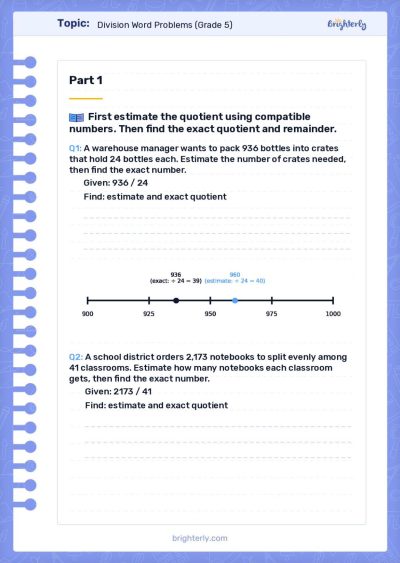
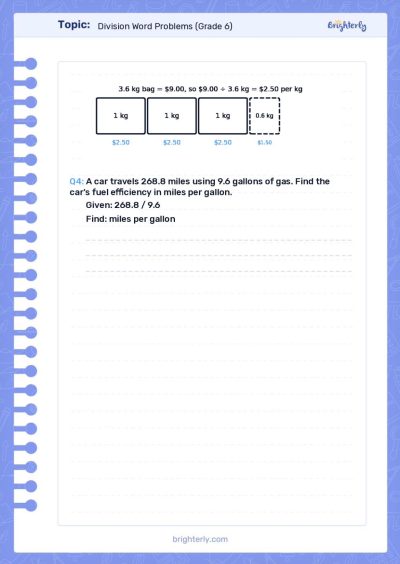
Division word problems require students to read the situation, identify the relevant values, choose division, and interpret the quotient in context.
For example, suppose 378 students are arranged into 18 equal rows. To find the number of students in each row, divide:
378 ÷ 18 = 21
So, each row contains 21 students.
Other problems may involve a remainder that needs to be interpreted, decimal quantities such as money or measurements, or negative values in real-world contexts.
Division Word Problems Worksheets [Download for Free]
Download Brighterly’s free division word problems worksheets for Grade 5 and Grade 6 practice. Students can work through printable problems involving whole-number division, remainders, decimals, and signed values at home or in class.
Students who need more practice with the calculation itself before applying it to word problems can use 5th grade division worksheets or long division worksheets for Grade 5.
Students who understand the calculation but struggle to decide how to approach a word problem may benefit from alternating between direct division exercises and contextual problems. Brighterly’s math program also provides structured practice across division and broader Grade 5–6 math skills.


See how confidently your child solves word problems
Take a quick quiz to reveal which division skills need more practice
Types of Division Word Problems for Grades 5–6
Whole-Number Division Problems
Students divide larger whole numbers to find how many items belong in each group or how many equal groups can be made. These problems reinforce the connection between division and everyday situations such as arranging people, packing objects, or sharing supplies.
Division Word Problems With Remainders
Some quantities cannot be divided evenly. In these problems, students calculate both the quotient and the remainder and then decide what the remainder means in the situation.
For example, if 50 students travel in vans that hold 8 students each, 50 ÷ 8 gives 6 remainder 2. Six vans are completely filled, but a seventh van is still needed for the remaining two students.
Students can review how quotients and remainders work in Brighterly’s quotient guide.
Decimal Division Word Problems
Grade 5 and Grade 6 students also encounter division in situations involving money, measurements, distance, and other decimal quantities.
For example, if 7.5 liters of juice are shared equally among 5 containers, students calculate 7.5 ÷ 5 = 1.5 liters per container.
For targeted calculation practice, use dividing decimals worksheets or review Brighterly’s guide to dividing decimals.
Problems With Negative Values
Some Grade 6 problems use negative values to represent situations such as temperatures below zero, losses, changes in elevation, or debt. Students need to determine both the correct division operation and the sign of the answer.
When signed numbers are the main challenge, integer word problems worksheets provide more focused practice.
How to Solve Division Word Problems
A reliable approach is to separate understanding the situation from performing the calculation:
- Read the problem carefully. Identify what is known and what the question asks you to find.
- Determine the total and the group information. Decide which value is the dividend and which is the divisor.
- Write the division equation. Translate the situation into a mathematical expression.
- Solve the division. Use mental math, long division, or decimal division as appropriate.
- Interpret the result. Decide whether a remainder should be kept, rounded, or used to create an additional group.
- Check the answer. Multiply the quotient by the divisor and account for any remainder.
Brighterly’s guide on how to teach division also explains how students can move from equal-group models to division equations and real-world word problems.
Division Word Problems in Grade 5 and Grade 6
In Grade 5, students strengthen multi-digit division and begin applying division to decimal and multi-step contexts. Division word problems give them a way to combine computation with reading comprehension and mathematical reasoning.
Brighterly’s 5th grade math skills checklist includes multi-digit division, decimal operations, and multi-step word problems among the important skills students work on at this level.
By Grade 6, division problems can involve more complex rational-number situations, including decimals and negative quantities. The main challenge is often not performing the calculation but recognizing which operation fits the situation and interpreting the answer correctly.
Other Worksheets
- 5th grade division worksheets
- Long division worksheets Grade 5
- Dividing decimals worksheets
- Integer word problems worksheets
Frequently Asked Questions
What Skills Do Division Word Problems Worksheets Practice?
Division word problems worksheets help students identify when division is needed, translate real-life situations into equations, calculate quotients, interpret remainders, and check whether an answer makes sense. More advanced problems can also involve decimals, negative values, and multiple steps.
What Grades Are These Division Word Problems Worksheets For?
These division word problems worksheets are designed mainly for Grades 5–6. They include more advanced skills than basic elementary division, such as multi-digit division, remainders, decimal quantities, and problems involving negative values.
How Do You Know When to Divide in a Word Problem?
Division is often needed when a problem asks how many equal groups can be made or how many items belong in each group. Look for situations involving equal sharing, grouping, rates, or splitting a total amount into equal parts, then check that the quotient answers the question being asked.


Math & reading from 1st to 12th grade
Looking for homework support for your child?

Choose kid's grade

Math & Reading for Grades 1–12
Build real confidence for your child with a Brighterly math or reading tutor.