Multi-Digit and Long Multiplication Worksheets
Updated on October 15, 2026
Multi-digit multiplication means multiplying numbers where at least one factor has two or more digits. Long multiplication is the standard written method for these problems: you multiply the top number by each digit of the bottom number, write each result on its own row, then add the rows. These free math worksheets for grades 4–5 cover multi-digit by one-digit problems and 2-digit by 2-digit problems solved with long multiplication.
Long and Multi-Digit Multiplication Worksheets: Free Download


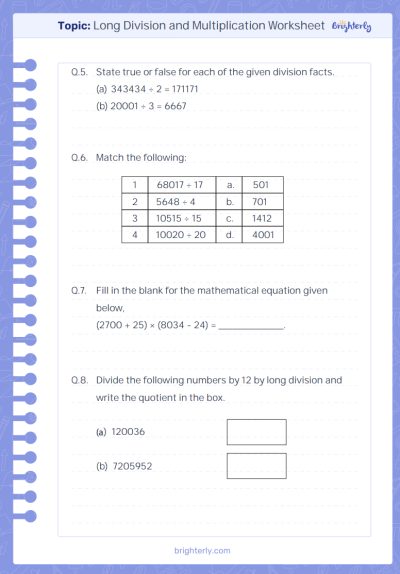
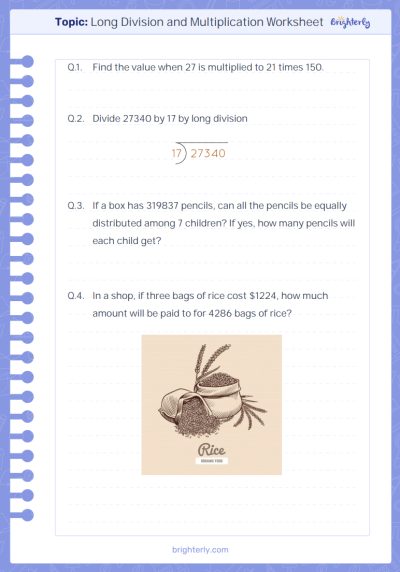
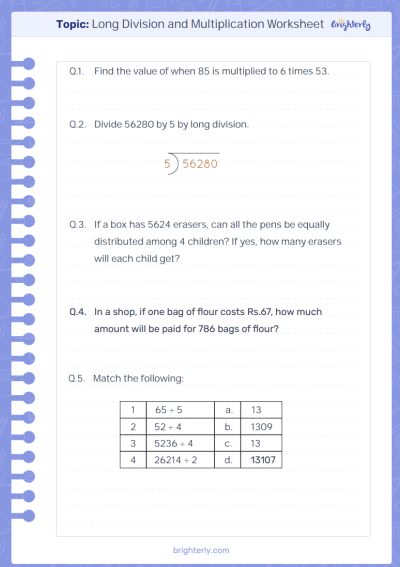
The set starts with 2- and 3-digit numbers multiplied by a one-digit number, like 43 × 8 and 197 × 6, then moves to long multiplication: 2-digit by 2-digit problems and more challenging combinations that use two or more rows of partial products.
How to Solve Multi-Digit Multiplication Problems
Multiplying a Multi-Digit Number by a One-Digit Number
When the second number has only one digit, you work in a single row, carrying from column to column.
Example: 197 × 6
- Ones: 7 × 6 = 42. Write 2, carry 4.
- Tens: 9 × 6 = 54, plus 4 = 58. Write 8, carry 5.
- Hundreds: 1 × 6 = 6, plus 5 = 11. Write 11.
Answer: 1,182
Long Multiplication: Multiplying Two 2-Digit Numbers
When the second number has two or more digits, you use long multiplication: one row for each digit, then add the rows.
Example: 34 × 26
- Multiply by the ones digit: 34 × 6 = 204.
- Multiply by the tens digit. Write a 0 in the ones place first, because you’re multiplying by 20: 34 × 20 = 680.
- Add the two rows: 204 + 680 = 884.
Check with an estimate: 30 × 30 = 900, so 884 is a reasonable answer.


Help your child reach their full potential!
Answer a few quick questions about your child’s learning, and we’ll recommend next steps.
What Kids Practice With These Worksheets
- Lining up digits by place value
- Carrying (regrouping) in each column
- Writing the placeholder zero in the second row of long multiplication
- Adding partial products to get the final answer
- Estimating to check whether an answer makes sense
Each worksheet comes with a solution sheet, so kids can check their work and find the step where a mistake happened.
More Multiplication Worksheets
- 3-digit by 1-digit multiplication worksheets
- 2-digit by 2-digit multiplication worksheets
- 3-digit by 2-digit multiplication worksheets
- 3-digit multiplication worksheets
- Area model multiplication worksheets
- 4th grade multiplication worksheets
- Multiplication and division worksheets
Frequently Asked Questions
Is long multiplication the same as multi-digit multiplication?
Not exactly. Multi-digit multiplication is the type of problem: multiplying numbers with two or more digits. Long multiplication is one way to solve it, using a written method with a separate row for each digit of the second number. Kids can also solve multi-digit problems with an area model or partial products.
What is long multiplication?
Long multiplication is a written method for multiplying when the second number has two or more digits. You multiply the top number by each digit of the bottom number, one row at a time, then add the rows.
Why do you add a zero on the second row?
Because the second digit is in the tens place. In 34 × 26 you’re really multiplying 34 by 20, so the zero keeps every digit in the right place value.
What grade learns multi-digit multiplication?
4th graders multiply up to 4-digit numbers by one-digit numbers and two 2-digit numbers, using place-value strategies like area models and partial products. 5th graders learn to multiply multi-digit numbers fluently with the standard algorithm, which is long multiplication.


Struggling with Multiplication?

- Does your child struggle to master the basics of multiplication?
- Try lessons with an online tutor.
Choose kid's grade

Is your child having trouble understanding multiplication? An online tutor could provide the necessary help.
Book FREE lesson