Measuring Angles With A Protractor Worksheet
Updated on May 17, 2026
Angle measurement is one of the most important math skills. You can turn tricky lessons into fun challenges by providing your child with worksheets that help him or her measure angles with a protractor. With clear, guided exercises, measuring angles worksheet with protractor helps your child master measuring angles.
What are Brighterly measuring angles with a protractor worksheets?
Brighterly’s measuring angles with a protractor worksheet PDF resources are interactive tools designed to bridge the gap between abstract geometry and hands-on practice. The purpose of these sheets is to help students visualize degrees and master the placement of tools. Measure angles using a measuring angles worksheet with protractor can be printed easily, making them ideal for use in class or at home. Structured exercises are provided to to foster independent identification of acute, obtuse, and right angles in a safe and effective manner.
Worksheet examples by Brighterly
Here are some examples of diverse worksheets, which include a variety of practice problems. By using these activities, children are able to learn geometry while improving their measurement accuracy at the same time. With these printable resources, students engage in interactive exercises that simplify complex math concepts.
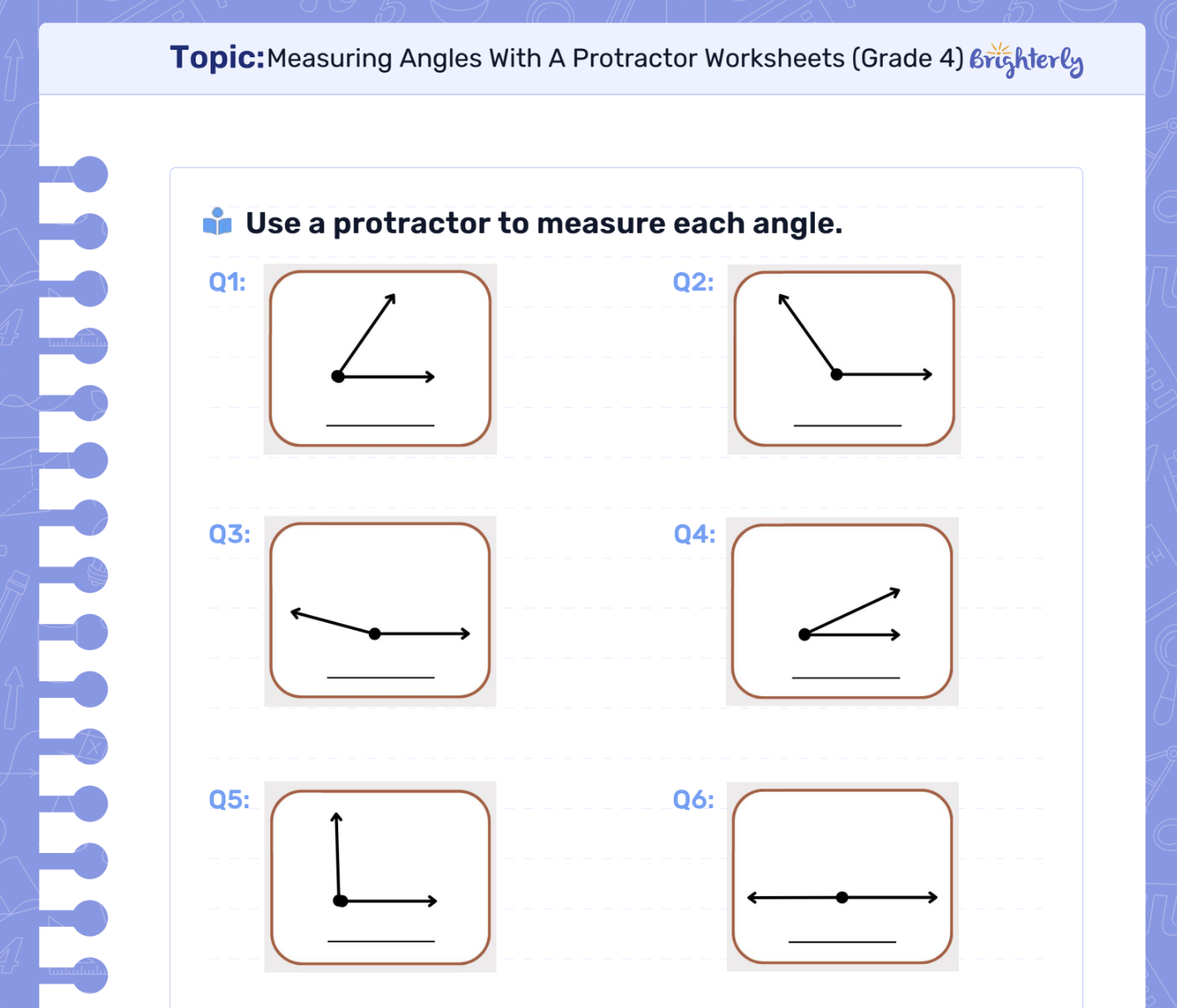
Download measuring angles worksheet with protractor PDF free
Angle reading is one of the most important topics in 4th-grade math. Using a protractor to measure angles is an effective supplementary practice for what your child has learned in the classroom. Our grade 4 worksheet follows Common Core Standards. To make it easier for students to check their work, each measuring angles using a protractor worksheet also includes answers.
More angle worksheets
Brighterly also offer a number of other printables that make learning arithmetic enjoyable and simple. To support your child’s development, you can find resources for measuring angles in different planes at different grade levels.


Help your child reach their full potential!
Answer a few quick questions about your child’s learning, and we’ll recommend next steps.
Skills children practice with Brighterly measuring angles with protractor worksheet
Vertex Alignment
Taking precise measurements starts with determining the origin point. To center the protractor’s hole or crosshair exactly on an angle’s vertex, students practice using a protractor. Preventing skewed readings and ensuring accuracy from the beginning is the goal of this step.
Baseline Calibration
During this lesson, children learn to align the 0° mark with one side of the angle. A steady hand-eye coordination is required to prevent the tool from slipping. By aligning the measurement correctly, you can confirm that it is based on a horizontal or slanted base.
Scale Selection
Protractors feature two sets of numbers running in opposite directions. Measuring angles using a protractor worksheet teachs students to identify which scale starts at zero on their chosen ray. This prevents common errors like reading 50 ° as 130 °.
Angle Classification
After finding the degrees, students categorize the results. They label figures as acute, right, or obtuse based on specific numerical ranges. This reinforces geometric vocabulary through direct application.
Estimation
The students practice eyeballing an angle to estimate its size before using the tool. It is possible to develop a spatial “gut feeling” for geometry by comparing an estimate with an actual measurement. By doing so, they can notice if an answer seems to be physically impossible.
Note: According to the ScienceDirect research visual activities like measuring angles can improve students’ math reasoning skills.
Types of problems included
- Vertex placement tasks: Positioning the center of the protractor at the angle’s vertex.
- Baseline alignment exercises: Rotating the protractor so the 0° line matches one side of the angle.
- Inner vs. outer scale identification: Choosing the correct scale to read the measurement.
- Acute angle measurement: Measuring angles between 0° and 90°.
- Obtuse angle measurement: Measuring angles between 90° and 180°.
- Reflex calculation: Finding angles greater than 180° by subtracting from 360°.
- Polygon interior angles: Determining the angles inside shapes like triangles or squares.
Note: According to the Educator’s practice guide iInstructions in geometry and measurement help develop focus and attention.
Measure angles with a protractor worksheet and test
The most effective way to achieve accurate results in geometry is to practice measuring angles with a protractor worksheet PDF regularly. As children practice math topics consistently, they gain the precision they need for advanced topics. The following 4-th grade math test will help you assess your current skills and identify areas for improvement.
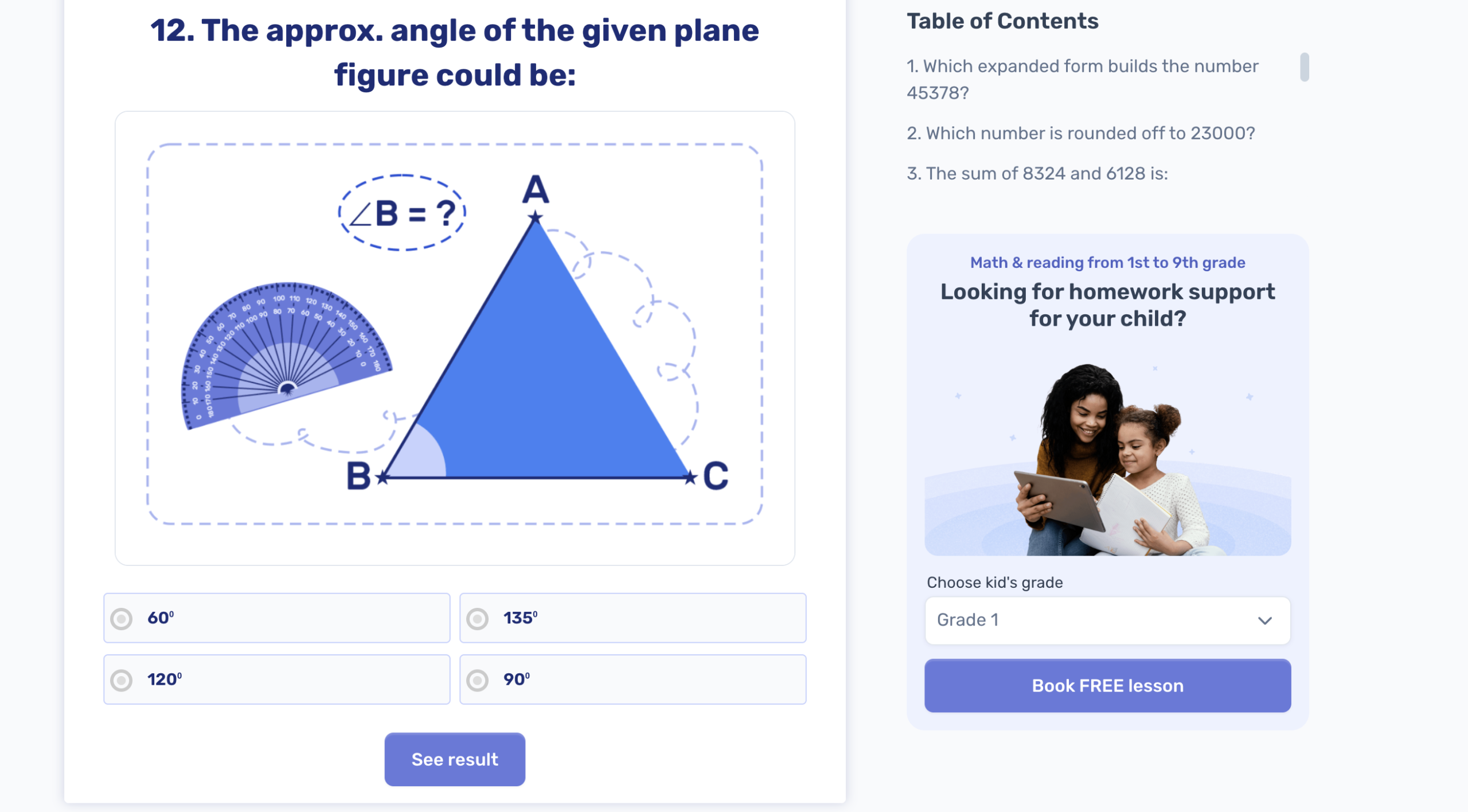
In addition to this topic, we also provide printable resources for various grade 4 subjects. Find them on the 4th grade math worksheets page.
FAQ
How to start using a protractor to measure angles worksheet?
To start using a measuring angles with a protractor worksheet PDF place the protractor’s center hole directly on the angle’s vertex. Align the zero line with one of the angle’s rays. Read the degree mark where the second ray crosses the scale and start drawing.
How to make measuring angle worksheets a daily practice?
To make measuring angle worksheets a daily practice, add one page into a morning routine. Use a timer for five minutes learning and drawing to keep the task focused.
What are the 7 types of angles covered in Brighterly worksheets?
There are 7 types of angels covered im Brighterly worksheets:
- Zero Angle 0°.
- Acute Angle (0°–90°).
- Right Angle (90°).
- Obtuse Angle 90° – 180°.
- Straight Angle that measures exactly 180°.
- Reflex Angle greater than 180° but less than 360°.
- Full Rotation (360°).


Need help with Geometry?
- Does your child need additional support with understanding of geometry?
- Start lessons with an online tutor.
Choose kid's grade

Is your child finding it challenging to master geometry concepts? An online tutor could be the solution.
Book FREE lesson