Rounding Worksheets for 3rd Grade
reviewed by Camille Ira B. Mendoza
Updated on October 20, 2026
Rounding worksheets for 3rd grade help students use place value to find the nearest ten or hundred. Brighterly’s printable worksheets give third graders practice rounding whole numbers, using number lines, identifying halfway points, and deciding whether a number is closer to the lower or higher benchmark. These skills also help students make reasonable estimates in everyday math problems.
Rounding Worksheets for 3rd Grade PDF: Examples
Brighterly’s 3rd grade rounding worksheets focus on whole numbers and the two main rounding targets at this level: the nearest 10 and the nearest 100. Students can use place value, number lines, and benchmark numbers to understand why a value rounds up or down.
For example, 47 rounds to 50 when rounded to the nearest ten because 47 is closer to 50 than 40. When rounding 342 to the nearest hundred, students compare it with 300 and 400. Because 342 is below the halfway point of 350, it rounds to 300.
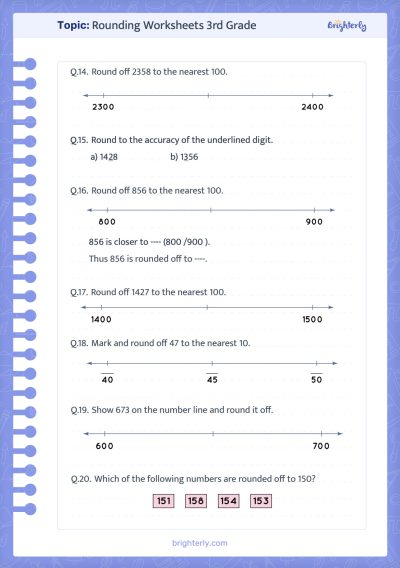
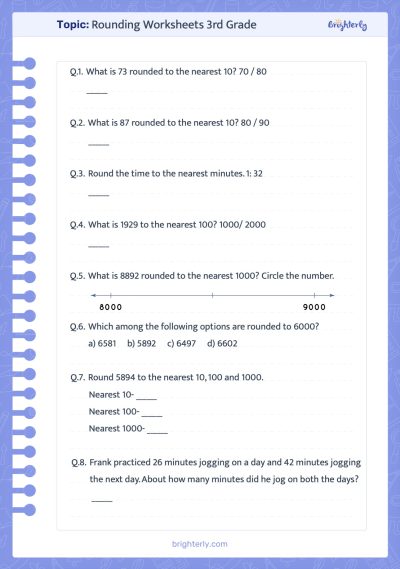
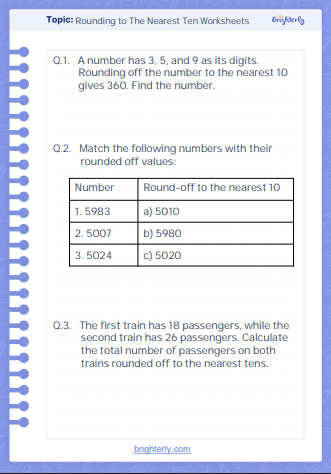
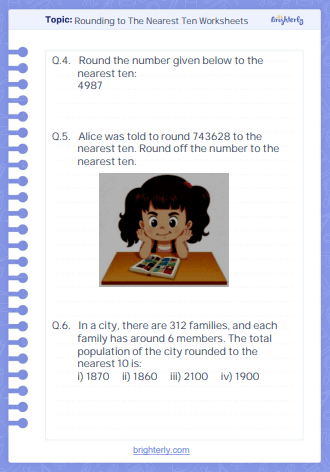
3rd Grade Rounding Worksheets [Download for Free]
Download and print Brighterly’s free rounding worksheets for 3rd grade for practice at home or in class. Worksheets 1–4 focus on rounding whole numbers to the nearest ten and hundred, interpreting number lines, and applying rounding to simple estimation problems. Worksheets 5–8 extend this to larger multi-digit numbers — including numbers in the thousands and millions — giving students more practice with the same place-value reasoning at a greater scale, suited to Grade 3–4 students ready for more challenge.
The worksheets include answers so children can check their work and return to problems where they rounded to the wrong benchmark. Encourage your child to explain why an answer is closer to one multiple of 10 or 100 than another instead of relying only on a memorized rule.
If your child understands basic numbers but struggles with place value or rounding decisions, a 3rd grade math tutor can provide personalized practice with rounding, place value, estimation, and other Grade 3 skills.


How strong are your child’s rounding skills?
A quick quiz can reveal which place value skills need practice
Other Worksheets
- Place value worksheets 3rd grade
- Estimation worksheets
- Place value worksheets
- Rounding worksheets 4th grade
- 3rd grade math worksheets
Students who find it difficult to identify the tens and hundreds digits can first review place value worksheets 3rd grade. Understanding what each digit represents makes it easier to determine which place is being rounded and which neighboring digit should be checked.
For more practice rounding larger multi-digit numbers, try Worksheets 5–8 above. Students can then connect rounding with practical approximation through estimation worksheets.
Once your child is ready to round to an even wider range of place values, rounding worksheets 4th grade provide the next level of practice.
Benefits of Rounding Worksheets for 3rd Grade
- Strengthen place value understanding
Rounding depends on understanding the value of each digit. To round 263 to the nearest ten, for example, students need to recognize that 6 represents 60 and then look at the ones digit to decide whether 263 is closer to 260 or 270.
Connecting rounding with place value helps children understand the reasoning behind the process instead of treating it as an isolated rule.
- Practice rounding to the nearest ten
When rounding to the nearest ten, students identify the two multiples of 10 surrounding a number. They can then decide which multiple is closer.
For example, 72 lies between 70 and 80. Because it is closer to 70, it rounds to 70. A number such as 76 is closer to 80, so it rounds up.
- Practice rounding to the nearest hundred
Third graders also learn to round whole numbers to the nearest hundred. A number such as 428 lies between 400 and 500. Since it is below the halfway point of 450, it rounds to 400.
This extends the same reasoning students use for tens while reinforcing the hundreds, tens, and ones places.
- Use number lines to understand rounding
Number lines make rounding visual. Students can locate a number between two tens or hundreds, identify the halfway point, and see which benchmark is closer.
For example, placing 64 between 60 and 70 makes it clear that 64 is closer to 60, while 67 is closer to 70.
- Understand the halfway rule
When a whole number sits exactly halfway between two rounding benchmarks, students round to the greater benchmark. For nearest-ten problems, numbers ending in 5 are halfway between two multiples of 10.
For example, 35 is exactly between 30 and 40, so it rounds to 40. Similarly, 350 is halfway between 300 and 400, so it rounds to 400.
- Use rounding for estimation
Rounding helps students replace exact numbers with nearby values that are easier to work with mentally. For example, 68 can be rounded to 70 when estimating a quantity or checking whether an arithmetic answer seems reasonable.
Students can build this connection further with estimation worksheets.
- Prepare for Grade 4 rounding
Grade 3 establishes the core idea of using place value to round whole numbers to tens and hundreds. In Grade 4, students extend this reasoning to larger multi-digit whole numbers and additional place values. Keeping the Grade 3 practice focused on tens and hundreds gives children a clear foundation before they work with more complex rounding tasks — though some worksheets on this page also offer early practice with larger numbers for students ready to stretch beyond the basics.
How to Round Numbers in 3rd Grade
First, identify the place you are rounding to. For the nearest ten, find the tens digit. For the nearest hundred, find the hundreds digit.
Next, look at the digit immediately to the right. When rounding to the nearest ten, check the ones digit. When rounding to the nearest hundred, check the tens digit.
If that digit is 0, 1, 2, 3, or 4, keep the rounding digit the same. If it is 5, 6, 7, 8, or 9, increase the rounding digit by one. Replace the digits to its right with zeros.
For example, to round 374 to the nearest hundred, look at the tens digit, which is 7. Since 7 is 5 or greater, increase the hundreds digit from 3 to 4. Therefore, 374 rounds to 400.
Students can also check the answer on a number line. If they rounded 374 to 400, they can compare its distance from 300 and 400 to confirm that 400 is closer.
Frequently Asked Questions
What Skills Do Rounding Worksheets for 3rd Grade Help Students Practice?
Rounding worksheets for 3rd grade help students practice using place value, rounding whole numbers to the nearest ten and hundred, locating numbers between benchmarks, using number lines, applying the halfway rule, and using rounded numbers for estimation.
What Rounding Do Third Graders Learn?
Third graders focus on rounding whole numbers to the nearest 10 and nearest 100. They use place value and number relationships to determine which multiple of 10 or 100 is closest to the original number.
How Are 3rd Grade and 4th Grade Rounding Worksheets Different?
Grade 3 rounding focuses on whole numbers rounded to the nearest ten or hundred. Grade 4 extends place-value reasoning to larger multi-digit whole numbers and asks students to round to a wider range of places, making the problems more complex.
How Can a Number Line Help With Rounding?
A number line shows the two benchmarks surrounding a number and the halfway point between them. Students can locate the original number and visually determine whether it is closer to the lower or higher multiple of 10 or 100.
Do Brighterly Rounding Worksheets for 3rd Grade Include Answers?
Yes. Brighterly’s rounding worksheets for 3rd grade include answers so students can check their work and review mistakes involving place value, rounding direction, or choosing the correct multiple of 10 or 100.


Math & reading from 1st to 12th grade
Looking for homework support for your child?

Choose kid's grade

Math & Reading for Grades 1–12
Build real confidence for your child with a Brighterly math or reading tutor.