How to Get a High SAT Score in 2026: 10 Proven Strategies
reviewed by Jessica Kaminski
Updated on April 2, 2026

Whether you’re a parent or a student, you probably aim for a decent SAT score. Thus, effective SAT prep tips and strategies may be your priority. Read on to explore how to prepare for the SAT, structure practice, and get tricks you can use before and during an exam.
Key points:
- A high SAT score depends on your academic and growth goals; so, set goals first and then develop a plan to ensure structured practice.
- Improvement of a score starts from the identification of weaknesses and analysis of mistakes that allow devising strategies for a targeted practice.
- Students shouldn’t limit themselves to learning content and concepts; test-taking and time management techniques ensure they keep pace and don’t get stuck.
What is considered a high SAT score?
Generally, one can define the high score as such that allows you to be in the TOP 10% of test takers and apply for decent colleges. In such a case, the high score will be 1400+. Nevertheless, for those who aim to enter highly competitive or Ivy League schools, the high score will be 1500+.
| SAT Score Range | High/Good | Great for |
| 1500-1600 | Very high | Entering highly competitive institutions (Harvard, Barkley, etc.) |
| 1400+ | High | Admission to the majority of medical schools or selective publics/privates |
| 1100-1390 | Good | Going to regional public and open admission institutions |
So, what’s a perfect score on the SAT? Generally, 1600, which is also the maximum score possible. Yet, the definition of a high SAT score depends on your goal.
How to get close to a perfect SAT score
- Use professional tutoring
- Practice key tasks
- Understand weaknesses and opportunities
- Set a clear goal
- Learn the Kaplan method
- Leverage the reading passage technique
- Master calculation
- Know how to approach equations
- Learn to manage time
- Prepare the formulas to use
Note: The best way to study for the SAT is to combine structured practice and learning test-taking strategies.
Professional tutoring
Professional tutoring is one of the most effective options that parents would pick to ensure structure for the SAT preparation of their kids.
The main reason is that tutors identify weaknesses and have established intervention techniques to apply. It ensures consistency and allows targeting a specific score.
How to do well on the SAT with Brighterly
One of the unique options that you, whether a student or a parent, have is to resort to the Brighterly educational platform.
- First of all, our tutors are certified experts with significant experience teaching core math and reading.
- Besides, we follow a personalized learning approach, meaning tutors develop customized plans based on learning needs and goals. Send SAT scores to us, and we’ll find weaknesses together.
- Lastly, at Brighterly, we provide affordable learning plans, for instance, charging $17.7 per lesson under a 12-month plan (with the 20% discount applied).
On the whole, our tutoring method focuses on interaction and targeted practice, allowing our students to stress out less and be confident.
Our tutors ensure consistent practice and support via customized plans 

Prepare for the SAT with confidence and guidance
Practicing SATs and tasks
It’s hard to hit a score bar without practice. Whether it’s an improvement of basic reading or math skills, practicing ensures structure and repetition of knowledge. The same goes for SAT preparation.
Successful preparation for the SAT depends on:
- Diagnostic tests, either digital SAT or a physical one, are a starting point for SAT practice.
- Breakdown of topics to cover all key skills necessary for the SAT.
- Detailed plan for mastery to ensure structure and reduce overload.
- Test strategies to know how to deal with content and test-taking during the exam.
- Log of mistakes to analyze what’s wrong and avoid repeating it.
Ways to decrease cognitive load during SAT preparation:
- Have a bank of tasks and questions that you need to practice in the long run.
- Short but daily practice sessions are hard work, but better than cramming sessions.
- Take pauses between simple practice of tasks and a practice test.
- Structure the practice by topic or block, and resort to official quality materials when practicing.
Set a plan and clear goals for preparations
Before even doing a diagnostic test, parents and students often have an idea of the score they need. Yet, they can take this method to each category of preparation.
For instance, you can set goals for content blocks or the number of hours you want to dedicate to each question or part.
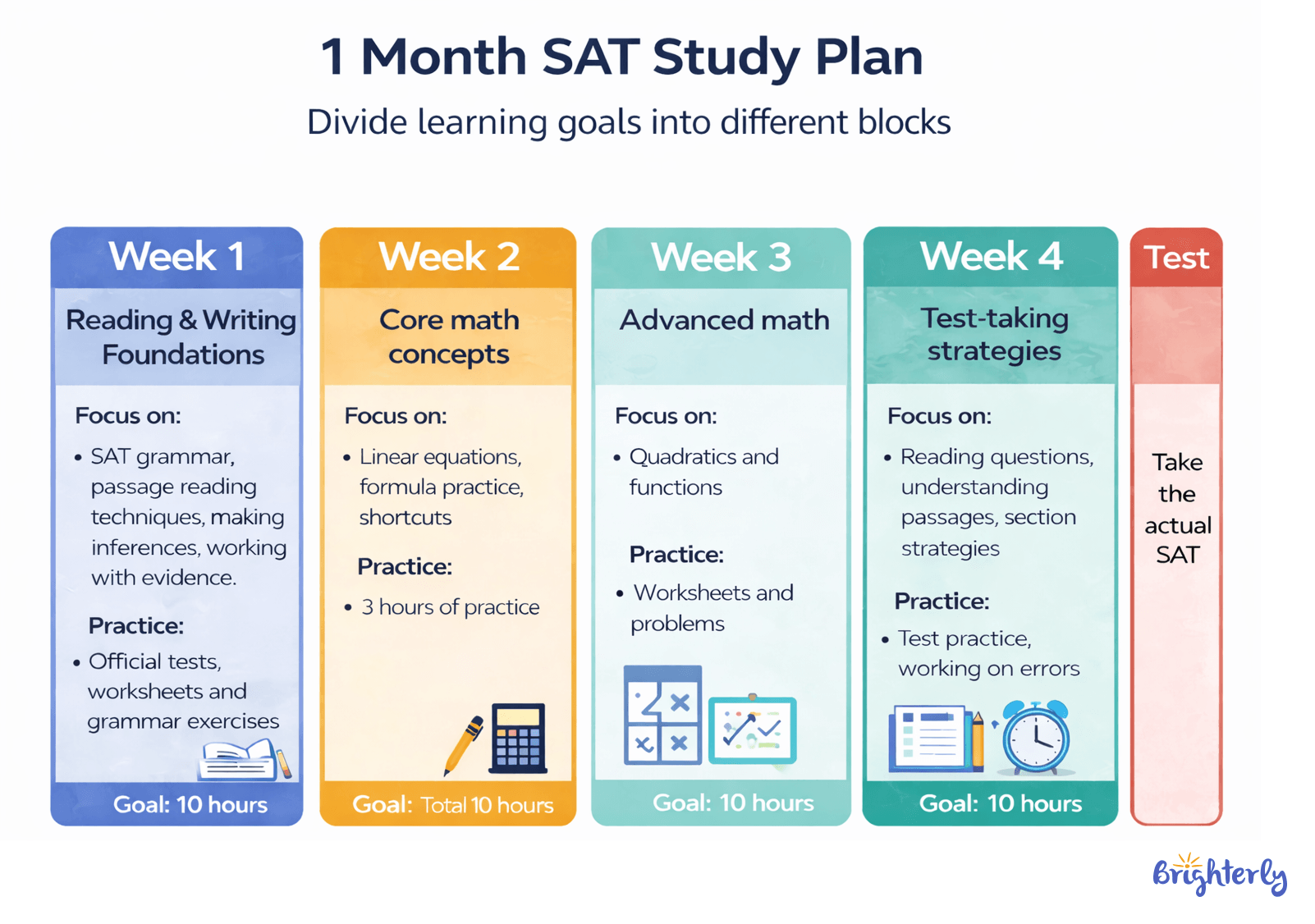
Since a student is going to spend several months, goals provide graduates with a system and help develop strategies.
What goals are worth setting when preparing for the SAT?
- Overall target score and SAT section goals. It can help you monitor your progress and prioritize specific learning.
- Study time goals. Set a specific test day or a goal on hours a week or month you practice; the more a student covers, the better their result may be.
- Skills or knowledge goals. Determine which skills are a priority, depending on the struggles
“One of the most important things students can do to improve their SAT scores is to focus on their struggles.”


Turn weaknesses and opportunities
The first diagnostic SAT can tell a parent or a student a lot. Even if a student finds it very hard or has lots of mistakes, it’s not a time for desperation. Look at them as weaknesses that can be worked on.
What are common types of weaknesses?
- School content or SAT section gaps.
- Test-taking skills.
How to ace the SAT preparation by working through your weaknesses?
- Find patterns in the errors (like struggling with certain concepts or misinterpreting)
- Group mistakes by types (like content, grammar, timing, and attention).
- Tackle the root of these errors and turn them into your advantage.
“Don’t rely too heavily on the categories in the score reports. For instance, a student might think they struggle with geometry, but in reality, they might face difficulties with fractions or vocabulary.”

Learn techniques for answering SAT questions
Except for learning academic concepts, you should also focus on how you handle questions. During a practice or real test, the answering strategies can help you manage time, focus on what you know, and prevent getting stuck on the challenges.
What are some working SAT study tips?
- Prioritize questions that you find easy, as you have aced them before or know the concept.
- Learn the elimination method to know how to exclude the wrong choice by finding active reasons to do so.
- Try predicting an answer before looking at the choices, especially if you understood the text well.
- Always read the whole question and make notes to better understand it.
“The SAT may seem complicated for many students because of the wording problems. To eliminate the issue, you need to get used to the language of the SATs.”
- If you need to, read the question out loud to yourself. It can help clarify confusing language.
- You can also use pictures or imagine a movie with the problem played out to understand what is asked.
- Finally, the best way is to practice with authentic questions written by the College Board, not ones written by other companies. I love opening up math to children from an unexpected angle. I love to see the twinkle in their eyes, and I love to watch their growth.

Learn how you handle reading passages
For some students, reading sections feels harder than math. In this case, the reason may be comprehension, not knowledge. There, learn reading passage techniques can help you feel more confident and get a good score on the SAT.
What are basic SAT reading passage tips?
- Try different strategies, either skimming the passage first and then reading the questions, or vice versa.
- Use a highlighter or a notebook to underline key ideas both in a passage and in questions.
- Practice active reading.
- Learn to identify keywords that give hints about conclusions, contrast, or evidence.
Master calculation
You may be strong in math concepts and understand how to do well on the SAT, yet the SAT math section can still be tricky. Why? Mistakes can occur due to a lack of practice, misreading questions, or inattention. Follow these tips to master the calculations:
- Start with the calculation errors you made during a practice test, and try resolving them on your own or with a guide.
- Learn to read problems and turn real-life situations into mathematical expressions.
- Identify where your reasoning breaks down and have additional math practice.
- Focus on solving steps and the conceptual math if you’re repeating mistakes.
- Know when (official use policy) and how to use the calculator (for specific topics, including graphic functions or fractions).
Practice calculation with certified tutors!
Feel more confident in SAT math
Know how to approach equations
As linear equation questions constitute a significant part of the SAT, you can’t ignore them.
Practicing them in different formats, from graphs to word problems, and knowing how to handle them can give you precious time during the test.
Decent equation SAT test-taking strategies
- Start by working on the coordination points from the tables.
- Learn to analyze graphs for key features, y-intercept, and slope direction.
- Practice using the right method of the system of equations, either elimination or substitution.
- Remember that a system of linear equations may have one solution, infinitely many solutions, or no solution.
Remember formulas and practice using them
Formulas may be another answer to the “How to pass the SAT math section” question. It’s important not only to remember and know how to use them.
What to do to practice formulas:
- Define the list of critical ones, including distance, quadratic formulas, exponent rule formulas, interest formulas, and shape formulas.
- Use mind maps, sheets, and graphic organizers to practice.
- Learn memorization techniques, first focus on “must understand” formulas, then switch to “nice to understand” formulas.
Learn to manage time
Also, students often get poor SAT exam results because they don’t know how to manage their time.
As you have 64 minutes for Reading and Writing and 70 minutes for the Math section, try a real simulation and develop strategies for each section. Also, pay special attention to managing your time with the following techniques:
- Identify how long it takes you to take each section, use a phone or a minutes calculator.
- Try the Two-Pass method, answering straightforward questions and returning later to the flagged ones.
- If you don’t know the answer, mark the question and return later if you have enough time.
- Don’t overthink the problem and don’t second-guess yourself.
Key SAT skills you should focus on
The best way to study for the SAT is by targeting three main sections and adequate skills. Let’s look at how to improve math problem-solving skills, reading skills, and writing and grammar skills.
Math problem-solving skills
| Skills | Strategy to use |
| Identifying problem type | Try grouping questions by type |
| Translating word problems | Break sentences into smaller parts |
| Use of formulas | Use the formula sheet, review, and memorize |
| Accurate calculation | Double-check, avoid rushing, use a calculator if appropriate |
| Analyze errors | Re-solve challenging questions and track patterns |
Reading comprehension strategies
| Skill | Strategy to use |
| Comprehend main ideas | Summarize each paragraph with one sentence |
| Identify details | Underline important information that reflects questions, and try active reading |
| Interpret questions | Learn to read carefully with no rush |
| Manage time | Try skimming strategies and see if it suits |
| Make inferences | Recognize inference wording, explain the answer with your words, and see the little and big picture |
Writing and grammar skills
| Skills | Strategies to use |
| Sentence addition/deletion | Find the purpose of the sentence, check it fits, and provide reasoning and logic |
| Grammar rules knowledge | Study common grammar rules, from punctuation and agreement to the use of colons and dashes. |
| Use of evidence | Learn to find direct support |
| Run-ons and sentence fragments | Practice telling the signs, writing, and proofreading |
| Verb tenses and forms | Revise forms and tenses, don’t forget about the gerund |
SAT tips and tricks to boost your score
To boost your SAT score, you should learn how to apply test-taking, reading, writing, and math strategies.
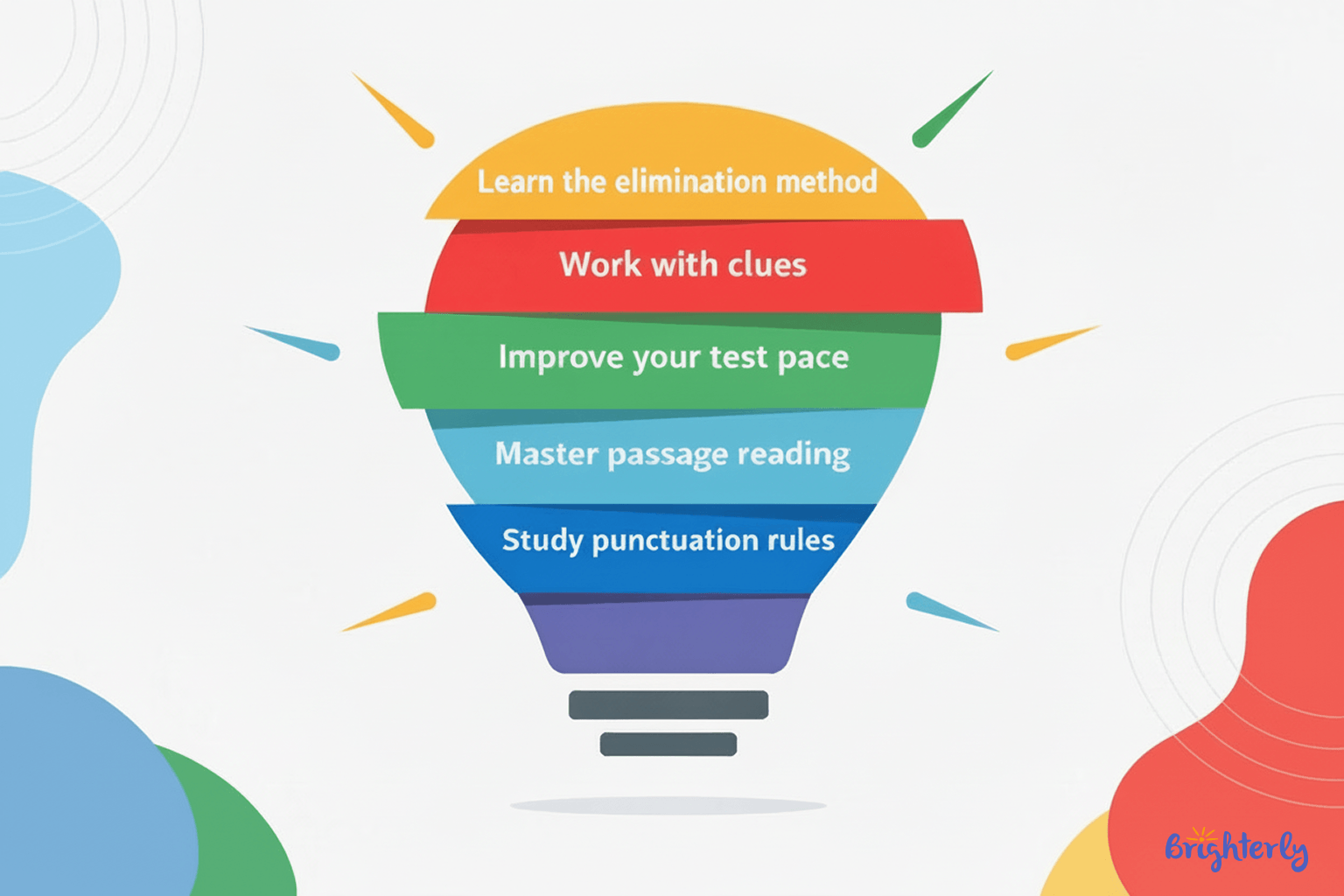
How to study for the SAT so that you feel confident during the test?
- Master the Elimination method to find the wrong answers if you can’t find the right one.
- Learn reading passage techniques, active reading, and skimming.
- Study punctuation rules and make it your shortcut.
- Know how to find clues in the context.
- Practice tests to make sure your pace matches SAT time limits.
How to improve SAT scores if you’re stuck
Achieving a high SAT score requires clear priorities, strategy, and consistency. Even if you’re stuck, a plan allows you to have a set of instruments and tools to overcome gaps and challenges,
To boost your score, identify weaknesses and target them. At the same time, develop a plan around structured practice and stay disciplined.
Nevertheless, knowing formulas and math, wiring, and reading concepts is not enough. Thus, think of test-taking strategies and test time management tricks.
Do you feel that you need guidance and support? It may be a signal to resort to Brighterly tutoring, book a free lesson to know how tutors can help.
FAQ
What is the highest SAT score?
The highest possible or a “perfect” SAT score is 1600. A person can achieve 1600 points if they get the highest number of points for the following sections: Math and Evidence-Based Reading and Writing.
Has anyone gotten a 1600 on the SAT?
Yes, even though it’s quite rare, it’s possible to get 1600 on the SAT. Considering that millions often do the test each year, only hundreds manage to get the highest score, which is less than 1% of test-takers.
How hard is it to get a 1600 on the SAT?
It’s quite hard, even challenging for a student to get 1600 points. However, it’s possible. The students should have an excellent academic background, know how to apply it to the questions in the SAT flawlessly and intuitively, and handle time limits effortlessly.
Why is my SAT not improving?
If your SAT is not improving, you may be focusing solely on practicing and studying, instead of targeting weaknesses and the roots of errors. Other reasons may refer to doing preparation incorrectly or inconsistently, or failing to effectively go through all the questions.



What kind of math is used in computer science? Generally, computer scientists need to be comfortable with binary mathematics, linear algebra, calculus, discrete math, and statistics. Computer science is a broad field. The type of math needed depends on the specific career path. Let’s see how math is involved in computer science. How it helps […]

May 22, 2024

If your kid has dyscalculia, you shouldn’t despair. I’ve put together 8 strategies on how to help a child with dyscalculia that I’ve seen work most effectively during my career as a math teacher. They’re easy to implement at home and will definitely make math more accessible to your little learner. Key points Dyscalculia affects […]

May 23, 2024
Math & reading from 1st to 9th grade
Looking for homework support for your child?

Choose kid's grade

Math & Reading for Grades 1–9
Build real confidence for your child with a Brighterly math or reading tutor.