Math Competitions for Students: Top 29 Contests for K–12
reviewed by Jo-ann Caballes
Updated on September 22, 2026
Key Points:
- Best overall: Brighterly Scholarship is a free and accessible math competition with no income documentation required and suitable for elementary and middle school math students of different levels.
- Best for all grades: Brighterly, Purple Comet, USAMTS, and IYAMC are some free, prestigious math competitions to consider.
- Best as first competitions: Math Kangaroo, Noetic, MOEMS, PiMC, Brighterly, and Perennial Math provide low-pressure math contests.
- Best real-world-based competitions: HiMCM, M3 Challenge, SCUDEM, TEAMS, and Modeling the Future all ask students to create models to solve real-world problems.
- Best for advanced learners: HMMT, ARML, Math Prize for Girls, Harvard-MIT, and Stanford competitions represent the highest level of math problems.
Top math competitions for students are Brighterly, AMC, MATHCOUNTS, NLMC, and MOEMS; they are great for middle-grade students. HMMT and COMAP are more advanced options for high schoolers, while Math League and Continental Mathematics League are top choices for testing kids’ skills on the state and national levels.
As such, math contests help kids develop math expertise and show their abilities. Below, you can find the list of 29 contests with grades, formats, and registration timelines.
Top Math Competitions to Participate in 2026
| Grades | Cost (as of August 2026) | Format | |
| Brighterly Scholarship | 1-9 | Free | Question-based format, run 3 cycles per year |
| AMC 8 | 1-8 | $55–$115 (depending on the registration date) $25 per 10-student team |
25 multiple-choice questions during 40 minutes |
| MATHCOUNTS | 6-8 | $42–53 for the team of schoolers (up to 14 students), $75–85 for non-school competitors (depending on the registration date) | 4 competitive math rounds (Sprint, Target, Team, Countdown), from school to national level |
| Math Kangaroo | 1-12 | From $18 to $35 (depending on the registration date) | 75-minute multiple-choice exam |
| MOEMS | 4-8 | Available after registration | 5 monthly contests with 5 questions each |
| Noetic Learning Math Contest | 2-8 | $129 for a team of up to 30 students (US competition) | 45-minute test with 20 problem-solving questions |
| Continental Mathematics League | 2-12 | $90–$100 as a team (depending on the grade), plus $85 for an additional team | 30-40 minutes per meet, 3-5 sessions per month, 6-8 questions each meet |
| MathCON | 4-12 | $75 individual student or $590 as a team per school | 45-minute online test with 32 multiple-choice questions, then an in-person exam with 40 questions for winners |
| ARML | 9-12 | $400 for math teams plus $65–$75 per person | 20-minute test to solve 10 questions in a group of 15 students, plus other formats |
| HMMT | 9-12 | $80 as a team $10 as an individual student |
Individual, team, and 80-minute 36-question Guts Round |
| Math League | 4-12 |
$45 per student (additional $9.95 for school) Free for registered schools |
30-minute multiple-choice test |
| COMAP HiMCM/MidMCM | 4-12 | $100 per team (up to 4 students) | 14-day intensive to complete a project |
| Purple Comet Math Meet | 4-12 | Free | 60-90 minutes per test with 20-30 problems (depending on the grade) |
| INTEGIRLS Math Competition | 5-12 | Free (female and non-binary students only) | 45-60 minutes for solo exam, 30-40 minutes for team round, 10-minute Relay Rounds, and a 30-minute game |
| Math Prize for Girls | 9-12 | Free (female students only) | 2.5 hours for 20 questions |
| PiMC | 3-12 | Free | 40-minute test with 25 multiple-choice questions (75 minutes for high schoolers) |
| SIGMA Math Competition | 6-9 | $35–$110 (depending on the number of tests) | 5 mini-contests for 30 minutes with 8 complex problems each |
| USA Mathematical Talent Search | 6-12 | Free | 3 rounds, one month each, 5 complex problems to solve |
| IMC-IMPEA | 6-12 | Free | 100-minute test with 15 questions |
| TEAMS | 6-12 | $300–$500 (depending on the team size) | Collaborative STEM problem solving |
| M3 Challenge | 11-12 | Free | 14-hour “Challenge Weekend” to produce a single PDF |
| Trig Star | 9-12 | Free | 60-minute test to solve 5 problems |
| American Scholastic Math Contest | 7-12 | $100–$200 (depending on the chosen number of divisions) | 6 mini-contests, each 35 minutes long with 7 questions to solve |
| Modeling the Future Challenge | 11-12 | Free | Scenario and Project Proposal phases of team collaboration |
| SCUDEM | 11–12 and undergrad | $100 per team (3 students each) | Present a 10-minute video on a chosen scenario within a 3-week period |
| AMC10/12 | 10-12 | $55–$115 (depending on the registration date) $30 per 10-student team |
25 multiple-choice questions during 75 minutes |
| IYMC | 10–12 | Free to enter €15 fee for advanced rounds |
Solve 5 math problems, then the winners take a 60-minute exam with 5 advanced problems |
| Perennial Math | 3-12 | Up to $100 per team From $15 per student |
4 monthly tests, 60-minute virtual tournament, 30-minute individual test with 15 word problems, 20-minute team test with 10 word problems |
| Stanford Math Tournament | 8-12 | $25–$35 (depending on the registration date) | Online math tournaments individual, team, advanced, and Guts rounds |
Exploring alternatives?

Explore Brighterly Learning Experience
Learn exactly how Brighterly helps students thrive through expert sessions, online tools, and proven feedback from thousands of satisfied parents
Brighterly Math Scholarship
Who can participate: elementary and middle schoolers
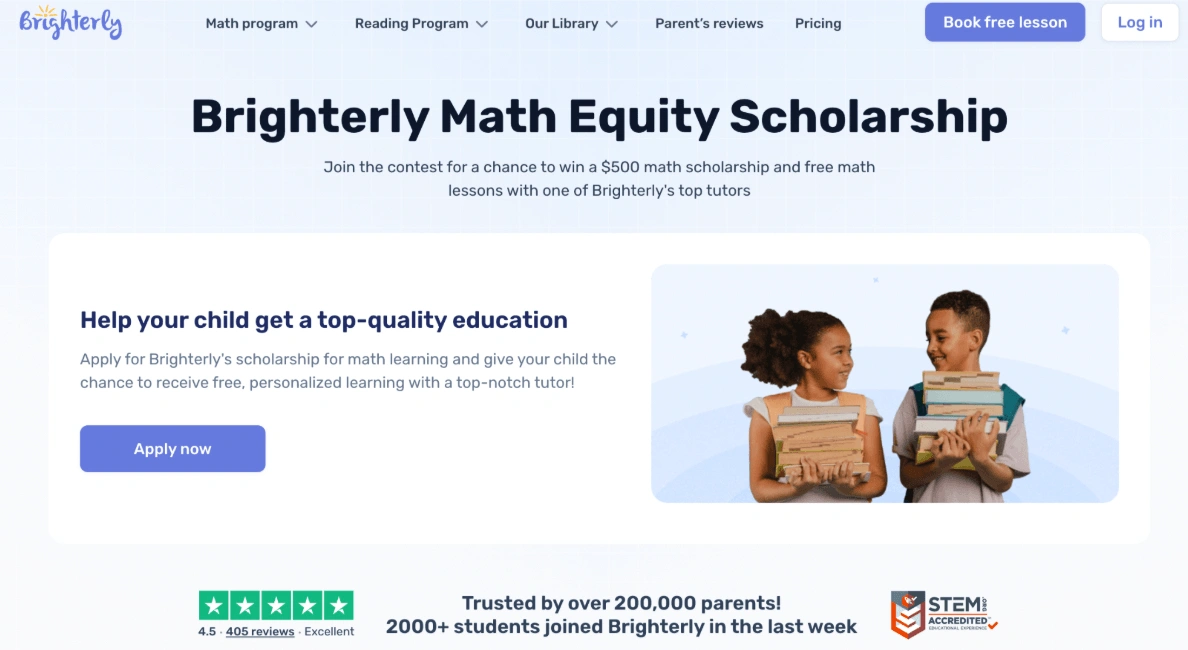
The Brighterly Scholarship is one of the free US online math competitions for elementary and middle school students with a $500 cash prize and 6 months of free 1:1 personalized math tutoring.
At Brighterly, we aim to help young learners build confidence and close learning gaps. Our math competition is accessible and doesn’t require any formal household income documentation.
What the competition involves:
- 3 application cycles.
- Questions built to test critical thinking, logic, and problem-solving skills.
- Cash prizes and a few lessons for winners with elementary math tutors or middle school math tutors
Registration timeline:
Registration is open until 30 November. To apply, students need to submit a short essay, a letter of recommendation, and a simple statement of financial need.
AMC 8
Who can participate: middle schoolers, up to 8th grade.
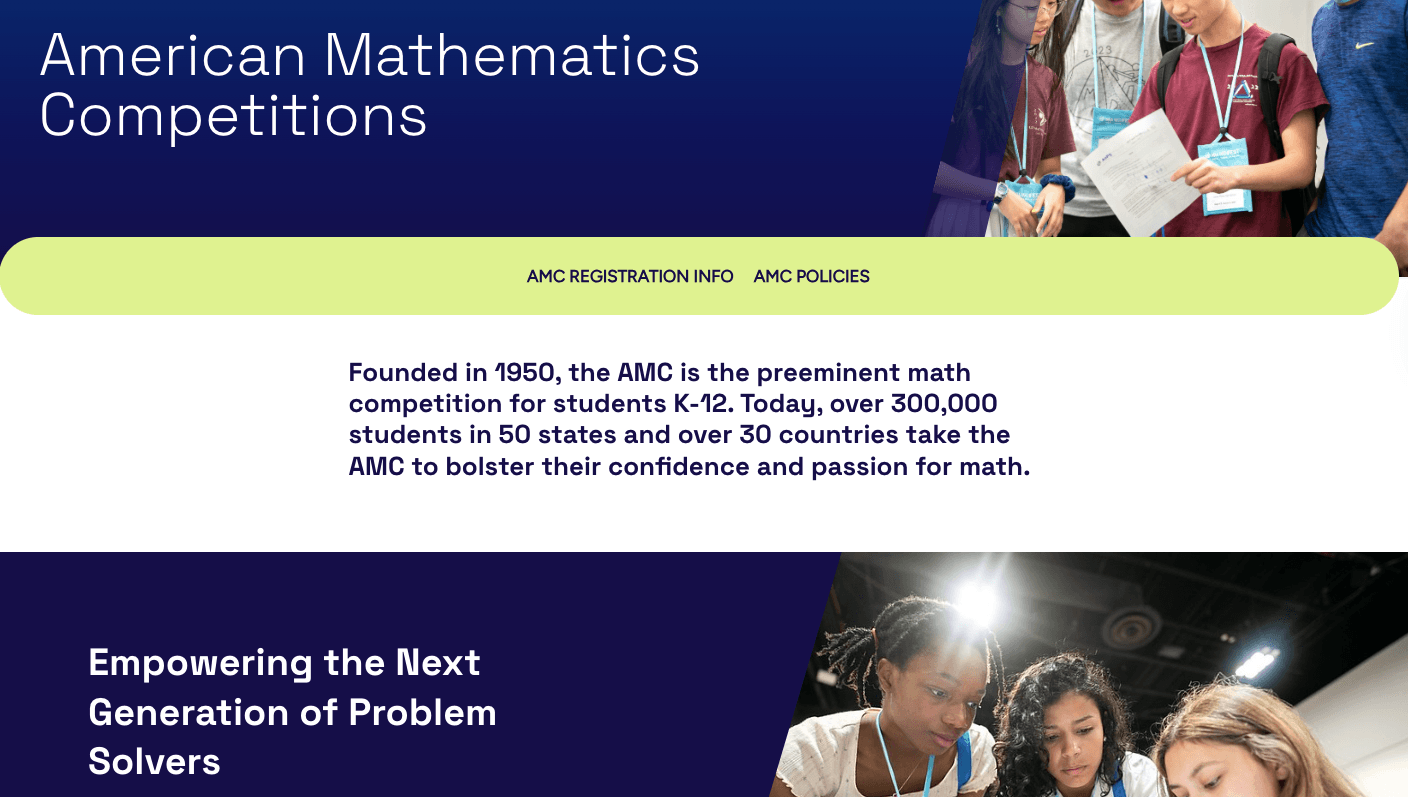
AMC8 is the national math competition for middle schoolers that the Mathematical Association of America holds every January to support kids’ math confidence and interest. Children have been taking it since 1950.
What the competition involves:
- 25 multiple-choice questions and 40 minutes to complete them
- Tasks around multi-step mathematics problems based on logical reasoning and core math skills.
- Topics that include counting, probability, geometry, and basic algebra.
- Awards, such as the National Distinguished Honor Roll or the National Honor Roll.
Registration timeline:
Registration starts in October, where schools work as centers. The competition will be held from January 21 to 27, 2027.
MATHCOUNTS
Who can participate: students in 6-8 grades
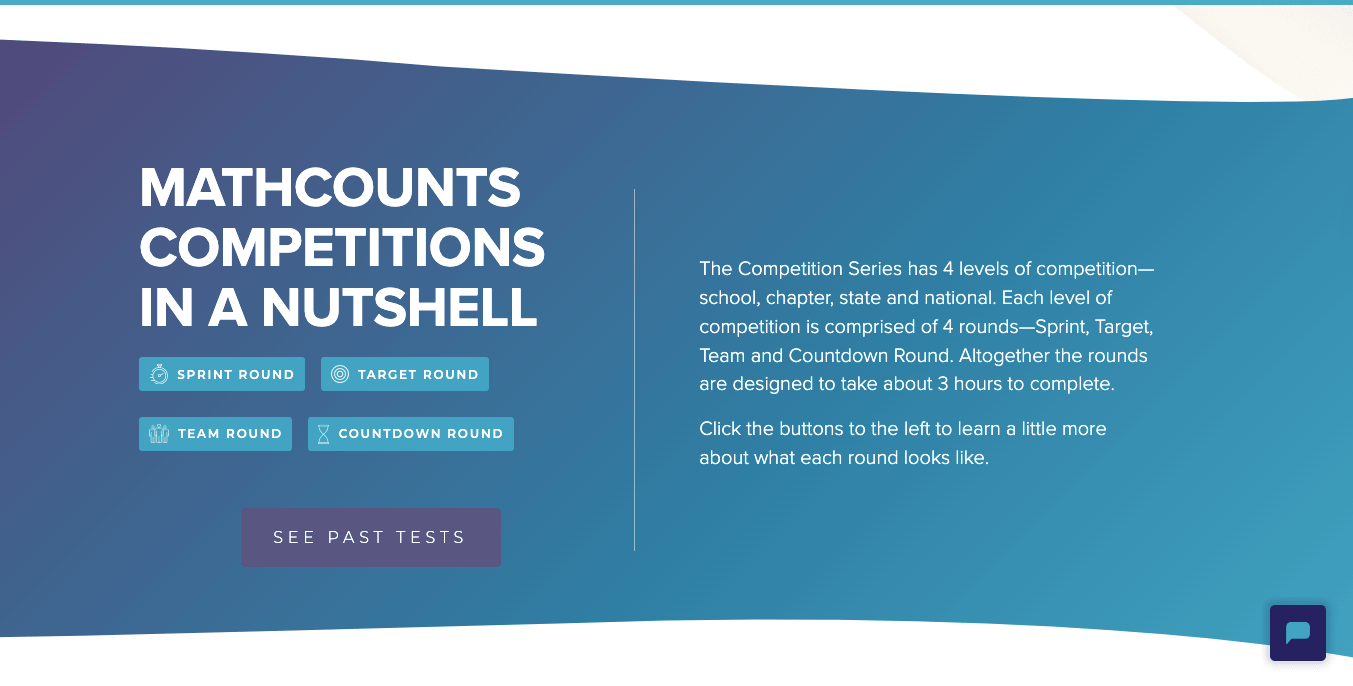
MATCHCOUNTS is a popular math competition for middle schoolers in the United States, attracting more than half a million participants. Also, MATHCOUNTS runs at 4 different levels (school, chapter, state, and national) and aims to develop problem-solving skills and interest in STEM programs and subjects.
What the competition involves:
- Spring Round (30 questions in 40 minutes).
- Target Round (8 problems to solve in pairs).
- Team Round (teams of 4 solve 10 problems in 20 minutes).
- Countdown Round (finalists compete against one another.)
Registration timeline:
Registration starts on August 17 and closes in mid-December, as the first school competitions start in January, chapter competitions in February, state competitions in March, and national competitions from 9-10 May, 2027.
Math Kangaroo
Who can participate: students from 1–12 grades (ages 6–18)

The Kangaroo Math National Competition is a universal, competitive, and fun online math competition for an international audience, available in more than 90 countries. As its questions are non-standard and cover everything from algebra to calculus and other math fields, the contest can be a decent first contest experience.
What the competition involves:
- 75-minute exam with multiple-choice questions
- 24 questions for lower grades and 30 questions for middle and high schoolers.
- Difficulty rises across the test.
Registration timeline:
Registration starts on September 15, as the competition is held in March. Be sure to fill in the form by December 31st to pay a reduced $18 per student fee, as registration between January 1 and February 1, 2027, will cost $35 per student.
MOEMS (Math Olympiads for Elementary and Middle Schools)
Who can participate: students in 4–8 grades (ages 9–14)
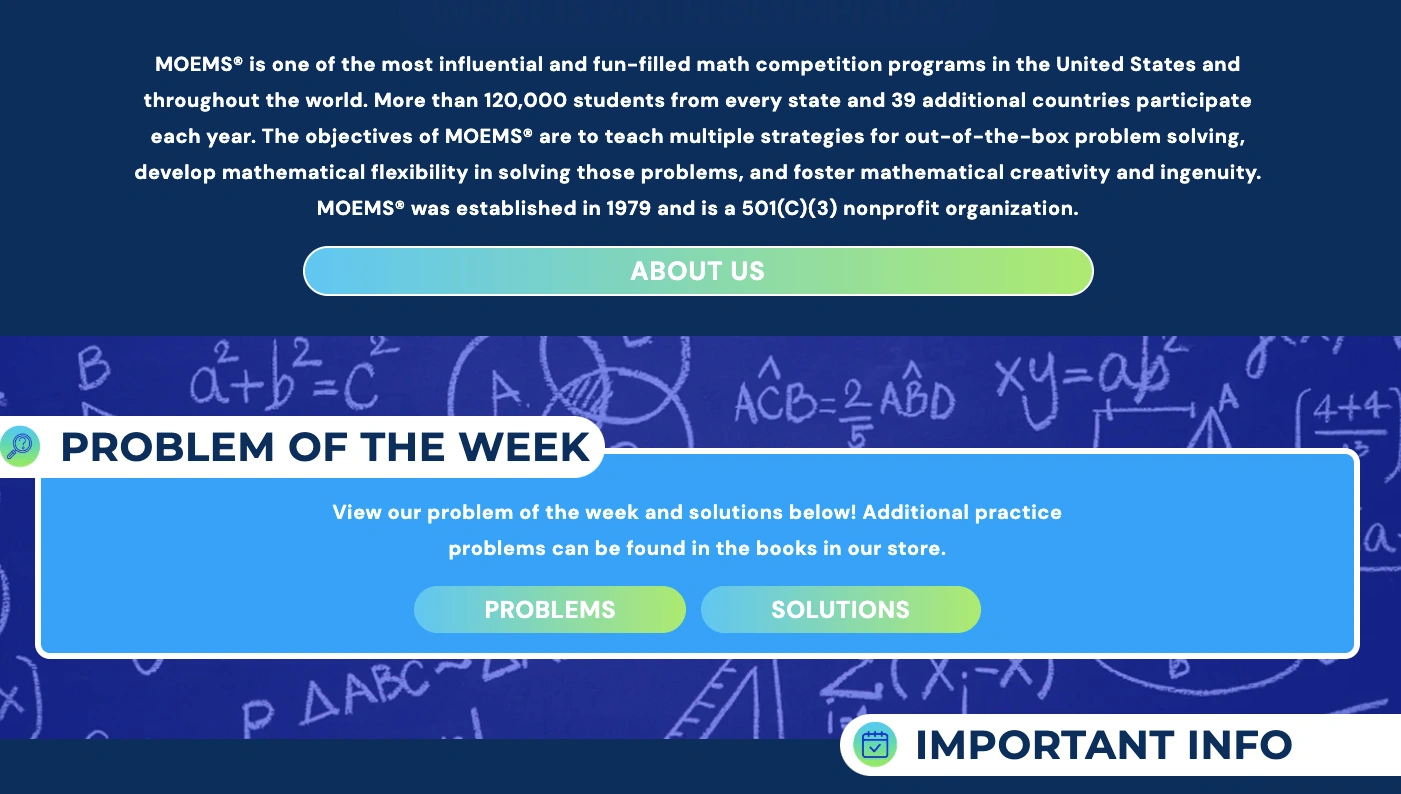
MOEMS is among the national elementary and middle school math competitions with a fun social format and rich history. Its math olympiad programs are accessible and have two divisions, E and M, with different difficulty levels for each group.
What the competition involves:
- 5 monthly contests, 30 minutes each.
- 5 free-response questions per test.
- Individual and team scores, homeschool students’ inclusion.
Registration timeline:
For school and homeschool students, it starts in the summer and ends in November. Administration windows for individual contests are in:
- November 9, 2026 – November 30, 2026
- December 7, 2026 – December 28, 2026
- January 4, 2027 – January 25, 2027
- February 1, 2027 – February 22, 2027
- March 1, 2027 – March 29, 2027
The deadline for all score entries is March 31, 2027, 11:59 PM (PT).
NLMC (Noetic Learning Math Contest)
Who can participate: elementary and middle school students
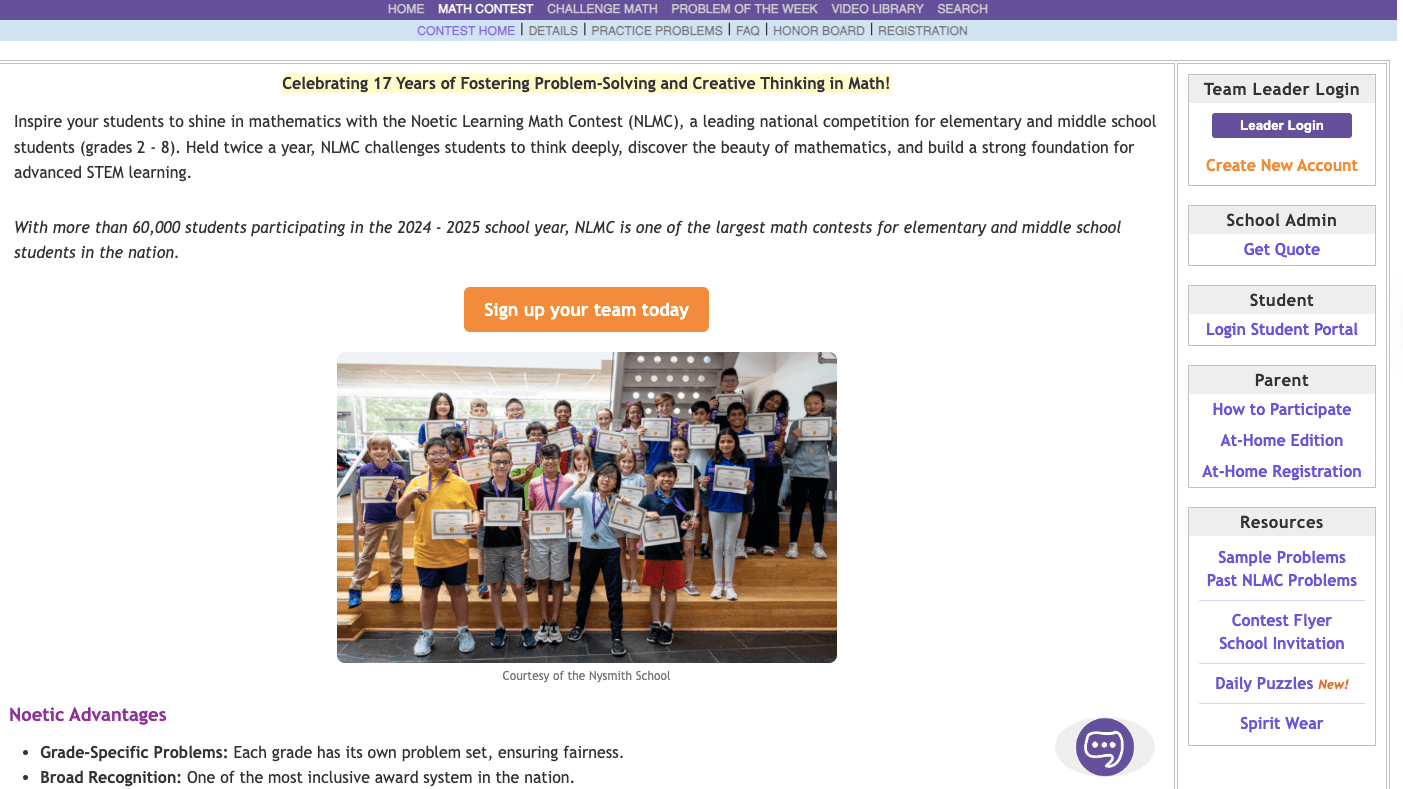
NLMS is a biannual problem-solving skills and mathematical reasoning test for students in grades 2-8. For math competitions, elementary school events like this one, children will work with creative tasks independently or in teams without a calculator.
What the competition involves:
- 20 questions with free responses per contest
- 45 minutes or 50 minutes for in-person and online testing, respectively
- Prizes on national, state-level, and school levels.
Registration timeline:
Registration starts in summer-fall and winter-spring, with the contest dates from November 12–25, 2026, to April 1–15, 2027. To register a team, you must pay a $99 registration fee.
Continental Mathematics League
Who can participate: any student from grades 1-12
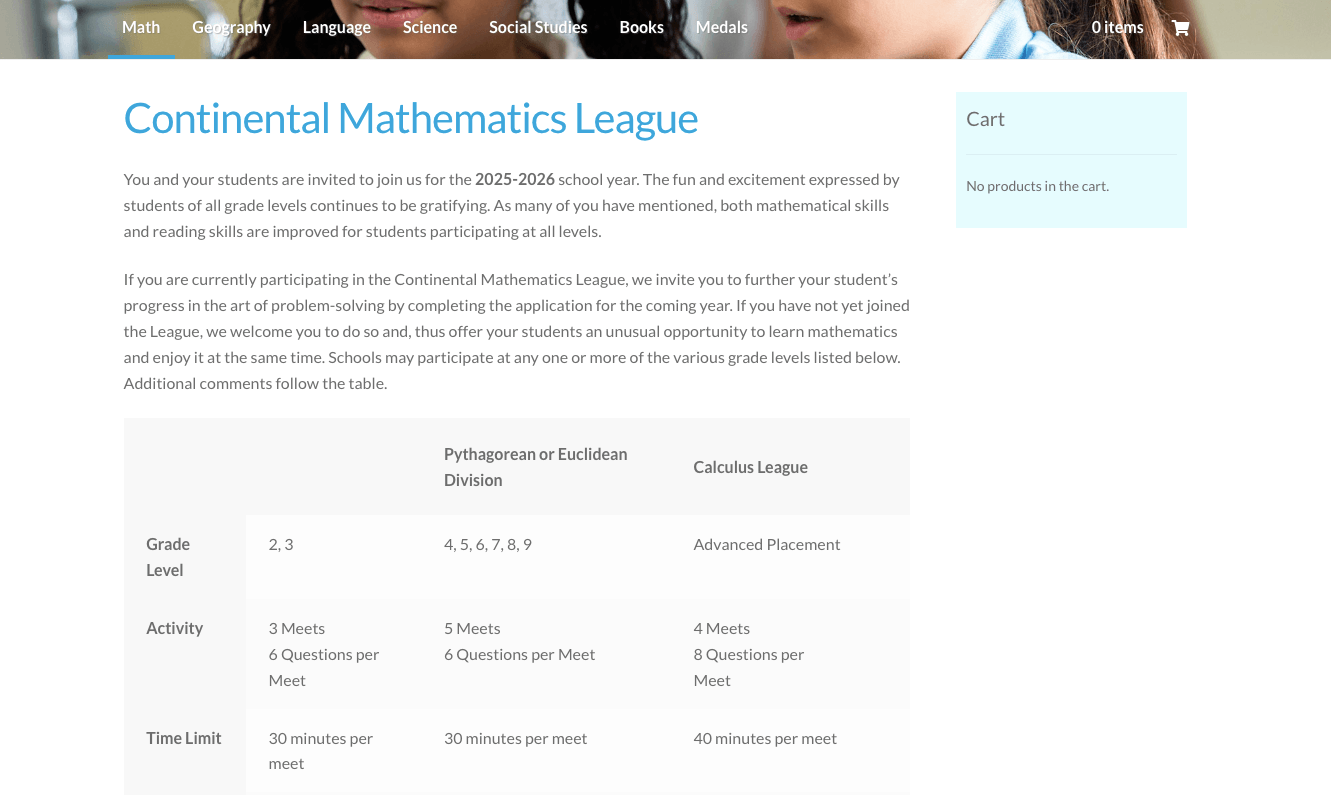
CML is a comprehensive competition for elementary school and middle school students to boost problem-solving. As it’s a League format, students have 3 to 5 meets, depending on grade (3 for grades 2–3, 4 for advanced placement, 5 for grades 4–9), to take tests and receive scores each time.
What the competition involves:
- 3 to 5 monthly sessions per year.
- 30 to 40 minutes and 6 to 8 questions to solve per meet.
- Scores add up.
- Wide range of divisions (suiting grades or students on a 504 plan).
Registration timeline:
- Registration started in August via the CML website. Schools would need to pay $90 or $100 for the first team and $85 for an additional team. Meet dates are set between November 5, 2026, and April 8, 2027, depending on the grade.
MathCON
Who can participate: all students from grades 4-12
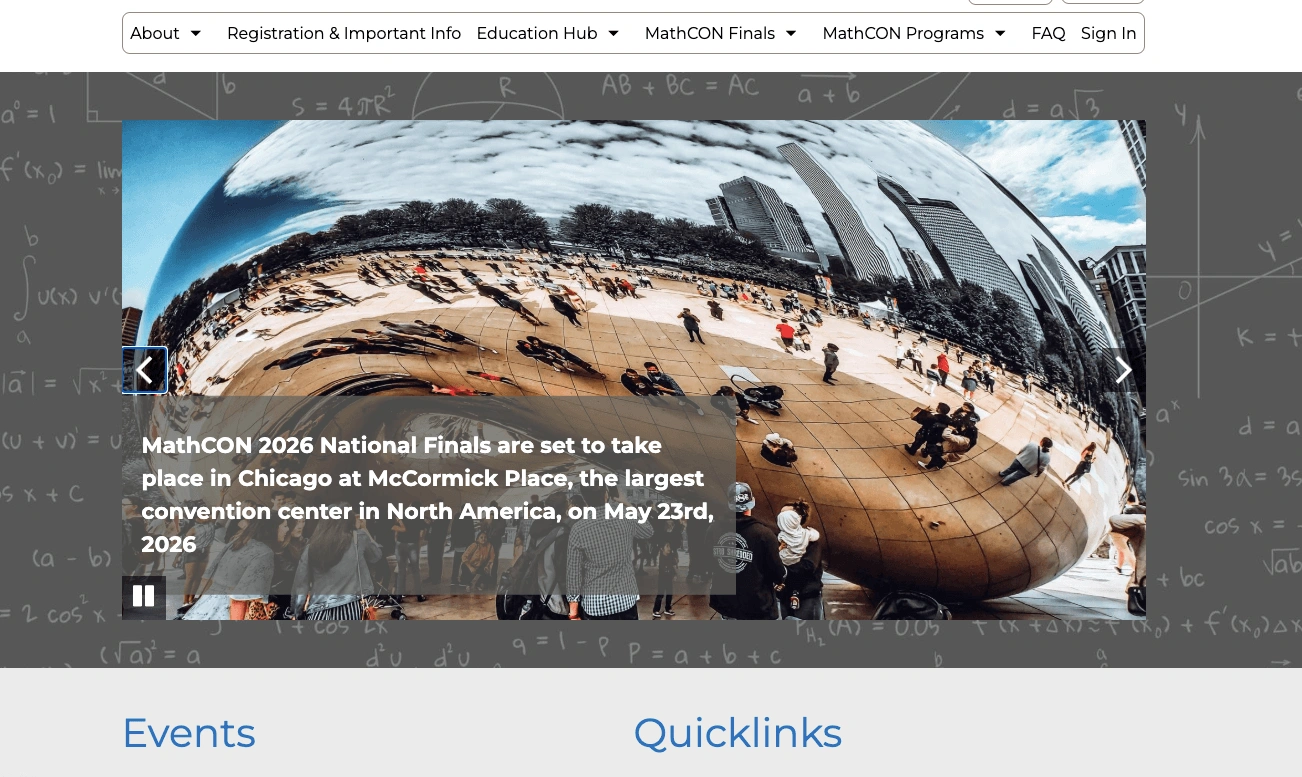
MathCON is an innovative platform that offers a series of national math competitions, summer camps, and serves as a community for math students. MathCON competitions are open to public, private, charter, and homeschool students.
What the competition involves:
- Preliminary round online.
- Finals in Chicago with TOP qualifiers.
- Topics that refer to algebra, geometry, number theory, and combinatorics.
- Weekly practice tests.
Registration timeline:
Opens on August 19, 2026, and closes on March 17, 2027, for the first online round. Registration for the final test is from March 19, 2027, to April 16, 2027.
Practice and close gaps with Brighterly
Customize learning to your math needs with personalized 1-on-1 sessions. 

ARML: American Regions Mathematics League
Who can participate: High school students
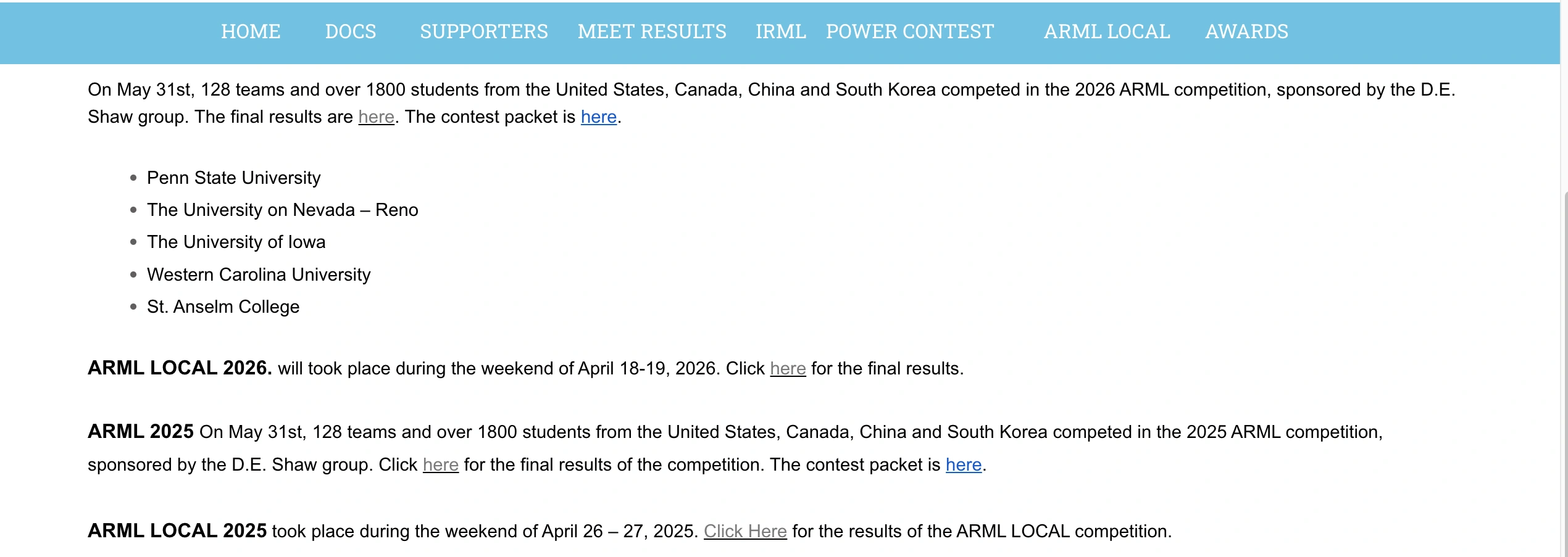
ARML is a well-recognized international high school math competition that takes place in US universities. There, students demonstrate math depth and have a math community experience.
What the competition involves:
- Team, Power, Individual, Relay, Tiebreaker Rounds with varied problems and goals.
- Topics that include algebra, geometry, number theory, and combinatorics.
- Live competition on campus (at one of 5 different universities).
- Math awards for high school students with top scores.
Registration timeline:
Registration is open until the start of May, and the competition takes place in late May or early June. The next competition is set for June 4 to 6, 2027.
HMMT: Harvard-MIT Mathematics Tournament
Who can participate: high school (grades 9-12)

HMMT is a math competition for high school students, a pretty reputable one, considering the relation to Harvard and MIT undergraduates. The competition takes place twice a year, in Harvard in November and in MIT in February, and it’s difficult as a competition.
What the competition involves:
- Individual (50 minutes) and Team (60 minutes) rounds with 10 problems each.
- Guts round offering 36 fast-paced problems.
- High difficulty (upper AMC to full olympiad level).
Registration timeline:
Registration opens on August 2 and ends September 20, 2026, and the lottery determines whether students can participate. The dates of the contests are November 7, 2026, at Harvard and February 13, 2027, at MIT. The fee is $80 per team and $10 per individual application.
Math League
Who can participate: middle and high school students
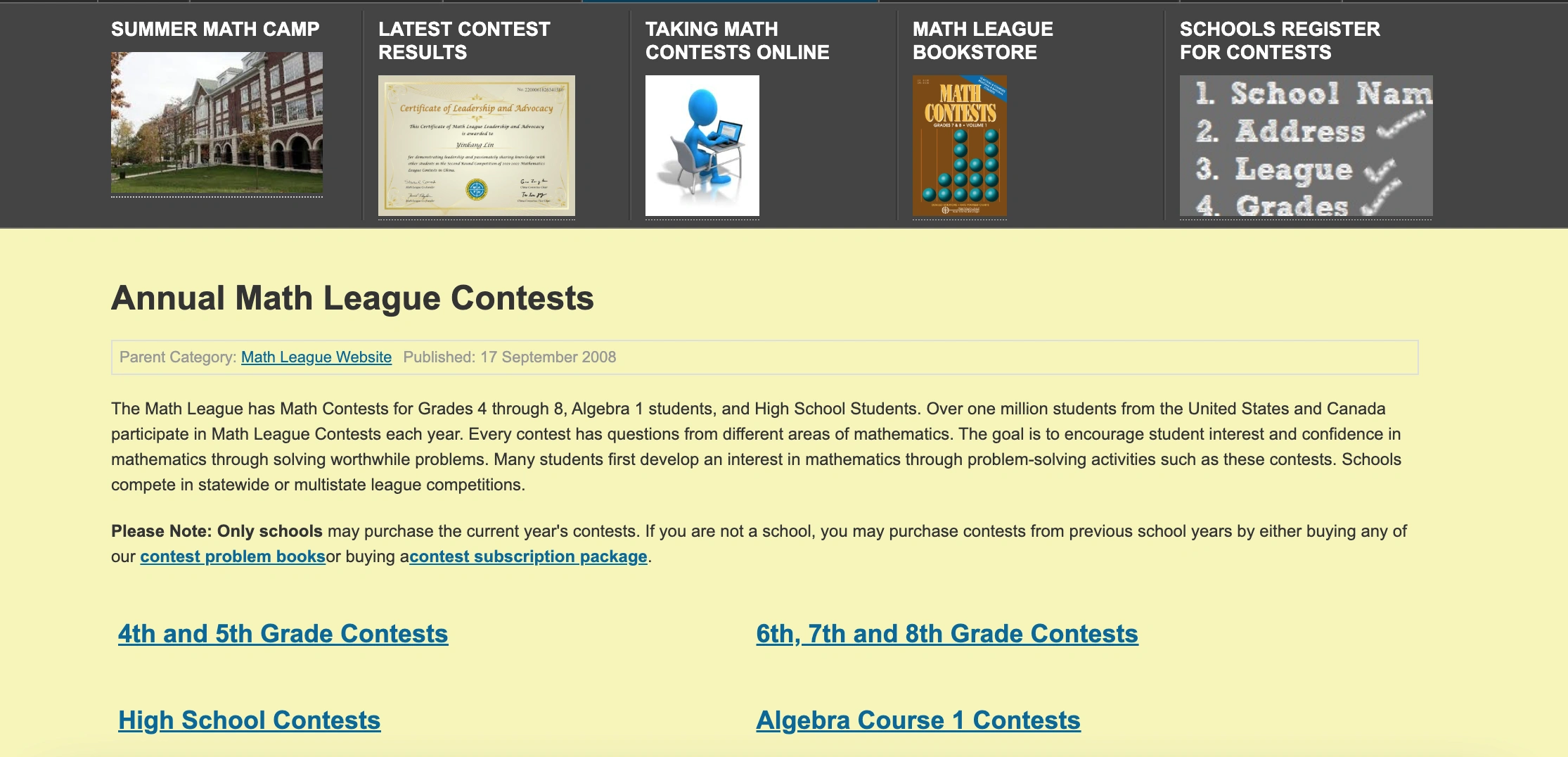
The Math League is one of the math competitions for middle school students. With divisions, from grade 4 through high school, and several levels, local, state, and national, its main philosophy is creating the relevant experience required to learn math.
What the competition involves:
- Monthly contests during the school year.
- Varied question formats (multiple choice and short answers).
- Rankings relating to different levels or tiers.
- Free practices.
Registration timeline:
Students should have a math teacher for registration. It closes at the end of January for 4th-5th grades, at the end of December for 6-8 grades, and at the end of September for high school students.
COMAP HiMCM/MidMCM
Who can participate: middle and high school (mainly) students
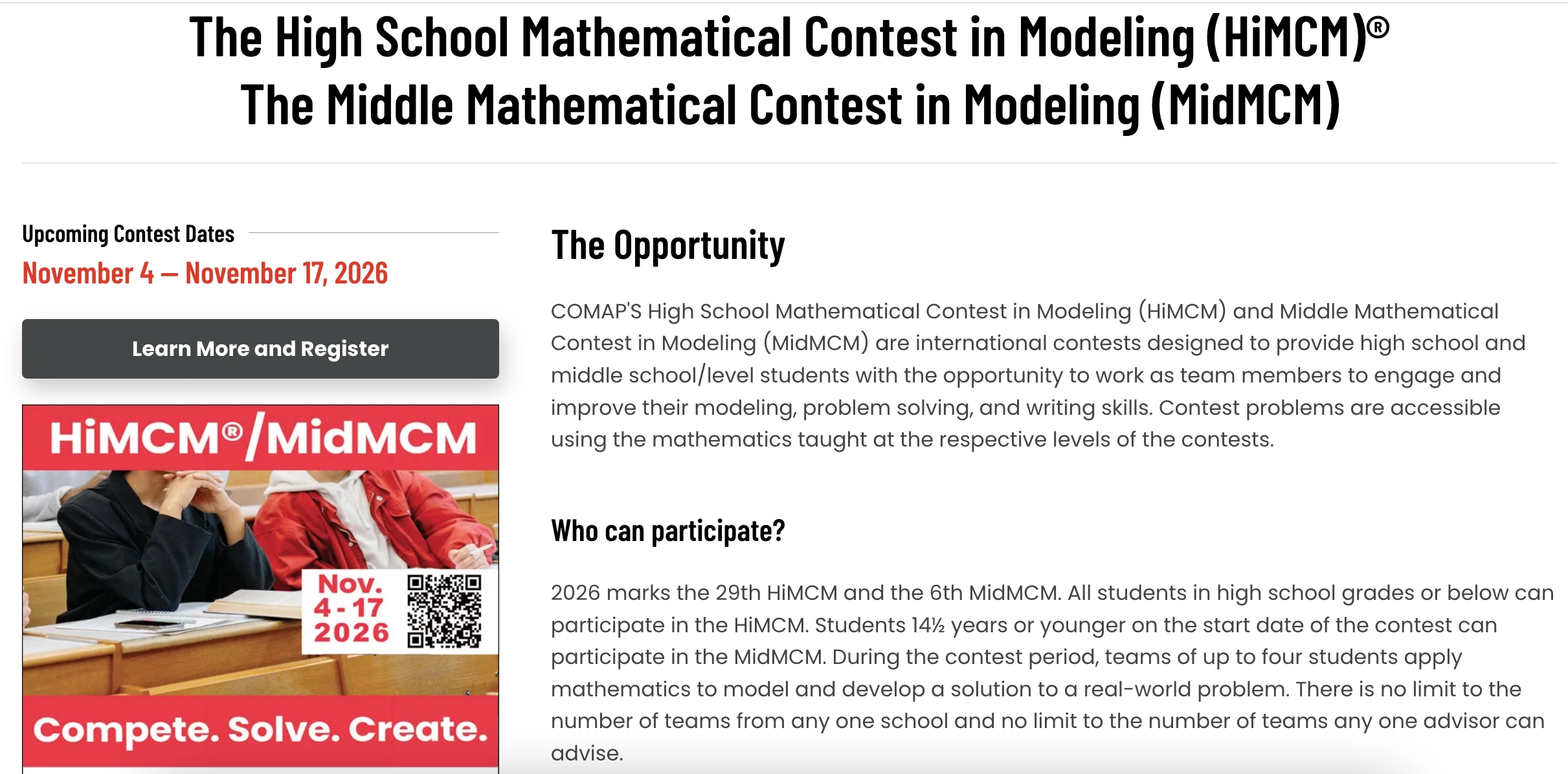
The High School Mathematical Contest in Modeling and the Mid School Mathematical Contest in Modeling are versions of the specific competitions that challenge teams of students to apply mathematical modeling to real-world problems.
What the competition involves:
- Teams competition (up to 4 students).
- Competition windows to analyze and model open-ended problems.
- Submission via the structured report.
Registration timeline:
COMAP holds it annually in November, and registration opens in the fall via the website. The upcoming contest dates are set from November 4 to November 17, 2026.
The Purple Comet! Math Meet
Who can participate: middle and high school students
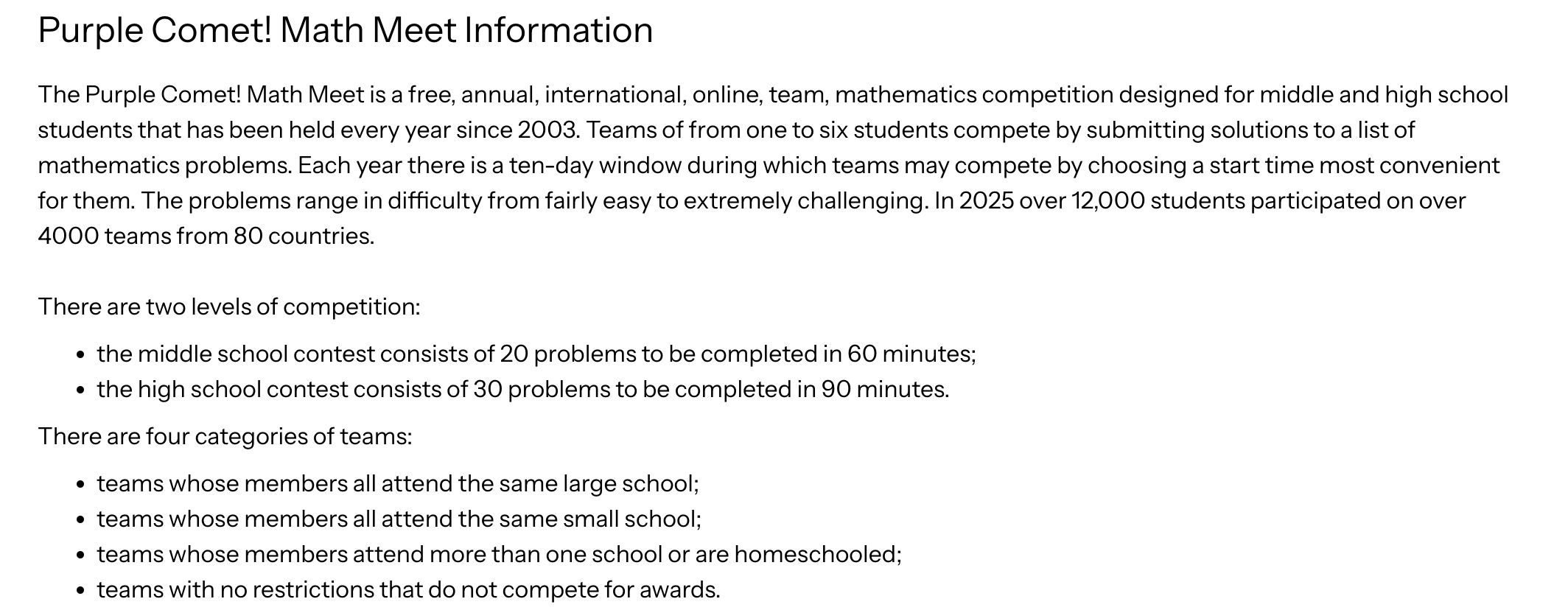
Purple Comet! is a team-based math competition that’s been running annually since 2003. For this competition, students can choose their team members and should work on solutions within a 10-day window.
What the competition involves:
- 20 or 30-task problem set for teams to solve.
- A competition window to submit the answers.
- Flexible schedule to start.
- International rankings.
Registration timeline:
As the competition takes place from April 6 to April 15, 2027, registration opens earlier. To register, you need to have at least one adult supervisor aged 21 or older.
INTEGIRLS Math Competition
Who can participate: middle school and high school (girls and non-binary students)

INTEGIRLS Math Competition is a student-led math competition held by a non-profit organization. It aims to offer contest opportunities specifically for girls and non-binary students affected by (trans)misogyny and interested in STEM subjects.
What the competition involves:
- Individual or team format.
- Multiple rounds, interactive sessions, games.
- Chapters across US states.
Registration timeline:
As competitions take place during the fall and spring, you should check the Instagram pages of the chapters to sign up a few weeks prior.
Math Prize for Girls
Who can participate: 11th and 12th-grade students or below
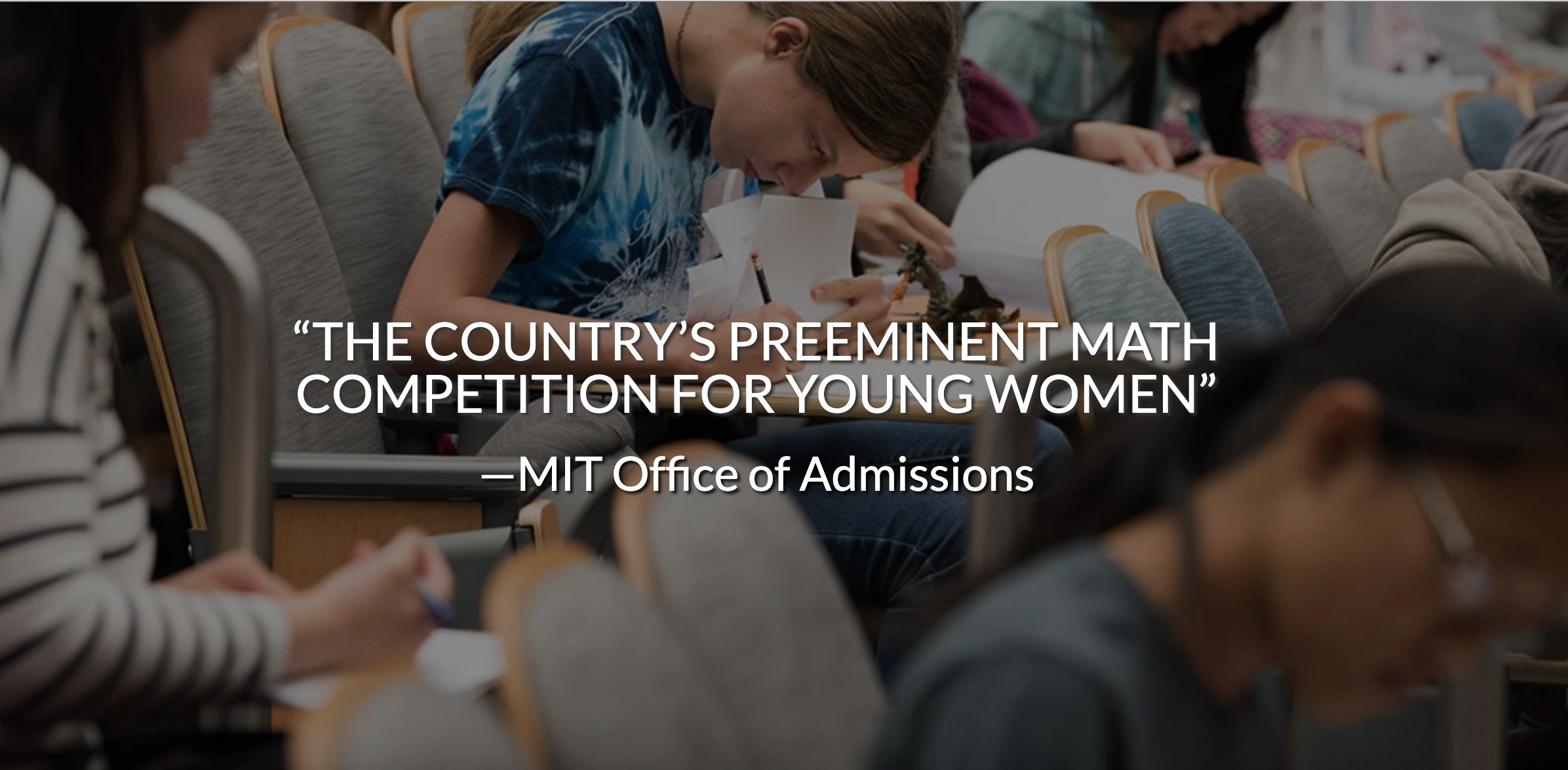
The Math Prize for Girls is a math olympiad for high school girls nationally and globally. It offers $50,000 in prizes and takes place at MIT, so it’s also distinguished.
What the competition involves:
- 20 short-answer problems (10 AMC/AIME level).
- An exam that lasts 2.5 hours.
- Invitation upon sending the AMC scores.
Registration timeline:
Registration ends at the end of May, while qualifying requires sending fall AMC 10/12 scores. The Math Prize for Girls will take place on October 11, 2026.
PiMC Math Contest
Who can participate: students from grades 3-12
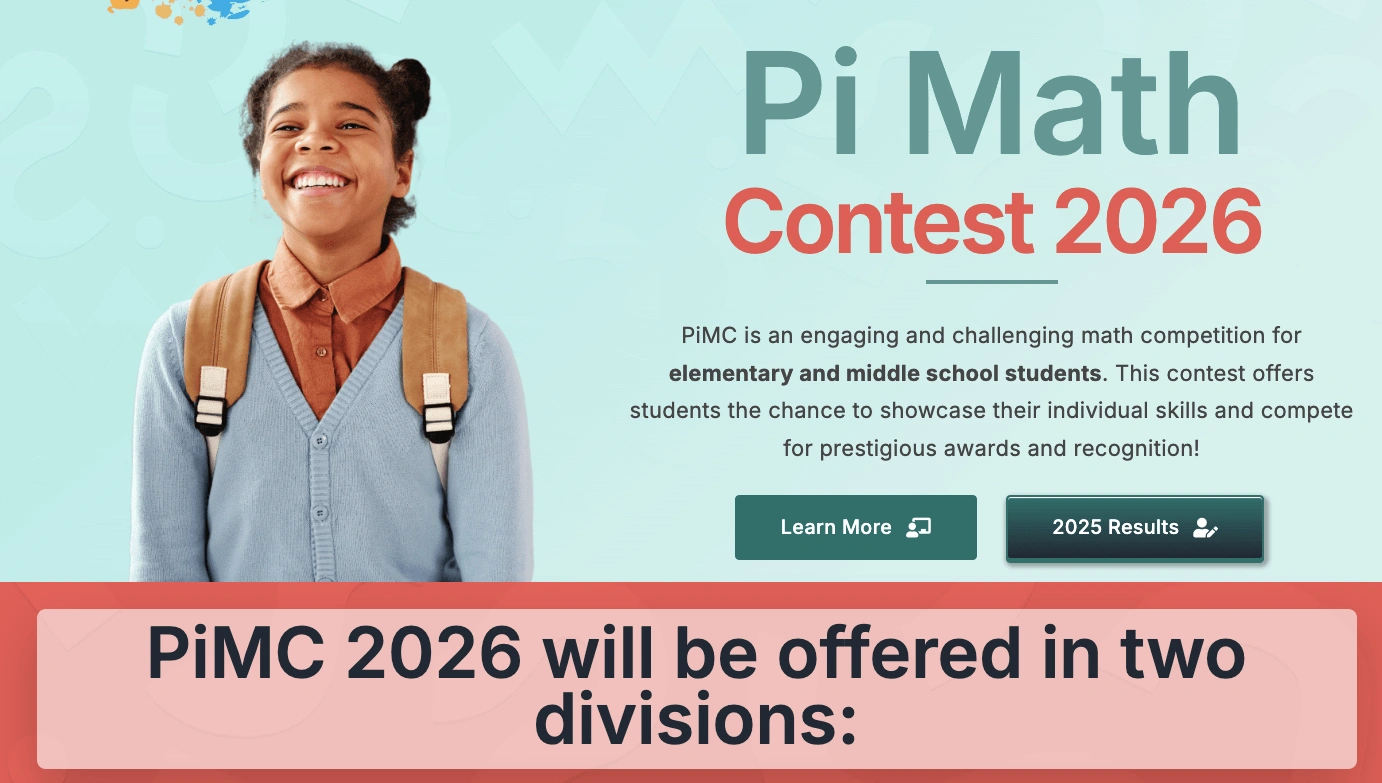
PiMC Math Contest is an annual online tournament that covers grades 3–12, focusing on boosting reasoning skills and tackling creative problems. The emphasis on fun helps kids gain confidence before other competitions.
What the competition involves:
- Online format.
- Various sets of problems depending on the grade or level.
- Certificates for top performers.
Registration timeline:
As the PiMC contest takes place in the middle of March, the registration closes around February.
SIGMA Math Competition
Who can participate: middle schoolers (grades 6-9)
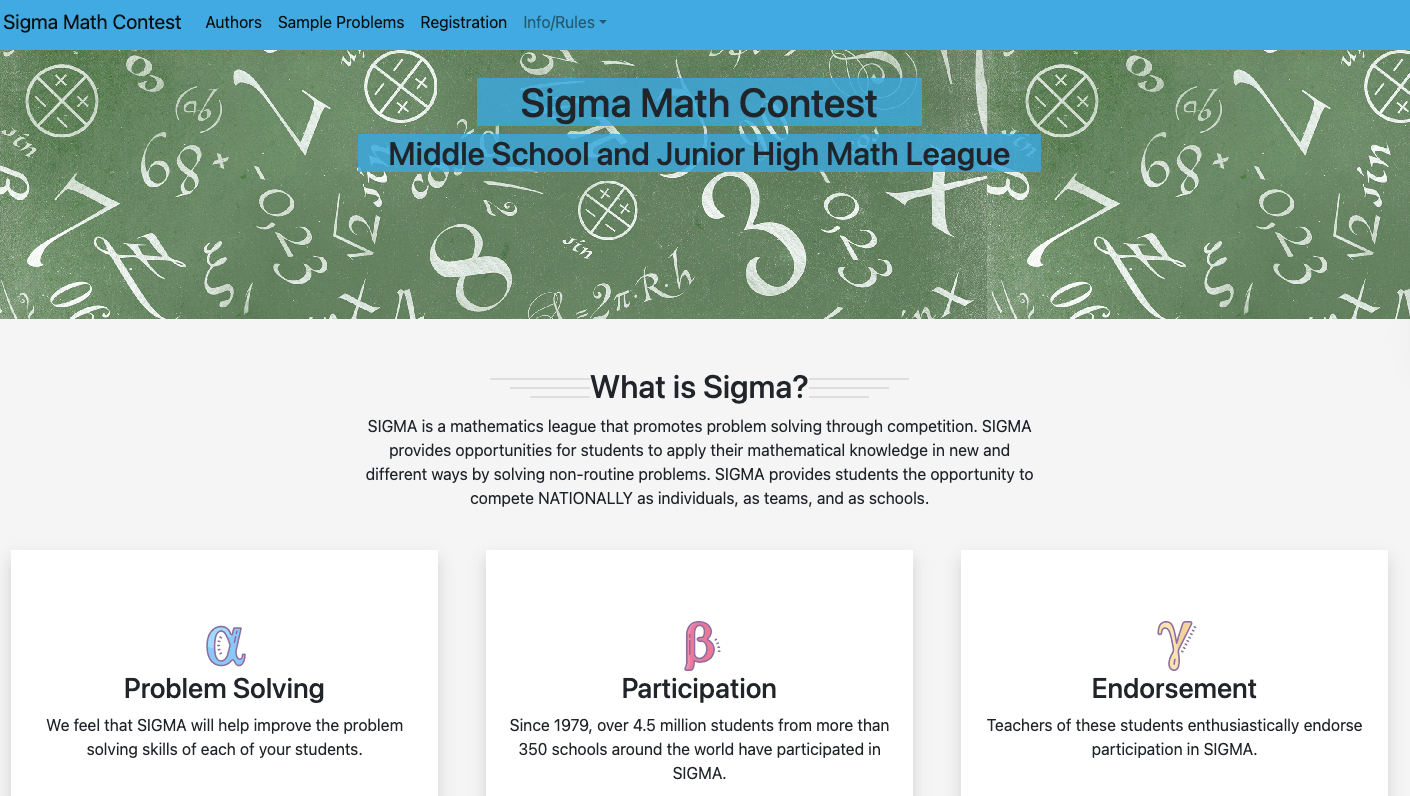
SIGMA (Sigma Math Competition) is a math league offering flexible contests for schools and individuals. It aims to develop problem-solving skills and offer unique and challenging questions.
What the competition involves:
- Separate contests for different grades.
- 8 questions and a 30-minute session.
- School division.
- National awards and pins.
Registration timeline:
SIGMA requires a membership fee; once you send a form, you can take part in contests. They take place in October (1st week), December (1st week), January (2nd week), February (last week), and April (1st week).
USA Mathematical Talent Search (USAMTS)
Who can participate: middle and high school students
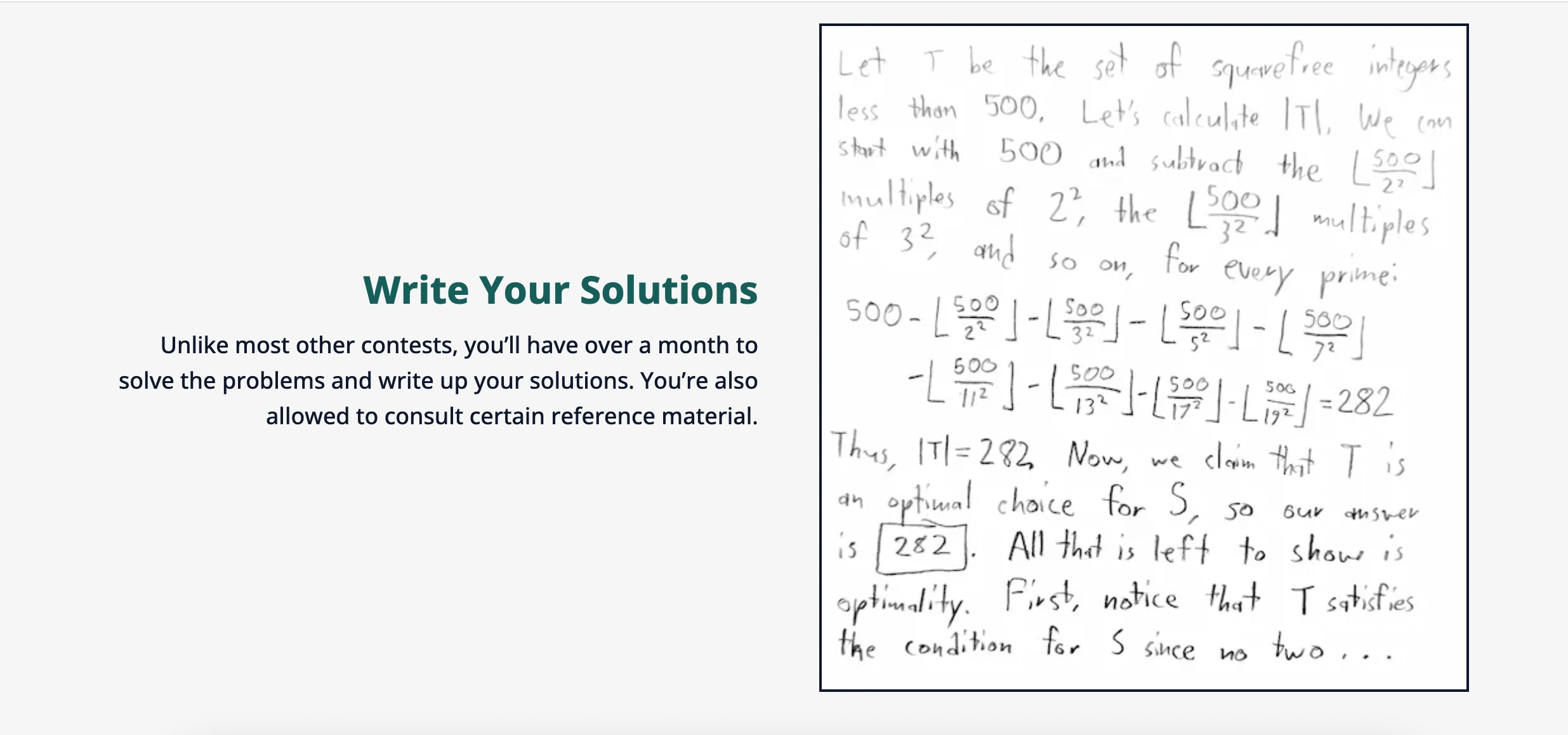
USAMTS is a unique math competition different from others due to its proof-based approach. It requires students to solve five challenging problems in a full month. USAMTS aims to develop and recognize deep mathematical thinking.
What the competition involves:
- 5 deep math problems per round (1 puzzle and 4 proof-based)
- Written solution from students.
- 3 rounds throughout the year.
- AIME qualifications if the student has high scores.
Registration timeline:
Students can register via the website; they need registration to submit a solution to the current problems. The USAMTS team holds the test throughout the fall and winter.
IMC-IMPEA
Who can participate: students from grades 6-12

The International Mathematical Competition by The International Mathematics Prodigy Education Association (IMPEA) is an online math competition focusing on improving test-taking and developing habits.
What the competition involves:
- Team test (15 questions and 100 minutes).
- Team Modeling Contest is 6 or 8 hours.
- Grade-level division.
- International rankings.
Registration timeline:
You should fill out the form. The IMC math tests take place in September and April.
TEAMS: Tests of Engineering Aptitude, Mathematics, and Science
Who can participate: middle school and high school students
TEAMS, organized by the Technology Student Association (TSA), is a niche national math competition that combines math and engineering problem-solving. This contest focuses on STEM subjects and the application of math in the real world.
What the competition involves:
- Solution building for an engineering challenge.
- Multiple choice test.
- Essay writing.
- Mathematical modeling.
Registration timeline:
The registration opens in August and closes in January, as the state competition will take place in January and February in 2027, and the Best-in-Nation competition is set for June 23 – June 27, 2027. Teams should register on the TSA website and pay for registration.
M3 Challenge: MathWorks Math Modeling Challenge
Who can participate: high school juniors and seniors
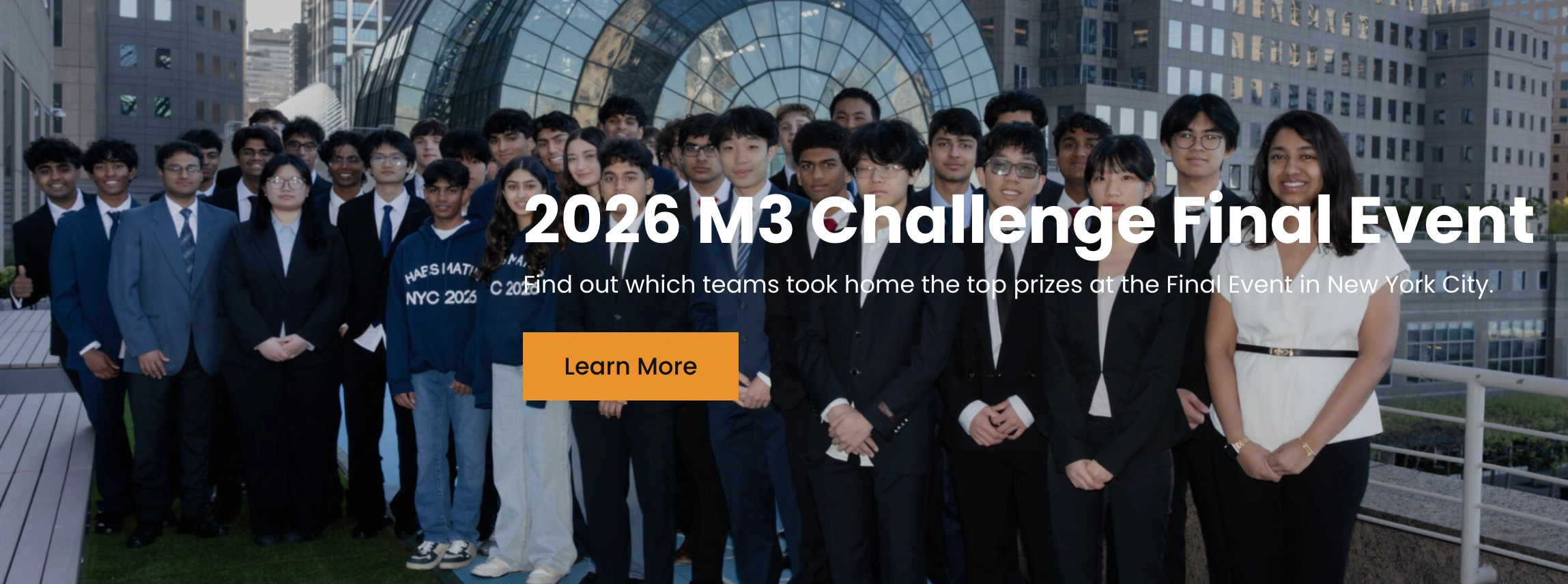
M3 Challenge is a free annual high school math competitions that offer $100,000 in scholarships. Within this contest, teams should find solutions and build a model to solve a real-world problem.
What the competition involves:
- 14-hour window to complete the challenge.
- Exciting real-world problem.
- Judges who evaluate models and reports.
Registration timeline:
Opens in January and usually lasts until late February, as the contest starts at the end of February or early in March.
Trig Star
Who can participate: high schoolers
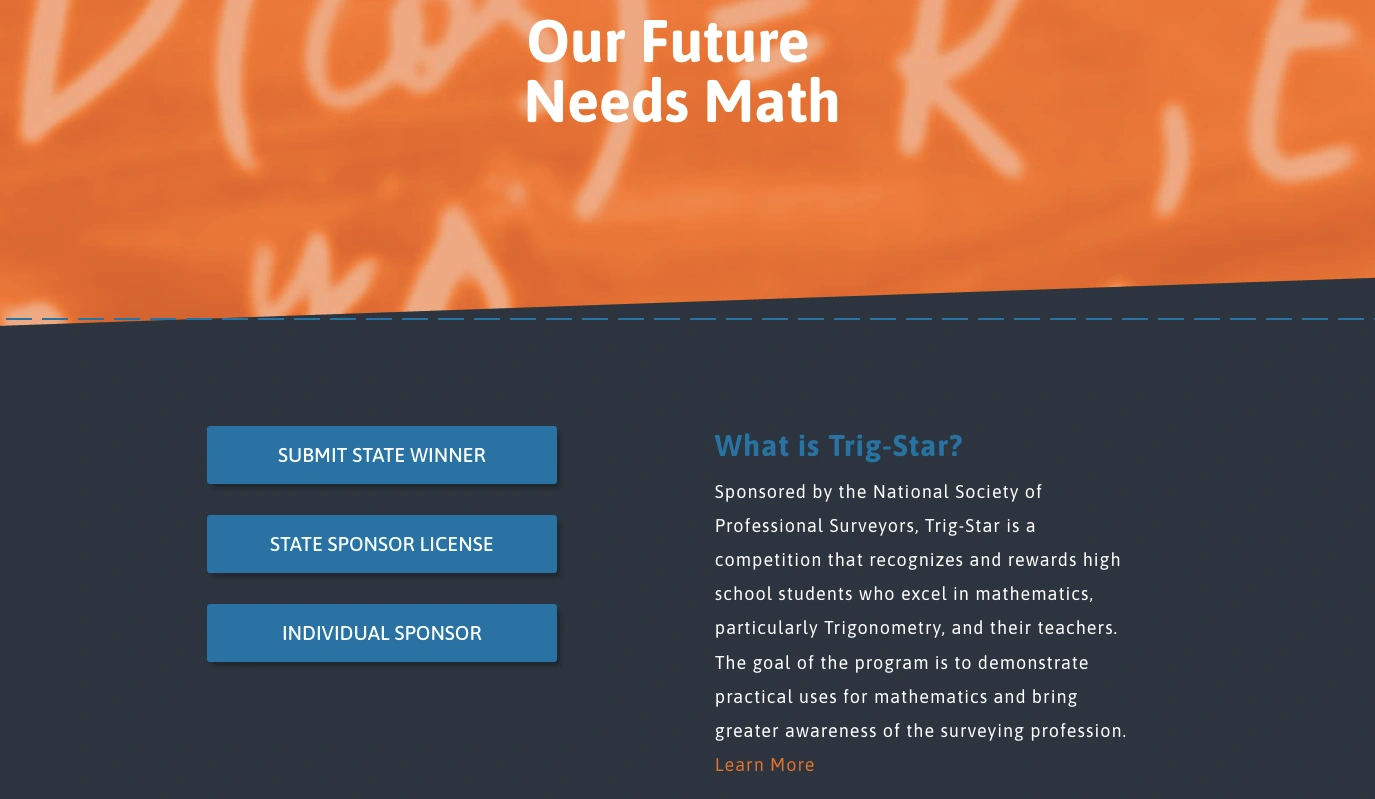
Trig Star is an exciting national competition organized by the Society of Professional Surveyors. The organization holds it every year and tests participants’ trigonometry skills via survey problems.
What the competition involves:
- Focus on trigonometry.
- School, state, and national levels.
- Cash and scholarships as rewards.
Registration timeline:
Check your state chapter’s site, as the deadlines are set independently by each state surveying society, with the national testing for state winners usually set for May.
American Scholastic Mathematics Association (ASMA)
Who can participate: Junior, intermediate, and senior high school students
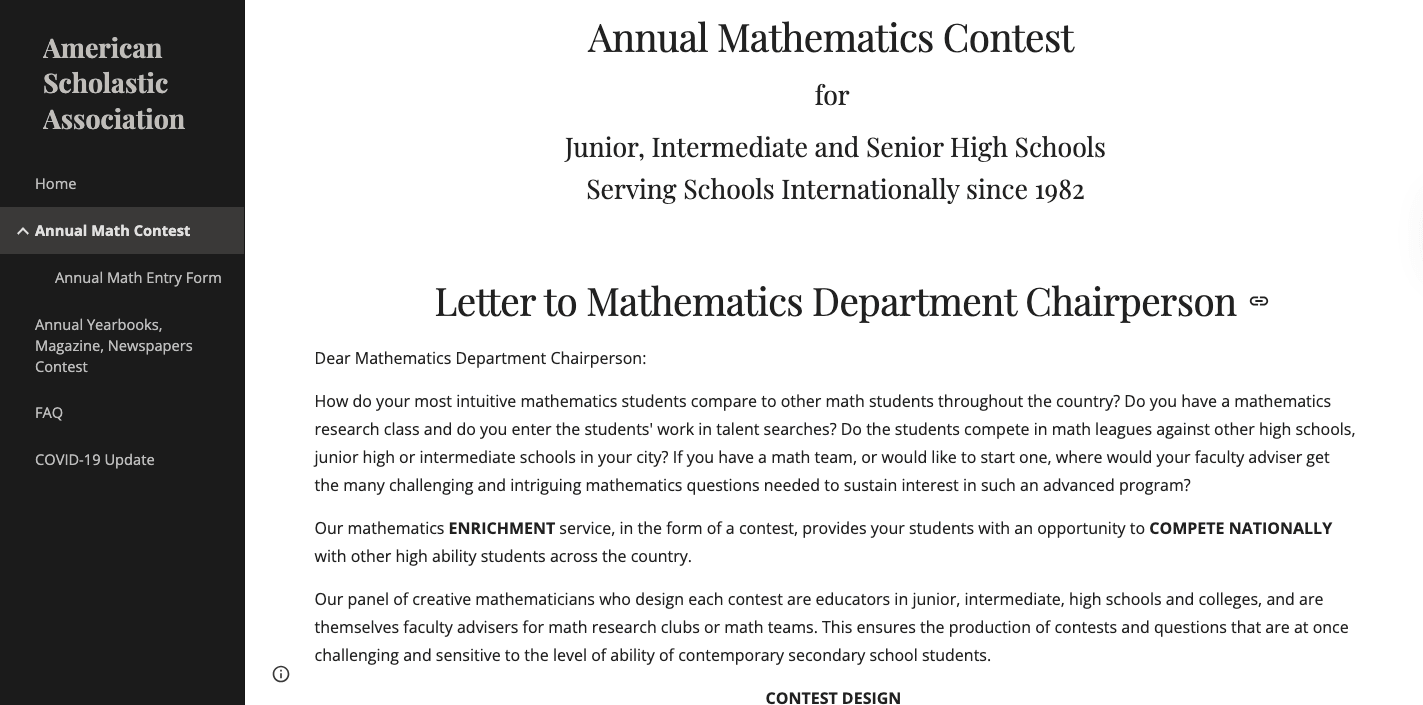
The American Scholastic Mathematics Association math contest is an annual international competition to sharpen the math skills of students. You can look at this contest as more of an achievement experience and extra-curricular enrichment.
What the competition involves:
- Six sets of questions for each month
- Each set has 7 questions
- Award certificates
Registration timeline:
The deadline for registration for schools is in mid-October; students take part on behalf of schools. As for the 2025-2026 competition, over 80 schools from 24 countries competed.
Modeling the Future Challenge
Who can participate: high school students

The Modeling the Future Challenge is a contest, sponsored by actuarial associations, that offers a real-world challenge for students to try their math skills. It combines modeling, data analysis, and risk management.
What the competition involves:
- Modeling, writing a report, and presenting via video.
- Connecting math to insurance, finance, and public policy.
- $60,000 worth of scholarship prizes.
Registration timeline:
Registration opens every fall, and usually closes in November. Students submit scenarios in December, projects and reports in February and March. The 2026-2027 registration opens August 24 and closes November 8, 2026, with the Scenario Phase Workshop planned October 7, 2026, and a more detailed timeline expected to be finalized in late September.
Note: As the 2022 research by Petar Kenderov suggests, such project-based competitions can help identify learners with an inclination towards research.
SCUDEM: SIMIODE Challenge Using Differential Equations Modeling
Who can participate: high school and undergraduate students
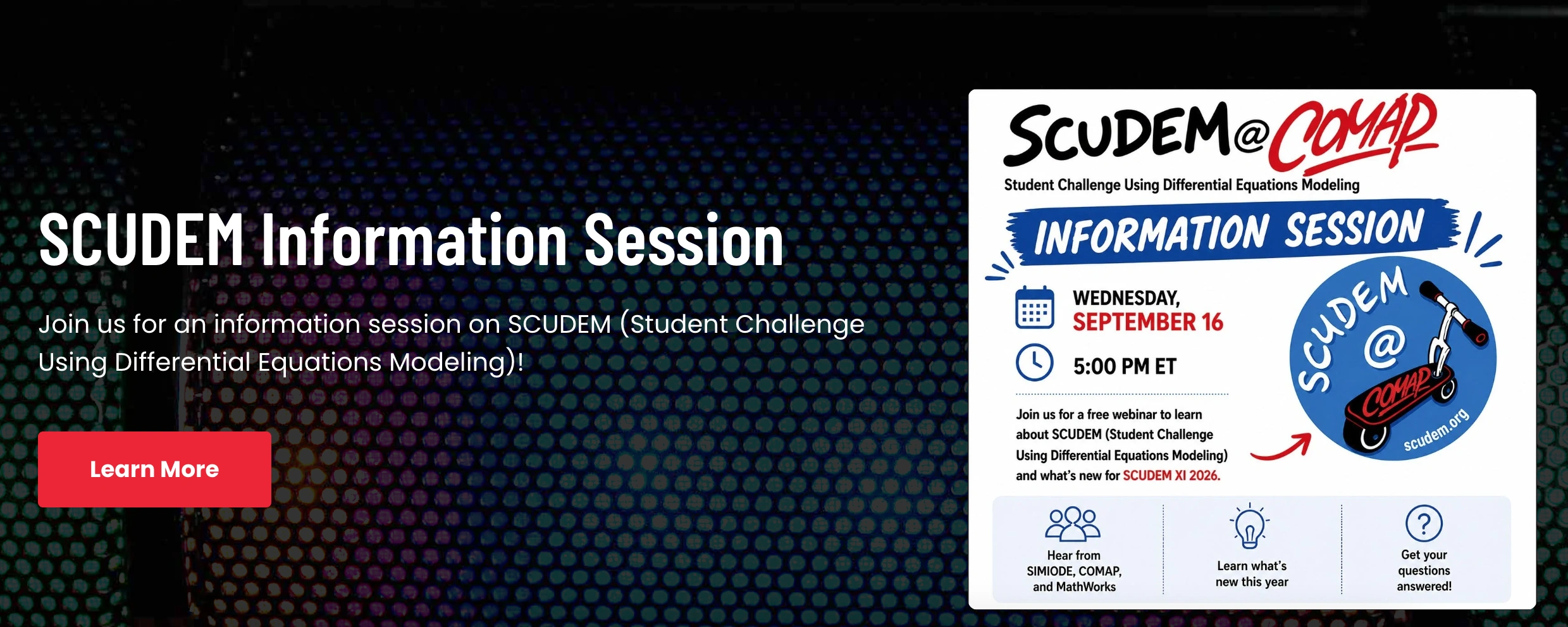
SCUDEM is one of the advanced challenges for high school and college students aimed at solving real-world problems via differential equations. It can be great for students who seek STEM modeling experience.
What the competition involves:
- 3-student teams.
- Three-week window.
- Different categories include physics, chemistry, engineering, and social sciences.
- Video presentation of a solution.
Registration timeline:
The registration costs $33 per student; as SIMIODE organizes it each fall (October-November), the registration is open until October through the COMAP website.
AMC10/12
Who can participate: high school students in 10-12 grades
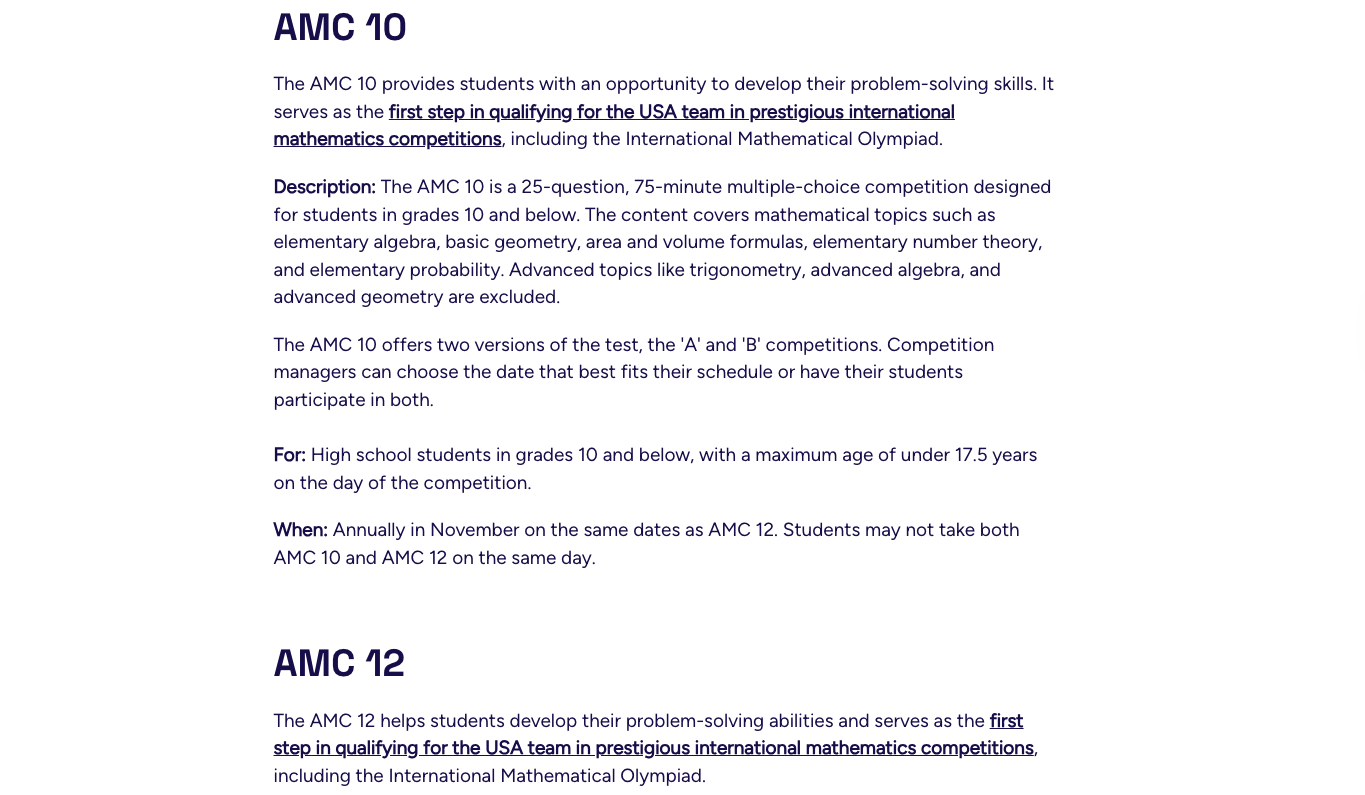
The AMC10/12 competition is an analog of AMC8, representing online math competitions for high school students. In the case of AMC, students from the US and over 30 other countries find solutions to multi-step mathematical problems as per their understanding.
What the competition involves:
- 25 questions (multiple-choice type).
- 75 minutes for a test.
- Using no calculators.
Registration timeline:
For AMC 10/12, early bird registration closes on 30th September, costing $55. The competition dates are 5 and 13 November.
IYMC: International Youth Math Challenge
Who can participate: high school students

The International Youth Math Challenge is an online competition for students worldwide, offering a math learning experience via experimental problem-solving tasks. The final round offers real-world tasks.
What the competition involves:
- Qualification round with 5 problems.
- 60-minute pre-final round with 2 basic, 2 advanced, and 1 research problems.
- 20-minute final round with 20 multiple-choice questions.
Registration timeline:
The Qualification Round deadline is September 27, 2026. This competition round is free, but the age-specific thresholds in points are set. The winners can take part in the Pre-Final Round for 15 euros in November 2026.
Perennial Math
Who can participate: for students in 3-8 grades

Perennial Math offers different types of math completion and tournaments, online and offline. The flexible approach makes it an accessible option for homeschool groups and tournament beginners.
What the competition involves:
- Online competition has 2 seasons, with 4 tests per season and 6 questions per test.
- On-site tournament upon demand from schools.
- Live online tournaments available on demand.
Registration timeline:
For the online math competitions, students pay from $15 for individual participation and up to $100 as a team. Students take tests during the November-February (Season 1) and January-April (Season 2) sessions.
Stanford Math Tournament (SMT)
Who can participate: high school students
The Stanford Math Tournament is a competition that takes place at Stanford University and is led by students. It invites high school teams to Stanford and brings in campus experience, together with math testing.
What the competition involves:
- Team and individual participation.
- The general test.
- Three types of rounds: Team, Guts, and Power (collaborative, timed, and proof-based).
Registration timeline:
Both offline and online competitions take place in April. Registration for the on-campus tournament is open from December to February, and March is for approval by teams. Registration costs from $25 rto $35, based on registration date (as of August 2026).
How to Prepare for a Math Competition
- Start preparation 3-6 months before the competition.
- Try a test sample or a diagnostic math test to identify the gaps.
- Identify and master specific math concepts to solve problems.
- Practice with past problems from the competitions you target.
- Simulate the conditions set by the contest.
- Join a club, group, or community to prepare for the contest.
- Develop a plan for the prep and review mistakes regularly.
Note: Brighterly provides math worksheets to target practice concepts or skills, depending on grade. They are great for practicing alongside official papers. Simultaneously, our math program offers structured support and tutors who help customize preparation to the specific needs and review certain types of problems
Here’s what Juliana Perez, the math expert teacher at BASIS Independent Manhattan Upper School, says about reviewing past math problems:
“To succeed, students should approach math contests like sports competitions.”
The preparation involves working through practice tests, solving past exams, and participating in math clubs. These activities build problem-solving skills, familiarity with contest formats, and confidence under timed conditions.
Like in sports, the key is to train regularly and develop a strong mindset for challenges.


And here are some tips shared by Stefanie LaPierre, the professional math tutor at BASIS Independent Manhattan Lower School:
“Many math competitions offer preparation tools on their website. For example:”
Noetic encourages students to participate in Challenge Math Online, their problem-solving practice program.
In last year’s Noetic Learning Math Contest, my grade 5 students won the Team Achievement Award, meaning they scored in the top 10% of the country as a class. Seeing everyone so excited and proud of themselves was such a special moment.

Conclusion
For elementary or senior students, participating in math competitions offers undeniable benefits. It’s how kids start learning math in a more sociable and engaging way.
If you’re looking for one for your kid, pick an appropriate one from the above list. And remember: whenever your kid needs thorough preparation, Brighterly is the free math competition that offers 1:1 math tutoring. Book free lesson now and get ready for any competition!
Frequently Asked Questions
What Is the Most Prestigious Math Competition for K–12 Students?
The Olympiad seems to be the most prestigious math contest for K-12 students. The International Mathematical Olympiad is one of them, if talking about global prestige. For the US audience, the AMC, Harvard-MIT, and Math Prize For Girls are among the most prestigious.
Are Math Competitions Free to Enter?
Yes, some of them are, requiring no registration fees. Among great free competitions are USAMTS, Purple Comet! Math Meet, M3 Challenge, and Brighterly Scholarship Contest, a competition that asks for no income documentation and offers 6 months of free 1:1 math tutoring in addition to a $500 cash prize.
How Do I Prepare My Child for a Math Competition?
To prepare your child for a math competition, you should focus on practicing, reviewing past math problems, memorizing the standards, and learning to manage exam time. Preparation should start beforehand to prevent a kid from cramming and focus on consistency.
What Grade Should My Child Start Competing in Math?
Children can start competing in math from an early age, for instance, in the 1st or 2nd grade. With such engaging contests like Math Kangaroo and the documentation-free Brighterly Math Scholarship for elementary school students, it’s possible. However, the better time is during the 4-6 grades. During this time, contests such as AMC8 can be interesting for your kid.
Do Math Competitions Help With College Admissions?
Yes, math competitions can help with college admissions for STEM majors or scientific careers. The reason is that work as a proof intellectual initiative, academic excellence, and passion for math. Some contests, like the Math Prize for Girls, allow high school students to have higher chances for admission.



Parents who decide to support their child’s learning at home have a wide range of methods to choose from. If you’re thinking about homeschooling, you might as well wonder what unschooling and deschooling are. This article will explore homeschooling, deschooling and unschooling as three pillars of home education and how they can benefit your kid. […]
Jun 30, 2022

Have you ever experienced a situation where kids get so nervous about a math topic they keep sweating or making excuses to leave the classroom? Math can be challenging for kids, especially without the help and guidance of an understanding adult. The school learning system has advanced from settling for conventional classroom learning to adopting […]

Jun 30, 2022
Math & reading from 1st to 12th grade
Looking for homework support for your child?

Choose kid's grade

Math & Reading for Grades 1–12
Build real confidence for your child with a Brighterly math or reading tutor.