Shapes for Kids (With Pictures, Examples & Fun Activities)
reviewed by Jessica Kaminski
Updated on April 26, 2026
Teaching children shapes and opening the world of geometry to them can be challenging, but if done right, it can be exciting and rewarding at the same time. If you are looking to find the descriptions, activity ideas, and real-world examples of shapes for kids, this guide is for you.
Key Points
- Teaching basic shapes preschoolers should know helps them make their first step into geometry
- Activities like shape scavenger hunt, shape collages, and tangrams ensure that your kid not only remembers shape names, but realizes that shapes are an ever-present part of our environment.
- With sensory and tactile games, you can help develop your kid’s understanding of geometry, spatial reasoning, and critical thinking skills in a fun and hands-on way.
Basic Shapes for Kids
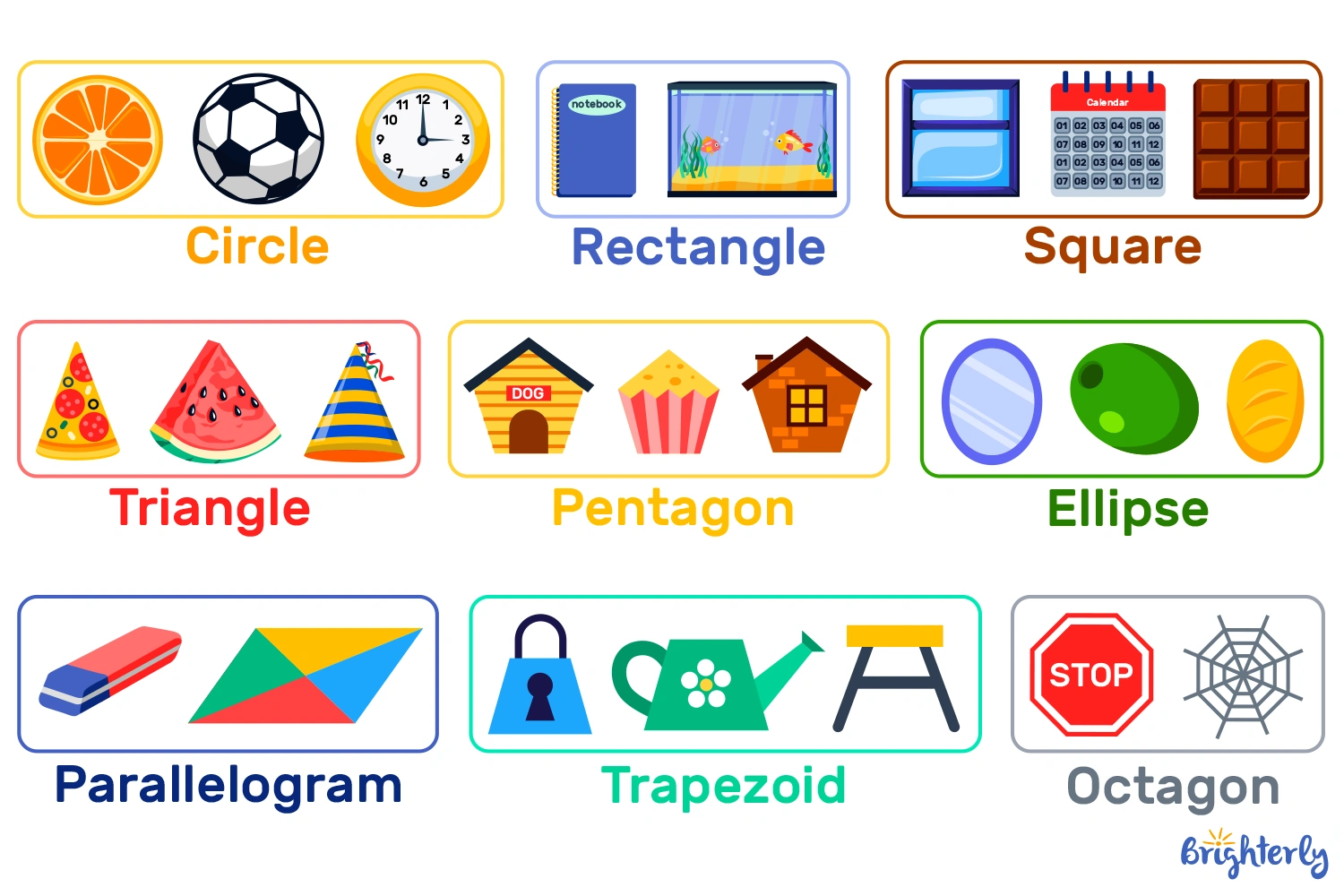
- Circle – A circle is a basic round shape with a central point, which is equally removed from any point of the outer line of the circle.
- Example: A bicycle wheel, a wall clock, a steering wheel
- Square – A square is a four-sided shape with four equal sides and 4 right angles
- Example: A post-it note
- Triangle – A triangle is a shape that consists of three edges and three vertices, with interior angles that always sum to 180°.
- Example: A well-cut slice of pizza
- Rectangle – A rectangle is a four-sided shape with four right angles, where the pairs of opposite sides have equal lengths.
- Example: A sheet of paper, a door, a writing table
- Ellipse – Ellipse is an oval-like shape (but not an oval!) that looks like a stretched circle.
- Example: The orbits of planets, the head of a tennis racket
- Pentagon – Pentagon is a five-sided polygon, where all sides and angles can be equal (regular) or unequal (irregular).
- Example: A home plate on a baseball field, a birdhouse
- Parallelogram – A parallelogram is a four-sided geometric shape where both pairs of opposite sides are parallel and equal in length, and the sum of adjacent angles is equal to 180°.
- Example: Erasers
- Trapezoid – A trapezoid is a quadrilateral with at least one pair of parallel sides; it resembles a triangle with its head cut off.
- Example: A shape of a gold bar, a popcorn bucket
- Kite – A four-sided shape with two pairs of equal-length sides that are adjacent to each other.
- Example: A traditional kite kids play with
- Octagon – A polygon with eight sides and eight interior angles, which sum to 1080°.
- Example: A standard STOP sign on the street
Explore Brighterly Learning Experience
Learn exactly how Brighterly helps students thrive through expert sessions, online tools, and proven feedback from thousands of satisfied parents
Shapes Around Us
The best way to teach shapes to preschoolers is to help them learn that they are already surrounded by shapes and geometry. By helping your child to notice hidden shapes in the world around them, you will help them to transition from thinking of shapes as something abstract to more concrete and practical. Let’s see what some of the more common shapes are around you in your daily life.
| Where | What |
| In the kitchen |
– A circular pancake – A rectangular cereal box – A square slice of cheese – An ellipse-shaped spoon |
| On the road |
– An octagon STOP sign – A triangle YIELD sign – Rectangular semi-truck trailers |
| In nature |
– A honeycomb’s hexagons – The triangular peaks of mountains – The circular center of a sunflower |
| At the playground |
– The rectangular slats of a bench – The trapezoid-shaped steps on a ladder |
| Around the house |
– A rectangular television screen – A square window pane – Circular coasters on a coffee table |
Note: Brighterly’s tutors go beyond basic shape recognition by building conceptual understanding through structured, interactive lessons. Instead of memorizing definitions, children learn how shapes relate to real-world objects, how they transform, and how they connect to broader math skills like spatial reasoning and problem-solving.
Fun Shapes Activities for Kids
- Shape Scavenger Hunt
- Playdough shapes
- Shape art & collages
- Shape matching
- Shape-shifting with tangrams
- Mystery bag guessing game
Shape Scavenger Hunt
The shape scavenger hunt is a perfect active learning game to help your kids learn shapes. You can also use it as a warm-up. Give your child a list of shapes (start with basic shapes for kids, like circle, triangle, and square, and gradually increase the number), and ask them to find three or five real-world examples around the house or in the park.
The learning goal is to help children realize that geometry is everywhere around them.
Playdough Shapes
Playdough shapes are an excellent way not only teaching shapes to preschoolers, but also to help them develop fine motor skills and have fun along the way. The activity is simple: buy some colorful playdough for your kid, and encourage them to make various shapes. For a bit more challenge, they can also make figures using the shapes they have created, e.g., a triangle body, circular head, and long rectangular legs make a pretty cute character. You can also play with them and make small competitions; the only limit here is your creativity.
Need personalized math help from a teacher?
Brighterly’s tutors offer 1:1 individualized learning paths for each child. 

Shape Art & Collages
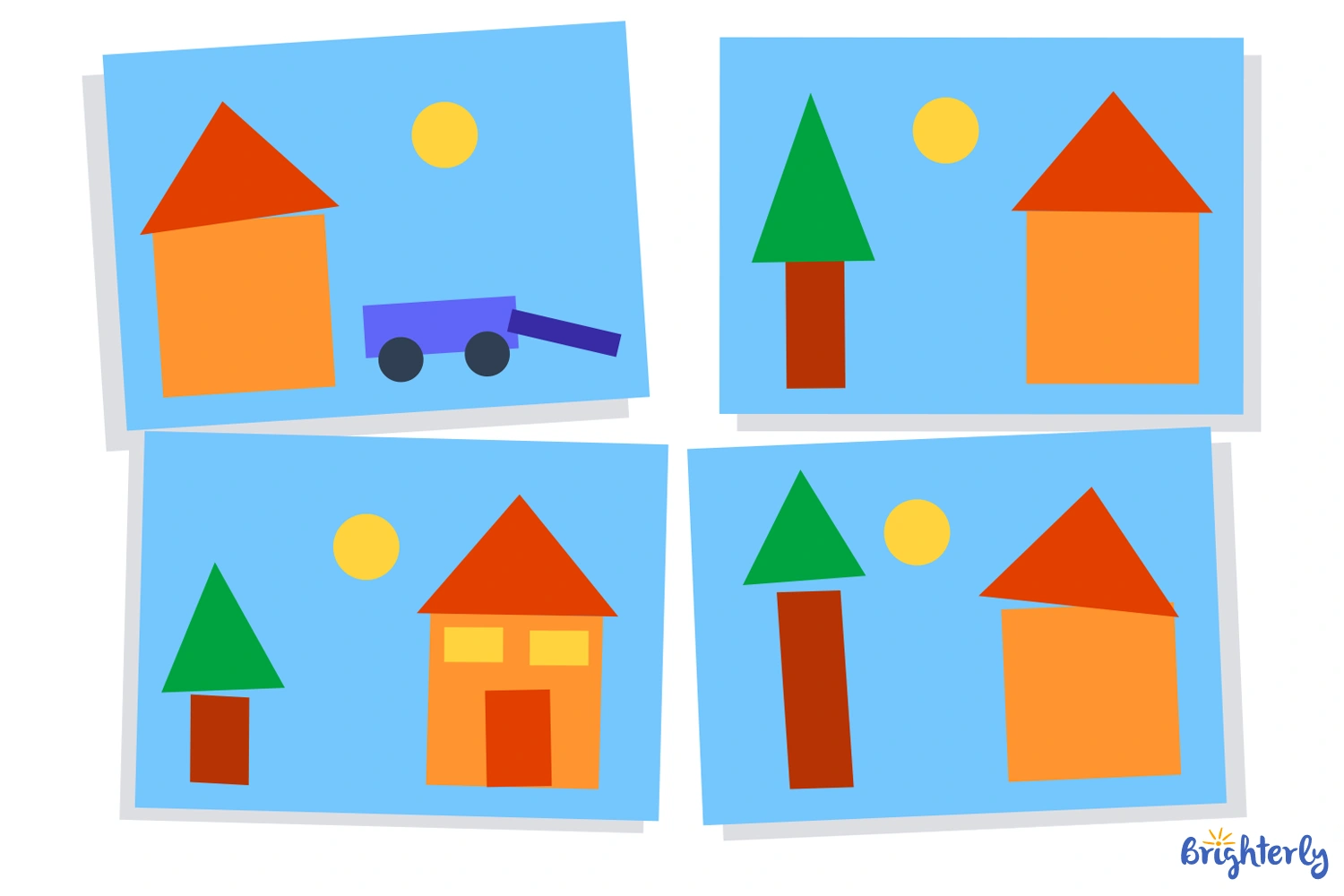
If your child loves to draw, this activity is for them. Start by giving your child a blank piece of paper or a canvas, colorful pencils, and rulers. Additionally, you can print out posters with colorful shapes. Ask your child to cut out and use the printed shapes and draw shapes themselves to create a piece of art that consists only of shapes. They can overlap circles to create clouds and use kits to draw a skyline.
Using shapes to make collages is an interesting activity because it helps your kid to mix geometry and creative expression. Math and geometry are creative and abstract in their nature, so this connection they make will come in handy during later math studies too.
Shape Matching
Shape matching is a very versatile way to teach shapes to preschoolers. Depending on your child’s age, you can choose various iterations of shape matching.
- For younger kids, you can give them toy shapes and ask them to match the toys to object images and group them.
- If your child is a bit more experienced, you can draw silhouettes of household objects in certain shapes, like a table or a clock, and then match each silhouette with a shape card or a cutout.
- In the case of more advanced students, you can use attribute cards instead of shadows. For example, your kid needs to match the card that reads a “shape with four equal sides and right angles” with a square.
Shape-Shifting With Tangrams
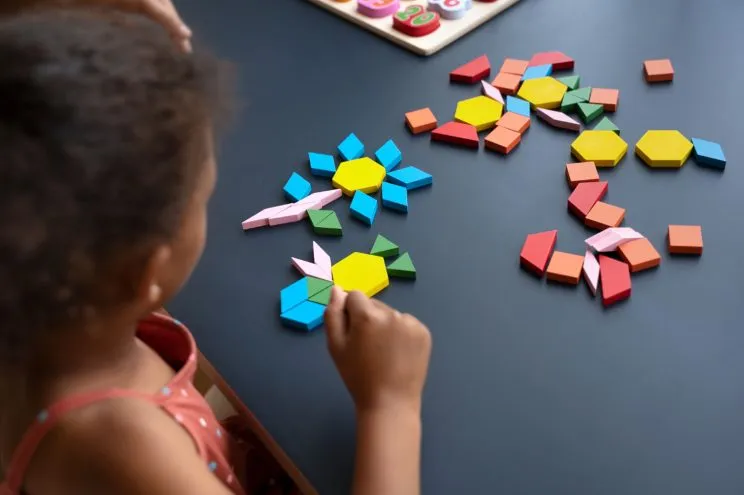
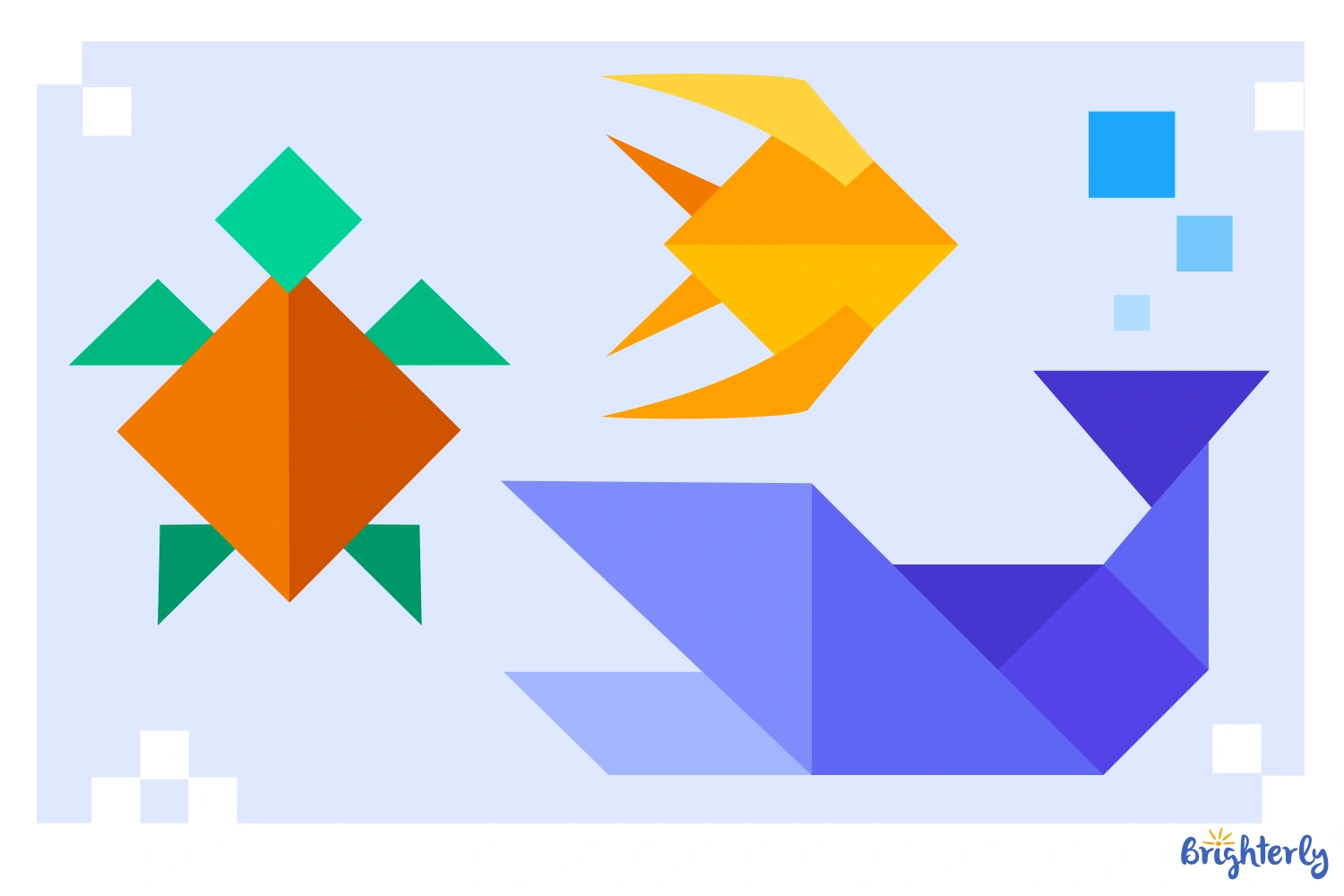
Tangram is an ancient Chinese shape puzzle. The puzzle consists of seven flat shapes of different colors that form a square, and children can use them to create specific figures, such as animals. As your kid breaks apart a figure they created to make a new one, they start to develop an early understanding of spatial transformation. Children learn that they can break down shapes and combine shapes to form other shapes.
Mystery Bag Guessing Game
The mystery bag guessing game is more of a sensory game and will make your child use their tactile understanding of preschool basic shapes. As the name of the game suggests, you need to fill a non-transparent bag with shapes. These can be shape toys or cardboard cutouts. Your child then grabs a shape in the bag and tries to figure out what the shape is using only their hand. Ask them to describe how many sides and vertices the shape has. They then take out the shape, and you check together if they got it right.
Learn reading the fun way with private tutors.
Try structured reading support through personalized 1:1 classes with Brighterly teachers.
Shapes PDF Activities for Teaching Shapes
- Shapes Worksheets For Kindergarten
- 3D Shapes Worksheets
- 3D Shape Worksheets Kindergarten
- 2D And 3D Shapes Worksheets
- Shape Tracing Worksheets
- Shapes Worksheets Preschool
- Shapes Worksheets
With these free worksheets, you allow your kids to explore shapes through a variety of fun activities without getting bored. A bonus point is that as they trace and color the shapes, they will also develop their fine motor skills.
Learn Shapes With Videos
Videos are a great way to teach preschool basic shapes to children as geometry is very visual, and seeing how shapes are formed and how they move can help your child understand this area of math on a deeper level.
Tips for Parents on Teaching Shapes
- Turn your routine errands into a spot-the-shape game. Ask your kid to find three cylinders in the canned goods section of a supermarket or identify 5 triangles as they are cleaning their room.
- Use the snack time as a teaching moment when you are having a busy day. Cut sandwiches into triangles or cheese into small squares to make learning delicious, and ask your kid to say out loud the shapes as they eat.
- Focus on attributes when possible. Instead of always asking them to simply name the shape, ask them questions like “How many vertices does a triangle have?”
- Keep it low pressure. Your kid should think of this as a process of exploration instead of a test they are being graded on.
- Enlist professional help when you feel your child needs more help. These online math classes for kids can make the learning process more structured and detailed whenever your child struggles with a specific concept.
Note: Teaching the basic shapes for preschool to kids in kindergarten and elementary grades doesn’t have to feel like a formal lesson. In fact, according to 2022 research published in the International Online Journal of Primary Education, children often remember math concepts they learned better when they can relate them to the real world. For a more in-depth explanation of shapes, make sure to check this guide on geometrical shapes.
Conclusion
Figuring out what shapes should a preschooler know and teaching it to them might not be the easiest task at first. However, with a positive and playful approach, repetition, and making learning part of your daily routine, you can transform simple activities into an exciting math adventure.
And if you are looking for a more structured approach and professional help with geometry, Brighterly’s certified tutors are here to help. Book a free lesson and start learning immediately.
FAQ
Why Shapes Are Important for Kids?
Shapes are everywhere, both in the math class and the outside world. The basic shapes preschool kids learn will help them identify and analyze visual information. These shapes are the foundation for more complex skills like reading comprehension, as they need to recognize letters, learn geometry, and navigate their environment safely, among other things.
What are Vertices in Shapes for Kids?
Vertices are the math term for corners. When your kid is just learning shapes, make sure to explain to them that the vertices are simply the pointy parts where the lines meet and form an angle.
How to Draw 3d Shapes for Kids?
You always need to start with a 2D base. For a cube, draw two overlapping squares and connect the corners with diagonal lines. For a cylinder, draw two ovals and connect them with two straight vertical lines. The logic is the same for almost all shapes: you draw two overlapping shapes and connect them.
How to Integrate Shapes into Everyday Life?
Shapes already exist in everyday life, so you don’t need to integrate them. Instead, you need to start noticing them. One way to do it is simply narrating your day. Mention the rectangular envelope, the circular lid of the peanut butter jar, and the triangular slice of pizza. Encourage your preschool kid to do the same.



If your kid hasn’t figured out a working long division method, learning math together can turn into a minefield. But don’t worry, with this handy how-to guide, you’ll explore how to teach long division and help your child overcome the most common long division problems. Key points While in some countries, long division problems are […]

Jun 05, 2024

If your child is approaching the sophomore year of high school, you’re probably wondering, “What do 10th graders learn in math?” After teaching math for 10 years, I’m here to answer your question and help you prepare your child and yourself effectively for math success. Key points In their sophomore year, high-school students study Algebra […]

Jun 15, 2024
Math & reading from 1st to 12th grade
Looking for homework support for your child?

Choose kid's grade

Math & Reading for Grades 1–12
Build real confidence for your child with a Brighterly math or reading tutor.