Expanded Form With Decimals – Definition with Examples
Updated on November 3, 2025
Here at Brighterly, we’re dedicated to supporting you with your math education via helpful articles on a range of math concepts.
Today, we’re going to focus on expanded form with decimals. Expanded form involves separating the digits in a number out into their place values, and can be applied to numbers with decimal places too. Using expanded form has many uses in math, from building number sense and an understanding of the base-10 system to simplifying math equations.
Here, we’ll cover the expanded form math definition, its properties and conversions. We’ll also answer some common questions we get about expanded form with decimals.
Let’s get into it!
What is the expanded form with decimals?
The expanded form of a decimal number is an expression where you’ve separated out each digit in a number to its place value. By breaking down this number, you end up with an expression representing the number.
For example, with the number 529.1, its expanded form with decimals would be 500 + 20 + 9 + 0.1. This is a form of number decomposition, as you’re breaking a number into its component parts.
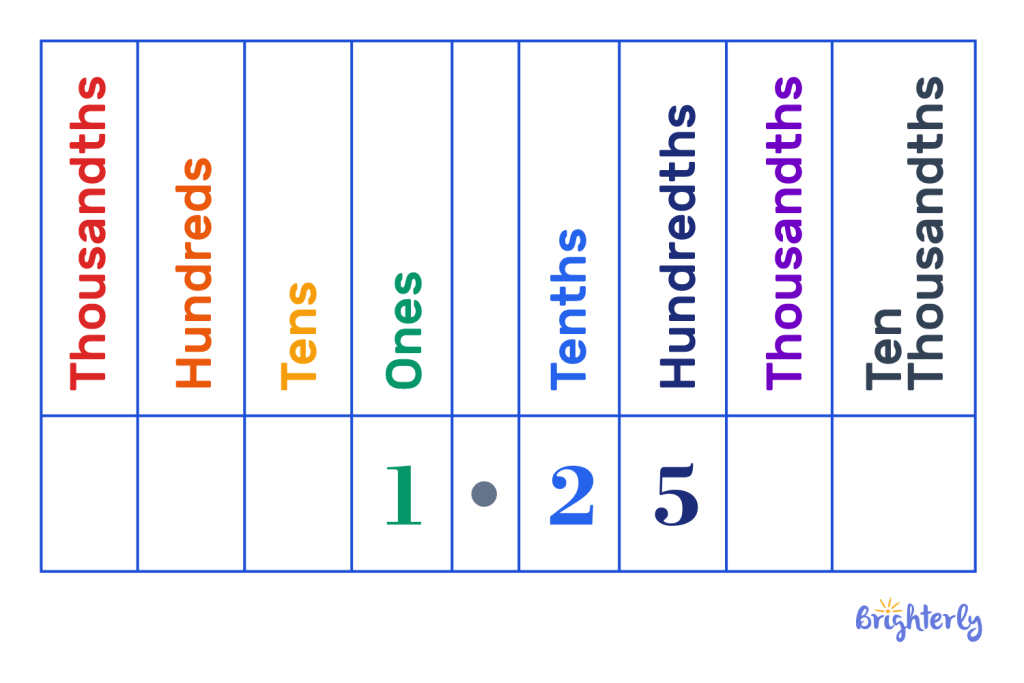
Definition of expanded form
The definition of expanded form is an equation that represents a number with its digits broken down into their place value. These place values can include thousands, hundreds, tens, ones and decimal places.
Properties of expanded form and decimals
There are some properties of expanded form and decimals that make them easier to learn and recognizable, and we’ll break down those properties below.
Properties of expanded form
- Expanded form with decimals is a form of number decomposition, which is breaking a number into its component parts. Expanded form in number decomposition represents the place value method of decomposition
- The commutative property is represented in expanded form with numbers. This property states that the order of numbers in an addition or multiplication expression can be changed, and the result will be the same
Properties of decimals
- Decimals are part of the base-10 system, meaning each digit in the place value increases by the power of 10
- The digits after the decimal place can be finite or infinite. This means they can either end with a specified number of decimals after the decimal place, or they can have an infinite number, making the decimal recurring
- Decimals turn integers (whole numbers) into non-integers (non-whole numbers)
- All decimal digits have a place value that decreases as we move from left to right after the decimal place


Difference between expanded form and decimal expanded form
Expanded form and decimal in expanded form follow the same rule of breaking a number down into its place value digits. However, with decimal expanded form, we are also breaking down the decimal places too.
An example of standard expanded form would be breaking 542 down into 500 + 40 + 2. However, if we had the number 542.817, we would break this down into the expanded form of decimals of 500 + 40 + 2 + 0.8 + 0.01 + 0.007.
Conversion of decimals to expanded form
To convert decimals to expanded form, aka write decimal in expanded form, you’d write out each digit in the form of its place value. For example, if we have the number 0.286, its expanded form would be 0.2 + 0.08 + 0.006.
Writing decimals in expanded form
Let’s use some more examples of writing decimals in expanded form so you can become familiar with how to do this. Here is how to write a decimal in expanded form:
When written in expanded form for decimals, the number 18.3082 would be 10 + 8 + 0.3 + 0.008 + 0.0002.
If we have the number 0.827, its expanded form would be 0.8 + 0.2 + 0.07.
Conversion of expanded form to decimals
If we have a number with decimals in its expanded form and we want to convert it to its decimal number, we would simply add all of the numbers in its expanded form up. For example, the expanded form of 0.9 + 0.01 + 0.003 is 0.913.
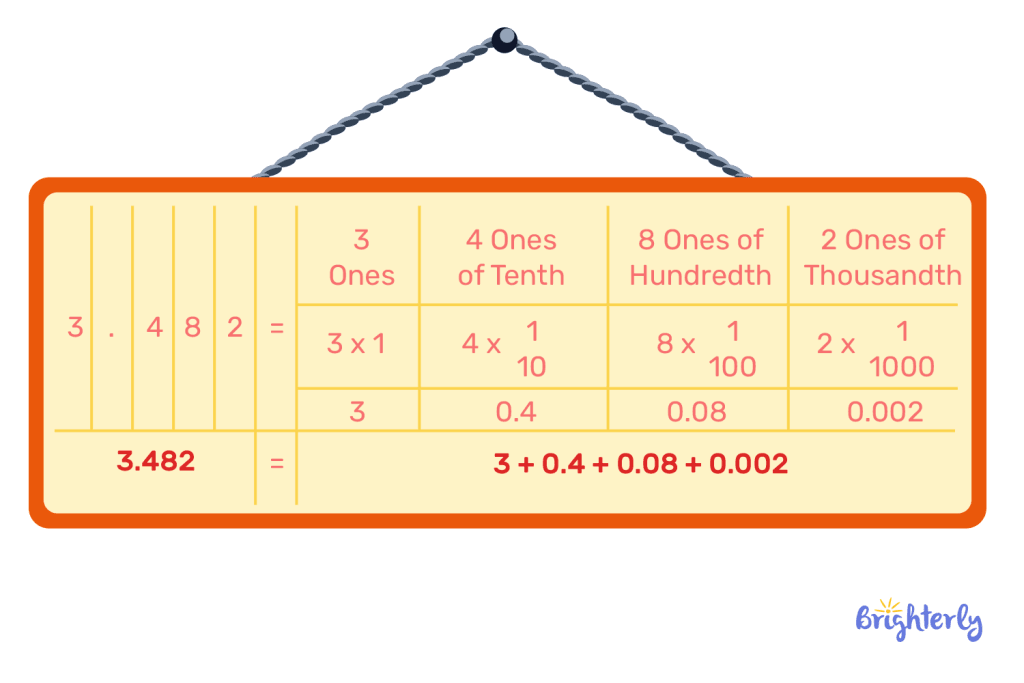
Writing expanded decimal form
When writing expanded decimal form as decimals, you simply reverse what you’d do to write decimals in their expanded form and you add up the individual place values.
For example, 0.2 + 0.04 + 0.008 becomes 0.248 when you write expanded form as its decimal number.
Want to learn more about writing decimals in their expanded form, or converting expanded form to decimals? Check out our 5th grade expanded form with decimals worksheets.
Conclusion
Here, we’ve covered the expanded form definition, how to write decimals in their expanded form and the properties of expanded form. Now, you can comfortably use expanded form with decimal numbers, and you can also convert decimals in their expanded form back into a decimal number!
Understanding decimals in expanded form supports a lot of other math skills, including number sense and working with non-integers. It will help you in your future math learning in areas like algebra and can make solving problems simpler through number decomposition.
Expanded form with decimals: Frequently asked questions
What is the purpose of writing numbers in expanded form?
There are many purposes of writing numbers in expanded form. One is making a math equation easier to solve; you can add two numbers together by adding each of their place values together before adding all numbers up. It also helps you understand place value and the base-10 system.
Is the decimal point included in the expanded form?
Yes, the decimal point is included in expanded notation with decimals. All numbers to the left will represent place values including ones, tens, hundreds and thousands, while numbers to the right represent tenths, hundredths and thousandths.
Can all decimals be converted to expanded form?
Yes, all decimals can be converted into their expanded forms. This includes both finite and recurring decimal numbers — although your expression will be never-ending if you convert a recurring decimal to its expanded form!
How to write decimals in expanded form?
To write decimals in expanded form, you would decompose your number into each digit’s place value and write them as an addition expression. For example, in the number 0.842, the 8 is in the tenths position, 4 is in the hundredth position and 2 is in the thousandth position. The expanded form becomes 0.8 + 0.04 + 0.002.
Is it easier to add and subtract numbers in decimal form or expanded form?
It can be easier to add and subtract complex numbers in expanded form. This is because you’re decomposing your number into smaller, more manageable parts. Take 23.81 + 42.69:
- 0.01 + 0.09 = 1
- 0.6 + 0.8 = 1.4
- 2 + 1 = 3
- 20 + 40 = 60
- Answer: 65.4


Math & reading from 1st to 9th grade
Looking for homework support for your child?

Choose kid's grade

Math & Reading for Grades 1–9
Build real confidence for your child with a Brighterly math or reading tutor.