Factors of 25 – Definition With Examples
Updated on November 29, 2025
At Brighterly, we strive to make learning more accessible by condensing concepts into simple explanations that young minds can understand. Each of the 25 factors contributes to a greater general interest and understanding of mathematics by shedding light on the relationships between numbers.
What are the factors of 25?
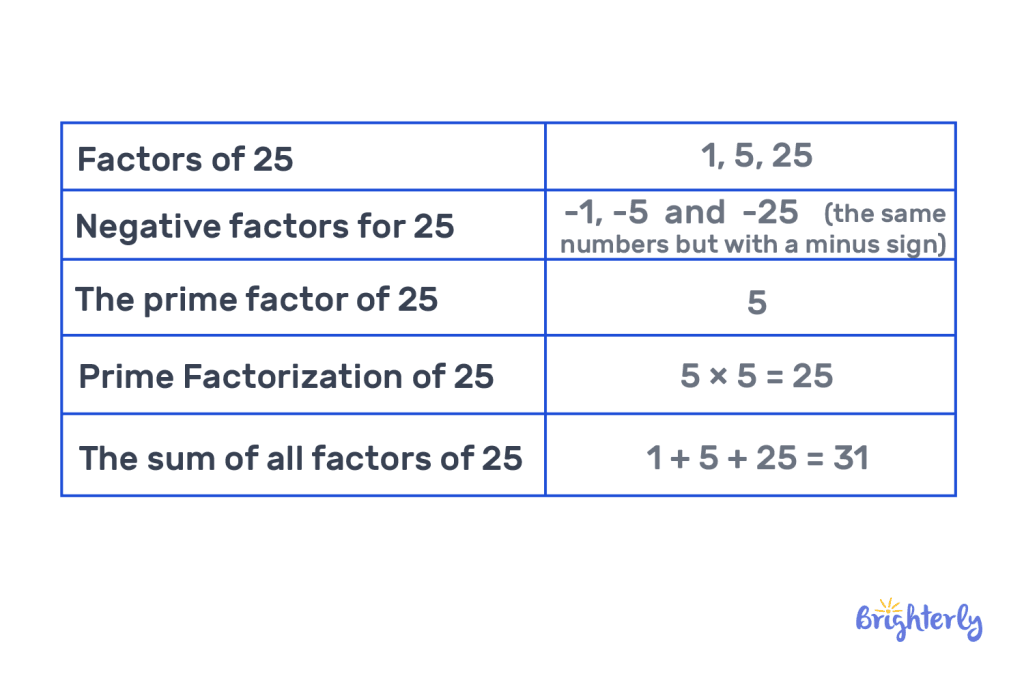
All the numbers that can be multiplied together to make 25 are called its factors. Since 25 is odd, it cannot be divided evenly by 2 or any other even number. The factors of this number don’t just include 1 and 25 — it also has another factor, 5, making it a composite number. So, all factors of 25 to list are 1, 5, and 25. Remembering these numbers helps us see how 25 is built and how it works in math.
Factors of 25: Explanation
The numbers that divide 25 evenly and leave no remainder are called the factors of 25. 1, 5, and 25 are the three possibilities to do so.
Properties of factors of 25
The factors of 25 have several properties, including the fact that all these numbers are odd and that the set of factors is finite.
Prime factors of 25
Prime factors are prime numbers in and of themselves and can be thought of as the “building blocks” of numbers. If a prime number is greater than one, it can only be divided equally by itself and one.
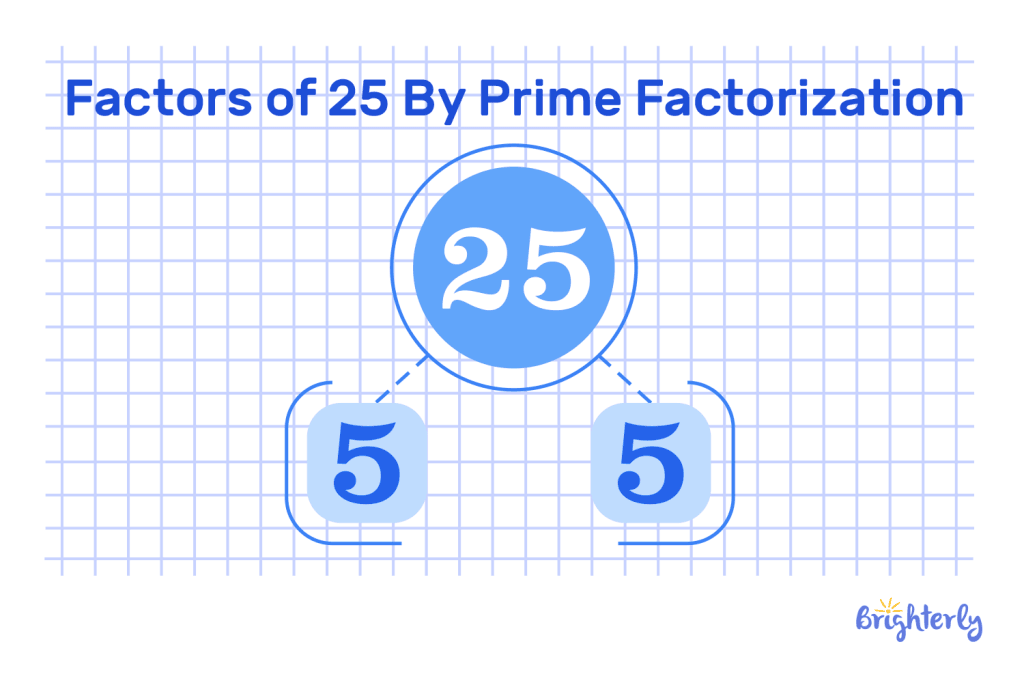
The only prime factors of 25 are the numbers 5. Why? Since 5 is a prime number, 5 multiplied by 5 equals 25. Similar to Lego bricks, these prime pieces can only be used to create 25 flawless pieces.
Composite factors of 25
Composite factors, on the other hand, are numbers that can be divided by numbers other than themselves or one. However, since factors 25 is only made up of factors 1 and 5, there are no composite factors other than 25. Thus, 25 is comparable to a small Lego set, as it requires only one type of brick to complete.
Factor pairs of 25
Each factor of 25 can also be examined in pairs, which are two numbers that add up to 25. (1, 25) and (5, 5) are the positive pair factors.
However, numbers can also be negative! 25 also has negative pair factors since multiplying two negative numbers yields a positive result:
(-5, -5) and (-1, -25)
Important details to keep in mind:
- Every factor 25 is odd because 25 is an odd number.
- A factor is never a fraction or a decimal.
Every factor of 25 pairs with its matching factor to make the number whole, so think of it like a matching puzzle!
Difference between composite and prime factors of 25
While some numbers can be divided into smaller ones, others cannot. Prime numbers are those that cannot be factored, and composite numbers are those that can.
It’s simple to see for 25. What is the factor of 25 that is impossible to deconstruct? Since five is a prime number, the answer is five. Consider it similar to building with blocks: the smallest block required to create 25 is 5, and it cannot be divided into smaller parts.
Examples of finding factors of 25
When we want to find the factors of 25, we look for numbers that can be multiplied together to make 25:
- 1 and 25: 1 × 25 = 25
- 5 and 5: 5 × 5 = 25
So, the factors of 25 are 1, 5, and 25.
Practice problems on finding factors of 25
1. How many factors does 25 have?
Hint: Remember that factors are numbers that can be multiplied together to get 25.
2. If you multiply 5 by itself, what number do you get?
Hint: Think about 5 × 5.
3. List all the positive factors of 25.
Hint: Start with 1 and 25, then see if there’s a number in between that multiplies to 25.
4. Besides 25 and 1, what is one factor of 25?
Hint: Look for the number that, when multiplied by itself, gives 25.
Conclusion
Exploring the factors of 25 shows how numbers fit together to form patterns. Looking at factor pairs like (1, 25) and (5, 5) makes it easy to see which numbers multiply to form 25. Even prime and negative factors help to complete the picture.
Frequently asked questions on factors of 25
What are factors of 25?
Factors of 25 are numbers you can multiply together to get 25. They fit perfectly into 25 without leaving anything leftover.
What are all the factors of 25?
All the factors of 25 are 1, 5, and 25. These numbers can be paired to multiply and make 25.
What is the prime factorization of 25?
The prime factorization of 25 shows which prime numbers make 25. For 25, it’s 5 × 5 because 5 is a prime number.
Are 10 and 2.5 factors of 25?
No, 10 and 2.5 are not factors of 25. Only whole numbers that multiply to 25, like 1, 5, and 25, are factors.
Why are 1 and 25 always listed as factors for the number 25?
1 and 25 are always factors because 1 × 25 = 25. Every number always has 1 and itself as factors.



Math & reading from 1st to 9th grade
Looking for homework support for your child?

Choose kid's grade

Math & Reading for Grades 1–9
Build real confidence for your child with a Brighterly math or reading tutor.