Rectangular Pyramid – Formula, Definition With Examples
Updated on December 2, 2025
In geometry, you’ll come across all types of 2D and 3D shapes, each with its own unique properties. One of these shapes is the rectangular pyramid. It’s a 3D shape with a rectangular base and triangular faces that meet at a common point.
Here, we’ll cover everything you need to know about the rectangular pyramid, including its definition, characteristics, different types of rectangular pyramids, and its formulas. We’ll also share rectangular pyramid real life examples, then we’ll give you some practice problems to try!
Definition of rectangular pyramid
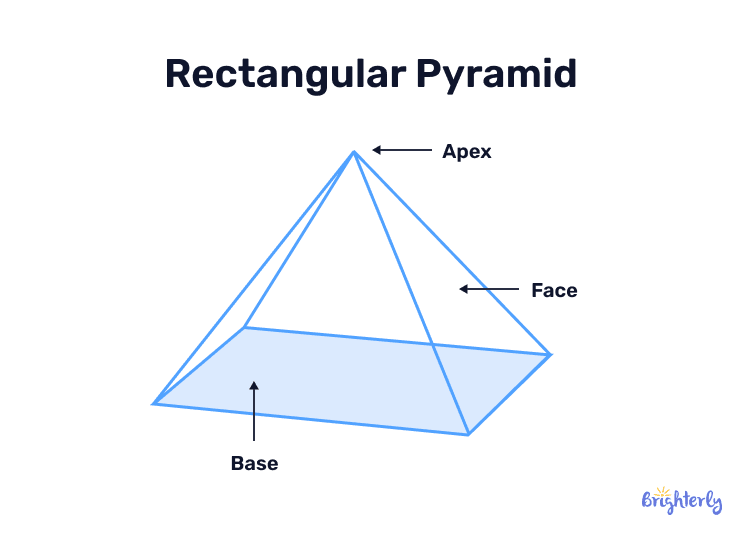
A rectangular pyramid is a 3D shape with a rectangular base and four triangular faces that meet at a common point (the apex). The rectangular pyramid net is a flattened 2D version of the rectangular pyramid with a rectangle and four triangles on each edge.
Characteristics of a rectangular pyramid
Now that we’ve covered what is a rectangular pyramid, let’s look at its characteristics:
- Such a shape has five faces — a rectangular base and four triangular faces
- Regarding the rectangular pyramid faces edges vertices, these shapes have eight edges where the faces meet and five vertices
- The edges of the base are perpendicular to the pyramid’s height
Types of rectangular pyramids
There are two different types of rectangular based pyramid: right rectangular pyramids and oblique rectangular pyramids. We’ll cover both types below.
Right rectangular pyramid
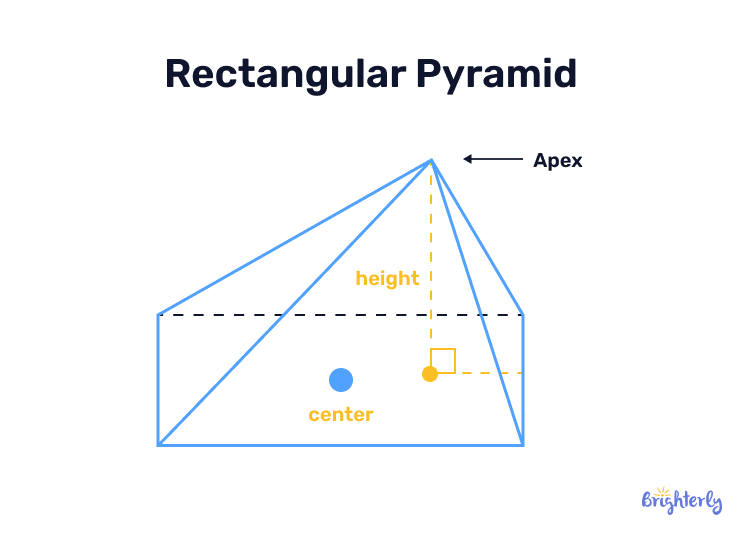
A right rectangular pyramid is defined by the fact that its apex sits directly above the center of the base. This makes the shape symmetrical, which in turn simplifies calculating its volume and surface area.
How do you find the height of a right rectangular pyramid?
To find the height of a right rectangular pyramid, you’d use the formula height = 3(volume) ÷ (length x width).
Oblique rectangular pyramid
In an oblique rectangular pyramid, the apex doesn’t sit directly above the center of the base, making it asymmetrical. This means calculating its properties can be a little more complex.
Rectangular pyramid formula
There are some simple formulas you can use to calculate the properties of a rectangular pyramid, including its volume, total surface area, and lateral surface area.
Volume of rectangular pyramid
To find the volume — aka the space inside the shape — you’d use this formula for rectangular pyramid:
Volume = (length x width x height) ÷ 3.
This is true of both right rectangular and oblique rectangular pyramids.
Let’s use an example. If you have a rectangular pyramid with a length of 3 cm, a width of 4 cm, and a height of 5 cm, your formula becomes (3 cm x 4 cm x 5 cm) ÷ 3 = 20 cm3.
Total surface area of rectangular pyramid
The total surface area is the area of the entire rectangular pyramid, which includes its base and triangular faces. You’d find this with the rectangular pyramid formula surface area:
Area = base area + lateral surface area.
Let’s use an example. If your base area is 15 in2 and your lateral surface area is 5 in2, your formula becomes 15in2 + 5in2 = 20in2
Lateral surface area of rectangular pyramid
The lateral surface area represents only the surface area of the four triangular faces of your rectangular pyramid. For this, you’d use the formula:
Lateral surface area = (P x s) x ½
For example, if the perimeter of your base is 6 m and your slant height is 3 m, your formula becomes (6 m x 3 m) x ½ = 9m2.


Applications of rectangular pyramids
There are lots of applications of the rectangular pyramid in real life! Here are just a few:
- Architecture: Some of the most well-known pyramid structures in history are found in Egypt, but they are not rectangular pyramids. The Pyramid of Djoser, for example, is a step pyramid with a square base, and later pyramids such as those at Giza also have square bases, making them square pyramids, not rectangular ones. So, if you’re wondering, “Is the Egyptian pyramid a rectangular pyramid?” — the answer is no. Egyptian pyramids are square pyramids, though their design has inspired many modern structures, including some rectangular-based pyramid forms.
- Roofs: Rectangular pyramids are often used specifically for roofs on buildings, thanks to their eye-catching shape and water-draining properties
- Tents: If you’ve ever been camping, you may have slept inside a rectangular pyramid tent!
- Packaging: Rectangular pyramids have often been used in packaging thanks to their stability and appealing design
Practice problems on a rectangular pyramid
Now that you know the fundamentals of the rectangular pyramid and have seen some rectangular pyramid examples, it’s time to try your hand at some practice problems related to this 3D shape! If it helps, you can use a pen and paper to work out your answers:
- You have a rectangular pyramid with a base length of 10 cm, a width of 8 cm, and a height of 12 cm. Work out its volume.
- You have a right rectangular pyramid with a base of 6 cm by 4 cm and a slant height of 5 cm. What is the total surface area?
- Describe the properties of an oblique rectangular pyramid with a base length of 15 cm and a base width of 10 cm.
FAQs on the rectangular pyramid
What is a rectangular pyramid?
A rectangular pyramid is a 3D shape with a rectangular base and four triangular faces that meet at a common point, known as the apex. There are two common types of this shape: the right rectangular pyramid and the oblique rectangular pyramid.
What makes a pyramid a ‘rectangular pyramid’?
The defining feature of a rectangular pyramid is its rectangular base. Other types of pyramids have bases of different shapes, including squares and triangles, but rectangular pyramids always have a rectangular base.
How many faces does a rectangular pyramid have?
There are 5 rectangular pyramid faces. The shape has a rectangular base and four triangular faces that connect to each edge of the base and meet at the apex, aka a common point.
Can a rectangular pyramid be symmetrical?
Yes, a rectangular pyramid can be symmetrical. We call this a right rectangular pyramid, and it’s defined by the fact that its four triangular faces meet in a common point above the base’s center. This is what makes it symmetrical. An asymmetrical rectangular pyramid is an oblique rectangular pyramid.
Why are rectangular pyramids important in geometry?
Rectangular pyramids are a fundamental 3D shape that helps children understand different types of 3D shapes and how they manifest. Children begin to understand spatial relationships and how these shapes compare and contrast with other 3D shapes.



Math & reading from 1st to 9th grade
Looking for homework support for your child?

Choose kid's grade

Math & Reading for Grades 1–9
Build real confidence for your child with a Brighterly math or reading tutor.