Adding Fractions with Like Denominators Worksheets
Updated on October 21, 2026
Adding fractions with like denominators worksheets help Grade 4 students practice adding fractions that already have the same denominator. Because the parts are the same size, students add the numerators while keeping the denominator unchanged.
For example, 2/7 + 3/7 = 5/7. Students can use these printable worksheets to practice the rule with proper fractions, improper fractions, and mixed numbers before moving on to more complex fraction addition.
Adding Fractions With the Same Denominator Worksheet: Examples
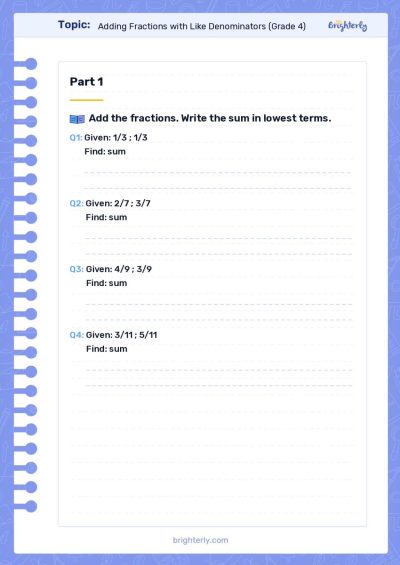
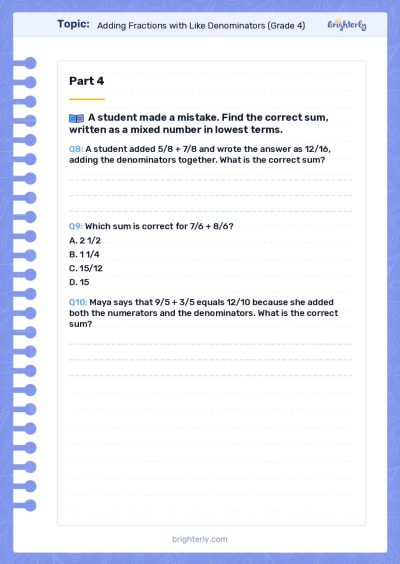
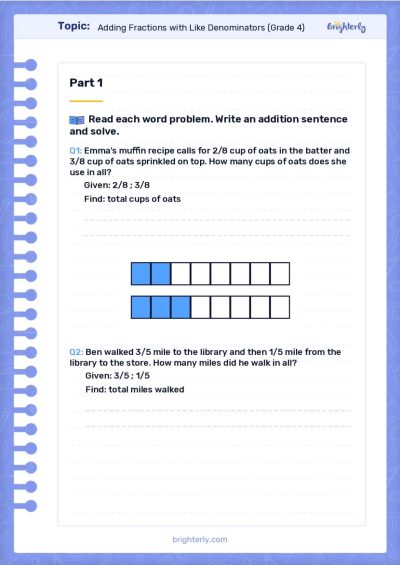
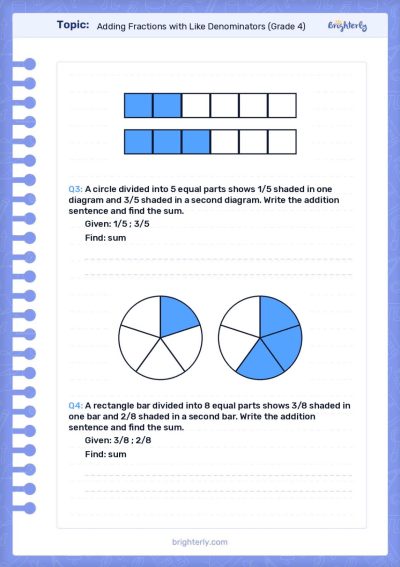
Brighterly’s worksheets give students repeated practice adding fractions with common denominators. The problems help children recognize which part of the fraction changes during addition and which part stays the same.
Students who need a refresher can review what the denominator represents before beginning the exercises.
Adding Fractions With Like Denominators Worksheet [Free Download]
Download Brighterly’s free addition of like fractions worksheets for Grade 4 practice at home or in class. The printable PDFs give students focused practice with fraction addition without requiring them to find a new common denominator first.
For broader Grade 4 fraction practice, including equivalent fractions, comparison, mixed numbers, and other fraction operations, use fraction worksheets for 4th grade.
If your child understands fraction models but still struggles with the calculations, a 4th grade math tutor can help connect visual fraction concepts with the rules used to add and simplify fractions.


Check how confidently your child works with fractions
A quick test can reveal which fraction skills need more practice
How to Add Fractions With Like Denominators
Fractions with like denominators already represent equal-sized parts. This makes addition relatively straightforward:
- Check that the denominators are the same.
- Add the numerators.
- Keep the denominator unchanged.
- Simplify the resulting fraction when possible.
For example:
2/9 + 4/9 = 6/9 = 2/3
The denominator remains 9 because the size of each fractional part has not changed. Only the number of ninths being counted increases.
Brighterly’s guide on how to add fractions explains why fractions need equal-sized parts before their numerators can be combined.
Adding Mixed Numbers With Like Denominators
Grade 4 students can also apply the same idea to mixed numbers when their fractional parts have the same denominator.
For example:
1 2/5 + 2 1/5 = 3 3/5
First add the whole numbers: 1 + 2 = 3. Then add the fractional parts: 2/5 + 1/5 = 3/5. The denominator stays 5, giving the final answer of 3 3/5.
Students who need to review how whole numbers and fractions work together can use Brighterly’s mixed numbers guide.
Skills Students Practice With Like Fraction Addition
- Adding proper fractions. Students begin with fractions whose numerators are smaller than their denominators. These exercises reinforce the basic rule of adding the numerators while leaving the common denominator unchanged.
- Working with visual fraction models. Pictures and fraction models can help students see why like fractions are easier to combine. When both fractions are divided into equal-sized parts, students can simply count how many of those parts there are altogether.
- Adding improper fractions. Some sums produce improper fractions in which the numerator is greater than or equal to the denominator. Students can practice recognizing these results and rewriting them when needed.
- Adding mixed numbers. Mixed-number problems help students combine whole-number addition with fraction addition. When the fractional denominators match, the same basic addition rule still applies.
- Simplifying fraction sums. After adding, students check whether the numerator and denominator share a common factor. For example, 4/8 can be simplified to 1/2.
- Mixed like-denominator practice. Mixed exercises require students to recognize different fraction forms while applying the same core rule. This helps reinforce the idea that a shared denominator represents equal-sized fractional parts.
Why Practice Adding Fractions With the Same Denominator?
Adding like fractions gives students a foundation for more advanced fraction operations. It lets them focus first on the meaning of fraction addition without also having to find equivalent fractions or a least common denominator.
This is an important Grade 4 skill. Brighterly’s 4th grade math skills checklist includes adding and subtracting fractions with the same denominator, including mixed numbers, among the fraction skills students work on at this level.
Visual practice can also help. Fractions on a number line worksheets show students where fractional values lie and can make the size of each fraction easier to understand.
Like vs Unlike Denominators
The main difference is whether the fractional parts are already the same size. With like denominators, students can add the numerators immediately:
2/5 + 1/5 = 3/5
With unlike denominators, students must first rewrite the fractions with a common denominator before adding. For example, 1/2 + 1/3 cannot be added directly because halves and thirds represent differently sized parts.
Once students are confident adding like fractions, they can progress to adding fractions with unlike denominators worksheets, which are designed for the next level of fraction addition practice.
Frequently Asked Questions
How Do You Add Fractions With Like Denominators?
To add fractions with like denominators, add the numerators and keep the denominator the same. For example, 2/7 + 3/7 = 5/7. If the resulting numerator and denominator share a common factor, simplify the fraction afterward.
What Grade Do Students Add Fractions With Like Denominators?
Students commonly practice adding fractions with like denominators in Grade 4. At this level, they work with proper fractions and mixed numbers that share a denominator before progressing to adding fractions with unlike denominators.
Why Does the Denominator Stay the Same When Adding Like Fractions?
The denominator stays the same because it represents the size of each fractional part. When the denominators match, the pieces are already the same size, so students only need to combine the number of pieces represented by the numerators.


Need help with Addition?

- Does your child need assistance with mastering addition fundamentals?
- Start learning with an online tutor.
Choose kid's grade

Is your child finding it challenging to grasp addition lessons? An online tutor could be the solution.
Book FREE lesson