Addition on a Number Line Worksheet
Updated on October 21, 2026
Addition on a number line worksheets help students in Grades 1–2 understand addition as forward movement along a sequence of numbers. Brighterly’s printable activities give children visual practice adding positive whole numbers within 20 while strengthening counting and basic addition skills.
A number line makes addition easier to see: students begin at the first addend and move to the right by the number of spaces shown by the second addend. For a refresher on how this visual tool works, see Brighterly’s number line guide.
Addition on a Number Line Worksheets PDF: Examples
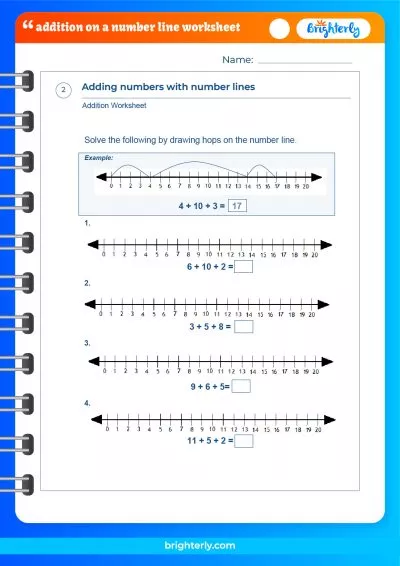
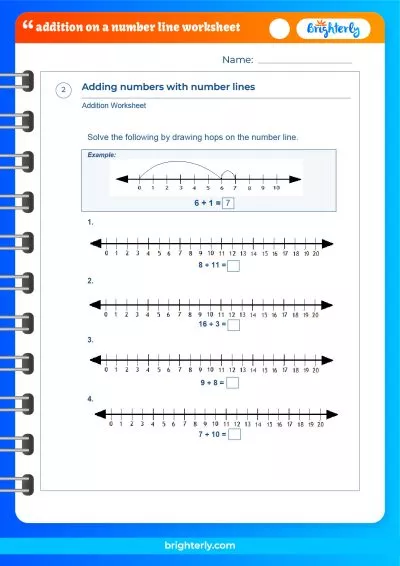
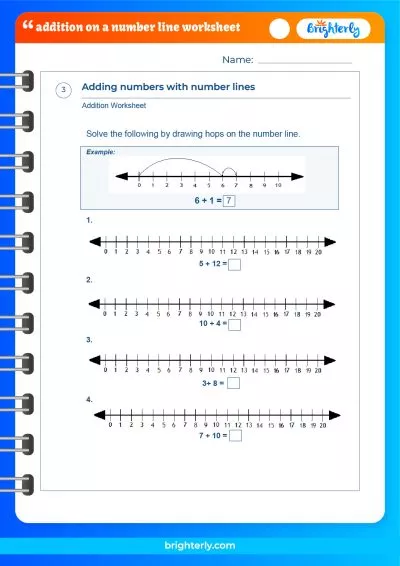
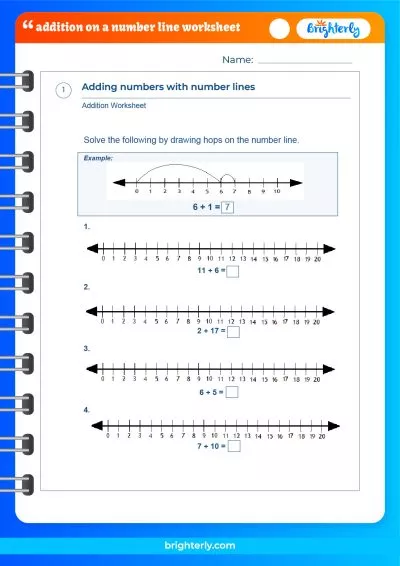


Brighterly’s worksheets use jumps along a number line to show how two numbers combine. Students can count each hop and identify the number where they land.
For example, to solve 6 + 3, start at 6 and move three spaces to the right:
6 → 7 → 8 → 9
So:
6 + 3 = 9
If your child needs more support, our 1st and 2nd grade tutors will help.


See how confidently early addition adds up
A quick quiz can reveal which early math skills need more practice
Addition on a Number Line Worksheets [Download for Free]
Download Brighterly’s free addition on a number line worksheets for Grades 1–2. The printable PDFs focus on positive whole-number addition within 20 and include answer keys for checking completed work.
How to Add on a Number Line
Adding on a number line involves three simple steps:
- Find the first number in the addition problem.
- Move to the right by the number of spaces represented by the second addend.
- The number where you stop is the sum.
For example:
4 + 5
Start at 4 and make five jumps to the right:
5, 6, 7, 8, 9
The answer is 9.
Brighterly’s guide on how to teach addition also recommends number lines as a visual way to show children how values increase during addition.
Why Do We Move Right When Adding on a Number Line?
Numbers become greater as you move from left to right on a standard number line. Adding a positive number increases the starting value, so each addition jump moves to the right.
This visual movement helps students connect the addition symbol with the idea of increasing a quantity rather than simply memorizing number facts.
Number Line Addition Within 20
These worksheets focus on early addition with positive numbers and sums within 20. This range allows students to practice number relationships visually while developing fluency with basic addition facts.
Children who need more direct equation practice can pair these activities with single digit addition worksheets.
Addition vs Subtraction on a Number Line
For basic positive-number problems, addition and subtraction usually move in opposite directions. Addition means moving to the right, while subtraction means moving to the left.
For example:
5 + 3: start at 5 and move 3 spaces right.
8 − 3: start at 8 and move 3 spaces left.
Students ready to practice the opposite operation can use number line subtraction worksheets.
Benefits of Number Line Addition Practice
- Make the addition visual. A number line gives students a concrete representation of addition. Instead of seeing only symbols such as 6 + 3, they can watch the value increase with each jump.
- Strengthen counting skills. Students practice counting forward accurately while connecting each count with movement between consecutive numbers.
- Build addition fact fluency. Repeated number-line practice helps children become familiar with basic sums before they begin solving the same facts mentally.
- Connect addition and subtraction. Using the same number-line model for both operations helps students understand that addition and subtraction are related processes.
- Prepare for more advanced number lines. Once children understand positive whole numbers on a number line, they can later extend the model to fractions, decimals, and integers.
Negative-number addition is a separate, more advanced skill covered in Brighterly’s 7th grade adding integers worksheets.
Frequently Asked Questions
How Do You Add Numbers on a Number Line?
Start at the first addend and move to the right by the number of spaces shown by the second addend. The number where you stop is the sum. For example, for 6 + 3, start at 6 and move three spaces right to reach 9.
What Grades Are Addition on a Number Line Worksheets For?
These addition on a number line worksheets are designed mainly for Grades 1–2. They focus on positive whole-number addition within 20 and help students move from counting to visual addition strategies.
Do These Addition on a Number Line Worksheets Include Answers?
Yes. Brighterly’s addition on a number line worksheets include answer keys so students, parents, and teachers can check completed problems and identify addition skills that may need more practice.


Problems with Addition?

- Does your child have difficulty with the basics of addition?
- Try studying with an online tutor.
Choose kid's grade

Is your child having a hard time with addition? Start learning with an online tutor.
Book FREE lesson