
Properties of Exponents Worksheets
Updated on August 31, 2026
Properties of exponents are also called rules of exponents and, in some cases, laws of exponents. These rules work with specific formulas that are used to solve problems. Kids must remember these rules, learn how they work, and master them.
Here are some of the properties of exponents and their formulas for easy recognition:
- Zero exponent rule (a⁰ = 1)
- Identity exponent rule: a1 = a
- Product rule: am × an = am+n
- Quotient rule (aᵐ / aⁿ = aᵐ⁻ⁿ)
- Negative exponent rule (a⁻ᵐ = 1/aᵐ)
- Power of a power rule: (am)n = amn
- Power of a product rule: (ab)m = ambm
- Power of a quotient rule ((a/b)ᵐ = aᵐ/bᵐ)
- Fractional exponents rule (a^(1/n) = ⁿ√a)
Properties of exponents worksheets: Examples
The exponents’ properties worksheet can help kids learn about the properties of exponents. But, more importantly, these tools can help them understand the properties, one after the other, and apply them in relevant math equations.
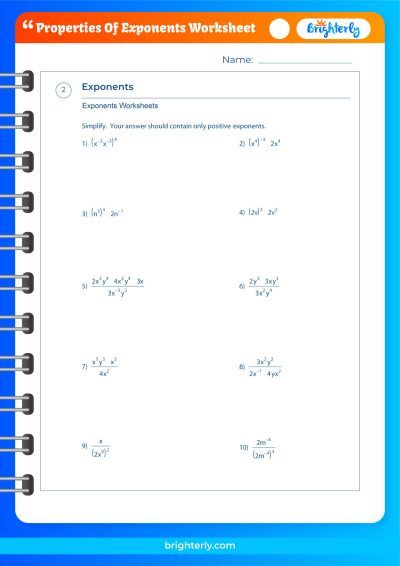
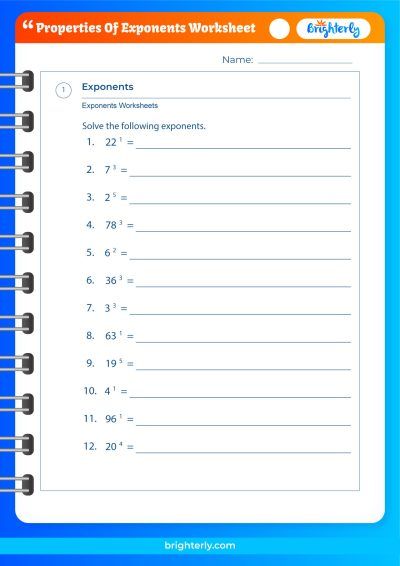
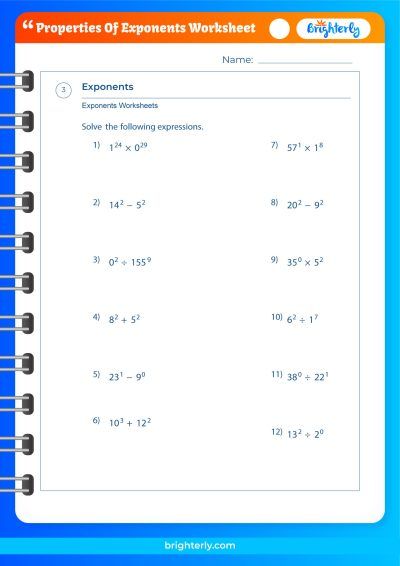
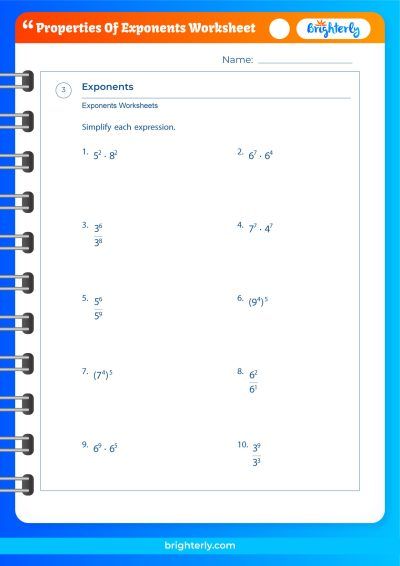
Download properties of exponents worksheets
You can find properties of exponents worksheets on internet math websites. Download as many sheets as you can as they are primarily free. They contain a wide range of questions, and kids can easily skip the ones that seem too complex and ask their teachers questions later.
Other 8th grade worksheets
- Consumer Math Worksheets
- 8th Grade Equations Worksheets
- Algebraic Expressions Worksheets
- Division Problems Worksheets


Help your child reach their full potential!
Answer a few quick questions about your child’s learning, and we’ll recommend next steps.
Benefits of exponent properties worksheets
It makes understanding the properties of exponents easier
The easiest way to get through exponents is by learning all their properties and practicing to use them in equations. Using the properties of exponents worksheet answer key as a learning material allows kids to learn all about the math concept and thus makes it easier for them to work within the exponent’s universe.
It helps parents understand their children’s strengths and weaknesses
If you are a parent who loves to help their child with studies, then you will find the exponent properties worksheet answers very beneficial. Going through the properties of exponents worksheet with answers together with your kids allows you to understand the exponents and properties of exponents, so that you can know how to teach your child effectively.
It builds a foundation for advanced algebra
Exponent properties aren’t just standalone rules — they show up constantly in polynomial operations, scientific notation, exponential functions, and even calculus down the line. Practicing with an exponent properties worksheet now means kids won’t get tripped up by these fundamentals when equations get more complex in later grades.
It strengthens mental math and pattern recognition
Working through rules like the product of powers, quotient of powers, and power of a power teaches kids to spot patterns instead of memorizing isolated facts. This pattern-based thinking speeds up mental math and helps students simplify expressions quickly, without reaching for a calculator every time.
It boosts confidence through repeated practice
Exponents can feel intimidating at first, especially when negative or zero exponents enter the picture. Working through a full worksheet — and checking answers against the key — gives kids the repetition they need to feel comfortable with the rules, turning early confusion into steady, growing confidence.
FAQ
What are the main properties of exponents kids need to know?
The core rules include the product rule (am × an = am+n), quotient rule (am ÷ an = am−n), power of a power rule ((am)n = amn), zero exponent rule (a0 = 1), and negative exponent rule (a−m = 1/am). Mastering these formulas lets students simplify expressions quickly instead of multiplying repeated factors by hand.
Why do students find exponent rules confusing at first?
Exponent rules can feel abstract because they involve manipulating symbols rather than counting objects. Kids often mix up when to add exponents versus multiply them, or forget that a zero exponent equals one rather than zero. Repeated practice with a properties of exponents worksheet helps these rules become automatic instead of memorized facts.
What grade level typically covers properties of exponents?
Properties of exponents are usually introduced in 7th and 8th grade as part of pre-algebra, then reinforced throughout high school algebra, where they’re applied to polynomials, scientific notation, and exponential functions. Brighterly’s worksheets are designed to match this progression, starting with basic rules before moving to combined operations.
How do exponent rules apply to negative and fractional exponents?
A negative exponent means taking the reciprocal, so a−m becomes 1/am. A fractional exponent represents a root, so a1/n equals the nth root of a. These extensions build on the same base rules students already know, letting them rewrite expressions in different forms depending on what a problem calls for.
Can these worksheets help with scientific notation and polynomials later on?
Yes. Once students are comfortable with exponent rules, they can apply the same logic to writing numbers in scientific notation, multiplying and dividing polynomials, and simplifying rational expressions. This makes properties of exponents one of the most foundational skills for success in algebra and beyond.
Does the worksheet include a full answer key?
Yes, every Brighterly properties of exponents worksheet comes with a complete answer key. Students can check their work step by step, catch mistakes early, and understand exactly where a rule was applied incorrectly, rather than just knowing whether the final answer was right or wrong.


Need help with Equations?
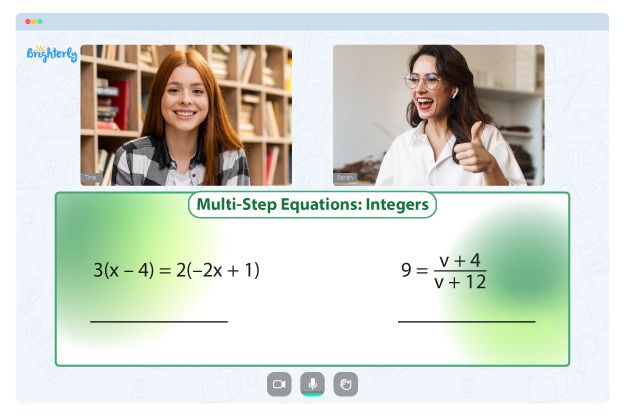
- Is your child finding it hard to understand equations?
- An online tutor could be of help.
Choose kid's grade

Does your child need extra assistance with grasping of equations? Start learning with an online tutor.
Book FREE lesson