Descriptive Writing for Kids: How to Turn Simple Sentences into Strong Writing
reviewed by Marvi M. Andres
Updated on March 4, 2026

Descriptive writing for kids is like the secret to “painting with words.” It encourages children to share the little details, such as how a leaf crunches or the smell of the air, instead of just listing boring facts. Learn how to help your child turn plain sentences into vivid stories.
Key takeaways
- Readers are best able to feel as if they are physically present in the scene by using the five senses.
- The performance of students who practice sensory writing across all academic subjects improves by 30%.
- The “Show, Don’t Tell” method helps kids move away from boring sentences by using actions and details.
- By creating vocabulary word banks, children can replace tired words like “big” or “nice” with stronger alternatives.
- Support from writing tutors can help children overcome writer’s block and build their confidence.
- Practice with reading & writing worksheets helps children master descriptive writing.
What is descriptive writing?
Descriptive writing is a literary device used to paint a detailed picture of a person, place, or object. The purpose of descriptive writing is to make the audience feel as if they are there. Rather than using general statements, it focuses on specific details. This guide provides a clear definition of how to transform basic ideas into art.
Descriptive writing consists of sensory details, vivid adjectives, and strong verbs. It gives the reader a better picture of the scene if a writer writes, “The massive golden retriever took up the entire hallway.” Rather than stating “The dog was big,” they might write, “The golden retriever took up the entire hallway.” Once kids learn how to write descriptions, even the most boring paragraphs can become enthralling journeys.
How to teach descriptive writing: 5 ways
- Work with a tutor
- The five senses chart
- “Show, don’t tell” games
- Interactive picture prompts
- Vocabulary word banks
Work with a tutor
Best for: young learners who need personalized feedback
A tutor provides the environment where a child can receive immediate help with their sentences. This method allows the language expert to identify exactly where a student is struggling, whether it is vocabulary or the descriptive writing format.
A personalized approach to writing with Brighterly
Brighterly is a leading math and reading learning platform that helps children master complex English skills. Its writing tutors focus on making the learning process fun and interactive.

Brighterly writing program uses games and descriptive writing examples to show kids how to use “show, don’t tell” techniques.
Beyond live sessions, kids can also train independently at home with high-quality Brighterly resources. Descriptive writing worksheets are perfect for daily practice.


The five senses chart
Best for: helping kids brainstorm detailed adjectives for any descriptive writing topics.
This method asks the child to look at an object and write down what they see, hear, smell, taste, and touch. It is one of the most basic elements of descriptive writing. For example, if the topic is “The Beach,” the child would list the “salty” air and “gritty” sand.
“Show, don’t tell” games
Best for: more advanced learners of descriptive writing style.
Using this activity, you give a child a “telling” sentence, such as “The boy was sad.” Their task is to “show” the sadness through their actions, such as “The boy put his head down and let a single tear fall.” This is a great way to practice descriptive writing for kids.
Interactive picture prompts
Best for: children who have “writer’s block” and don’t know how to start descriptive writing.
It can be helpful to use a picture or video of nature to generate new ideas. Make sure your child includes at least three sensory details when describing people or scenery. It helps them develop the “writing muscles” they will need for a full essay.
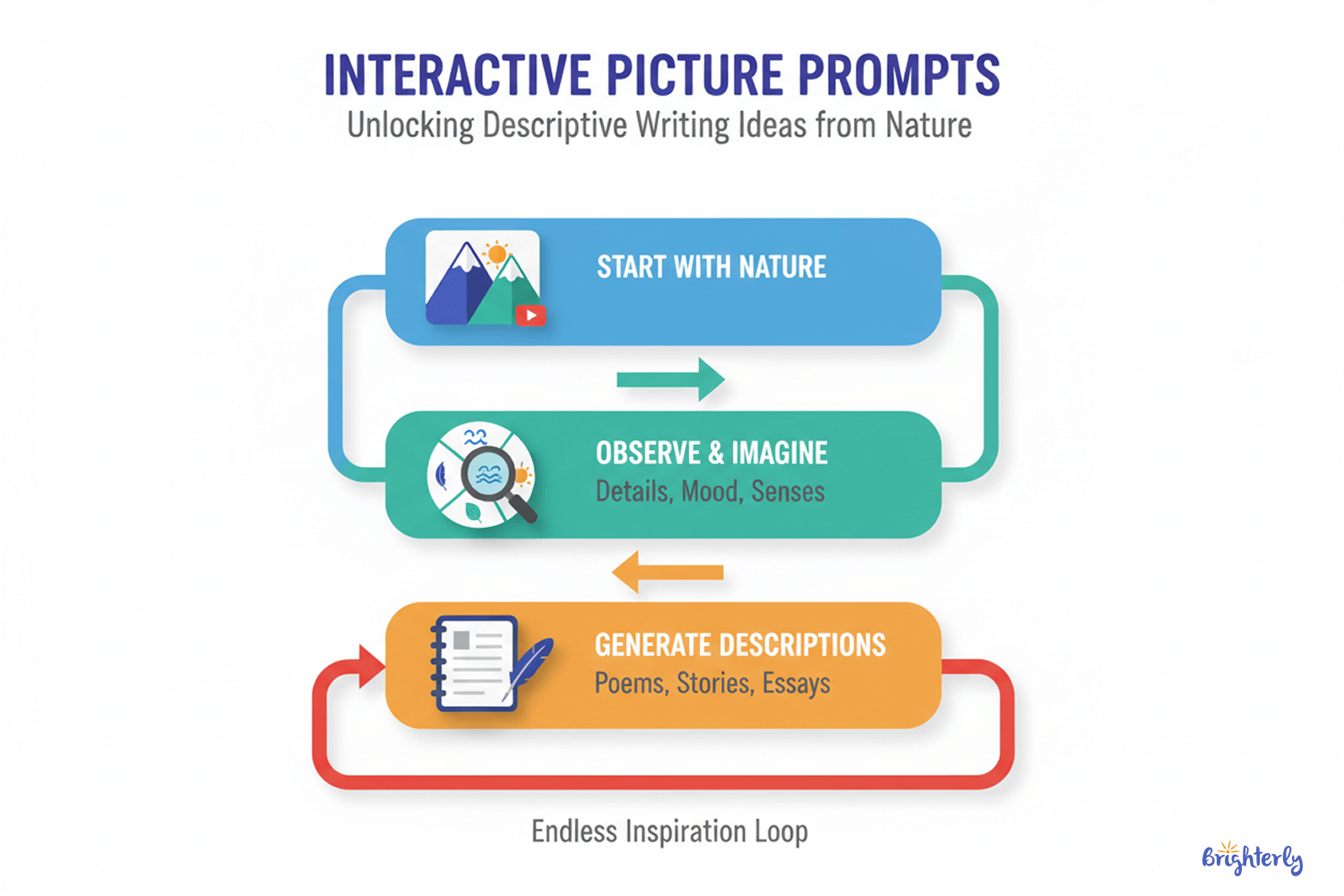
By seeing a real image, a child does not have to guess what to write. It gives them a clear starting point so they can focus on choosing the best words.
Vocabulary word banks
Best for: expanding the language tools a student uses during an English Language Arts lesson.
Characteristics of descriptive writing often depend on the specific words a child chooses to use. Think about tired words like nice, good, or big. To replace them, ask your child to think of five “strong” words. One characteristic of strong writing is the use of words like ‘magnificent’ or ‘towering’. For creativity, these word banks act as a “cheat sheet.” This gives children the confidence to use new vocabulary without feeling overwhelmed.
What are the five elements of descriptive writing?
| Purpose | Examples | |
| Sensory details | By using the five senses, we can create a “mental movie” for the reader that makes them feel as if they are physically present in the story. | The scent of cinnamon and the steady hiss of the kettle filled the warm room. |
| Figurative language | Similes, metaphors, and personifications can help create vivid pictures. | “The lake was like a giant blue mirror,” or “The wind whispered in the trees.” |
| Dominant impression | When you describe a scene, choose a single mood or focus (such as frightening, peaceful, or busy). It makes a scene appear much cozier or mysterious. | If describing a bedroom, focus on how messy it is to show the character’s personality |
| Precise language | Using specific, strong nouns and verbs instead of “boring” general words. | An eagle soared majestically above the jagged mountain peaks. |
| Thoughtful organization | Organizing details logically (for example, from top to bottom, from left to right, or from far to near). | Describing a giant from his muddy boots up to his cloud-reaching head. |
The use of these elements is what differentiates informational writing from descriptive writing. While persuasive writing tries to convince you of an idea, description tries to show you a world.
Conclusion
Students who master descriptive writing become wonderful storytellers. With the help of visual learning tools, children can build the confidence they need to succeed at school by focusing on the five senses. Whether working with professional writing tutors at Brighterly or completing descriptive writing activities at home, every child can write. Take a simple sentence and turn it into a masterpiece. You can book free lesson today to see how this class environment builds skills.


When you read a lot, you usually start to wonder about keeping track of your reading history and progress. Among the ways to do it effectively is to use a digital solution designed exactly for that purpose. Whether you want it for yourself, your kid, or the entire family, there are options for all. To […]

Feb 28, 2026

If you are looking to see if Monarch Homeshool is the right choice for you, the Monarch Homeschool reviews are a great way to get a glimpse into how the platform works. In this article, we take a deep dive into the reviews available online for the homeschooling program, including its online curriculum, costs, pros […]

Mar 03, 2026
Math & reading from 1st to 9th grade
Looking for homework support for your child?

Choose kid's grade

Math & Reading for Grades 1–9
Build real confidence for your child with a Brighterly math or reading tutor.