10 Effective Study Methods & Techniques to Try This Year
reviewed by Franz Jerby Delos Santos
Updated on March 4, 2026

Learning for a child is like a journey: if the route is confusing, it is easy to get lost or lose interest altogether. That is why it is worth looking for methods that make this path easier and more engaging. Today, I will share effective study methods tested with my students. Hope you will definitely find something useful for yourself.
Key points
- Homeschooling is most successful when there is a clear routine and a comfortable learning space. For better results, you can use methods like the Pomodoro technique, the Feynman technique, and active recall.
- Many scientifically proven study methods are built around short, structured lessons and regular breaks, along with active explanation and review.
- Every child has a preferred learning style: visual, auditory, or kinesthetic. Knowing this can make learning easier and more effective.
- Parents can significantly improve learning outcomes by using games, flashcards, active discussions, or seeking quality tutoring. All of these approaches are part of the Brighterly online learning program as well.
What are the most effective study methods for kids?
The most effective teaching methods are those that help a child take an active part in learning. According to the scientific journal Frontiers in Education, short and structured lessons work best. When learning is organized this way, children are not overloaded and can move through the material step by step.
Teachers note that after studying a topic, it is very helpful to ask a child to explain it in their own words. The Association for the Study of Medical Education states that systematic review helps well: flashcards, quizzes, and short practice tests are simple tools that support long-term learning.
At the same time, it is important to remember that each child processes information differently. Children are still developing, so parents need to observe their child, stay patient, and look for answers to the question: What are good study methods for my child? If this feels difficult to do on your own, qualified tutors can help. For example, tutors from Brighterly math and reading learning platform work with each student individually, offering one-on-one lessons and a personalized learning program.


Check the basics behind this term
Take our quick quiz to discover the perfect learning solution based on your child’s needs.
Types of study methods
- Visual method: Children who prefer this approach understand information best through pictures, charts, diagrams, mind maps, and color-coded notes. If your child enjoys seeing everything clearly structured and laid out, visual techniques can become one of the most effective study methods for them.
- Auditory method: Some children learn better by listening to explanations, reading aloud, participating in discussions, or using audiobooks. If your child easily remembers spoken information, this approach may help them absorb material more efficiently.
- Kinesthetic method: This method works best for children who need movement and hands-on practice. They learn through experiments, games, real-life tasks, and active participation rather than long theoretical explanations.
- Individual study method: Some children feel more comfortable working one-on-one with a teacher or studying independently at their own pace. They may focus better without group distractions.
- Group study method: Other children thrive in collaborative environments where they can discuss ideas, share opinions, and solve problems together with classmates.
Best ways to study at home
- Tutoring and guided learning at home
- Creating a distraction-free study space
- Creating a daily study routine
- Pomodoro technique
- Feynman technique
- Active recall
Tutoring and guided learning at home
The first study technique I would recommend is quality tutoring, especially if your child thrives in one-on-one learning. Student-focused teachers design lessons that are both useful and engaging, which helps students learn more effectively. I know how hard it is to find such teachers, but in cases like this, I always recommend Brighterly reading and math programs.
First, Brighterly tutors and the platform create a fully personalized and friendly learning environment for each student demonstrating how to study smarter, not harder. Each lesson is different to keep kids interested – teachers include games, discussions, and animated videos. Every time, there’s something new.
For American families, an extra plus is that all lessons align with the US school curriculum, so your children will be learning the right way! Here is a little bonus: on the Brighterly platform, users can find free and engaging math and reading worksheets for kids of all ages. Another way to learn at home for $0.
Check the basics behind this term
Take our quick quiz to discover the perfect learning solution based on your child’s needs.
Creating a distraction-free study space
This is an important and often overlooked factor that really affects how well a child learns. To help your child stay focused and in the mood to study, make sure their study space is set up properly. They should have their own place to do tasks, and it should be pleasant, well-lit, and free of unnecessary items on the desk. And this way, it becomes the most effective way to study as your child feels comfortable.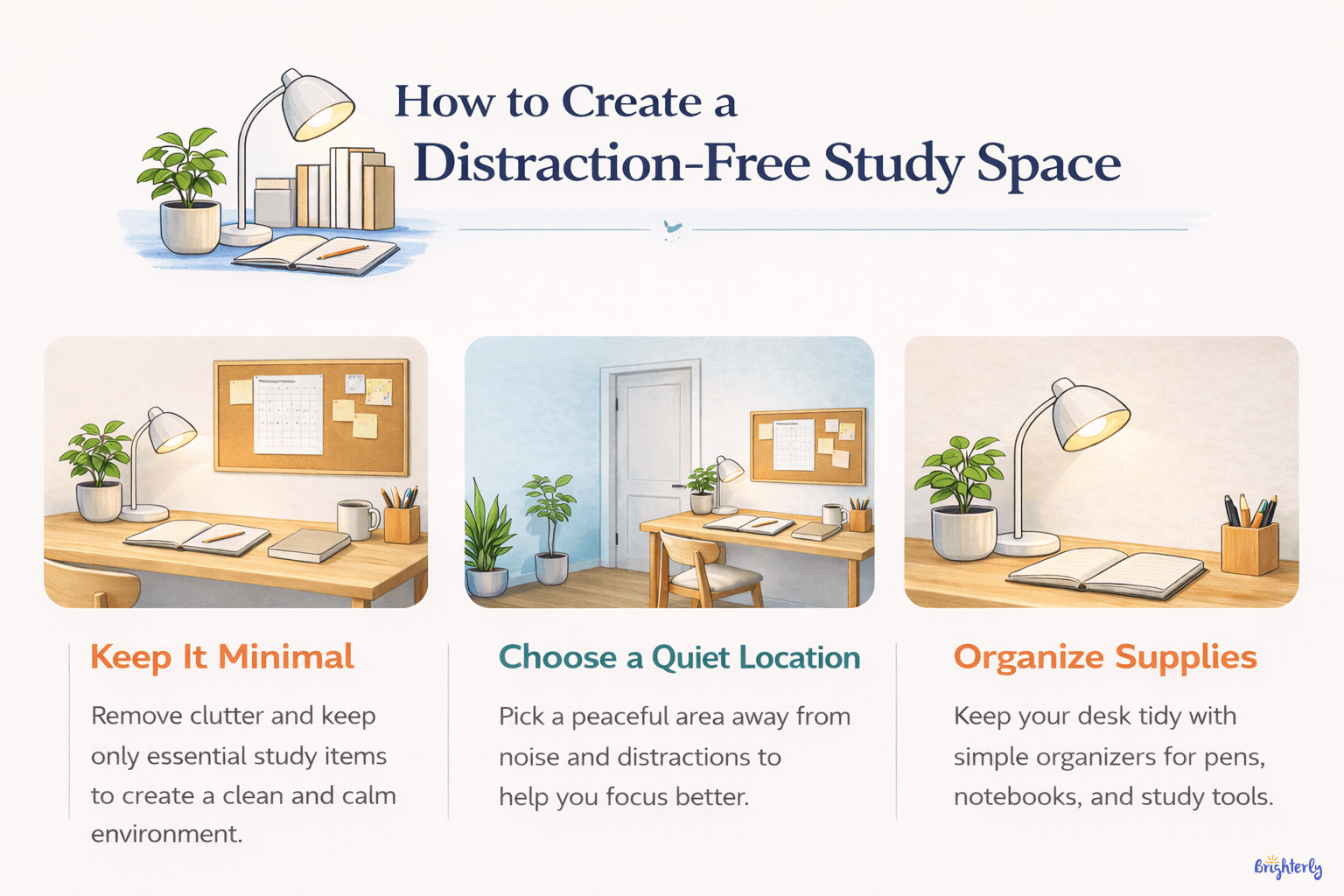
Think about it yourself: if your desk is messy, with toys scattered around, clothes lying about, or piles of textbooks, could you focus? Personally, I never can. I need an order on my desk for it to be in my head. With children, it works even more, and keeping a tidy space is one of the most important ways to study effectively, as scientists have confirmed in the American Journal of Public Health.
Note: To boost motivation and create the right atmosphere, you can add healthy snacks like nuts, dark chocolate, or water to the desk. Play calming music and make sure the room is well-ventilated. These are simple things to help you study more effectively.
Creating a daily study routine
I also want to point out that effective learning starts with a solid daily system of habits. Make sure your child isn’t studying late at night. They should have a consistent schedule, eat well, get enough sleep, and include physical activity in their day.
Pomodoro study technique
As I mentioned before, teachers and researchers strongly recommend studying in a structured way. Don’t sit down with your child and go through material for three hours straight. Instead, set clear times: a fixed time for the lesson and a set time for taking breaks. Also, set realistic goals for each session: don’t try to finish all the homework in one go; focus on one exercise at a time. This approach, known as the Pomodoro technique, is one of the useful study strategies for students.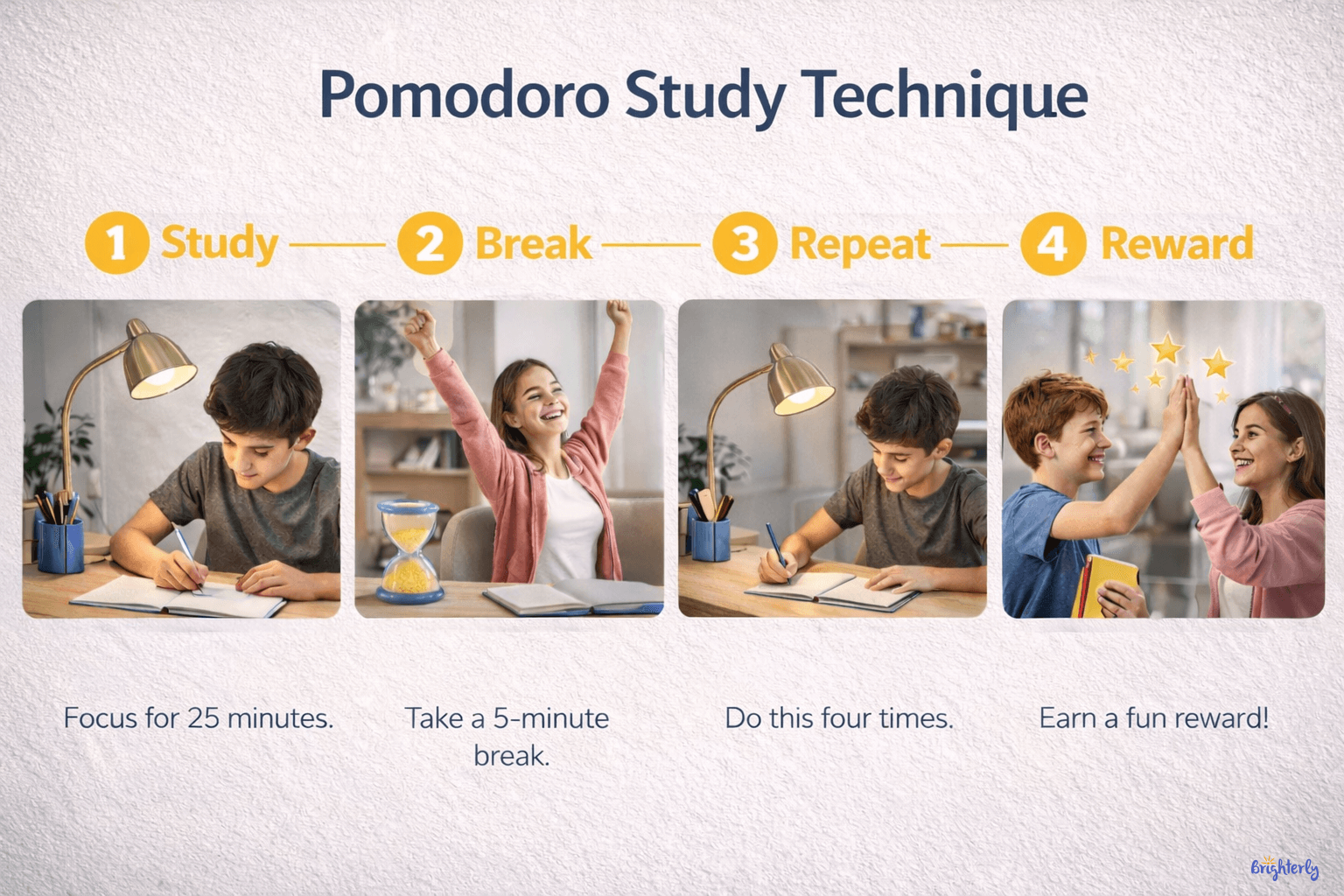
In practice, you set a timer for 25 minutes for focused work, followed by a 5-minute break. You can even find free online Pomodoro timers and play relaxing music in the background. And you know it really helps manage time.
Note: You can adjust the length of work and breaks for your child. The older they get, the longer they can focus, so experiment and find what works best.
Feynman study technique
I often use the Feynman technique with my students as it’s one of the best study techniques. It’s a simple method that helps a child understand the material instead of just memorizing it.
Here’s how it works: after learning a topic, ask your child to explain it in their own words. This immediately focuses their attention and shows you where they might be struggling. If your child can explain it clearly, congratulations, they will remember it for a long time.
Note: If you have two or more children, ask one to explain the topic to the other. If your child is learning alone, have them explain it to you. This really strengthens their understanding.
Active recall study technique
The idea of active recall is simple: after studying a new topic, ask your child to tell you what they remember, without looking at the material. This activates the brain and helps the child see what they still need to learn. It really works!
Note: You can use this technique during the lesson, right after, or a few days later. It’s very helpful for your child’s overall development.
Effective study techniques parents can use with kids
- Using flashcards and visual aids
- Learning through games and interactive activities
- Asking questions and active discussions
- Progress tracking and positive feedback
Using flashcards and visual aids
Flashcards are a great way to review material in intervals, and you can even use them with little ones. You can buy sets for learning things like words, or make your own for any topic.
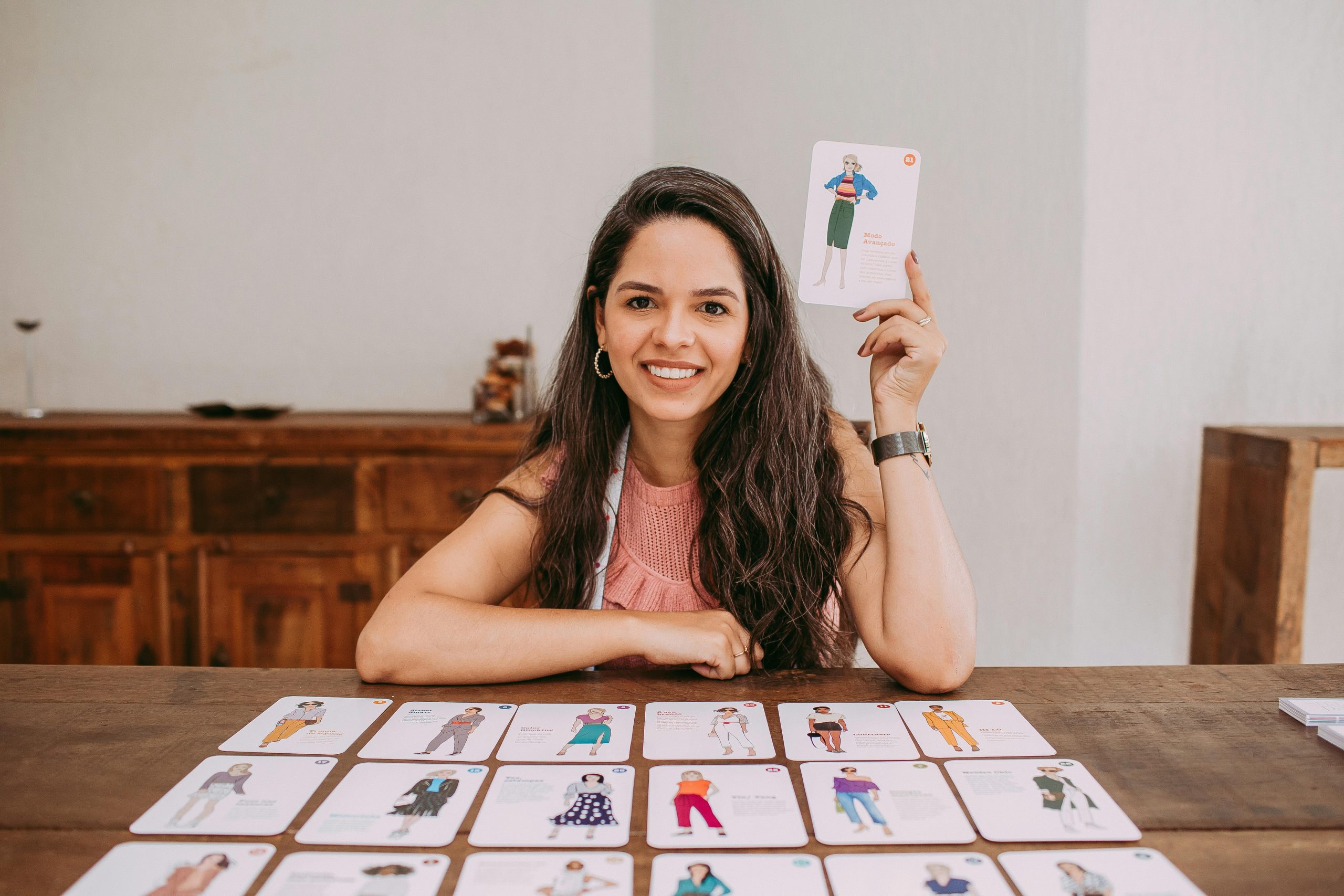
Write down questions or draw pictures and diagrams that match the topic or words. Then go through them again and again. Kids love flashcards because they feel like a game, making them one of the best study methods.
Note: There’s a method for using flashcards: repeat the cards the day you learn the topic, then the next day, then after 3-4 days, and again after 10 days. If your child still remembers the material, then it’s truly learned!
Learning through games and interactive activities
Learning through games is a method that keeps stress low and fun high for kids. Games can fit different ages and needs. If your children are young, the article on the 8 types of learning styles will help you find the best study method for your little one. For older kids, there is a variety of science board games: physics, chemistry, biology, economics, math, and even grammar. Set up a cozy family night and learn together.

Here’s another study tip from my friends who are teachers. My colleagues often turn leisure time into learning. For example, if they’re studying World War II in history, they visit a museum to see exhibits. To learn about the human body, they go to biology exhibits or do small experiments at home. For geography, if travel isn’t possible, they watch classic films or try cooking traditional dishes from different countries.
The point is you can really boost your child’s learning just by picking an evening activity, like a movie, that matches what they’re studying. Everything is in your hands!
Asking questions and active discussions as best studying methods
I also recommend having more educational discussions. For example, when reading a text or topic, ask your child questions like: “Why do you think this is important?”, “Where could you use this knowledge?” or “What do you think would happen if…?” First, this helps them understand the topic better, and second, it develops their analytical thinking.

Progress tracking and positive feedback
Of course, if you’re actively involved in your child’s learning, try to keep track of their progress. You can do this by testing them periodically or by noting the topics they’ve already learned. And be sure to praise your child, show them how much they’re improving and that their effort really pays off.
Note: Try to motivate your child with something that matters to them. It could be a special trip, a fun meeting, or even a treat they’ve been looking forward to.
What are the best ways to study for your child? Conclusion
The most important thing is that the best learning methods are the ones that fit your child. Watch how they take in information and use that when studying. Maybe they learn better from videos or audio. If they don’t enjoy reading complicated rules, show them how it works in practice. Make sure their study space is comfortable and maintain a healthy daily routine. Everything about this really matters and is a good way to study. If possible, include sports or physical activity, which only helps.
Also, track their progress and don’t forget to praise your child for small and big achievements, so the benefits of their learning last. If you can’t organize this yourself, qualified tutors can help.
At Brighterly, teachers are friendly and attentive, and they fully understand what study methods are most effective for your child. They offer one-on-one lessons, adapt to your child’s needs, and monitor results. If you’re unsure about what your children needs, book free lesson with Brighterly and discover it.


Lindamood Bell reviews on independent platforms frequently mention research-backed learning methods alongside quite demanding schedules and (far too!) high costs. To help you decide whether to go ahead with the platform, this guide provides an evidence-led overview of LMB’s main features, pricing, methodology, effectiveness, and more. TL;DR Features: 8.5/10. LMB offers a specialized sensory-cognitive toolkit, […]

Feb 19, 2026
Choosing the right online curriculum for your kid is a high-stakes decision. I compared Miacademy vs Acellus to help you decide which platform is a better fit for your family. Whether you are shifting schedules or looking for new learning formats, understanding these two options is a great first step. Key Points: Miacademy is an […]

Feb 22, 2026
Math & reading from 1st to 9th grade
Looking for homework support for your child?
Choose kid's grade

Math & Reading for Grades 1–9
Build real confidence for your child with a Brighterly math or reading tutor.