Math Activities for Preschoolers: 30 Hands-On Ideas That Work
reviewed by Camille Ira B. Mendoza
Updated on August 20, 2026
Key Points: Fun-based preschool math activities and printable worksheets help children build number sense, spatial reasoning, logical thinking, and get ready for 1st grade math. Activities that use everyday household items as a teaching tool make learning easy and fascinating. Therefore, preschoolers aged 3-5 develop early numeracy while having fun.
Not sure how to help your child in math?
Try personalized support from a teacher to prepare for 1st grade
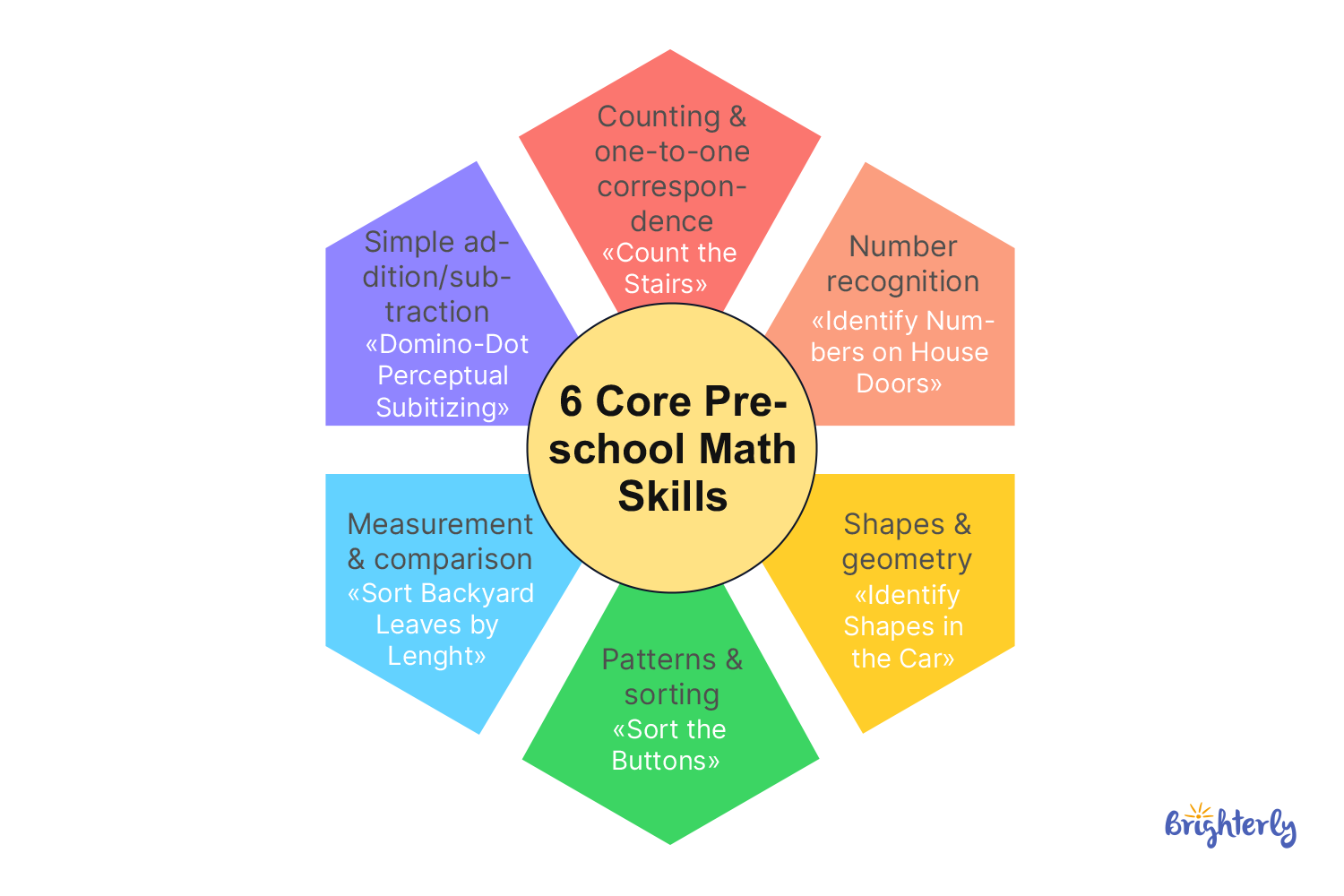
Preschoolers can learn math skills such as counting, one-to-one correspondence, number recognition, shape and pattern identification, object sorting and classifying, measurement and comparison, and basic addition and subtraction. These number activities for preschoolers help develop strong logical thinking and problem-solving skills. Here are some basic pre-k math activities that help kids learn to sharpen their minds. Math Activities Age 3–4 Age 4–5 Ready for Kindergarten Counting Range Count to 10 Count to 20 or higher. Start counting from any number. Count to 100 Number Recognition Match numbers to quantities (1-10) Match numbers to quantities (1-20) Understand counting and cardinality Shapes Identify basic shapes (circle, triangle, square) Name more shapes (rectangle, oval, stars) Shape recognition with their sides and corners. Patterns Copy simple patterns (AAA) Write simple patterns (ABABA) Write more complex patterns (ABCD..) More/less Understand more and less (compare two groups) Say more/less verbally while comparing two groups Compare numbers and understand the more/less/equal signs. ( >, <, = ) Simple Add/Subtract With objects- Add and remove Solve basic problems of addition and subtraction Solve problems of addition and subtraction Explore Brighterly Learning Experience Learn exactly how Brighterly helps students thrive through expert sessions, online tools, and proven feedback from thousands of satisfied parents Counting activities like a scavenger hunt and counting stairs are the easiest way to improve the child’s play-based learning ability. This enhances preschoolers’ focus and boosts their confidence. These easy exercises are meant to keep math for preschoolers interesting while helping kids build the fundamental abilities necessary for success in math in the future (Palmér & Björklund, 2022). A scavenger hunt is a fun math activity for preschoolers. Give the kid a set quantity of objects to collect, like five blue blocks. The scavenger hunt teaches youngsters that the last number counted represents the total, helping them learn cardinality. Make holes in playdough “pancakes” with a pencil or finger. Young students reinforce one-to-one correspondence with every unit they design. In this game parents clap for a certain number of times. The child has to listen carefully and then repeat the same number of claps. This improves the child’s listening and concentration abilities. Count trees in a row or butterflies in the garden while reading a book. Children can track the data points in the story by using their fingers as a “calculator” as a visual aid. Enhance kids’ number learning abilities by asking them to count how many stairs they have climbed. Put a number on a card or circle and have your child attach the matching number of pins. This improves numeral identification and gives a clearer concept of the quantities related to each number. Therefore, kids have a better understanding of how maths is connected to real-world amounts. Domino-dot is a great way to boost kids’ pattern recognition skills. It is an easy way of learning addition and subtraction. Parents can easily modify the game according to their kids’ age and perception levels. These preschool number games teach children how to recognize little numbers without counting them one by one. Make a number line on the floor from 1 to 10. Call out a number, and the kid will hop on that number. Likewise, you can say what comes after 7? The kid has to hop on the right answer. Our platform offers a collection of number games designed to spark young minds and make learning math fun. Parents can make boring math time fun by involving kids in these simple preschool math activities. Turn your supermarket trip into a fun math class. Ask your child to match the locker key or token to the correct numbered locker. As they solve a practical problem, this real-world task turns a routine errand into a number-recognition game. Ask your child to point out the numbers on neighboring houses while you’re walking. By noticing rectangular signs or circular wheels, you can turn your travel into a geometry math lesson. The fact that shapes can be found in nature proves that math is more than a textbook subject. Draw a triangle or “4” with your finger in a shallow tray filled with sand or salt. Unlike a smooth pen on paper, the sensory resistance of sand helps the brain “lock in” the shape better. Make an opaque cloth bag to conceal 3D shapes like cubes and spheres. To identify the object, ask your child to reach in and describe the edges and corners with only their tactile senses. The study shows that augmented reality-supported learning is also a useful tool. It has a positive effect on kids’ visual perception development. (Özel, Ö., Hançer, B., & Sop, A. (2025). Challenge your children to build a 3D block structure from a 2D sketch. According to the study, children develop spatial skills and can have great benefits from involvement in constructive play. (Akdemir, K., & Sevimli-Çelik, S., 2023). Make A-B-A-B sequences with different types of pasta such as penne, fusilli, and bowties. With these pre-k math activities, you will help kids recognize more complex algebraic sequences by using these basic math skills. Create a blue-red-blue base and let your child pick the next color. The block tower activity teaches the rules of pattern recognition and encourages logical prediction. Organize a jar of mixed buttons into multiple categories, such as “round and two holes.” When children compare different features of an object at the same time, they develop skills including sorting, classifying and critical thinking. Gather a variety of leaves and challenge your child to line them up from shortest to longest stem. Lining leaves by length (seriation) helps children grasp graduated measurement. Organize clean forks, spoons, and knives into their designated compartments with your child. This activity teaches kids to identify key objects’ attributes. Test the scale by placing a grape on one side and an apple on the other. Visual comparison introduces the concepts of mass and weight directly to the learner. Likewise, try measuring a television remote or a shoe with Lego bricks instead of a ruler. Using non-standard units helps small hands easily grasp the concept of length. You can also encourage your kid to measure dry items like pasta or flour with a measuring cup to teach them volume and capacity. Draw a huge circle on the ground with numerals 1 through 12. To help your child understand how time passes, say a time and have them point to the correct hour with their arms or torso. Put rocks on a chalkboard. Use an outdoor slate or sidewalk to create a plus sign with two circles. Allow your youngster to see the total of five by arranging three rocks in one container and two in the other. To illustrate your backyard floor, draw a 3×3 grid on paper and mark ‘X’ where the sticker is hidden. Match the paper map to the actual region to help your youngster learn about mapping and spatial concepts. According to one study, this interactive game promotes the development of spatial orientation abilities in young children’s homes as well as in classrooms by utilizing familiar materials and innovative technologies. (Lewis Presser, A. E., Braham, E., & Vidiksis, R., 2025) Math activities for 3-year-olds include counting games. Ask your child to count trees or flowers in your backyard. Or tell them to collect 8 pebbles. Collect different parts of a plant- leaves, flowers, buds, and stems. Ask your kid to sort them out. This nature play math activity for preschool kids can strengthen their learning skills. (Speldewinde, C., & Campbell, C., 2022) Our professional free pre-K math worksheets are printable and include high-contrast visuals and logic puzzles suited to children’s ages. These worksheets give extra practice while strengthening the basic math skills, developing critical thinking and providing a hands-on learning experience to preschoolers. Provide stickers and a grid of ten frames. Sticker grids help your child see how numbers break into smaller groups (such as 5 + 2 = 7). Print numbers on the bottom of each tin cup and tape them on. By dropping the corresponding number of buttons into each slot, your child can see the cups getting “fuller” as the numbers increase. This is a board game with numbers inscribed on it. Ask your youngster to roll the die. Count the dots on the dice, then cover the matching number on the board. Continue until all numerals are covered. This enhances children’s hand-eye coordination and makes learning easier. The study shows that it provides active, playful learning for children 4 years and above. Additionally, they discovered that board games improved students’ willingness to learn and even resulted in positive behavioral improvements. (O’Neill, D. K., & Holmes, P. E., 2022).
Give your child a head start in math
Brighterly expert tutors make math click — one lesson at a time
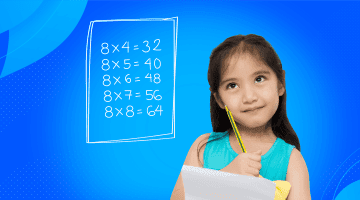
Early math activities build a strong foundation where preschoolers develop the mental habits needed for logical thinking. The child will be able to go beyond mindless memorization to get to know why math matters for their future. Teaching preschool math does not require the need for expensive supplies. Everyday items provide fun, engaging learning. These are basic materials that allow children to count, sort, compare and explore early math concepts through play: Preschool math activities can help your child feel more at ease with numbers before they start kindergarten. Whether you’re playing math games or discovering math in nature, these activities make numbers less daunting. Screen time transforms into active mastery through interactive sessions on our online learning platform. Looking for an online math tutor? Many parents report progress in core math concepts within the first three months of personalized instruction. Our K-12 math program gives your child a head start and provides 1:1 sessions aligned with US state standards. Moreover, Brighterly offers interactive math classes for young learners to make math easily understandable for them. Hands-on learning, play-based activities, and everyday experiences help build strong basic math skills and help preschoolers enter kindergarten confidently. This stress-free way of learning prevents future math anxiety. They start gaining interest in simple math problems while playing. In this way, the knowledge of math comes organically rather than in a stressful way. Kids usually learn to count to 10 by age 4, though it can differ. Many 3-year-olds start counting to 5 or 10, often with a little help, but by age 4, most can do it on their own. Singing songs, playing games, and counting in daily tasks make learning to count fun and easy for them. Preschoolers can start learning addition between the ages of 4 and 5. Before they start learning sums on paper, they first learn addition by combining different objects or their toys. While playing, they build number sense and develop the basis of addition before going to kindergarten. Preschoolers should practice math each day for 5 to 15 minutes. At this age, consistency is more important than duration. Short, frequent interactions build better retention. Parents can use Brighterly to answer questions of their little ones. If your preschooler can count, recognize numbers, identify shapes, do addition/subtraction and more/less problems, then they are probably on track. They will be able to solve simple problems while playing. Remember, each child learns at a different pace, so minor differences are not to be worried about. Yes, preschoolers can learn Math without worksheets through hands-on activities, play-based learning, and everyday experiences. Counting stairs, measuring household items, sorting objects, playing with blocks and scavenger hunt-type games help preschoolers learn math skills in a stress-free, playful way. Preschool math focuses on basic math skills like number recognition, identifying shapes, comparing two groups and sorting different objects. While in pre-K math, kids learn more structured math skills built on the skills of preschool math. They compare quantities, identify different patterns, measure, and write simple addition and subtraction. Multiplication facts are often seen as rote practice, and parents often think the only way to make their children master the topic is to drill it with flashcards. Practicing and drilling really help kids memorize multiplication, but how can this process be improved? Let’s explore the best way to teach multiplication facts and why they […] Apr 29, 2022 If your kid starts crying over homework or freezes when a math test begins, they’re most likely experiencing math anxiety. You don’t need to be a math expert yourself to understand what triggers this neurological and emotional block, what signs and symptoms math anxiety entails, and how to help your kid cope with them. What […] May 05, 2022

What Math Skills Do Preschoolers Learn?
Preschool Math Milestones by Age
Counting Activities for Preschoolers
Go for Scavenger Hunting
Make Holes in the Playdough
Match-the-Claps
Count Storybook Characters
Climb the Stairs
Number Recognition and Number Sense Games for Preschoolers
Clothespin on Numbered Circles
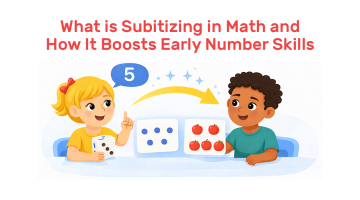
Domino-Dot Perceptual Subitizing
Jump along a Number-Line
Supermarket Locker Game
Identify Numbers on House Doors
Shape and Geometry Activities for Preschoolers
Identify Shapes in the Car
Tracing Shapes on the Sand-Tray
Mystery Shapes in Your Bag
Create a 3D Model from a Paper Drawing
Pattern, Sorting, and Measuring Activities
Make Patterns with Dry Pasta
Use Color Sequences to Complete Block Towers
Sort Buttons Based on Their Hole Size and Shape
Sort Leaves by Length
Silverware Sorting
Measurements of Weight and Length
Outdoor Math Games for Preschoolers
Stand on the Numbers of a Large Chalk Clock
Put Rocks on A Chalkboard
Find Treats by Following Grid Maps
Count Your Backyard Trees
Sort Out the Plant Parts
Easy Printable Math Activities for Preschoolers
Complete Brighterly Free Worksheets for Preschool Math
Use Colorful Sticker Sets to Fill Grids
Sort Buttons in Muffin Tins
Roll Dice and Cover
Why Early Math Activities Matter for Preschoolers
How to Make Math Fun for Preschoolers at Home
Everyday Ways to Practice Math at Home
Simple Materials and Manipulatives to Start With
Building a Strong Math Foundation Before Kindergarten
Conclusion
Frequently Asked Questions
At What Age Should a Child Count to 10?
When Do Preschoolers Start Learning Addition?
How Long Should Preschoolers Practice Math Each Day?
How Do I Know If My Preschooler Is on Track in Math?
Can Preschoolers Learn Math Without Worksheets?
What’s the Difference Between Preschool and Pre-K Math?




Math & reading from 1st to 12th grade
Looking for homework support for your child?
Choose kid's grade

Math & Reading for Grades 1–12
Build real confidence for your child with a Brighterly math or reading tutor.