Equiangular Triangle – Definition with Examples
Updated on December 1, 2025
An equiangular triangle is a shape where all three sides and all three angles are equal. At Brighterly, we explain the essence of this concept and why it is important in geometry. Students can see how predictable and consistent geometric shapes can be by comprehending their symmetry. Learning more complex math concepts is also supported by this straightforward idea.
What are equiangular triangles?
A triangle with three equal angles, each measuring 60 degrees, is called an equiangular triangle. Because each angle has the same measure, the equiangular triangle definition in geometry is a fully symmetrical shape. The words “equi,” meaning equal, and “angular,” meaning angles, combine to form the word “equiangular.”
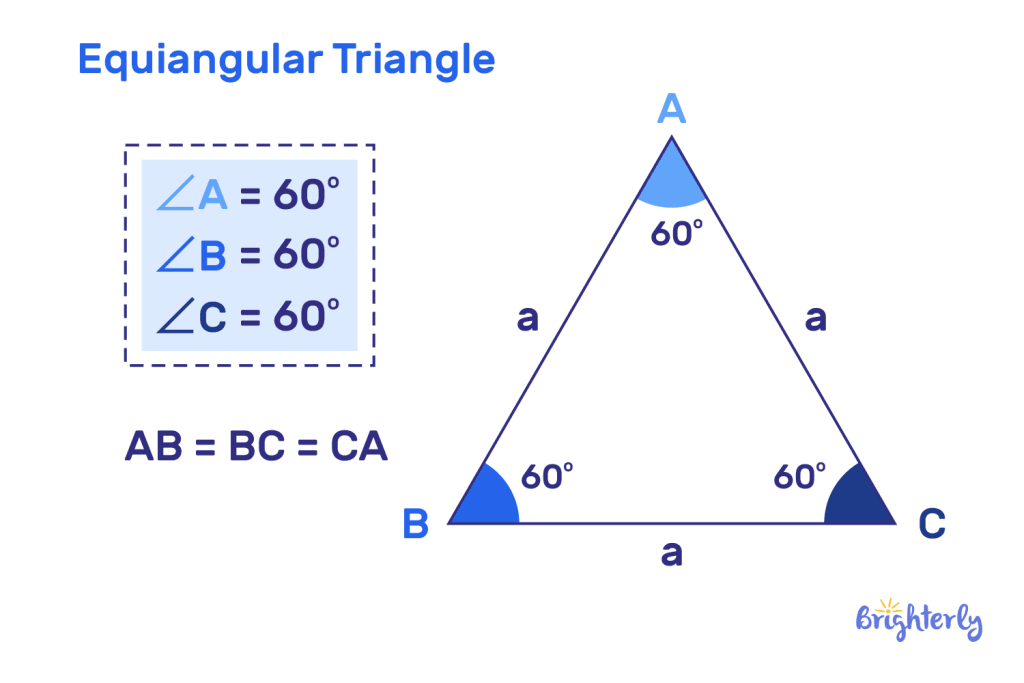
Shape of an equilateral triangle
An equilateral triangle has three equal sides and three equal angles, making it perfectly symmetrical. This simple balance makes it easy to understand basic geometry and see how sides and angles relate to one another.
Properties of equiangular triangles
Depending on their characteristics, angles, and sides, triangles can be classified as either a right triangle or an isosceles triangle. Based on its angles and sides, an equiangular triangle has the following characteristics:
- The three sides of an equiangular triangle are congruent with one another.
- In an equiangular triangle, the radius of an encircle is precisely half that of a circumcircle.
- Each of the three angles measures 60° and is equal to the others.
- An orthocenter and a centroid are regarded as the same point in an equiangular triangle.
- Equiangular triangle examples do not include right-angled triangles, isosceles triangles, or scalene triangles, because none of their three interior angles are 60° or equal to one another.
- An equiangular triangle is always an acute-angled triangle because its angles are 60 ° each.
Comparison: Scalene, isosceles, and equilateral triangles
Depending on their sides and angles, triangles can have a wide range of appearances. All three sides and angles of an equiangular triangle are equal. A scalene triangle has no matching sides or angles, whereas an isosceles triangle has just two sides and identical angles.
Equilateral triangle theorem
The equiangular triangle theorem states that a triangle is equilateral if and only if it’s equiangular. In short, all three of a triangle’s angles will be equal if all three of its sides are the same length, and vice versa. This theorem shows that a triangle’s angles and sides are connected, so knowing one lets you find the other.
Equilateral triangle formulas
An equiangular triangle’s area can be calculated using the following formula: Area = (√3 / 4) × side², where “side” refers to the triangle’s edge length.
We use another simple formula to determine the perimeter: 3x side is the perimeter.
Formulas for equilateral and equiangular triangles help us understand their size and shape and show how these triangles appear in geometry and real-world applications.
Area of an equilateral triangle
To determine the area of an equiangular triangle, you only need to know the length of one side because all of its sides are equal. For instance, you can use the formula Area = (√3 / 4) x side². Thus, if each side is 4 units long, Area = (√3 / 4) x 4² = 4√3 square units.
Perimeter of an equilateral triangle
Similarly, we multiply the length of one side by three to determine the perimeter of the shape. For instance, the triangle’s perimeter is 3 x 5 = 15 units if one of its sides is 5 units.


Height of equilateral triangle
Pythagoras’ theorem, or the formula Height = √3/2 x side, can be used to determine the height of an equilateral equiangular triangle, also known as the altitude. When solving three-dimensional geometric problems, such as determining the volume of a pyramid with an equilateral triangle base, this computation is useful.
Centroid of equilateral triangle
In an equilateral triangle, the three medians — lines from each vertex to the midpoint of the opposite side meet at a single point called the centroid. In this triangle, the centroid, circumcenter, incenter, and orthocenter all overlap, showing the shape’s perfect symmetry and balance.
Constructing an equiangular triangle
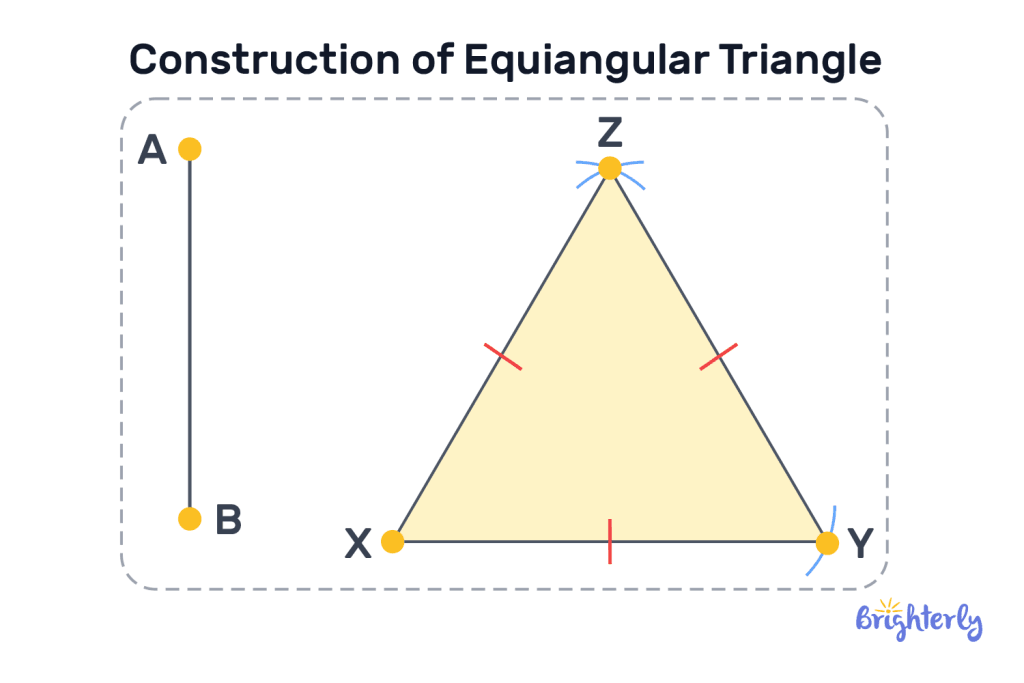
After we learned the equiangular triangle definition, it’s time for practice! Start by drawing a straight line for one side. Then, using a compass, draw arcs from each endpoint and connect the points where the arcs cross. This creates a triangle with all sides and angles equal.
How to construct an equiangular triangle?
Draw a segment for the base. With a compass set to the same radius, make arcs from each endpoint so they intersect. Join the intersection point to the ends of the base.
Practice questions on equiangular triangle
- If all angles in a triangle are equal, what is the measure of each angle in an equiangular triangle?
- If one side of an equiangular triangle is 6 units long, what is its perimeter?
- Using the formula Area = √3/4 × side², find the area of an equiangular triangle with a side of 4 units.
- True or False: All equiangular triangles are also equilateral triangles.
Frequently Asked Questions on Equiangular Triangles
What does equiangular mean?
Equiangular means “equal angles.” In geometry, it describes a shape in which all angles are equal. For example, in an equiangular triangle, each angle measures exactly 60°, creating perfect symmetry and balance in the figure.
What is equiangular triangle?
An equiangular triangle is one where all three interior angles are equal.
Are all equiangular triangles equilateral?
Yes, all equiangular triangles are equilateral. Since all three angles measure 60°, their opposite sides must also measure 60°, making the triangle equilateral and equiangular simultaneously.
How to find the area of an equiangular triangle?
To find the area of an equiangular triangle, you simply need to know the length of one side.
What is the height of an equiangular triangle?
The height of an equiangular triangle is found using the formula: Height = (√3/2) × side. This line divides the triangle into two equal right triangles and helps calculate both the area and overall proportions of the shape.



Math & reading from 1st to 9th grade
Looking for homework support for your child?

Choose kid's grade

Math & Reading for Grades 1–9
Build real confidence for your child with a Brighterly math or reading tutor.