Equilateral Triangle – Definition with Examples
Updated on November 28, 2025
Here at Brighterly, we believe math should feel like playtime. This is why we’d love to introduce kids to the equilateral triangle — the shape perfectly balanced on all sides. By measuring, drawing, and dreaming up patterns, children discover the fun of geometry through its simple magic.
What is an equilateral triangle?
Equilateral triangles are perfectly balanced shapes with all sides having the exact same length. In its simplest form, the word “equi-” means “equal,” and that’s what this shape is.
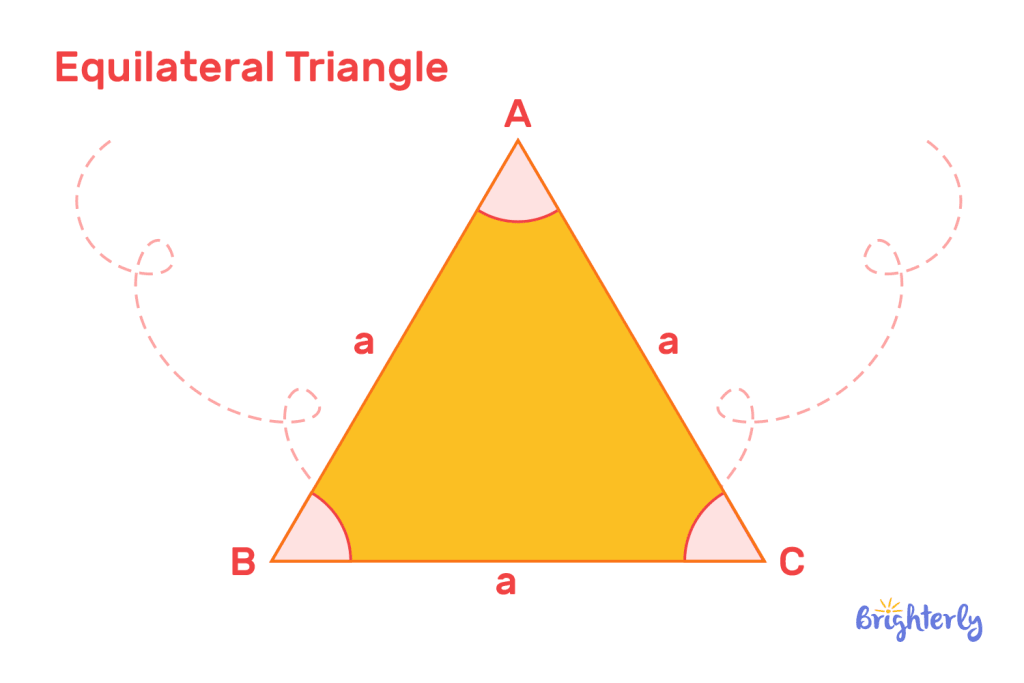
Shape of an equilateral triangle
Think of an equilateral triangle as a small spinning top that doesn’t wobble, no matter how you turn it. All corners embrace the same 60-degree angle, and all sides are exactly the same length!
You’ll spot these real life examples of equilateral triangle all around you without even trying. Consider the sturdy, stable frames of a playground slide, the tidy slices on a pizza wheel, or even the stylish, inverted logo on your backpack.
Properties of equilateral triangle
Here are some fun equilateral triangle facts. As with all triangles, each angle adds up to 180 degrees, and all three sides are the same length. You can also find the bisectors and medians of this shape by drawing a line from a corner to the height of the other side. There is a lot to like about equilateral triangles, as everything fits together so perfectly.
Comparison: Scalene, isosceles, and equilateral triangles
Scalene triangle, isosceles triangle, and equilateral triangle differ by the correlation of their sides, that is:
- Scalene triangles have different sides and angles, so their sides and angles are never equal.
- In an isosceles triangle, both sides are equal in size, and both angles are equal in size.
- A triangle with three equal sides and angles is called an equilateral triangle.
To effectively solve equilateral triangle problems and compare different types of triangles, it is essential to understand these differences.
Equilateral triangle formulas
Let’s use the equilateral triangle formula to keep things easy and enjoyable! Use Area = (√3 / 4) × side² to find the area. There is a very simple formula for calculating perimeter: perimeter = 3 × side.
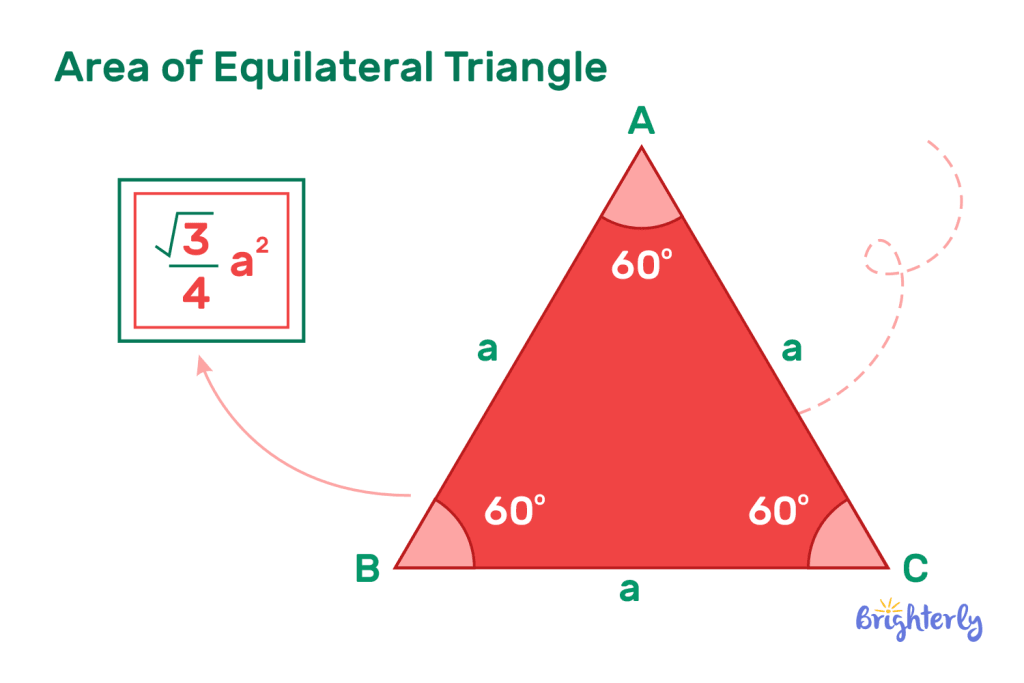
In addition to being equilateral, an equiangular triangle can also be equilateral (and vice versa).
What are NOT equilateral triangles?
Wondering which triangle is equilateral? Now you know, it’s the one with all three sides the same length. If even one side differs, it’s not equilateral. Some other similar types of triangles include isosceles triangles (two sides are equal), scalene triangles (all sides are different), and any triangle with right angles. And that simple equilateral triangle definition is exactly why this shape shows up everywhere, from pizza slices to playgrounds, ready to sprinkle a little harmony into our day!
Perimeter and area of equilateral triangle
Just multiply the side length by three — it’s that simple. To see how much space your triangle hugs, add a little magic to the area using the formula (√3 / 4) × side².
Height of equilateral triangle
We already dealt with the definition of an equilateral triangle, and its perimeter, so what’s about height? To find the height, use the friendly formula (√3 / 2) × side, and you’ll land on the perfect number.
Centroid of equilateral triangle
It’s the point where all the median lines connecting corners to midpoints meet. It maintains perfect balance by sitting precisely two-thirds of the way down any median in an equilateral triangle.
Circumcenter of an equilateral triangle
The circumcenter is the point where the perpendicular bisectors of all three sides intersect. In an equilateral triangle, this center coincides with the centroid, orthocenter, and incenter. It is also the center of the circumscribed circle that passes through all three vertices.


Equilateral triangle in real life
Equilateral triangles appear in engineering (bridge trusses), nature (honeycombs), and everyday objects (yield signs, pizza slices). Their equal sides provide strength and stability, which is why architects and designers use them. Children can spot them in playground equipment and logos too.
Practice problems on equilateral triangle
These quick exercises help kids and parents explore properties step by step:
- How many sides does a equilateral triangle have?
- If each side is 10 cm, calculate the perimeter and area.
- Find the height of a triangle with side length 12 cm.
Conclusion
The equilateral triangle isn’t just a shape on paper; it’s the quiet hero widespread in our day-to-day worlds. Spotting these equilateral triangle real life examples turns an ordinary walk or snack time into a secret geometry treasure hunt. So why not keep exploring? Your next favorite triangle is waiting just around the corner!
Frequently Asked Questions on Equilateral Triangle
What does equilateral mean in math?
Equilateral in math means every side of the triangle is exactly the same length. It’s all about fairness and balance in shape!
Which triangle is equilateral?
A triangle is equilateral when all three sides are the same length, no more, no less. If even one side is different, it’s not part of the equilateral club!
Do equilateral triangles have equal angles?
Yes, every angle in an equilateral triangle is 60 degrees, so all three corners are perfectly aligned. That’s what makes it so balanced and special.
What is the relationship between the sides and angles of an equilateral triangle?
When all sides are equal, all angles become 60 degrees too. Here’s the correlation: equal sides create equal angles, and equal angles need equal sides!
What are equilateral triangle real life examples?
Equilateral triangle real life examples include pizza slices, road signs, honeycombs, and playground frames.


Troubles with Geometry?
- Does your child struggle to master geometry?
- Try studying with an online tutor.
Choose kid's grade

Is your child having trouble understanding geometry? An online tutor could provide the necessary guidance.
Book FREE lesson