Obtuse Angle – Definition with Examples
Updated on December 1, 2025
Angles are a core component of geometry, and there are many different types of angles, each with their own unique properties.
One of those types is the obtuse angle. What makes the obtuse angle different from other angles is its degree measurement: an obtuse angle is always larger than 90° but smaller than 180°. You’ll see obtuse angles in many shapes, including real-life objects around us.
Here, we’re going to cover everything you need to know about the obtuse angle. We’ll take you through the obtuse angle definition in geometry, examples of these angles, where they fit into real life, and how they compare to other types of angles. We’ll also share some practice test questions with you so you can test your new knowledge.
Let’s get into it!
What is an obtuse angle?
An obtuse angle is a type of angle defined by its degree measurements, which are always larger than 90° but less than 180°. You’ll see the obtuse angle in a range of different geometric shapes, from triangles and parallelograms to hexagons and pentagons.
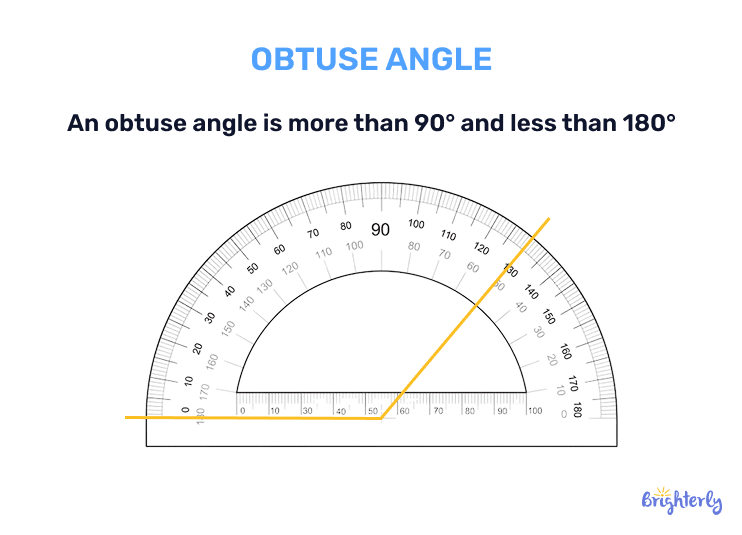
Obtuse angle definition
The definition of obtuse angle is an angle that is greater than 90° but smaller than 180°. This means that an obtuse angle is wider than a right angle (which is exactly 90°) but narrower than a straight angle (which is 180°). It also differs from the acute angle, which measures less than 90°.
Obtuse angle of a triangle
One of the most common shapes in which you’ll find an obtuse angle is a triangle. These three-sided polygons come in lots of different categories, including right-angled triangles and isosceles triangles, but you won’t find an obtuse angle in any of them.
Triangles can only have one obtuse angle. That’s because obtuse angles are always bigger than 90°, meaning that two obtuse angles would add up to more than 180°, while the sum of a triangle’s three angles will always be 180°.
Obtuse triangles — aka triangles that have obtuse angles — can be isosceles or scalene triangles.
- An isosceles triangle has two sides of equal length, plus two opposite angles that are equal. The other angle, therefore, can be an obtuse angle.
- Scalene triangles, meanwhile, have lengths and angles that are all different, and they too can have an obtuse angle.
There are two types of triangles that can’t have an obtuse angle: the right-angled triangle and the acute triangle. The right-angled triangle can’t have an obtuse angle because one angle is always 90°, meaning an angle of over 90° isn’t possible. An acute triangle cannot have an obtuse angle because it is defined by the fact that all three angles are acute angles.


Obtuse angle of a rhombus
Did you know that certain types of rhombuses can have obtuse angles? These shapes have sides that are all of equal length, and opposite angles that are equal. The square is a specific type of rhombus, but this can’t have obtuse angles because all angles in a square are equal at 90°.
Rhombuses that aren’t squares will always have two angles that are obtuse and two acute angles. They are examples of shapes with 2 obtuse angles. The two obtuse angles will be opposite angles, also known as pairs of angles, and will be equal to one another. This is true of the two acute angles, too.
Obtuse angle of a parallelogram
Like rhombuses, some parallelograms will have obtuse angles too — but again, squares do not have obtuse angles even though they are a special type of parallelogram. This is also true of rectangles, because their internal angles are always 90°.
Parallelograms that aren’t squares or rectangles will have a pair of obtuse angles and acute angles. You can see here that this is true of both parallelograms and rhombuses with these angles. These shapes have parallel pairs of sides, and these pairs of sides will also be the same length, which is what makes them different from rhombuses.
Obtuse angle degree
The key defining factor of obtuse angle shapes is the degrees of their angles, which will always be larger than 90° and smaller than 180°. This means that the degrees of an obtuse angle can be between 91° and 179°. That’s because 90° is a right angle, and 180° is a straight angle.
Obtuse angles in real life
We can see an obtuse angle real life example almost everywhere we look! For example, the angle of the top of your roof at home or school could be an obtuse angle, depending on the angle needed to effectively drain water. When you have an open book in front of you, the angle between the covers is obtuse. Similarly, you can open up a pair of scissors to represent an obtuse angle, too.
Acute and obtuse angles
Acute and obtuse angles are two distinct types with different properties. We know now that angles that are obtuse will be larger than 90° and smaller than 180°, while the acute angle will be smaller than 90°. This means an acute angle will always measure between 1° and 89°. A fun fact is that many shapes that have obtuse angles, like triangles, parallelograms, and rhombuses, will also have at least one acute angle.
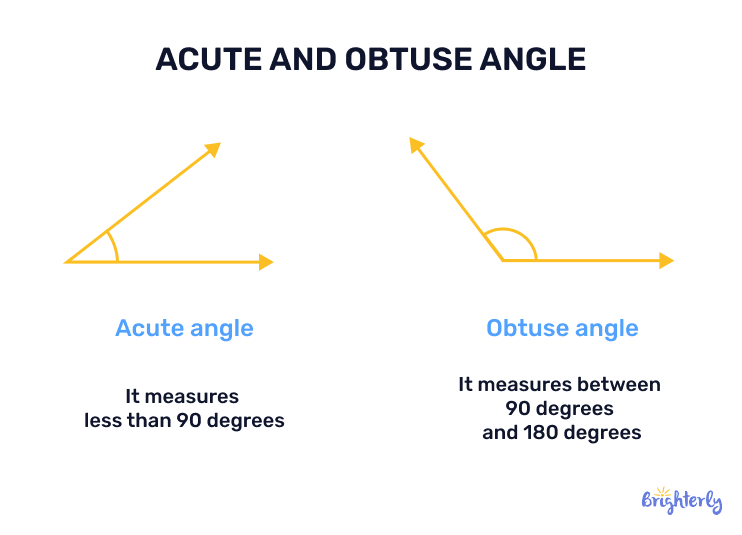
Obtuse angle examples
Let’s look at some more examples of obtuse angles so you can begin to spot them more easily:
- The capital letter K has an obtuse angle
- Opening a door past its hinge point creates an obtuse angle between the door frame and the door
- A reclined chair will usually recline at an obtuse angle
- Regular shapes with more than 4 sides will often have obtuse angles — these include pentagons, hexagons, septagons, and more
Practice questions on obtuse angle
Now that you know all the important information on obtuse angles, are you ready to put it into practice? The questions below have been formulated to allow you to apply your new knowledge, which can help you become more comfortable with answering real exam questions on geometry and angles. Grab a pen and paper and write your answers down!
- You have a shape with an angle of 110°. Is this an obtuse angle? Show your reasoning.
- You have a parallelogram with one angle of 120 degrees. Work out the other three angles based on this.
- Can a rectangle have an obtuse angle? Tell us why.
- Name some objects from your classroom which have an obtuse angle.
Conclusion
Now, you can consider yourself an expert on the obtuse angle! Here, we have explained the obtuse angle meaning and this type of angle unique properties. We’ve also answered questions like “Which shape has an obtuse angle?” and “What is the difference between acute and obtuse angles?”
We’ve also shared obtuse angle real world example and geometric examples, and how they work in shapes including triangles, rhombuses, and parallelograms. This foundational information will set you on the path to a successful education in math and geometry!
Frequently asked questions on obtuse angle
What is obtuse angle?
An obtuse angle is an angle that measures more than 90° but less than 180°. This means its degree measurements can range from 91° to 179°. Obtuse angles can be found in many different shapes, from triangles and rhombuses to pentagons and parallelograms.
Can a triangle have more than one obtuse angle?
No, a triangle cannot have more than one obtuse angle. This is because the sum of all three angles in a triangle is always 180°. If a triangle had two obtuse angles, they would total more than 180°. This means the total would already exceed the required total.
Are the opposite angles of a parallelogram with obtuse angles also obtuse?
Yes, the opposite angles of obtuse angles in a parallelogram will also be obtuse. They will also be equal, meaning that their degree measurements are the same, as all opposite angles are equal in a parallelogram. This also means that the other pair of angles will be acute.
Can a square have an obtuse angle?
No, a square cannot have an obtuse angle. This is because one of the fundamental properties that defines a square is the fact that it has four equal angles of 90°. If any of the angles in a square were obtuse, this would mean it is no longer a square.


Struggling with Geometry?
- Does your child struggle with understanding the fundamentals of geometry?
- Try lessons with an online tutor.
Choose kid's grade

Is your child having difficulties with mastering the concept of geometry? An online tutor could provide the necessary support.
Book FREE lesson