Thousandths
Updated on November 28, 2025
Having a good understanding of thousands makes working with decimals and small numbers much easier. The more you understand how the parts inside them fit together, the simpler even the trickiest calculations become. Often, you can find them in everyday life, such as reading measurements and sharing resources fairly. Brighterly is here to show how these parts appear in practical situations, making learning decimals simple, clear, and even a little fun.
What are thousandths?
The decimal system is made up of tenths, hundredths, thousandths, and even smaller parts. The thousandth place is the third digit to the right of the decimal point. For example, in the number 7.123, the digit 3 is in the thousandth place. To read decimal numbers, first say the whole number part, then say “point,” and finally read each digit after the decimal one by one. So, 7.123 is read as “seven point one two three.”
Thousandths definition
A thousandth is one part of a whole divided into 1,000 equal parts, smaller than tenths and hundredths.
Two are in the thousandth place of the number 4.372, which means two out of 1,000. When performing science experiments and calculating money, a thousandth’s knowledge is necessary.
What is the thousandths place?
The thousandth place is the third digit to the right of the decimal point in a number. It represents one part out of a thousand. For example, in 5.683, the digit 3 is in the thousandth place.
Decimals place value chart
With a treasure map, navigate the world of decimal places. Starting with whole numbers, you pass the decimal point, move through tenths and hundredths, and finally reach the thousandth place.
For example, the decimal number 354.867 in the place value system will be written as:
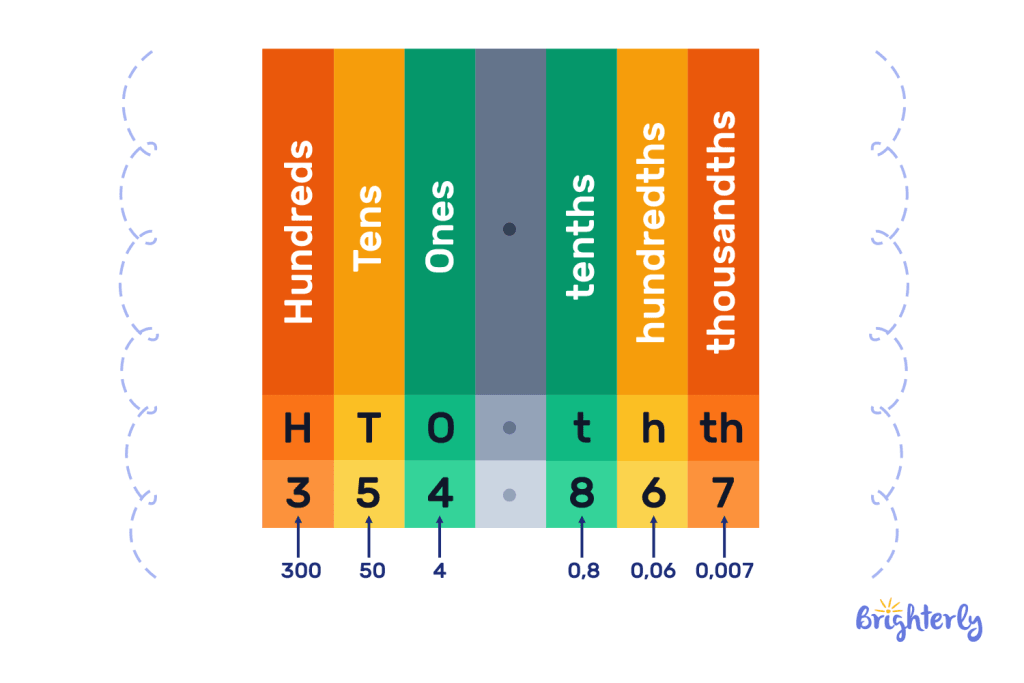
The tenth represents one tenth, the hundredth represents one hundredth, and the thousandth represents one thousandth.
Tenths, hundredths, and thousandths
The best way to understand one thousandth is to break it down step by step.
Tenths
An equal part is a tenth, which can be found by dividing a whole into 10 parts. Each part is called a tenth. When you have four tenths, that means you have four out of ten equal parts.
Hundredths
The hundredth comes from dividing a whole into 100 equal parts. In each part, there is a hundredth. Using 6.25 as an example, it means six whole parts plus 25 hundredths.
Thousandths
In math, thousandths refer to the division of a whole into 1,000 equal parts. Parts are divided by one thousandth. An example of this would be the number 1.409, which consists of one whole number, four hundredths, and nine thousandths.
Visual representation of one thousandth
In math, a thousandth refers to a number smaller than one. A part is created when 1,000 equal pieces are divided into a whole. We can read decimals, do calculations, and understand how numbers are composed of many parts when we understand thousandths.
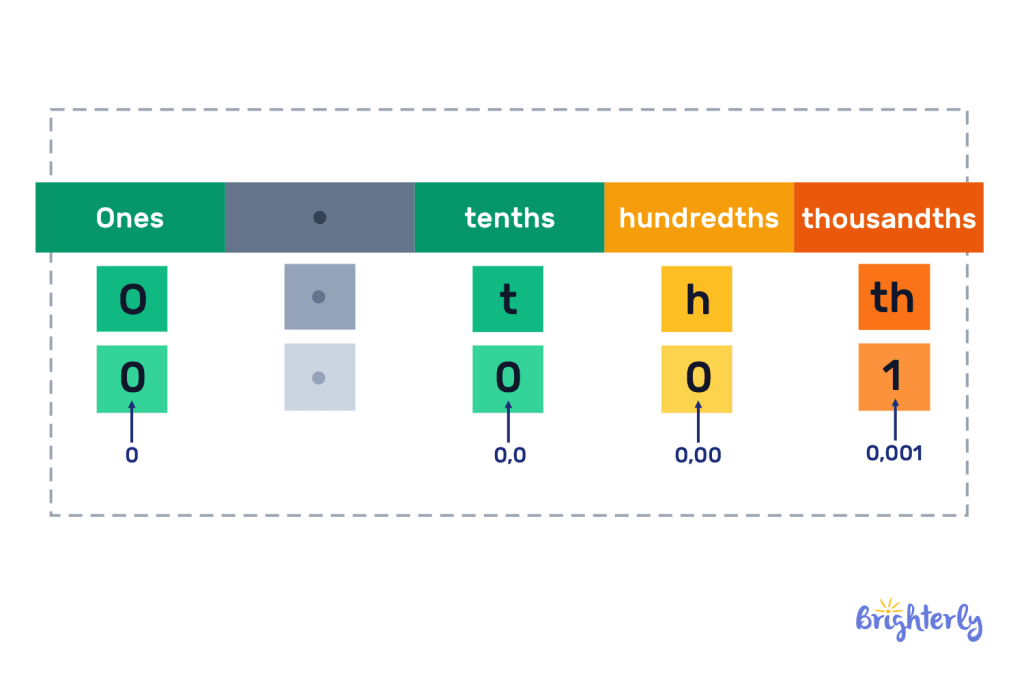
Representing thousandths using base ten blocks
Base ten blocks make it easier to visualize the thousandth place in a decimal. Each tiny cube represents one thousandth. Ten of these cubes can be combined to form a rod representing one hundredth. Then, ten hundredths rods can be combined to create a square representing one tenth. This visual approach helps students understand how decimals are built from smaller parts.
Fractions with 1000 as a denominator
There is also the possibility of representing thousandths as fractions with 1000 as the denominator. When 0.001 is converted to 1/1000, for example, we get 1/1000. A thousandths place example is 0.237, which is written as 237/1000, showing how each digit represents a tiny part of a whole. This allows you to see how small each part of a thousand really is!
Representing thousandths on a number line
You can divide the number line 0 to 1 into 1,000 equal parts. One thousandth makes up each part. We can better understand decimals when we can see very small numbers. With a number line, you can see exactly where a number falls and how each part fits together. This makes learning about thousandths easier and clearer.
‘Thousandth’ as an ordinal number
To indicate someone’s position, we use “first,” “second,” or “third.” In this regard, there is no major difference between a thousandth and a ten thousandth! Imagine 1,000 kids participating in a big race. First place means you crossed the finish line first!
In the same way, finishing 1,000th in a race indicates a very small position. This is the third digit after the decimal point, and indicates how many parts there are in a thousand. When 2.438 is written, the eight is in the thousandth place, which means it is the eighth out of 1,000.
For every step that is one-thousandth of a meter, it takes 1,000 steps to make one meter. Even though it’s only a small fraction, it makes a huge difference in precision measurements, savings, and scientific experiments.


Solved examples of thousandths
- In 5.482, find the thousandth place
There are three digits after the decimal point in the thousandth place. This is the digit 2 in 5.482.
- Write 0.736 as a fraction
If you want to write 0.736 as a fraction, use 1000 as the denominator since it goes to the thousandths. The value of 0.736 is 736/1000. 736/1000 is the result.
- Using thousandths to compare 0.854 and 0.845
To compare 0.854 and 0.845, look at each digit from left to right. The hundredths place shows 5 > 4, so 0.854 is greater than 0.845, even though the thousandths place has 4 < 5.
- To the nearest thousandth, round 7.12567
Check the fourth digit after the decimal (the ten-thousandth place). Six is greater than five, so we round up the third digit (thousandths place). It becomes 7.126 instead of 7.125.
Practice problems of thousandths
- Identify the digit in the thousandths place for 9.307
- Write 0.482 as a fraction with 1000 as the denominator
- Compare the numbers 0.639 and 0.693 using thousandths
- Round 12.7649 to the nearest thousandth
Conclusion
Even though thousandths are small, they play an important role in understanding decimals. Thus, knowing where is the thousandths place helps us visualize how a larger whole can be divided into smaller, more precise parts. A number line, base ten blocks, or even a pizza divided into 1000 slices make thousandths easy to understand. It builds a strong foundation for all kinds of math adventures for young mathematicians to learn the thousandth decimal to correctly read, write, compare, and round decimals!
Frequently asked questions of thousandths
What is a thousandth?
A thousandth is one part of a whole divided into 1,000 equal pieces. It’s the third digit after the decimal, like the 3 in 7.123. Thousandths help us understand very small quantities in math and everyday situations.
How many decimal places is thousandth?
A thousandth is the third digit after the decimal point. The first is the tenth, the second is the hundredth, and the third is the thousandth. For example, in 5.682, the 2 is in the thousandth decimal place.
What is the purpose of learning about thousandths?
Learning thousandths helps us handle small parts of a whole, work accurately with decimals, measure precisely, and manage money or science calculations. It also builds a strong foundation for comparing, rounding, and understanding numbers.
How can I practice thousandths more?
You can practice thousandths more by reading, writing, and rounding numbers with three decimal places. Convert decimals to fractions with 1000 as the denominator, use number lines or base ten blocks, and compare numbers to strengthen your understanding of thousandths.
How are thousandths used in real life?
Thousandths are used in real life in precise measurements, money calculations, science experiments, and engineering. They help ensure accuracy, divide resources fairly, and work with small decimal quantities in everyday life, making numbers easier to understand and calculate.


Struggling with Numbers?
- Is your child finding it challenging to master numbers basics?
- An online tutor could be the answer.
Choose kid's grade

Does your child struggle to understand the concept of numbers? Try lessons with an online tutor.
Book FREE lesson