Metric Conversion Worksheets
Updated on October 13, 2026
Metric conversion worksheets help students practice converting between units of length, mass, and liquid volume within the metric system. Brighterly’s printable worksheets cover relationships such as millimeters to centimeters, centimeters to meters, meters to kilometers, milliliters to liters, and grams to kilograms. These skills are especially important in Grade 5, when students work more systematically with measurement conversions and real-world problems.
Metric Conversion Worksheets PDF: Examples
Brighterly’s metric conversion worksheets help students understand how metric units relate to one another through powers of 10. Learners can convert between smaller and larger units, compare measurements, complete conversion tables, and solve practical problems involving length, mass, and liquid volume.
For example, 1 meter equals 100 centimeters, so 4 meters equals 400 centimeters. Similarly, 1 liter equals 1,000 milliliters, which means 2.5 liters equals 2,500 milliliters.
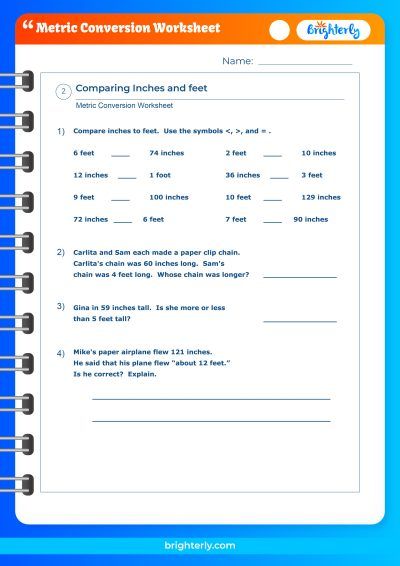
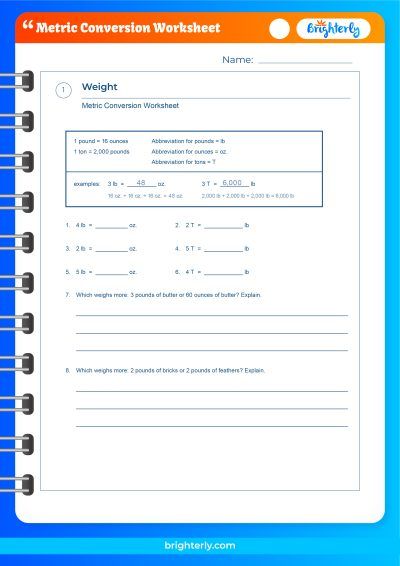
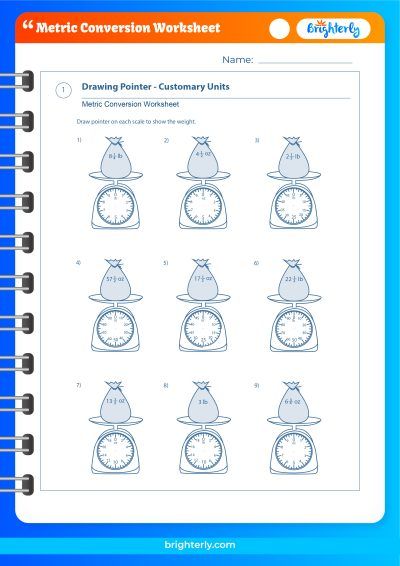
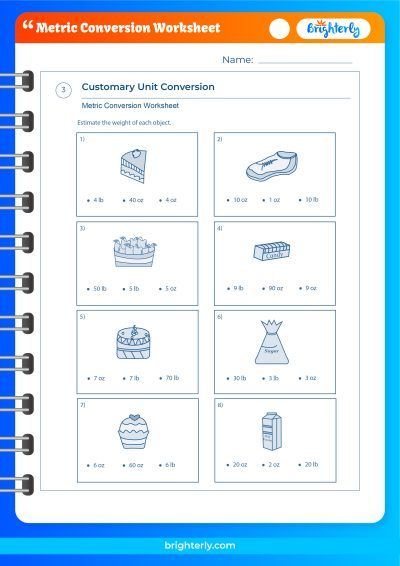
Metric Conversion Worksheets [Download for Free]
Download and print Brighterly’s free metric conversion worksheets for practice at home or in class. Students can work through metric length, mass, and liquid-volume conversions and use the answer keys to review their calculations.
Encourage your child to identify whether they are converting to a larger or smaller unit before calculating. This helps them decide whether the numerical value should become larger or smaller and provides a quick way to check whether an answer is reasonable. If your child needs personalized help with measurement, decimals, or unit conversions, an online math tutor can provide targeted practice based on their current skill gaps.


Ready to check those measurement skills?
A quick quiz can reveal measurement skills that need more practice
Metric Conversion Worksheets for Grade 5
Metric conversions are an important Grade 5 math skill because students begin working more confidently with relationships between different-sized units. Fifth graders can practice converting measurements such as 5 kilometers to 5,000 meters, 300 centimeters to 3 meters, 4 kilograms to 4,000 grams, or 2,000 milliliters to 2 liters. They also use conversions in word problems involving distance, mass, and liquid volume. These exercises reinforce multiplication and division by powers of 10 and prepare students for more advanced measurement work in middle school.
Students who are still learning the units themselves can begin with metric system worksheets. These activities focus on metric units such as meters, grams, and liters and the relationships between them.
For broader conversion practice that can include different measurement systems, use measurement conversion worksheets. This keeps the intent distinct: the worksheets on this page focus specifically on conversions within the metric system.
Students can also strengthen individual measurement skills with measuring lengths worksheets and measuring liquid volume worksheets.
For a wider range of grade-level topics, students can use Brighterly’s 5th grade math worksheets.
Benefits of Metric Conversion Worksheets
- Understand relationships between metric units
The metric system is organized around powers of 10, which makes its units closely connected. Students learn that 10 millimeters equal 1 centimeter, 100 centimeters equal 1 meter, and 1,000 meters equal 1 kilometer.
Recognizing these relationships helps learners understand the system instead of memorizing unrelated conversion facts.
- Convert between larger and smaller units
Students practice moving in both directions between units. Converting from meters to centimeters produces a larger numerical value because centimeters are smaller units, while converting centimeters to meters produces a smaller numerical value.
Thinking about unit size before calculating can help students catch errors involving multiplication and division.
- Practice metric length conversions
Metric length problems may involve millimeters, centimeters, meters, and kilometers. Students learn to choose an appropriate conversion factor and express the same length using different units.
For example, 3,500 meters can be written as 3.5 kilometers, while 62 centimeters can be written as 620 millimeters.
- Convert grams and kilograms
Metric mass conversions reinforce the relationship between grams and kilograms. Since 1 kilogram equals 1,000 grams, students can use multiplication or division by 1,000 to move between the units.
These conversions also appear naturally in real-world situations involving food, packages, and other measured quantities.
- Convert milliliters and liters
Students also practice liquid-volume relationships such as 1 liter = 1,000 milliliters. For example, 3 liters equals 3,000 milliliters, while 750 milliliters equals 0.75 liter.
For additional practice interpreting liquid measurements, students can use measuring liquid volume worksheets.
- Connect conversions with powers of 10
Metric conversions reinforce place value because many conversions involve multiplying or dividing by 10, 100, or 1,000. Students can use their understanding of decimal place value to see why 2.4 meters equals 240 centimeters or 3,000 grams equals 3 kilograms.
This connection helps make conversions more systematic and reduces reliance on memorized tricks.
- Apply metric conversions to word problems
Measurement problems often require students to convert units before comparing, adding, or subtracting quantities. A problem may ask whether 2 meters or 175 centimeters is longer, or how many milliliters are contained in several liters.
Working with these situations helps students decide which unit will make a calculation easier before solving the problem.
How to Use Metric Conversion Worksheets
Start by identifying the type of measurement involved: length, mass, or liquid volume. Then write down the relationship between the two metric units before performing the conversion.
Next, decide whether the target unit is smaller or larger. When converting to a smaller unit, the numerical value generally increases; when converting to a larger unit, it decreases.
Use multiplication or division by the appropriate power of 10, then label the answer with the correct unit. Encourage your child to check whether the size of the final number makes sense for the direction of the conversion.
Once straightforward conversions are comfortable, move to comparison questions, conversion tables, decimal measurements, and word problems involving more than one step.
Frequently Asked Questions
What Skills Do Metric Conversion Worksheets Help Students Practice?
Metric conversion worksheets help students practice converting between metric units of length, mass, and liquid volume. They also reinforce powers of 10, decimal place value, comparing measurements, choosing appropriate units, and solving measurement word problems.
What Grade Are Metric Conversion Worksheets For?
Metric conversions are especially important in Grade 5, when students work with conversions between different-sized measurement units and apply them to multi-step problems. These worksheets can also be used by students in other grades who need additional metric system practice.
What Metric Units Do Students Convert?
Common metric conversions include millimeters, centimeters, meters, and kilometers for length; grams and kilograms for mass; and milliliters and liters for liquid volume. Students learn the relationships between these units and use multiplication or division to convert them.
Are Metric Conversion and Measurement Conversion the Same Thing?
Metric conversion is a specific type of measurement conversion that works with units inside the metric system. Measurement conversion is broader and may also include customary units or conversions between different measurement systems, such as inches and centimeters.
Do Brighterly Metric Conversion Worksheets Include Answers?
Yes. Brighterly’s metric conversion worksheets include answer keys so students can check their calculations and review mistakes involving conversion factors, decimal placement, or the direction of a unit conversion.


Need help with Measurement?
- Does your child need extra support with understanding measurement concepts?
- Start lessons with an online tutor.
Choose kid's grade

Is your child finding it hard to master of measurement? An online tutor could be of help.
Book FREE lesson