Number Bonds Worksheets
Updated on October 22, 2026
Number bonds worksheets help kindergarten and 1st grade students understand how one whole number can be split into two smaller parts. Brighterly’s printable activities focus on number bonds within 20, missing parts, addition facts, and the relationship between addition and subtraction.
For example, the number 7 can be broken into 3 and 4 because 7 = 3 + 4. This part-whole model helps children see how numbers are connected instead of memorizing addition facts separately.
Number Bonds Worksheets PDF: Examples
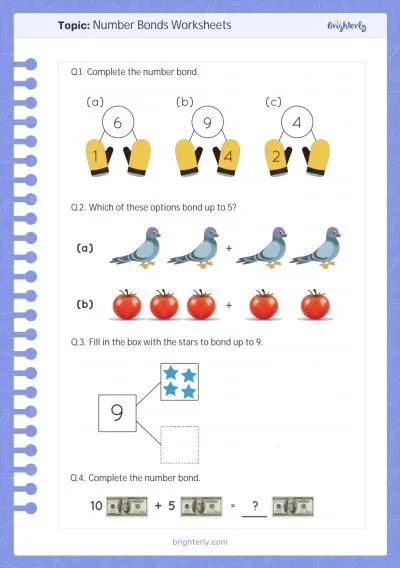
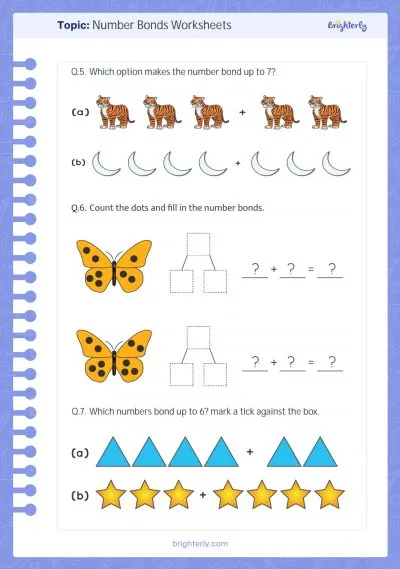
Brighterly’s number bond worksheets use part-whole diagrams, missing-number problems, and addition equations. Students identify the whole, find the two parts, or calculate a missing part when the whole is already known.
For example:
Whole: 7
Parts: 3 and 4
So:
7 = 3 + 4
Number Bonds Worksheet [Download for Free]
Download Brighterly’s free number bonds worksheets for kindergarten and 1st grade. The printable PDFs give children practice splitting numbers within 20, finding missing parts, and connecting number bonds with addition facts. Answer keys are included for checking completed work.
Students who are specifically working with combinations that total 10 can also use making 10 worksheets.
For broader early arithmetic practice, students can explore Brighterly’s 1st grade math worksheets or work through foundational skills in the math program.


Help your child reach their full potential!
Answer a few quick questions about your child’s learning, and we’ll recommend next steps.
How Number Bonds Work
A number bond shows the relationship between a whole and its parts. The largest number is usually the whole, while the two smaller numbers combine to make it.
For example:
7 = 3 + 4
Here, 7 is the whole, while 3 and 4 are the two parts.
A number bond can also contain a missing part:
10 = 6 + ?
Students ask what needs to be added to 6 to make 10:
10 − 6 = 4
So:
10 = 6 + 4
Number Bonds Within 10
Beginning number-bond practice often focuses on small totals. Students explore different pairs that make the same whole, such as:
- 5 = 1 + 4
- 5 = 2 + 3
- 5 = 5 + 0
Learning several ways to compose the same number helps children build flexible addition strategies. Brighterly’s addition to 10 worksheets provide more practice with these early facts.
Number Bonds Within 20
Once students understand smaller number bonds, they can use the same part-whole reasoning with larger numbers.
For example:
14 = 9 + 5
or:
18 = 10 + 8
Working within 20 helps 1st graders build fluency with addition and subtraction while preparing for more complex mental math strategies.
Number Bonds and Fact Families
One number bond can produce several related addition and subtraction equations.
Using the numbers 3, 4, and 7:
- 3 + 4 = 7
- 4 + 3 = 7
- 7 − 3 = 4
- 7 − 4 = 3
These related equations form a fact family. Students can continue practicing this relationship with fact family worksheets.
Benefits of Number Bond Practice
- Understand part-whole relationships. Number bonds show that a number can be composed of smaller parts, helping children develop a more flexible understanding of quantity.
- Build addition fluency. Repeatedly working with combinations such as 6 + 4 = 10 helps students recognize addition facts more quickly.
- Connect addition and subtraction. Students can use the whole and its parts to write both addition and subtraction equations, making the inverse relationship between the operations easier to understand.
- Practice missing numbers. Problems such as 10 = 6 + ? encourage students to reason backward and find an unknown part rather than simply calculate a given addition problem.
- Support mental math. Knowing common number combinations makes later strategies such as making 10 and using doubles easier. Students can also practice related patterns with doubles facts worksheets.
Other Worksheets
Frequently Asked Questions
What Are Number Bonds?
Number bonds are visual models that show how one whole number can be split into two parts. For example, 7 can be divided into 3 and 4 because 3 + 4 = 7. They help children understand addition and subtraction relationships.
What Grade Do Students Learn Number Bonds?
Students often begin working with simple number bonds in kindergarten and continue developing the skill in 1st grade. They practice composing and decomposing numbers within 10 and 20, finding missing parts, and connecting number bonds with addition and subtraction facts.
Do Number Bonds Worksheets Include Answers?
Yes. Brighterly’s number bonds worksheets include answer keys so students, parents, and teachers can check missing-part problems and number-bond equations after completing the activities.


Math & reading from 1st to 12th grade
Looking for homework support for your child?

Choose kid's grade

Math & Reading for Grades 1–12
Build real confidence for your child with a Brighterly math or reading tutor.