Parallel Lines and Transversals Worksheets
Updated on October 14, 2026
Parallel lines and transversals are important geometry concepts that help students understand how lines and angles relate to one another. Brighterly’s parallel lines and transversals worksheets give 8th grade students practice identifying and drawing parallel lines, recognizing transversals, and working with corresponding, alternate, vertical, and same-side interior angles.
These worksheets provide a broad introduction to the topic before students move on to more advanced problems involving algebra, proofs, and proving that lines are parallel. For a concept review, students can also explore Brighterly’s guides to parallel lines and transversal lines.
Parallel Lines and Transversals Worksheet PDF: Examples
Brighterly’s parallel lines and transversals worksheets include activities that ask students to identify parallel lines, locate a transversal, classify the angles created at each intersection, and find missing angle measures.
For example, students may need to recognize a pair of corresponding angles or determine that two alternate interior angles have equal measures when a transversal crosses parallel lines. Other problems help learners distinguish interior from exterior angles and identify supplementary angle pairs.
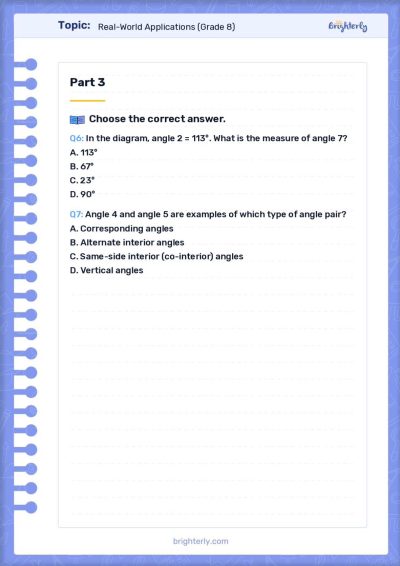
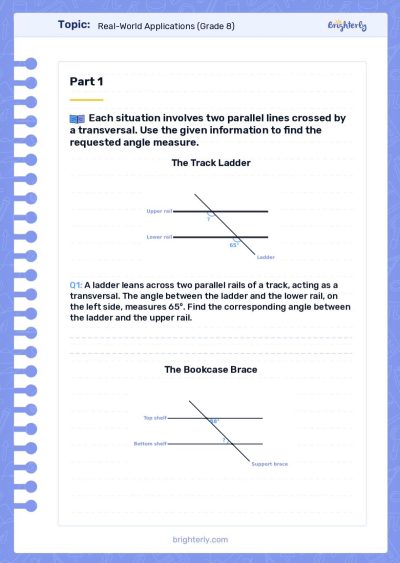
Parallel Lines and Transversals Worksheets [Download for Free]
Download Brighterly’s free parallel lines and transversals worksheets for additional Grade 8 geometry practice at home or in class. Students can use the exercises to review line relationships, angle vocabulary, and basic calculations involving parallel lines and a transversal.
The worksheets include answer keys, allowing students to check their angle classifications and calculations after completing the exercises.
If your child understands the terminology but still struggles to recognize angle relationships in diagrams, an 8th grade math tutor can provide personalized practice with geometry and other middle school math skills.


Check how well angle relationships stick
Reveal which geometry skills need more practice
Other Worksheets
- Points, lines and planes worksheets
- Lines and angles worksheets
- Parallel and perpendicular lines worksheets
- Pairs of angles worksheets
- Parallel lines cut by a transversal worksheets
- Geometry worksheets
Students who need more practice with basic geometric vocabulary can start with points, lines and planes worksheets or lines and angles worksheets.
Once identifying angle relationships becomes comfortable, students can move to parallel lines cut by a transversal worksheets. That collection focuses more heavily on calculating unknown angles, using algebraic expressions, and applying parallel-line theorems in high school Geometry.
Benefits of Parallel Lines and Transversals Worksheets
- Recognize parallel lines and transversals
Before students can work with angle relationships, they need to identify the lines in the diagram correctly. Parallel lines remain the same distance apart and do not intersect, while a transversal crosses two or more lines at different points.
- Identify corresponding angles
Corresponding angles occupy the same relative position at the two intersections created by a transversal. When the intersected lines are parallel, corresponding angles have equal measures.
For example, if one corresponding angle measures 65°, its matching angle also measures 65°. Students can review this relationship in Brighterly’s corresponding angles guide.
- Understand alternate interior angles
Alternate interior angles lie between the two parallel lines and on opposite sides of the transversal. When the lines are parallel, these angle pairs are congruent.
Learning to recognize their position in a diagram prepares students to solve missing-angle problems without measuring each angle directly. Brighterly’s alternate interior angles guide gives more examples of this relationship.
- Work with supplementary angle pairs
Same-side interior angles are located between the parallel lines on the same side of the transversal. When the lines are parallel, these two angles are supplementary, meaning their measures add to 180°.
For example, if one same-side interior angle measures 110°, the other measures 70°. Students can learn more about this rule through Brighterly’s same-side interior angles theorem.
- Find missing angle measures
Once students recognize an angle pair, they can use its relationship to calculate an unknown measure. They may use equal corresponding or alternate angles, supplementary same-side angles, vertical angles, or linear pairs to determine the missing value.
This encourages students to choose an appropriate geometry rule rather than relying on how a diagram looks.
- Build a foundation for high school geometry
Parallel lines and transversals introduce angle relationships that students will use again in triangle geometry, polygons, coordinate geometry, and geometric proofs.
The Grade 8 worksheets on this page emphasize recognizing and applying these relationships. More advanced high school problems may ask students to solve algebraic equations or prove lines parallel using converse theorems.
Parents who want a broader picture of this stage can read Brighterly’s guide to what students learn in 8th grade math, including the geometry foundations that prepare learners for high school.
How to Use Parallel Lines and Transversals Worksheets
Begin by asking your child to identify the two lines and the transversal in each diagram. Make sure they recognize which lines are marked as parallel before applying special angle rules.
Next, practice naming the angle pairs. Students should be able to distinguish corresponding, alternate interior, alternate exterior, and same-side interior angles based on their positions.
Then move to missing-angle problems. Encourage your child to name the relationship first and only then perform the calculation. For example, they might say “these are alternate interior angles, so they are equal” before writing the missing measure.
Drawing their own examples can also help. Brighterly’s article on how to teach geometry includes ideas for using drawing and visual activities to make geometric relationships easier to understand.
Students can also check their broader Grade 8 knowledge with the 8th grade math test or continue practicing other topics with 8th grade math worksheets.
Frequently Asked Questions
What Are Parallel Lines and Transversals?
Parallel lines are lines in the same plane that remain the same distance apart and never intersect. A transversal is a line that crosses two or more other lines at different points, creating several pairs of angles at the intersections.
What Angles Are Formed by Parallel Lines and a Transversal?
A transversal crossing parallel lines creates corresponding, alternate interior, alternate exterior, and same-side interior angle pairs. Corresponding and alternate angle pairs are congruent, while same-side interior angles are supplementary.
What Grade Are Parallel Lines and Transversals Taught?
Parallel lines, transversals, and their angle relationships are commonly practiced in Grade 8 geometry and provide a foundation for more advanced high school Geometry. Later problems may include algebraic angle expressions, converse theorems, and geometric proofs.
What Is the Difference Between These Worksheets and Parallel Lines Cut by a Transversal Worksheets?
These worksheets provide broader Grade 8 practice with identifying parallel lines, transversals, and basic angle relationships. Parallel lines cut by a transversal worksheets move further into high school-level calculations, algebraic angle problems, proving lines parallel, and geometric reasoning.
Do Brighterly Parallel Lines and Transversals Worksheets Include Answers?
Yes. Brighterly’s parallel lines and transversals worksheets include answer keys so students can check their angle classifications and calculations after completing the exercises.


Problems with Geometry?
- Does your child need additional assistance with mastering geometry?
- Start learning with an online tutor.
Choose kid's grade

Is your child finding it challenging to grasp of geometry? An online tutor could be the solution.
Book FREE lesson