Temperature Worksheets
Updated on October 22, 2026
Temperature worksheets help students in Grades 3–5 practice reading thermometers and interpreting temperature values. Brighterly’s printable activities focus on Celsius and Fahrenheit scales, scale intervals, comparing temperatures, and reading values above and below zero.
The goal of these worksheets is to understand what a thermometer shows rather than convert one temperature scale into another. Students who are ready to practice Celsius-to-Fahrenheit and Fahrenheit-to-Celsius formulas can use Brighterly’s temperature conversion worksheets.
Temperature Worksheet: Examples
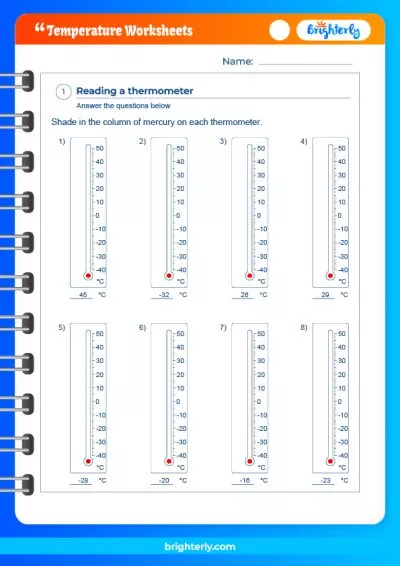

Brighterly’s temperature worksheets ask students to examine thermometer scales, determine the value of each interval, read the position of the liquid or marker, and compare temperature measurements.
For example, if a thermometer is marked in intervals of 5°C and the level is one mark below 0°C, the temperature is −5°C.
Temperature Worksheets [Download for Free]
Download Brighterly’s free temperature worksheets for Grades 3–5 to practice reading Celsius and Fahrenheit thermometers, comparing values, and interpreting temperatures below zero.
Temperature is one part of a wider set of measurement skills. Brighterly’s 3rd grade math skills checklist explains how measurement develops alongside other elementary math topics.
If reading measurement scales remains difficult, Brighterly’s math program can provide structured practice based on a child’s current skill level.


See how well measurement skills are heating up
A quick quiz can reveal which measurement skills need more practice
For broader work with measurement tools and quantities, students can also use 3rd grade measurement worksheets or explore Brighterly’s measurement worksheets collection.
How to Read a Thermometer
To read a thermometer accurately, students first identify the temperature scale and then determine the value represented by each mark.
- Check the unit. Look for °C for Celsius or °F for Fahrenheit.
- Find two labeled values. For example, the thermometer may show 10°C and 20°C.
- Count the spaces between them. Use these intervals to determine how much each small mark represents.
- Locate the top of the liquid or temperature marker.
- Read the matching value.
For example, if the marks between 10°C and 20°C increase by 2°C and the liquid stops at the third mark after 10°C, the thermometer reads 16°C.
Students can review temperature as part of the wider measurement topic in Brighterly’s measurement guide.
Skills Students Practice With Temperature Worksheets
- Read Celsius thermometers
Students identify temperature values shown on thermometers marked in degrees Celsius. They learn to read both labeled values and smaller intervals between them.
- Read Fahrenheit thermometers
Fahrenheit thermometer activities use the same scale-reading process but help students become familiar with the temperature system commonly used in the United States.
- Count scale intervals
Not every thermometer labels every degree. Students may need to determine whether each small mark represents 1, 2, 5, or another number of degrees before reading the temperature correctly.
- Compare two temperatures
Students compare temperature values to determine which is warmer or colder.
For example:
18°C > 12°C
So 18°C represents the warmer temperature.
- Read temperatures below zero
Some thermometer scales extend below 0. Students learn that negative temperature values represent colder temperatures and continue decreasing as they move farther below zero.
For example, −8°C is colder than −3°C.
- Match thermometers to temperature values
Students may also match a pictured thermometer with its numerical temperature or draw a marker at a given value. These exercises connect visual scale reading with written temperature notation.
Comparing Hot and Cold Temperatures
Temperature comparison requires students to consider numerical value rather than simply look at the thermometer image.
With positive temperatures, a larger number represents a higher temperature:
18°C > 12°C
With negative temperatures, the value closer to zero is higher:
−2°C > −7°C
This makes thermometer practice a useful real-world introduction to numbers below zero without turning the worksheet into a full lesson on integer operations.
Celsius and Fahrenheit Thermometers
Celsius and Fahrenheit are two different scales used to measure temperature. Students working with these worksheets should focus on identifying which scale a thermometer uses and reading the value shown correctly.
They do not need to convert a Celsius value into Fahrenheit on this page. That is a separate mathematical skill involving formulas and is covered in Brighterly’s temperature conversion worksheets.
Other worksheets
Frequently Asked Questions
What Skills Do Temperature Worksheets Practice?
Temperature worksheets help students read Celsius and Fahrenheit thermometers, interpret scale intervals, compare hot and cold temperatures, and work with temperatures above and below zero. The focus is on reading and understanding temperature values rather than converting between the two scales.
What Grades Are These Temperature Worksheets For?
These temperature worksheets are designed mainly for students in Grades 3–5 who are developing measurement skills. The activities include reading thermometer scales, comparing values, and interpreting negative temperatures.
How Do You Read a Temperature Below Zero on a Thermometer?
First determine the value of each interval on the thermometer, then count the marks below 0. Values become more negative as they move farther below zero. For example, one mark below 0 on a scale that increases by 5 degrees represents −5°.


Struggling with Measurement?
- Does your child have problems with measurement?
- Start studying with an online tutor.
Choose kid's grade

Is your child having trouble learning measurement? Start lessons with an online tutor.
Book FREE lesson