Time to the Hour and Half Hour Worksheets
Updated on October 21, 2026
Telling time to the hour and half hour worksheets help Grade 1 students learn the first two major analog-clock intervals. Children practice reading hour and minute hands, matching clock faces with digital times, and recognizing times such as 3:00 and 3:30.
These worksheets focus on whole and half hours before students move on to quarter hours, five-minute intervals, or exact-minute clock reading.
Telling Time to the Hour and Half Hour Worksheets PDF: Examples


When the minute hand points to 12, the clock shows an exact hour. For example, if the hour hand points to 3, the time is 3:00.
When the minute hand points to 6, 30 minutes have passed. If the hour hand is halfway between 3 and 4, the time is 3:30, or half past three.
Telling Time to the Hour and Half Hour Worksheet [Download for Free]
Download Brighterly’s free telling time to the hour and half hour worksheets for Grade 1. The printable PDFs help children read analog clocks, match analog and digital times, and draw hour and minute hands, with answer keys included.
If your child still finds time confusing, let our 1st grade math tutor explain the topic to them in detail.


Help your child reach their full potential!
Answer a few quick questions about your child’s learning, and we’ll recommend next steps.
How to Tell Time to the Hour
To read a whole-hour time, students first look for the minute hand. At an exact hour, the long minute hand points to 12.
The shorter hour hand then tells which hour it is.
For example:
Hour hand → 3
Minute hand → 12
Time → 3:00
Students can review the role of the short hand in Brighterly’s hour hand guide.
How to Tell Time to the Half Hour
A half hour equals 30 minutes. On an analog clock, the minute hand points to 6 because it has moved halfway around the clock face.
The hour hand also moves halfway toward the next hour. So at 3:30, the hour hand should sit between 3 and 4 rather than directly on 3.
This helps children understand that time continues moving between numbered hours rather than jumping instantly from one hour to the next.
Analog and Digital Time
Students can connect clock-hand positions with the digital format they see on phones, appliances, and schedules.
For example:
7 o’clock → 7:00
Half past 7 → 7:30
Connecting both formats helps children understand that analog and digital clocks represent the same time in different ways.
Bonus: Time to the Quarter Hour (Grade 2)
Some clock activities may also introduce quarter-hour times such as 3:15 or 3:45. These are a useful next step but are more closely aligned with Grade 2 practice than the main Grade 1 hour-and-half-hour skill.
Once a child is confident with 3:00 and 3:30-style problems, use telling time worksheets for Grade 2 to introduce quarter past, quarter to, and additional clock-reading intervals.
Benefits of Hour and Half Hour Practice
- Identify the hour and minute hands. Students learn that the shorter hand shows the hour while the longer hand shows the minutes.
- Recognize whole hours. Whole-hour practice gives beginning learners a simple rule: when the minute hand points to 12, read the number indicated by the hour hand.
- Understand half past. Half-hour exercises introduce the idea that 30 minutes is half of an hour and show how the hour hand moves between two numbers.
- Connect analog and digital clocks. Matching activities help students translate clock faces into digital forms such as 5:00 and 5:30.
- Prepare for more precise time reading. Once students can read hours and half hours confidently, they can progress to quarter hours, five-minute intervals, and eventually telling time to the minute worksheets.
Other Worksheets
- Clock worksheets
- Telling time worksheets Grade 1
- Telling time worksheets Grade 2
- Telling time to the minute worksheets
- Telling time worksheets Grade 3
Students who need broader first-grade time practice can also use Brighterly’s Grade 1 telling time worksheets, which reinforce clock-hand identification and hour-and-half-hour reading.
Frequently Asked Questions
What Grade Do Students Learn to Tell Time to the Hour and Half Hour?
Students commonly learn to tell time to the hour and half hour in Grade 1. They practice identifying the hour and minute hands, reading whole-hour times such as 3:00, and recognizing half-hour times such as 3:30.
How Do You Tell Time to the Half Hour?
At the half hour, the minute hand points to 6 because 30 minutes have passed. The hour hand sits halfway between the current hour and the next one. For example, halfway between 3 and 4 with the minute hand on 6 represents 3:30.
What Should Kids Learn After Telling Time to the Hour and Half Hour?
After mastering whole and half hours, students can move on to quarter-hour times such as 3:15 and 3:45, followed by five-minute intervals and exact-minute clock reading.


Struggling with Time in Math?
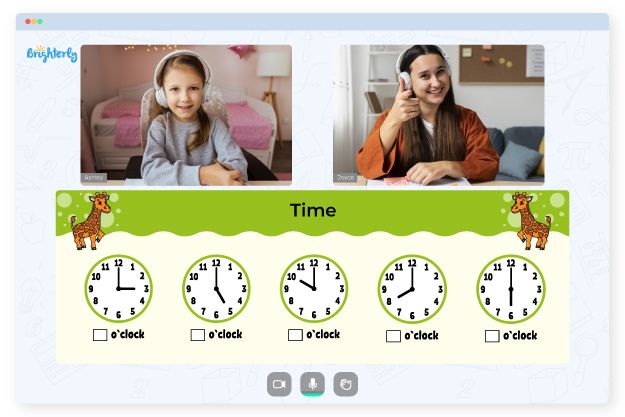
- Is your child having difficulty with basic time in math concepts?
- Try lessons with an online tutor.
Choose kid's grade

Does your child find time in math to be challenging? An online tutor can provide the needed guidance.
Book FREE lesson