CRA Math: What It Is and How the CRA Approach Works
reviewed by Jessica Kaminski
Updated on March 4, 2026

CRA math is a three-stage instructional method. It moves students through concrete, representational, and abstract phases to build conceptual understanding. This article describes the process. It includes examples, steps, and grade-level application instructions.
Key Points:
- CRA is a three-stage method guiding a student from Concrete (physical) to Representational (visual) to Abstract (symbolic) phases.
- It strives to eliminate memorization and build up a comprehensive understanding of math rules.
- In self-directed practice, it’s recommended to use household items, keep stages visible simultaneously, and avoid rushing to symbols too fast or using inconsistent tools.
- Brighterly offers expert help with printable worksheets, diagnostic math tests, and personalized tutoring.
What is CRA in math?
CRA is a math instruction method with three stages. First, students use physical objects. Second, they use drawings or images. Third, they use numbers and mathematical symbols. This sequence aligns with cognitive development theory to build a deeper understanding of the entire concept. It’s used in K-12 education to help students learn mathematical operations and logic.
Concrete
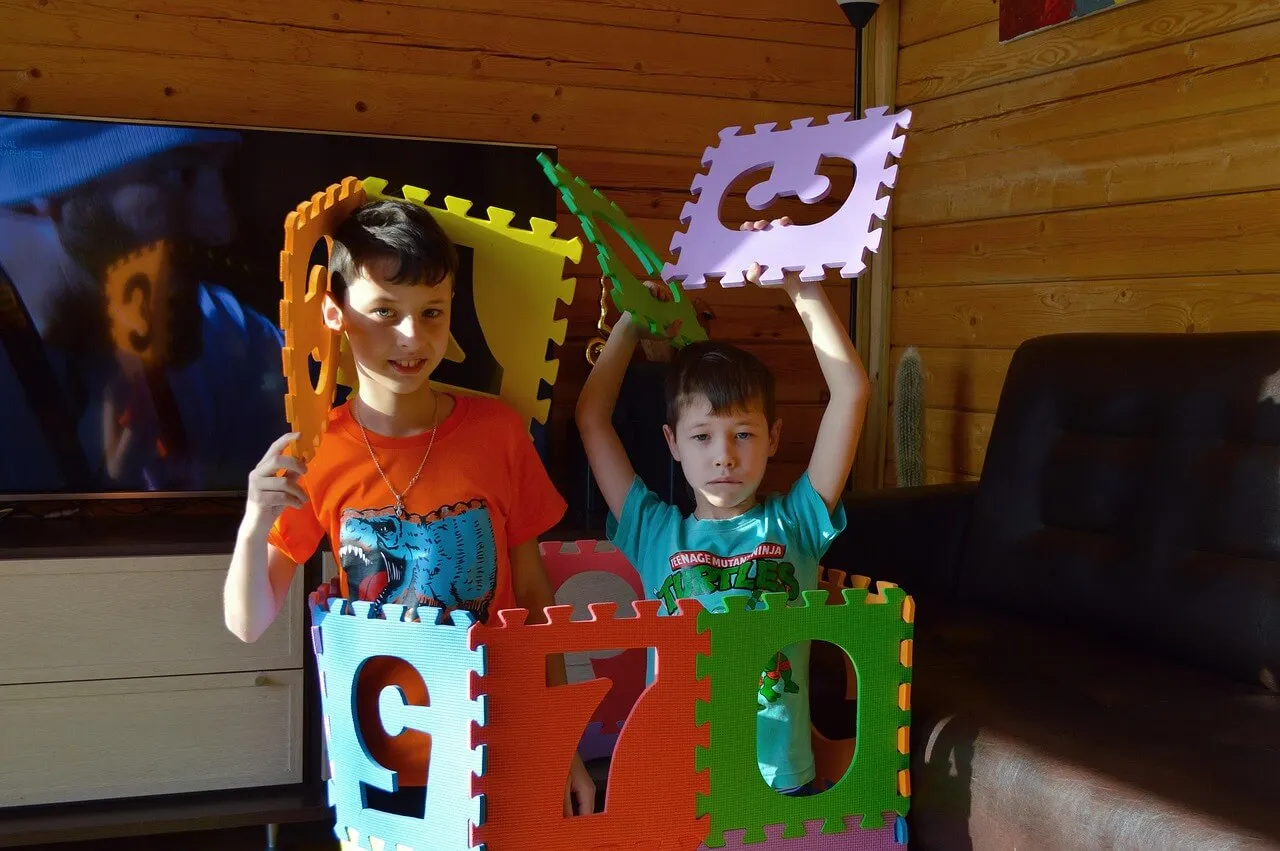
In this first stage of the CRA model math, children use physical objects to perform math tasks. They interact with items such as base-ten blocks, counting beads, and geometric tiles. Kids physically move and group these objects, which helps them gain a direct understanding of how numbers and operations essentially work.
Representational
The second stage, often called the pictorial phase, transitions students from dealing with physical objects to visual drawings. They create sketches (circles, line segments, tallies, etc.) to represent the items they previously handled. This stage facilitates a connection between physical activity and purely numerical work, as well as helps build a mental image of the mathematical process.
Abstract
In the final stage of the CRA math strategy, students use numbers and math symbols to actually solve problems. They work with written notation, such as 5 + 5 = 10, without the need for physical items or drawings. Kids reach this stage as soon as they have a firm grasp of the underlying logic developed during the concrete and representational phases. This transition is crucial for students who want to get better at math and solve problems with speed and accuracy.
Note: The Brighterly math and reading platform provides math lessons and assessments for kids who need extra practice. Diagnostic tests find exactly which skills your kid’s missing. Seasoned tutors then guide the student through lessons to improve their math understanding and accuracy.
Brighterly’s tutor will personalize lessons, selecting specific activities that match your kid’s unique learning style to ensure they spend as much time as they need to master every skill.
Consistent practice of the concrete representational abstract (CRA) approach will ultimately lead to better retention and higher accuracy for students in all grades.


Check the basics behind this term
Take our quick quiz to discover the perfect learning solution based on your child’s needs.
What does CRA stand for in education?
Educators use the CRA sequence to ensure students understand the meaning of their work. The systematic progression from physical interaction, which establishes a baseline of knowledge, to visual models reduces the need for memorization and focuses on the underlying principles of the subject matter.
It’s a structured way that schools provide for learners to transition from simple tasks to complex problem-solving. Given that it provides multiple ways to process information and, therefore, explain a concept in three different formats, this method is especially useful for supporting students with different learning needs. Besides, the connection between ADHD and math struggles often stems from difficulty with focus, which the concrete stage, in particular, helps improve.
What is the intention of the CRA model?
The goal of the CRA method is to remove the need for rote memorization by providing a physical and visual history for every number or symbol, so that kids can identify the quantity and meaning behind the digits they write.
This framework also aims to identify exactly where a student’s understanding fails. If, say, a child can’t draw a problem, an educator knows to return to physical objects. Gaining mastery at each level prevents the accumulation of learning gaps that often occur when students move too quickly into symbolic work.
How the CRA approach works?
The CRA framework functions as a tiered learning process that syncs instructional delivery with how the human brain processes information. To ensure that a student sees the relationship between a physical quantity and a written number, they should show mastery of a concept in a physical format prior to moving to a two-dimensional format, and finally to a symbolic one.
In the classroom, the educator strives to teach the concept and monitor the students’ ability to explain their work at every stage. For example, if a student can’t translate a drawing into a numerical equation, the instructor provides additional support at the visual level.
CRA Math examples by grade level
- Basic operations for kindergarten through 2nd grade
- Mastering multiplication and fractions in grades 3-5
- Ratio and percentage concepts for grades 6-8
- Algebra concepts for 9th-12th grades
K-2 addition/subtraction
At this age, the CRA focuses on making the concepts of ‘putting together’ and ‘taking away’ feel tangible. First, kids start with physically regrouping clusters of items to understand how numbers can be composed and decomposed. You can also use these same blocks to teach shapes to kids for recognizing geometric patterns while they count. They then move to using tally marks or filling in empty boxes on a grid to track their work.
Note: As soon as kids understand that a drawing represents a specific quantity, they begin writing equations using plus and minus signs to solve problems independently.
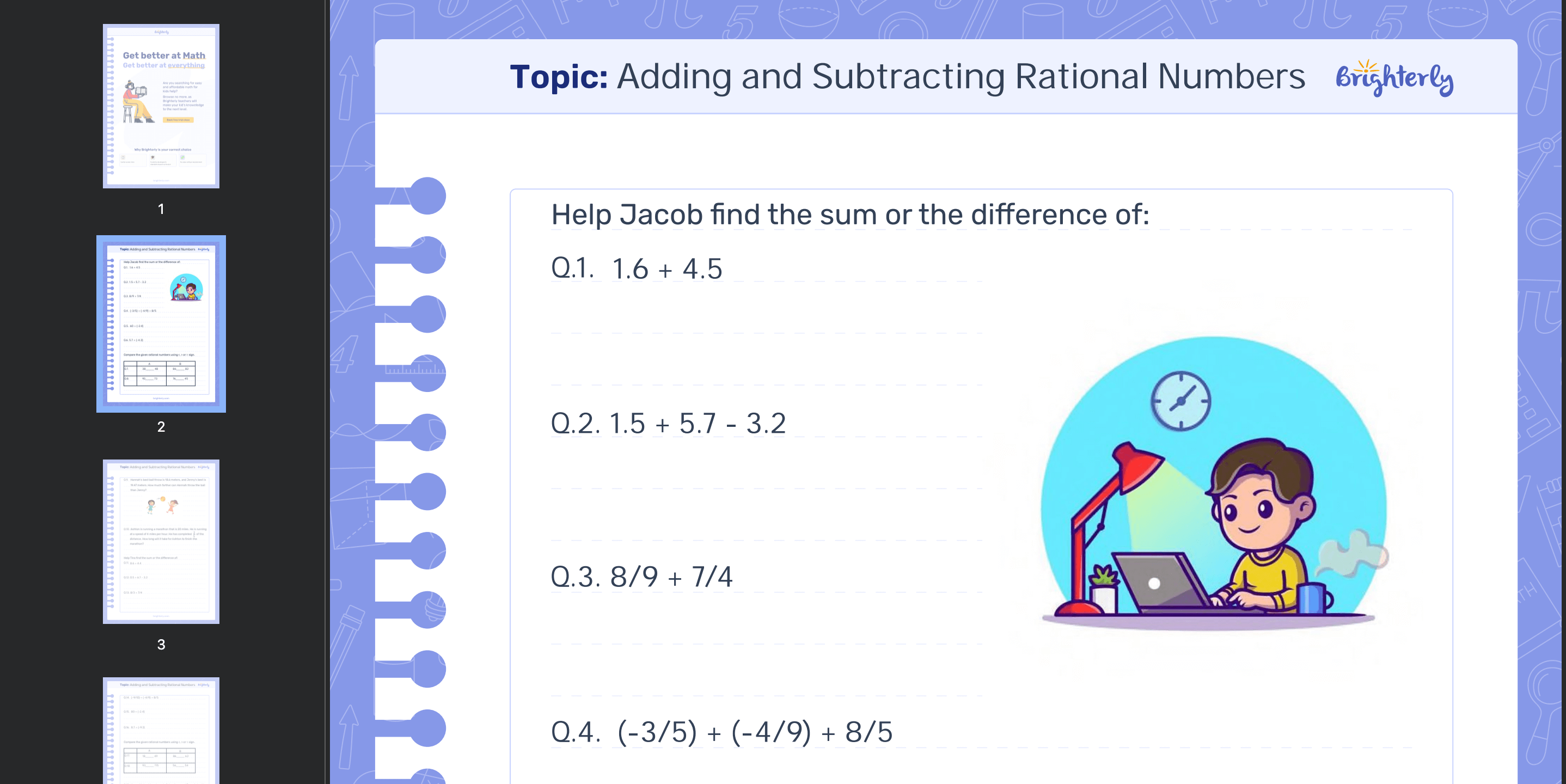
Brighterly’s addition worksheets provide a structured sequence of exercises that help kids transition from counting colorful objects to solving purely numerical problems. These – printable and free – materials use engaging themes and clear layouts to ensure your kid feels comfortable with each new math rule they encounter.
Mastering the initial stages of the concrete representational abstract math prepares a child for all future arithmetic lessons and, in particular, the more complex regrouping and multi-digit problems they’ll face in the 3rd grade. They naturally stop counting on their fingers and get a grasp of mental math.
Take our quick quiz to discover the perfect learning solution based on your child’s needs.
Check the basics behind this term
3 – 5 multiplication/division, fractions
In the upper elementary years, children apply the CRA sequence to more sophisticated operations. To understand multiplication and division, they physically arrange objects into equal groups or rows to see the relationship between factors and products. For fractions, kids use physical tiles or circles to see how parts make a whole.
Note: As soon as children can represent these actions with sketches (area models, tape diagrams, etc.), they begin to use symbols to solve long division or equivalent fraction problems.
Brighterly offers specialized multiplication worksheets that guide kids through these levels of the CRA strategy math by using visual arrays and step-by-step exercises to build mental math speed.
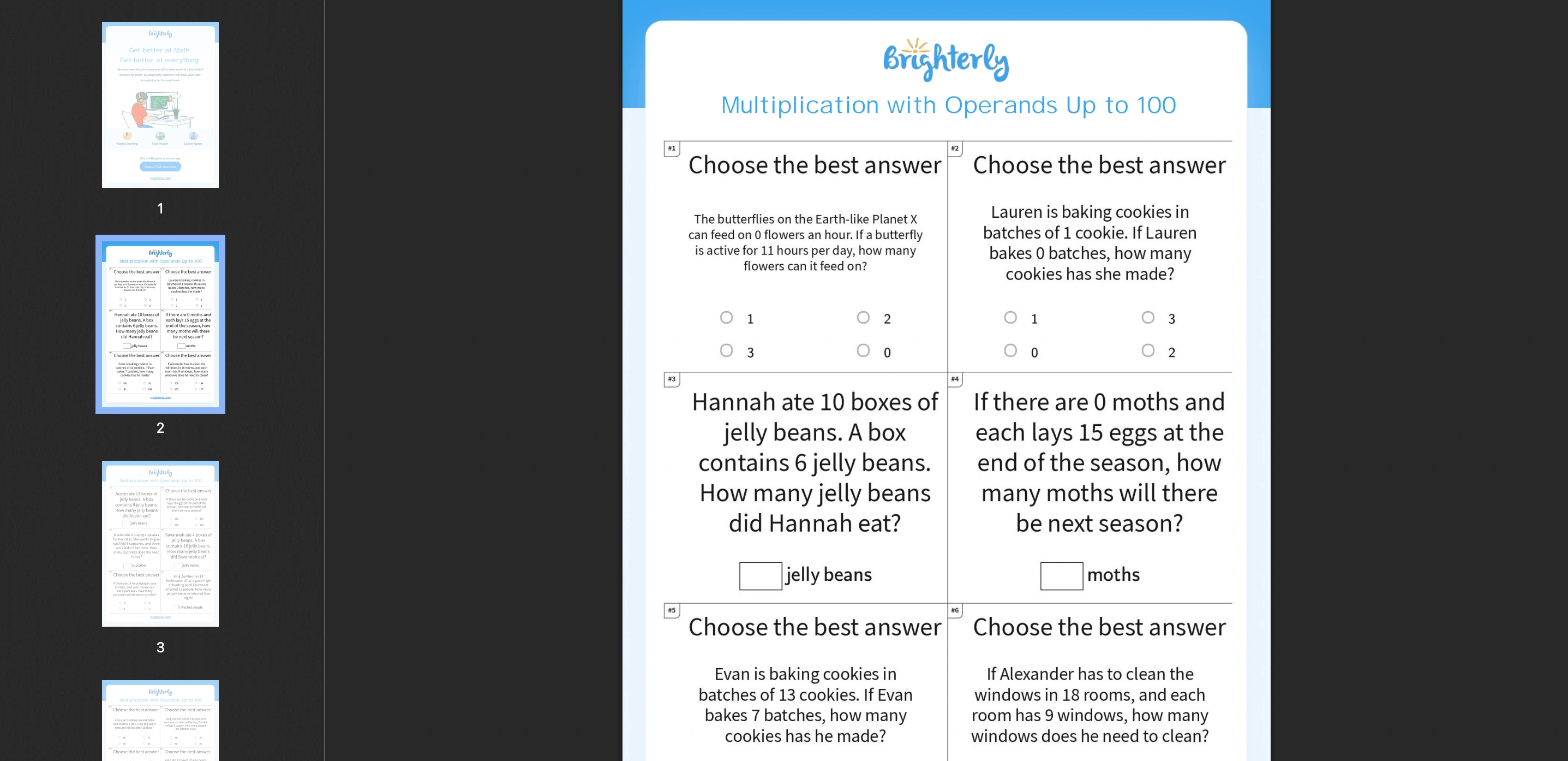
In the 3rd-5th grades, to make the transition from basic counting to complex operations more effective, it’s especially useful to apply multiplication and division as arrays (e.g., to help kids see that 4 x 3 isn’t just a math fact, but a physical space of 12 units) and fractions on a number line (e.g., to visualize that 1/2 and 2/4 occupy the same physical spot), etc.
6 – 8 ratios/percents
The middle school years are a time for students to shift from whole-number to proportional reasoning.
In the concrete phase of the CRA method math, they use colored beads or ‘double-sided counters’ to physically demonstrate a 2:3 ratio (like, placing two red chips for every three yellow ones).
To move into the representational stage, students draw ‘tape diagrams’ or ‘ratio tables’ to visualize these relationships on paper. Such sketches, in particular, help them understand percentages as ‘parts of one hundred.’
Once the student can accurately model a percent as a shaded portion of a 10×10 grid, they enter the abstract phase of the CRA math approach. In it, they solve complex algebraic proportions and percentage change problems using only numerical formulas.
From now on, middle schoolers can solve real-world problems involving discounts, interest, and scaling.
9 – algebra (equations, function representation)
In high school, students are meant to master variables and functions by grounding abstract symbols in physical logic. To ensure they see variables as actual quantities, they apply algebra tiles to physically balance equations and factor polynomials. Afterward, students draw graphs and coordinate planes to visualize how these values change. Result? They can finally solve multi-step equations using purely symbolic notation.
Note: For students who struggle with the shift to complex variables, the CRA math intervention may be required. Revisiting physical or visual models should enable older learners clarify the logic behind advanced equations.
Doing some extra practice with Brighterly’s algebra worksheets helps build the accuracy needed for college preparation.
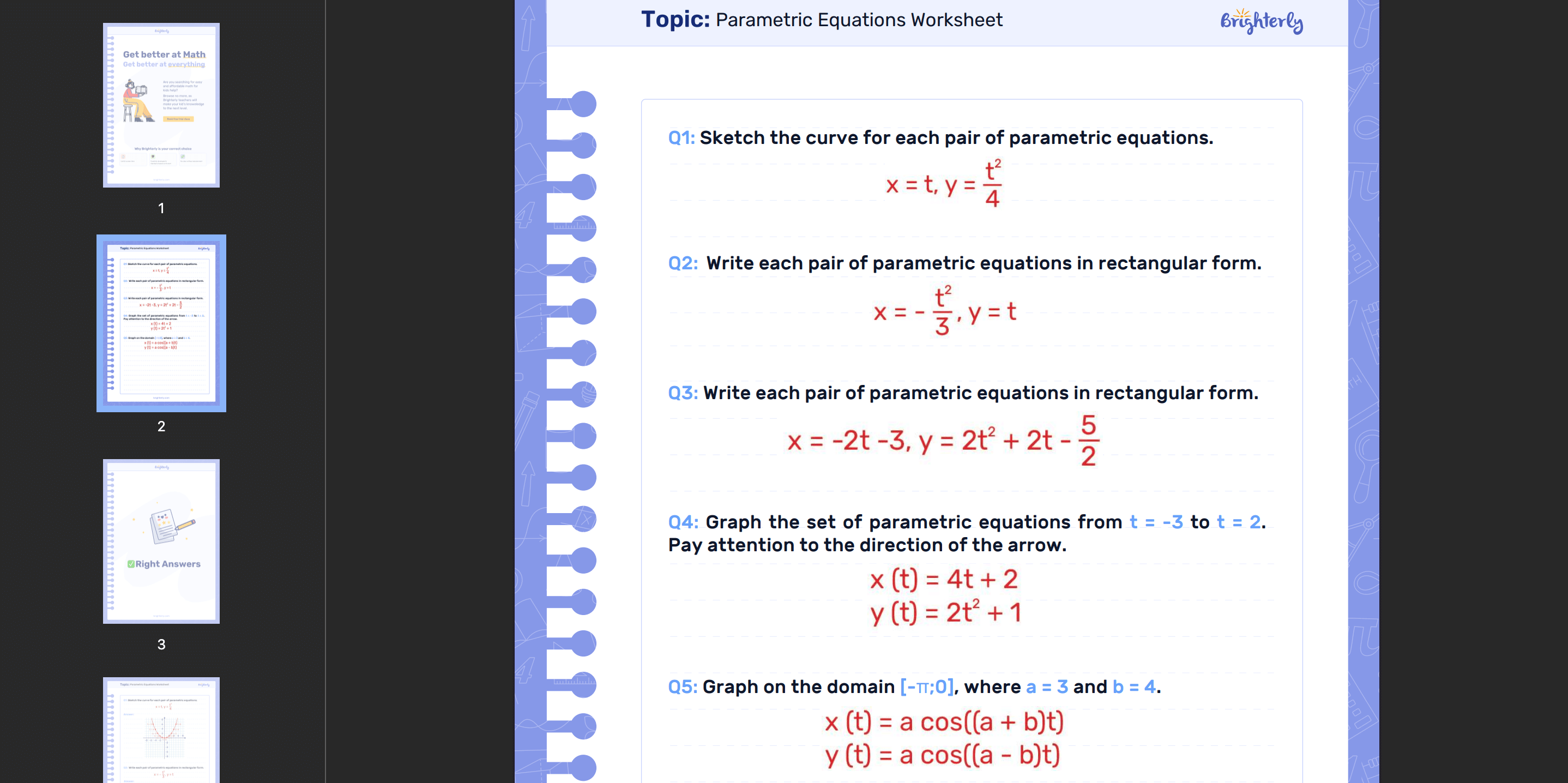
To further support students in mastering high-level math in the 9th-12th grades, demystifying the relationship between numbers and their visual behavior is a must. They are to apply, for instance, balancing equations with scales (to understand that whatever operation is performed on one side of an equation must be performed on the other to maintain equality) and function mapping – i.e., mapping diagrams to see how ‘input’ values are transformed into ‘output’ values.
Tips for teaching using the CRA model math
Practical concrete practice with daily items
You don’t need specialized school equipment to practice the concrete stage. Employ common objects like buttons, coins, or dried pasta to represent numerical values. When kids physically move these items, they better understand the actual quantity behind a number.
Model the math with simple drawings
Before moving to numbers and symbols in your CRA math practice, let your kid create a visual representation of the problem. They can use simple sketches like circles, dots, or tallies to show the math they just performed with objects.
Have your child describe their thinking
Ask your child to describe their work out loud as they move through the stages. Let them explain how their physical objects relate to their drawings or, say, how their drawings turn into an equation. Verbalizing the logic helps kids reinforce the concepts and allows you to identify possible areas of difficulty.
Common mistakes when using the CRA model in math (and how to avoid them)
- Moving too quickly to abstract symbols. Don’t rush your child into written equations before they’ve fully mastered the physical or visual stages. If they can solve on paper but can’t build a matching array with blocks, their understanding is fragile. Ensure your kid can explain their work using objects or drawings prior to removing those supports entirely.
- Treating the stages as separate lessons. Keep the concrete abstract representational stages visible at the same time. Place the physical blocks next to the drawing, and write the numerical equation right beside both of them.
- Using inconsistent manipulatives. Switching tools too often (like using bears for one addition lesson and then blocks for the next) can confuse a young kid. The focus should be on the math, not the toy’s novelty. So, stick to a few reliable tools, like snap cubes or ten-frames, so the child becomes comfortable with the tool’s logic across different topics.
- Skipping the representational drawing phase. The drawing phase is what builds the mental imagery needed for fast mental math later on. Yes, it might take some time, yet still, make it a mandatory step when solving a new type of problem.
- Using the method only for struggling students. Assuming that advanced students don’t need the concrete stage can once lead to hitting a ‘ceiling’ when they reach complex subjects like Calculus because they never learned the physical foundations. So, introduce every new, difficult concept (like fractions or variables) using the full CRA sequence for all learners, regardless of their skill level.
Conclusion
Mastering mathematical concepts starts with physical touch and ends with mental fluency. You can follow the CRA math examples and tips covered across different grade levels to help your kid build a logical understanding that prevents frustration and enhances long-term retention. Or, you can benefit from Brighterly’s…
✅Interactive learning with engaging materials
✅Expert guidance from tutors who personalize math classes according to your kid’s learning speed, style, and specific goals
✅Free printable grade-specific math tests for analyzing the patterns in your kid’s academic performance.
The best way to see the impact is to book free math lesson and find out how a structured and supportive environment can transform your child’s relationship with mathematics.



Helping kids really get into reading can be much easier when you have constant access to a variety of books to choose from. And that’s where digital libraries like Libby can help. Being a reading tutor, I often get questions like “How does Libby work?” So, I’ve decided to collect the most recent and relevant […]

Feb 18, 2026

Lindamood Bell reviews on independent platforms frequently mention research-backed learning methods alongside quite demanding schedules and (far too!) high costs. To help you decide whether to go ahead with the platform, this guide provides an evidence-led overview of LMB’s main features, pricing, methodology, effectiveness, and more. TL;DR Features: 8.5/10. LMB offers a specialized sensory-cognitive toolkit, […]

Feb 19, 2026
Math & reading from 1st to 9th grade
Looking for homework support for your child?

Choose kid's grade

Math & Reading for Grades 1–9
Build real confidence for your child with a Brighterly math or reading tutor.