Homework Statistics 2026: Trends, Time Spent, and Learning Impact
reviewed by Marvi M. Andres
Updated on January 5, 2026
In this article, I will examine the long-debated question of homework productivity and how does homework cause stress. Homework statistics show that long, repetitive, and demanding assignments are only linked to higher stress levels among students and weaker academic performance.
By contrast, some methods do agitate for homework effectiveness. Find all the numbers listed and analyzed from my teacher’s perspective.
Key points
- In the U.S., high school students average about 6-7 hours of homework per week, while OECD data show 15-year-olds globally average around 5 hours per week.
- Homework is most effective when it is short and purposeful.
- Excessive homework is linked to higher stress, less sleep, and diminished academic performance.
- Quality matters more than quantity, especially when feedback and support are provided.
Homework statistics worldwide
Recent global homework statistics reveal one surprising pattern. Many of us intuitively associate heavier and longer homework with better educational outcomes. After all, our parents made us stay at the table until every assignment was finished for a reason.
However, global data challenges this common belief. Students in South Korea, the country ranked first globally in education, spend less than three hours per week on homework. In Japan, which holds the #2 position, students average just 3.8 hours weekly.
And what about the most well-funded education system in the United States? Students in the U.S. spend an average of 6.1 hours per week on homework, yet the country ranks only 17th overall. Pupils in countries with the heaviest homework loads, such as Russia and Italy, where weekly homework averages 9.7 and 8.7 hours respectively, also lag behind in global education rankings, placing 13th and 25th.
So, does this data say that less homework automatically leads to better educational outcomes? I won’t make that conclusion.
Rather, it is a lighter but meaningful homework load, paired with effective teaching and supportive environments, that makes all the difference. If you wonder how to help kids with homework, you can check out this article.
But why is homework bad for students?
How does homework affect students globally?
Homework affects students similarly around the world, with 74% of students considering it a major source of stress, ranking it just below school grades. Even elementary school kids nowadays are being burdened with large amounts of homework, with 10% of fourth graders spending multiple hours on homework each night.
Meanwhile, for elementary school students, even 30 minutes of homework a night, if combined with other sources of academic stress, can have a negative impact. Researchers in China have linked homework of two or more hours per night with sleep disruption.
These and other studies that show homework is not beneficial prompted many countries to recognize homework’s counterproductivity and take steps to improve the health stance of the growing generation.
For example, in France many schools are now implementing “supervised study hours” as a replacement for homework. These supervised study hours mean that students stay in the classroom or a designated study space for 30 minutes to an hour, during which they can work together on assignments or receive help from a teacher rather than stress at home.
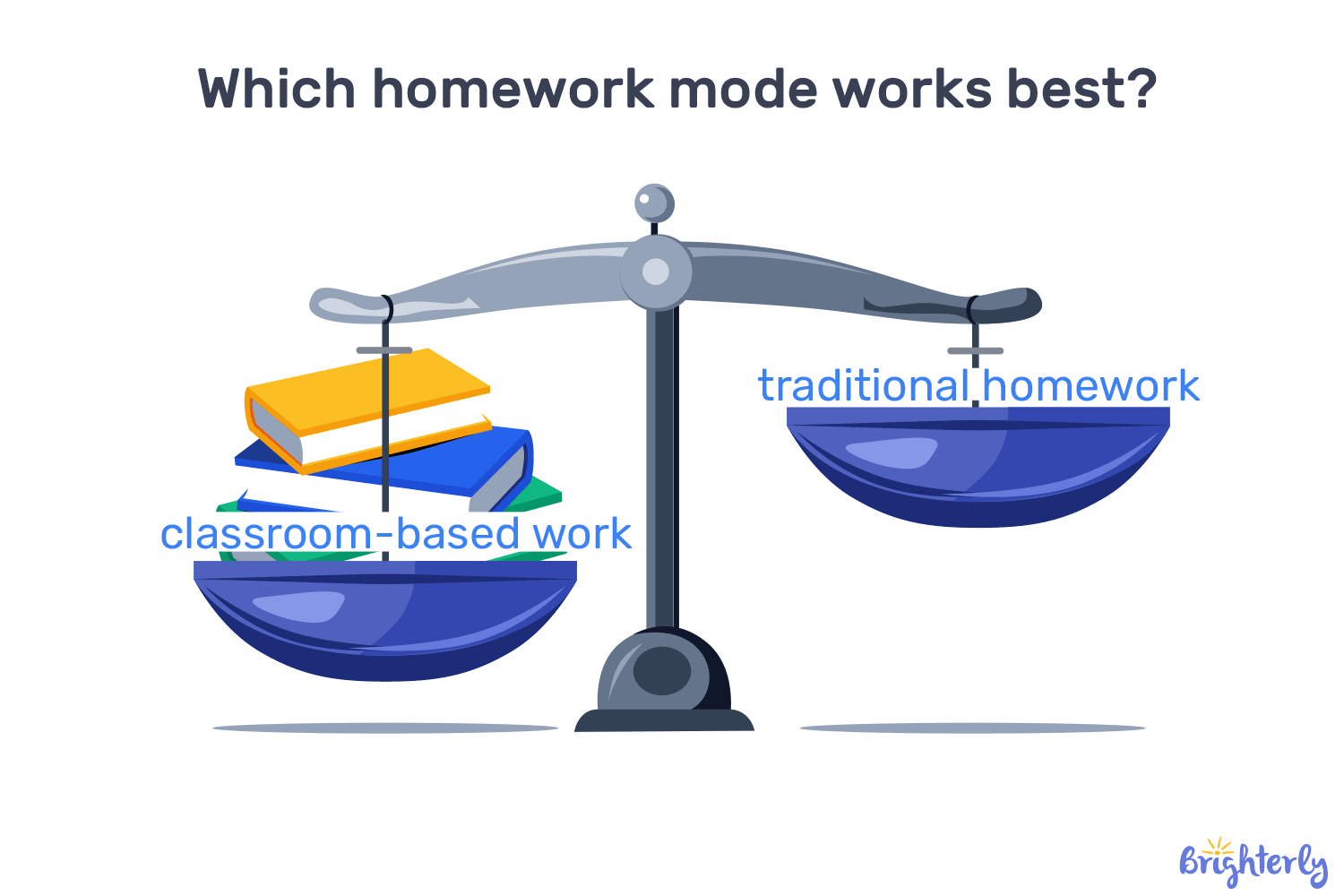
In China, infamous for its long study hours and negative effects of homework, authorities took measures to reduce academic pressure, cut screen time, and mandated two hours of physical exercise daily.
How does homework affect students’ mental health?
There is little doubt that long homework hours lead to poorer mental health and homework causes stress. A reputable Singaporean study found that when teenagers spend more time studying, they tend to sleep less. During weekends, heavy homework loads also reduce the time students spend with their families and friends. No wonder that a worse mood led to increased levels of depression among observed teenagers. Quantitatively, students who studied five or more hours per day on weekends showed particularly concerning outcomes, including less enjoyment in activities and higher levels of anxiety.
Similarly, a Stanford University psychology study found that 56% of high school students in California considered homework as a primary source of stress.
So, how can homework cause stress?
Homework causes stress in the way that heavy learning load results in lack of sleep, headaches, exhaustion, and weight loss. Moreover, it often leads to burnout, so kids rely on a parent to help with homework or even stop doing it altogether. All of that is actually counterproductive to learning.
What are the statistics about homework in the US?
In the United States, homework remains a significant part of students’ academic lives. On average, high school students spend about 6.8 hours per week on homework, or roughly one hour per school day, according to the National Center for Education Statistics survey.
Studies of competitive high-achieving U.S. high schools find students consistently reporting more than 3 hours of daily homework per day. Elementary students get an average of 4.7 hours of homework each week.
In contrast, the golden rule proposed by the National Education Association recommends “10 minutes of homework per grade level,” which means first graders should receive about 10 minutes and high school seniors up to two hours per night.
What percent of students are stressed by homework in the US?
No wonder that with such an early workload, U.S. students report elevated levels of stress and anxiety. To what extent does homework cause stress? Stress levels rise as students advance in school: roughly 50% of middle-school students and 75% of high-school students report constant academic stress. In fact, high school students in the U.S. report higher stress levels than adults.
Gender-wise, female students often report higher levels of homework-related stress than males. As striking evidence, now 70% of college students report high stress compared to 40% level back in the 1990s.
And how does homework affect sleep statistics? The average hours of sleep have shrunk by 20% since then to a mere 6 hours per night.
How does Brighterly reduce homework-related stress?
It is not the sheer amount of homework that makes your child improve, but well-structured and purposeful study time. Online platforms that offer one-on-one personalized lessons, such as the Brighterly math and reading platform, provide learning experiences tailored to each child’s needs.
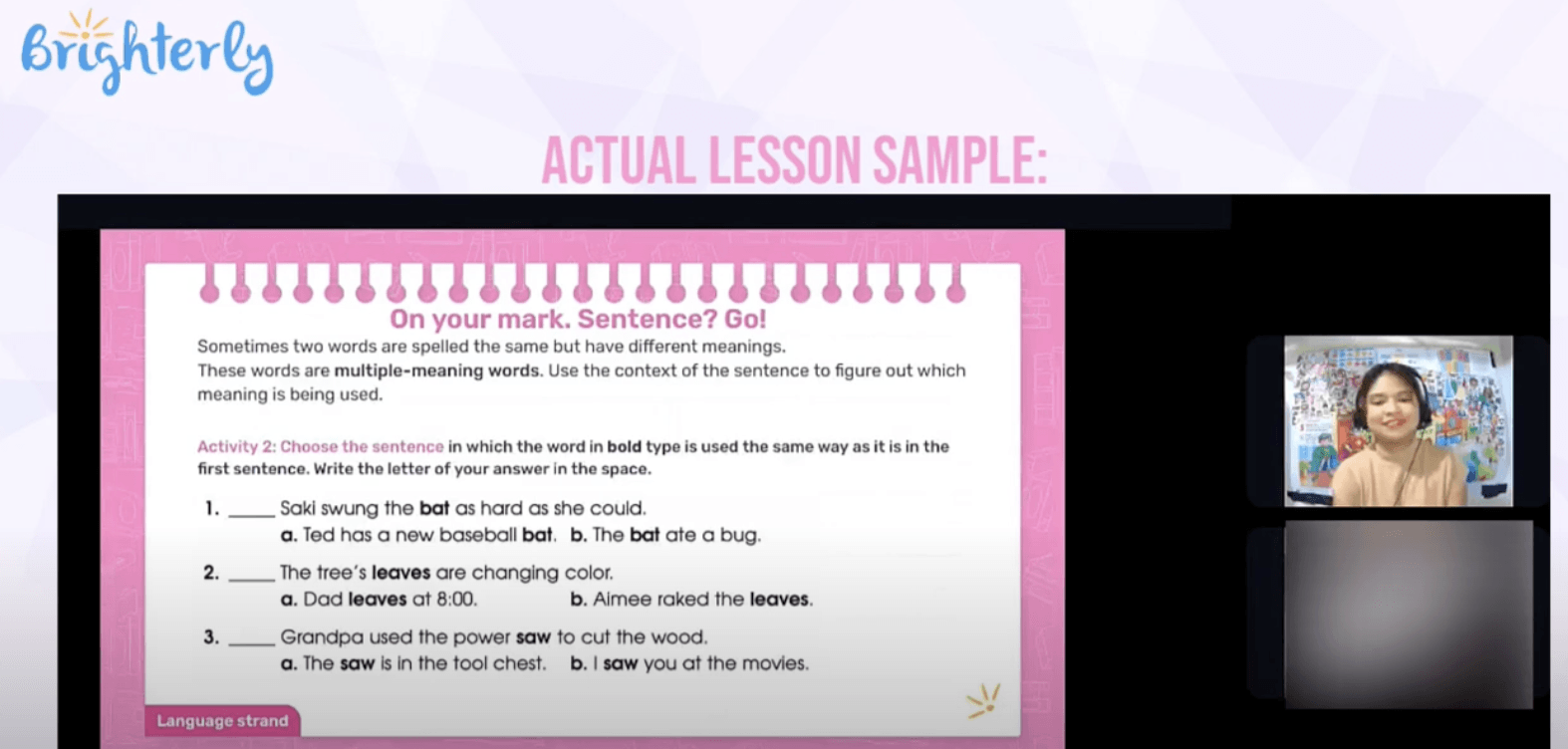
With Brighterly, the young learner receives continuous guidance from a professional tutor, teaching and tasks that adapt to their individual progress. All of that ensures an effective learning experience free from the constant race for grades and added stress.
Brighterly e-platform provides:
- 1:1 lessons conducted by strong math and reading tutors in a video mode.
- Math homework help and immediate feedback with an explanation provided in real-time.
- Regular progress reports compiled by Brighterly reading and math program tutors for parents.
- Adaptive learning paths that closely follow individual needs.
As a bonus, Brighterly offers a well-developed collection of tasks you can use for learning at home. These are math worksheets and reading worksheets that will make your kids’ learning much fun, effectively minimizing the negative effects of homework on students.
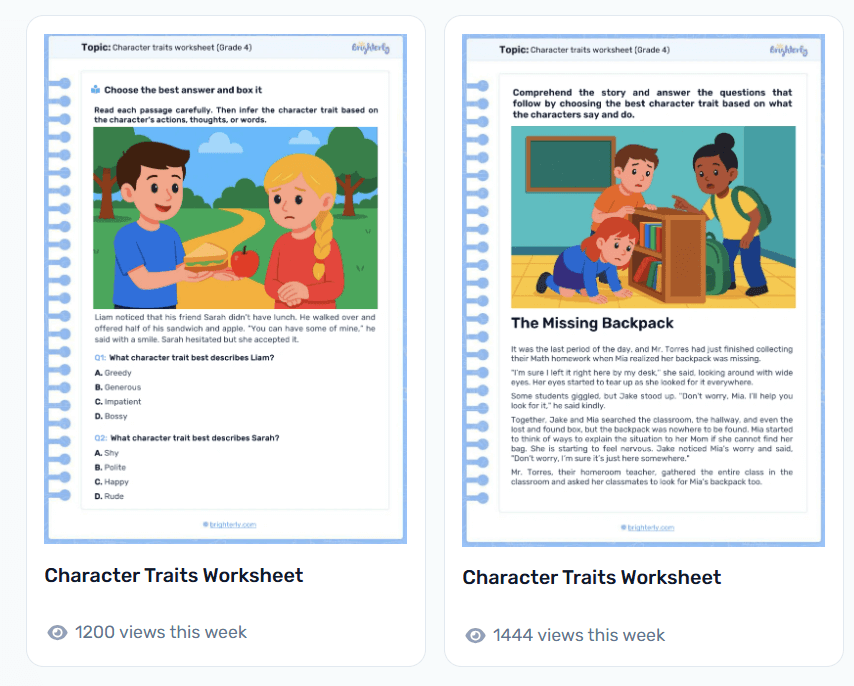
Note that the math and reading program, as well as the supplementary materials available on Brighterly, all meet the requirements of U.S. school curriculum standards, ensuring that children receive high-quality at-home instruction that closely aligns with their school curriculum.


What are the homework statistics by state?
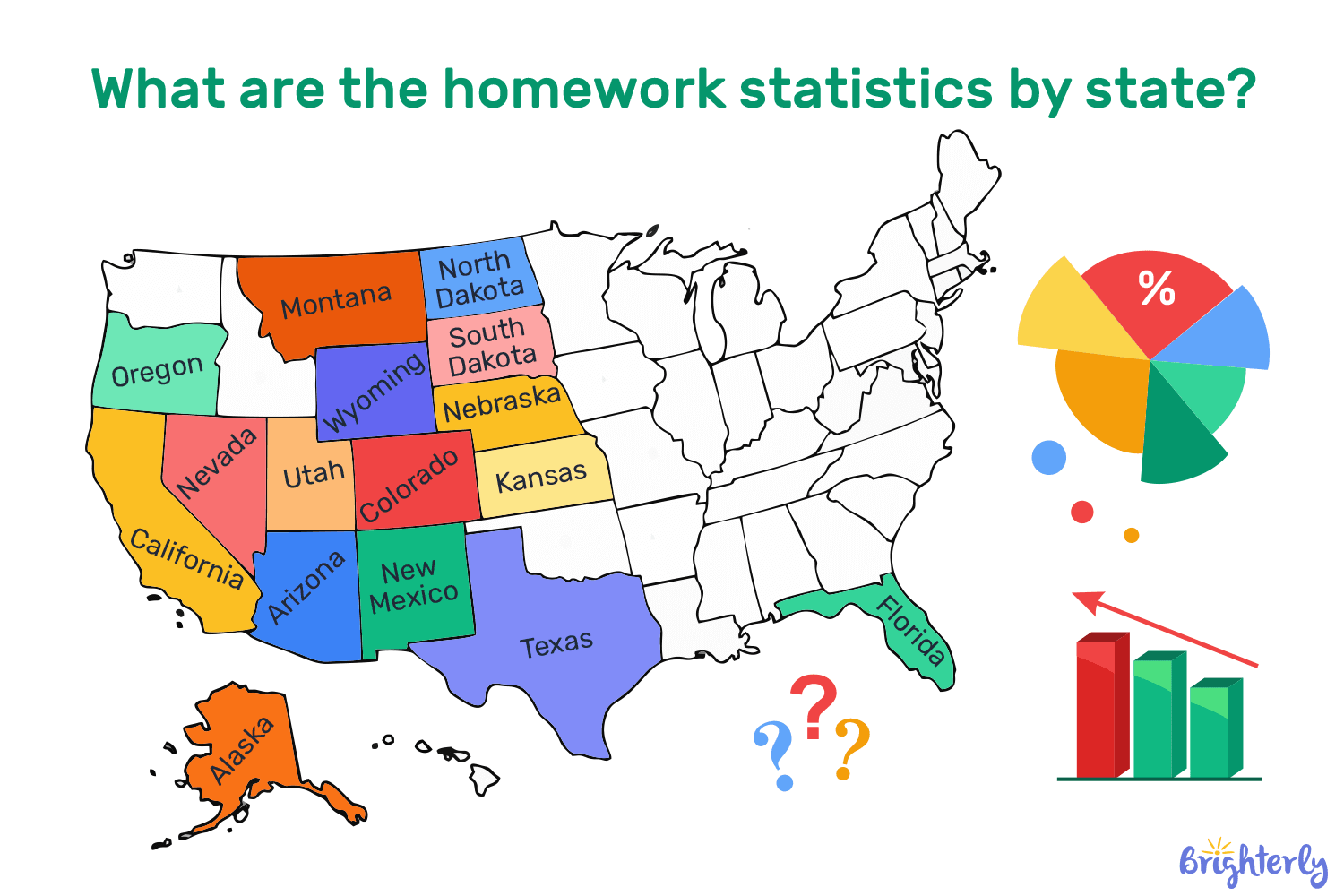
Homework time in the United States differs substantially by state. At the high school level, students in Northeast states such as Vermont, Maine, New Jersey, and Connecticut spend the most time on homework, averaging over 100 minutes per day, or nearly twice as much homework as some of their peers.
In contrast, students in Florida report the lowest average homework time at the high school level, with about 44 minutes per day. Similarly, the Deep South states of Mississippi, Alabama, and South Carolina fall on the lower end of the spectrum, averaging under 50 minutes per day. At the elementary and middle school level, California, Washington, and Utah assign more homework than average, while Texas and North Dakota report the lightest workloads.
Statistics on homework by year and age
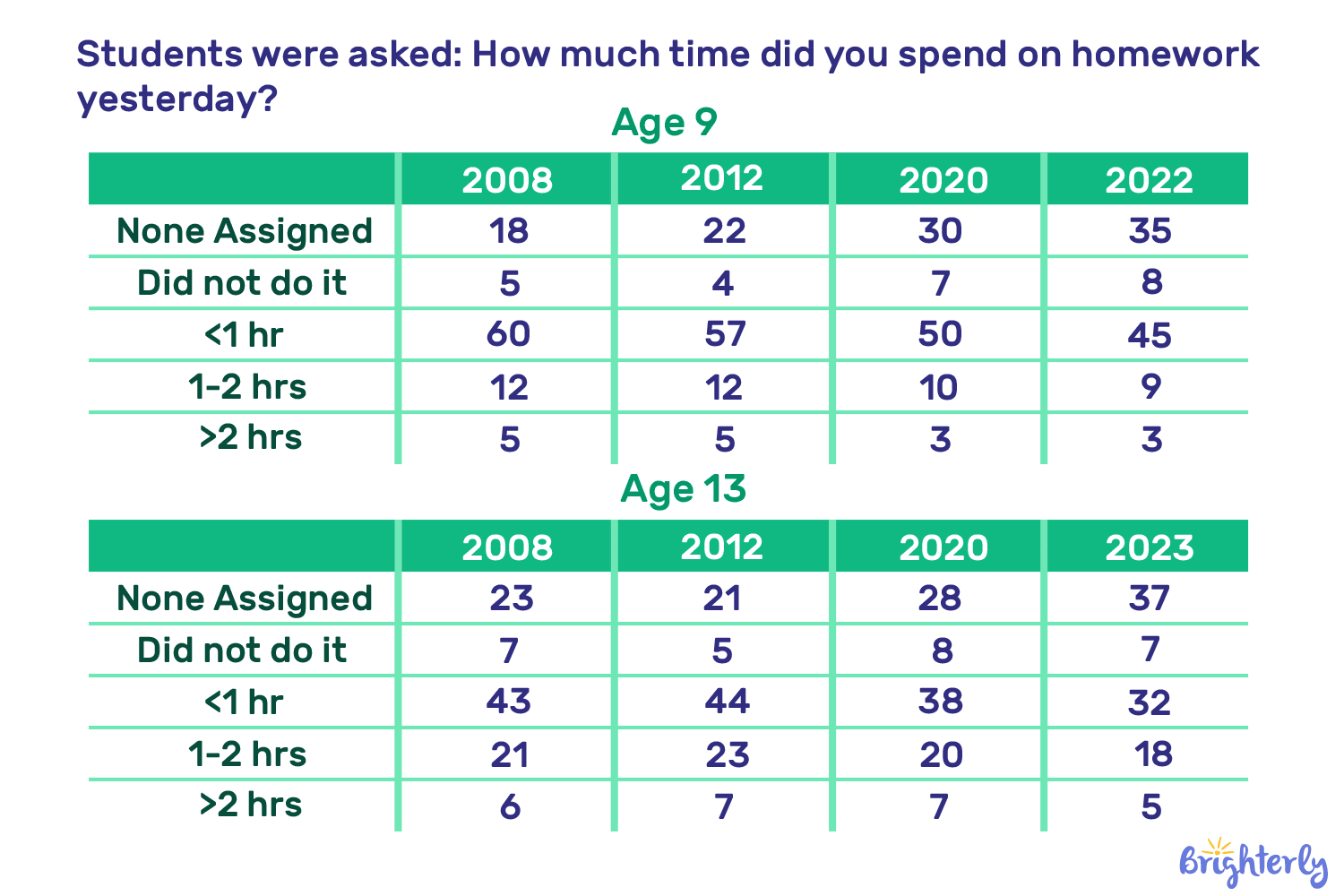
National Assessment of Educational Progress data show U.S. students’ homework loads indeed have dropped over time.
- For 9-year-olds, the share of students reporting no homework grew from ~23% in 2008 to 43% in 2022.
- Among middle school 13-year-olds, the share of students reporting no homework increased from about 14% in 2008 to roughly 29% in 2022.
At the same time, students reporting heavy homework loads remain rare. Across age groups, only about 3-5% of students report spending more than two hours daily on homework, a proportion that has stayed consistently low for decades.
Homework stats by country
The most comprehensive study on homework length by country is OECD study of 15-year-olds, which showed the average time spent on homework across economically developed countries is around 4.9 hours per week. However, country-by-country data varies significantly.
It is China, where students spend the most time on homework, averaging 13.8 hours per week, followed by Russia (9.7 hours) and Singapore (9.4 hours). Other countries with relatively high weekly homework include Kazakhstan, Italy, Ireland, and Estonia. In contrast, students in Finland and South Korea have the lowest homework load at about 2.8 hours per week.
But those average hours don’t necessarily tell the whole story. Across countries, students spending less time on homework aren’t necessarily studying less. In South Korea, for example, 15-year-olds spend less than 3 hours on homework per week, but they spend an additional 1.4 hours per week with a personal tutor and 3.6 hours in extracurricular classes.
That said, I will next discuss why is homework good for students.
Homework vs no homework statistics
To better understand the debate over whether homework improves academic performance or simply brings more stress to children, in the next section, I will examine the pros and cons of homework backed by statistical findings. Thus, does homework actually help? As usual, there is no universal answer. However, the evidence increasingly suggests that moderate, purposeful homework assignments tend to do more good than harm.
Statistics about homework being good
Homework research published in The High School Journal shows that students who are assigned homework outperform 69% of their peers who don’t work on home tasks. That is true for both standardized test scores and overall grades.
A study from the City University of New York found that homework encourages self-discipline. It improves goal-setting, time management, and sustained focus, which are closely linked to high academic achievement. That’s why homework is good if balanced.
Statistics about homework being bad
A study conducted by Stanford researchers revealed that 56% of students identify homework as a major source of stress, linking it to health issues such as migraines, ulcers, and sleep deprivation. Fewer than 1% of students reported that homework caused no stress at all.
Other research on homework conducted by the Organisation for Economic Co-operation and Development found that beyond approximately four hours of homework per week, additional time spent yields little to no improvement in academic performance.
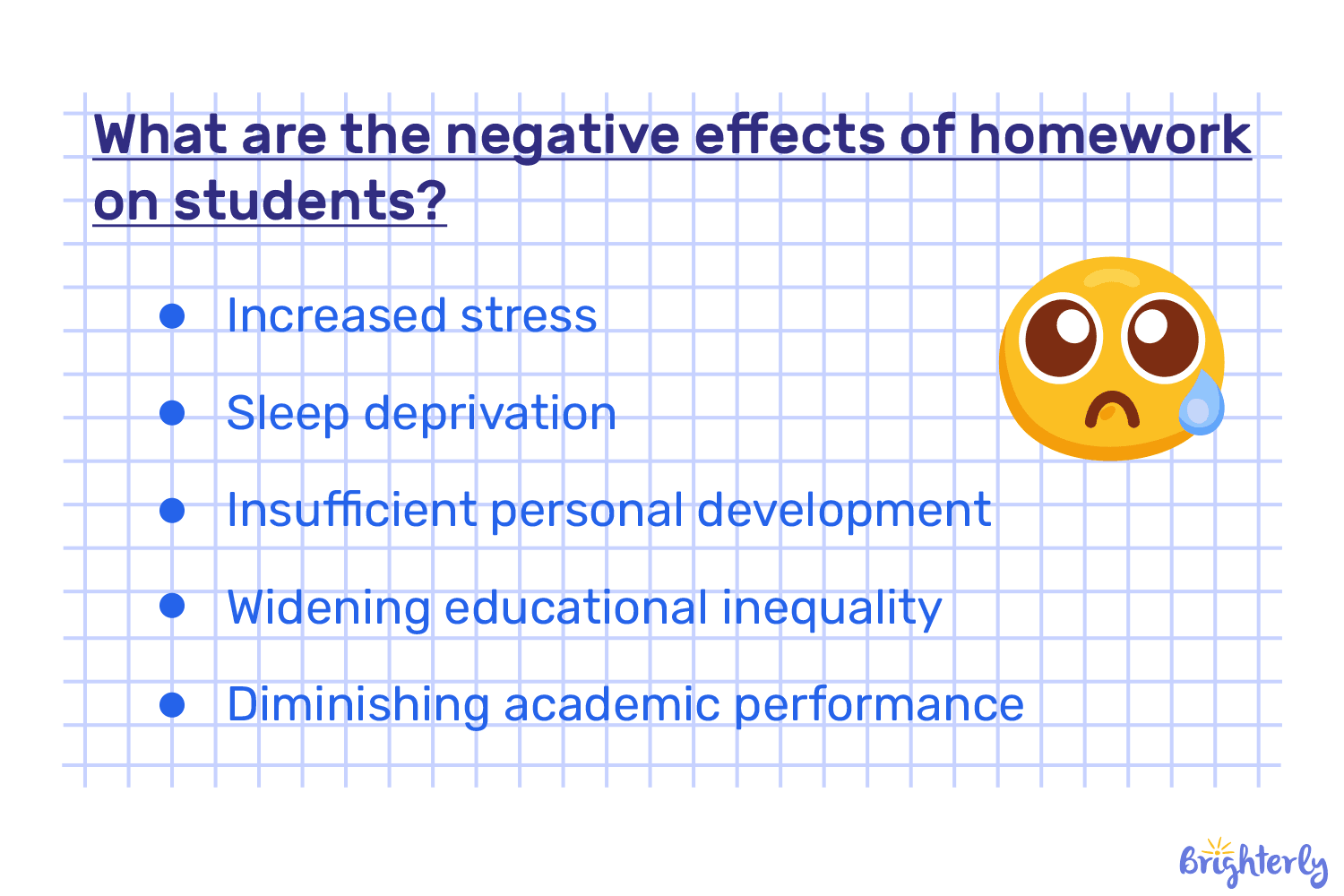
What are the negative effects of homework on students?
- Increased stress
- Sleep deprivation
- Insufficient personal development
- Widening educational inequality
- Diminishing academic performance
Increased stress
Homework stress statistics suggest that heavy homework loads are consistently linked to higher stress, anxiety, and depressive symptoms, especially among middle and high school students. Many students report homework as one of their main daily stressors, which can contribute to emotional exhaustion and burnout.
Sleep deprivation
Spending long hours on homework often cuts into sleep time, leading to chronic fatigue. Reduced sleep is associated with headaches, weakened concentration, lower mood, and poorer overall health, which can ultimately harm academic performance.
Insufficient personal development
Among other cons, excessive homework leaves students with less time for family interaction, socializing, sports, and hobbies. These activities are important for social skills, emotional growth, and physical health, particularly during adolescence.
Widening educational inequality
Homework can actually amplify socioeconomic differences. Students with quiet study spaces, parental help and income, and access to technology benefit more than peers who lack these resources. That creates unequal learning outcomes.
Diminishing academic performance
Homework facts show that beyond a moderate amount, additional homework produces little to no academic benefit. Excessive workloads are just inefficient.
Does homework help students learn?
As was discussed, light but appropriate and challenging homework actually helps children to develop discipline and succeed academically. Some other positive effects of homework include:
- Skill mastery. Homework reinforces classroom learning, particularly in subjects like math and science, where regular practice and problem-solving improve understanding.
- Feedback. Homework has a greater positive impact when teachers review assignments and provide feedback. Online platforms with personalized tutoring and homework help are of particular usefulness. At this point, why not check out the 12 best homework help websites?
- Creativity. Students in a class have little time to think outside the box, while interesting and challenging home assignments develop the ability for critical thinking and independent problem-solving. For example, major German mathematician Carl Gauss, as a schoolboy, famously found a quick method to sum 1 + 2 + … + 100 by pairing numbers (1+100, 2+99, etc.). That’s why is homework important.
10 facts about homework
- More homework does not always mean better results — studies show diminishing academic returns after moderate weekly amounts.
- Students in top-performing countries often receive less homework than students in lower-ranking education systems.
- U.S. high school students average about 6-7 hours of homework per week, compared to less than 3 hours in South Korea and over 13 hours in China.
- Homework benefits increase with age — it has little measurable academic impact in elementary school, but is more effective in middle and high school.
- Homework is one of the most commonly reported sources of student stress, especially among adolescents.
- Some of the effects of homework on students are linked to reduced sleep, which negatively affects health, mood, and academic performance.
- Studies suggest that after about 1 hour per day, the academic benefits of homework begin to level off, while stress continues to rise.
- Short, focused assignments have more positive effects than long, repetitive tasks.
- Studies on homework show that homework works best when teachers provide feedback, rather than assigning it without review.
- Well-designed homework builds non-academic skills, including time management, responsibility, and independent learning.
Homework statistics: Conclusion
To conclude our data-heavy topic, homework works best when it is limited and meaningful. A reasonable amount of about 3-5 hours per week can help students practice what they learn and build good, essential study habits.
In contrast, too much homework only causes stress and frustration. When homework is well planned and not overwhelming, it is more helpful than harmful.
In contrast to conservative school home assignments, Brighterly developed a modern learning scheme. It implies that children receive continuous involvement and feedback from the friendly tutor without homework stress or rush for grades. Book free lesson and open the door to lifelong reading success today.



Brilliant.org cost isn’t obvious at first glance. You can taste interactive math through a free trial, but as you achieve some progress, you find yourself at the door with paid access. What’s hidden behind the Brilliant.org price? What’s included in the subscription, and how does the cost scale over time? I’ll answer these questions, and […]

Jan 04, 2026

Googling for the most up-to-date Kahoot pricing feels overwhelming? Don’t go anywhere! This in-depth review is what you need to understand the pricing plans, cost per month and per year, and features you pay for. Whether you’re a parent, teacher, or tutor, we’ll discuss everything you need to know in 2026. Key points: Kahoot is […]

Jan 04, 2026
Math & reading from 1st to 9th grade
Looking for homework support for your child?

Choose kid's grade

Math & Reading for Grades 1–9
Build real confidence for your child with a Brighterly math or reading tutor.