How to Teach Kids Time Management for Academic Success
reviewed by Janice S. Armas
Updated on March 4, 2026

Kids receive tons of information at school and are exhausted in the afternoons. I see this almost every day, and no surprise that these days, more parents are worrying about how to teach kids time management and at what age to start. Helping children manage time starts small, so let me share some practical life hacks with you in this blog post.
Key points
- Visual schedules and guided daily choices are the best way to start early time management.
- Effective time management skills include forming small daily habits, such as predictable routines.
- Controlling every minute of your child is the wrong way. Children are more responsible without too much pushing.
- A developed skill to make daily choices prepares kids for future time management projects at school.
What is time management for kids?
Time management for kids is a learned ability to organize time, both at school and at home. Children decide what needs to be done first and learn to balance studying, various activities, and time for rest and play.
Parents and caregivers help children estimate how long tasks take, and move between activities with less resistance (and more fun). If you help your kid grasp the fundamentals of time management early, it will bring tons of benefits to both of you, to name just a few:
- Homework takes less time as planning reduces procrastination, and parents don’t need to remind them about home tasks not done.
- Kids learn to start and complete tasks on their own with stronger focus and attention.
- Kids sleep better and both children and adults have calmer evenings at home.
There’s less parent–child conflict as daily communication between them becomes not nagging but friendly cooperation.
Note: Learning time management should be age by age. It can be more guided by adults for smaller kids, who are not expected to plan independently.
What is time management skills?
Time management skills for kids are small and repeatable abilities of organizing their day, following routines, and completing tasks without constant reminders. These include breaking big tasks into steps, using visual cues, and knowing when to rest or play (finally!).
Children’s brains are not yet developed enough to plan their time by themselves. Kids mostly live in the moment, in ‘today’, so time management skills are taught and supervised by adults. However, too much pressure is a complete mistake. Dear parents, you may do even worse! All you will achieve with such actions is stronger resistance from your child, emotional distance, and a lack of mutual understanding.
Which of the following can be considered an important part of time management? Speed? Perfection? Or awareness?
The real skill is awareness, of course. It means understanding priorities and staying focused without emotional overload. When you teach these skills early, you’ll see children become calmer learners and more independent students when they get older.
I’ve collected more tips on how to manage time wisely, so read further.

9 time management tips for parents
- Set small goals and track progress
- Create a daily schedule
- Teach time in real-life moments
- Break homework into timed blocks
- Build morning and bedtime routines
- Let kids plan part of their day
- Use planners
- Practice reflection
- Support independent practice
Set small goals and track how they are achieved
Best for: Kids who often procrastinate
This method of time management is great for younger and middle school children.
Ask your child to choose just one task per day, for example,10 minutes of reading or up to 3 math tasks.
I recommend progress checks using math tests and reading tests on the Brighterly math and reading learning platform to keep motivation high. These short assessments are invaluable for kids who can see their progress, and parents can spot gaps early too.
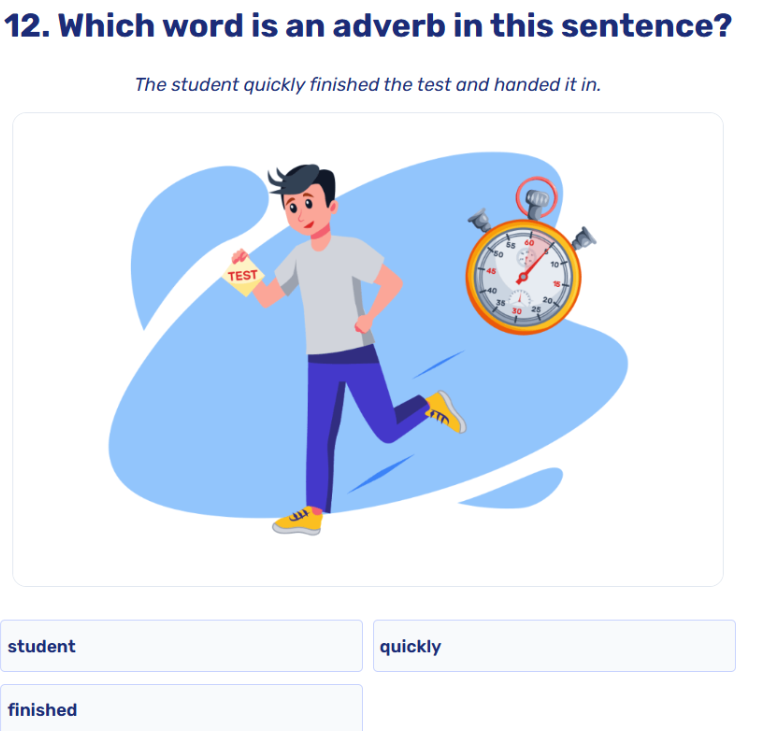
By the way, I use these tests in class, and I think it’s one of the most effective time management strategies for kids for now.
Create a visible daily schedule
Best for: Kids who get upset when it’s time to stop one task and start another
Make a simple DIY schedule from paper. You can print it, but it would be much better to draw it by hand. Divide the day into blocks: school, homework, play, and bedtime. Use one color for schoolwork, another for play, and choose some calm shade for bedtime rest. Put it on the fridge with a magnet, so your child sees it every morning while eating breakfast.
This is one of the easiest daily time management ideas for kids but incredibly effective! “Hurry up”, “Start your homework now!”, “Don’t be lazy and do your math task” and dozens of other daily reminders will be unnecessary, because this small routine teaches children to prioritize tasks and manage expectations, and of course, build stronger time management skills.
Note: Visual schedules work best when reviewed together and are respectful of the child’s preferences.
Teach time in real-life moments
Best for: Younger kids (ages 5–8)
Let’s teach small kids to estimate time! Playing, or getting ready for school, cleaning or cooking, whatever you choose, are all great moments to do it.
Ask, “Do you think this task will take ten minutes or an hour?” Don’t be angry if the answer is wrong, just laugh and explain that cooking soup, for example, can’t take 5 minutes (only if it’s instant)
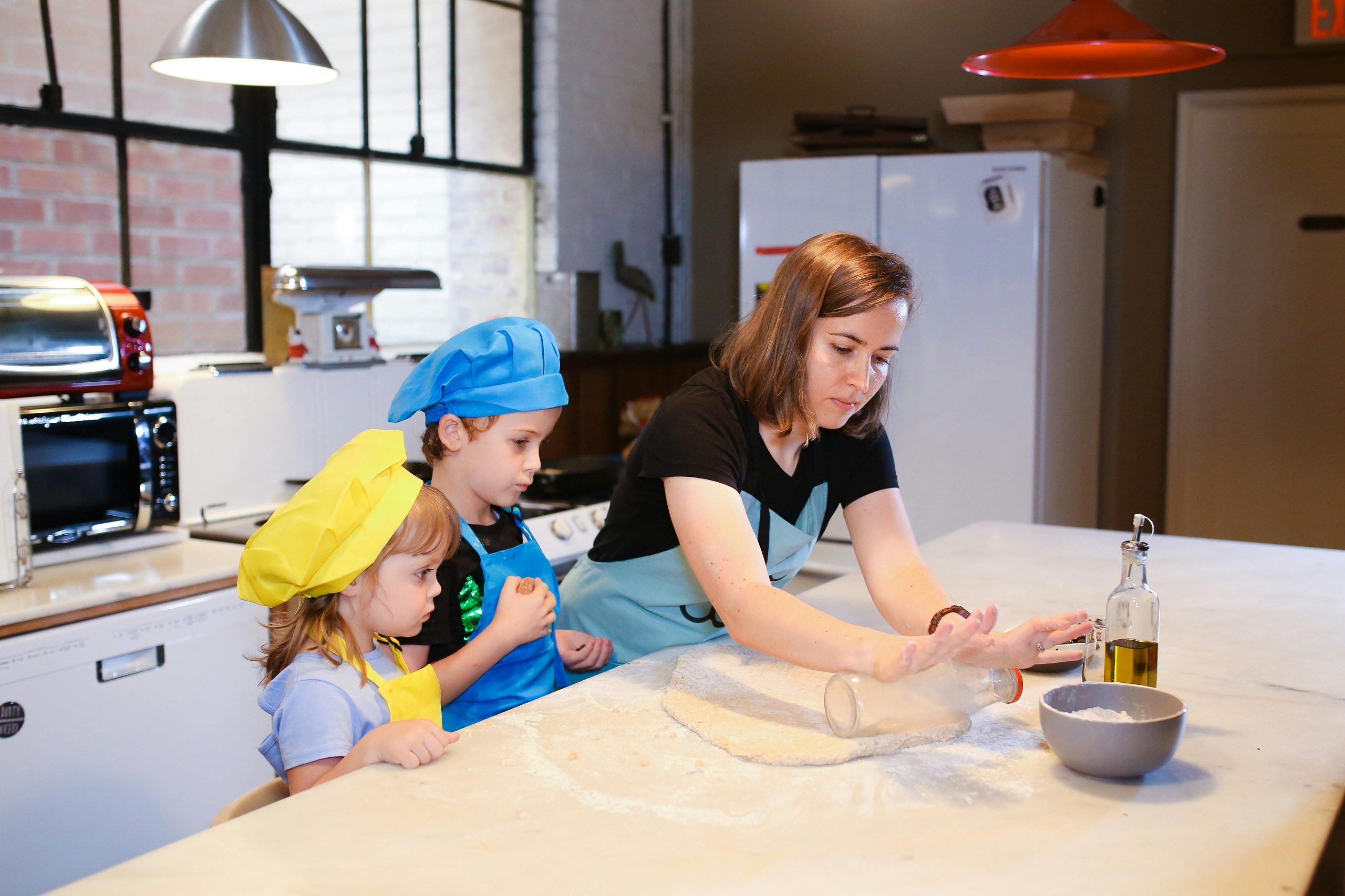
You teach your child time naturally, without information overload, and this is time management kids often miss.
Break homework into timed blocks
Best for: Kids with short attention spans
Homework after school can be tiresome and frustrating, even for the best students. Their defence in this case is procrastination. A solution to this problem can be splitting work into short, focused blocks using a timer.
Set a kitchen timer for 10–15 minutes and tell your child: “Work until the timer rings, then we stop.” Place the timer where they can see it, not on a phone.
If your child experiences problems with math or reading, it would be great to make a combo: one timed block complemented by math worksheets and reading worksheets from trusted learning platforms such as Brighterly. They are fun and easy to print, and absolutely free.
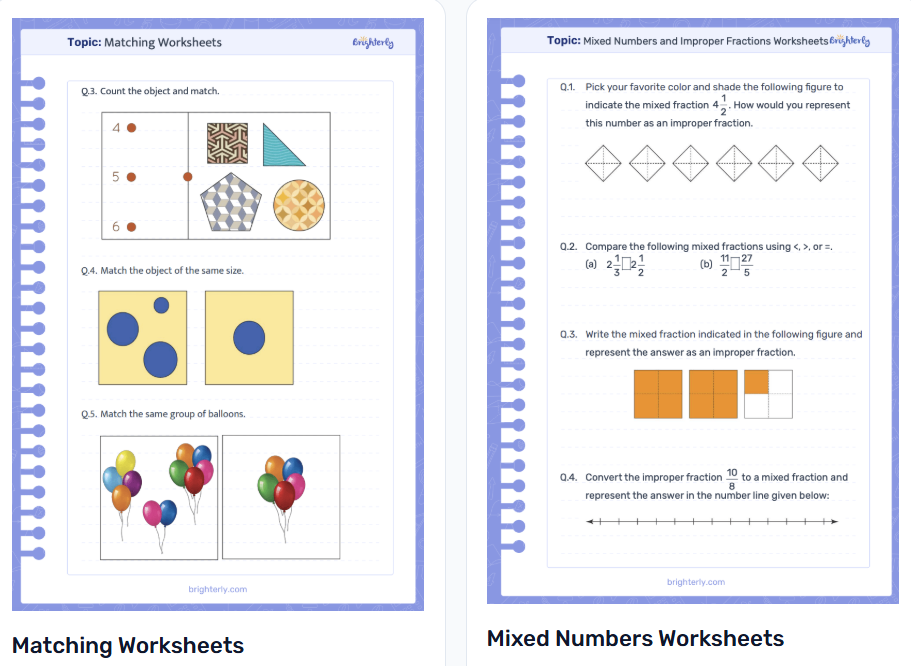
This is one of the most reliable time management techniques for students I’ve seen, and it’s so easy to implement!
Note: One block = one subject. No multitasking. The brain focuses better on one type of task at a time. When a child switches between subjects, it drains attention and increases mistakes.
You can also try 1:1 tutoring on the platform, providing tailored support to your child’s needs.


Build predictable morning and bedtime routines
Best for: Kids who feel anxious or rushed
Routines are the basis of all time management strategies for students. Even more, morning and bedtime routines are essential because they help kids’ bodies and minds settle into predictable rhythms.
Routines’ superpower is in being repeatable. I always suggest starting with just three fixed anchors in the morning and evening.
Morning routine
- Try to wake up at the same time
- Try to keep the same order every day: bathroom, then breakfast, get dressed and be ready for school
- Put a reminder checklist on the fridge or wall, where a child can see it.
Bedtime routine
- Screens off at the same time each evening
- One calming activity (reading, talking, drawing)
- Lights out at a consistent time, even on school nights with homework
Predictability reduces decision fatigue, and student mental health statistics support this fact: structured daily routines are linked to lower anxiety levels, better emotional regulation, and improved focus during the school day – exactly what teenagers need the most. So, if you’re seeking the best time management for teens, building effective daily routines is a must.
Let kids plan part of their day
Best for: Elementary and middle school students
One mistake I see quite often is adults controlling every minute of a child’s day. Well, I understand, parents want homework done and evenings to run smoothly. But when adults make all the decisions, children miss the chance to practice planning. Letting kids choose what to do first or when to take a break is a great way to manage time. Its efficiency is highlighted in any serious article on time management for students, as it has the power to gradually develop independence in the little ones.
Here are some examples of how it can look in real life:
- “Do you want to start with math or will you read a story?”
- “Do you want a break after this task or after the next one?”
So, you still set the boundaries, but the child has options, so they learn to make small daily decisions. Such kids are much better prepared to plan longer tasks and manage their workload at school and at home. Moreover, they feel less anxiety and other mental health distress.
Use planners as thinking tools
Best for: Kids who push back against rules and plans
If a child is naughty, one of the reasons may be that they do not have a daily plan, so they have no idea what to do next. Planners in this case can be a remedy to some extent, but not to monitor every minute, but to see tasks and make the right decisions.
Time management for students includes leveraging planners to write down tasks, estimate how much time each one might take, and check off progress when it’s done. I rejoice when I see children begin to notice patterns: which tasks take longer, when they lose focus, and when it’s time to have a break.
Planners become one of the most practical time management strategies for kids, just with one condition: no pressure, please.
Practice reflection, not punishment
Best for: Kids who avoid homework
When homework takes twice as long, try these two simple questions after a tough session:
- What part of the task was the most difficult for you today?
- What could we do differently next time?
This strengthens resilience because children learn that setbacks are part of learning and shifts the tone at home from conflict to collaboration.
If homework avoidance is a recurring issue, you can find the guide on how to help kids with homework helpful.
Support independent practice with slight guidance
Best for: Homeschooling families
Homeschooling is far from being easy as parents need to educate children, and then also manage extracurricular and household chores. How to teach time management is becoming a vital question under such circumstances.
Help them get started and then redirect them to one of the things they can do by themselves. Let them try on their own before proposing any solutions.

Short, well-defined tasks are great to support consistent routines. A good example is the time management for kids worksheet, which you can make by yourself or with the help of tutors. Also, check out Brighterly’s homeschool reading and homeschool math programs if your kid struggles with math or reading or has special learning needs.
Daily time management ideas for kids
- Let your kid choose one priority task for the day and then check the result in the evening.
- Practice the same homework start time. This is a key element of time management strategies for students.
- Make a plan for rest before kids are tired. Breaks are necessary to prevent burnout and support mental health.
- Avoid multitasking as it can be counterproductive.
Time management for elementary students
Elementary school is where learning time management should be visual, guided, and… forgiving. I recommend a one-page daily planner with time indication. You can print it or, even better, draw it by hand.
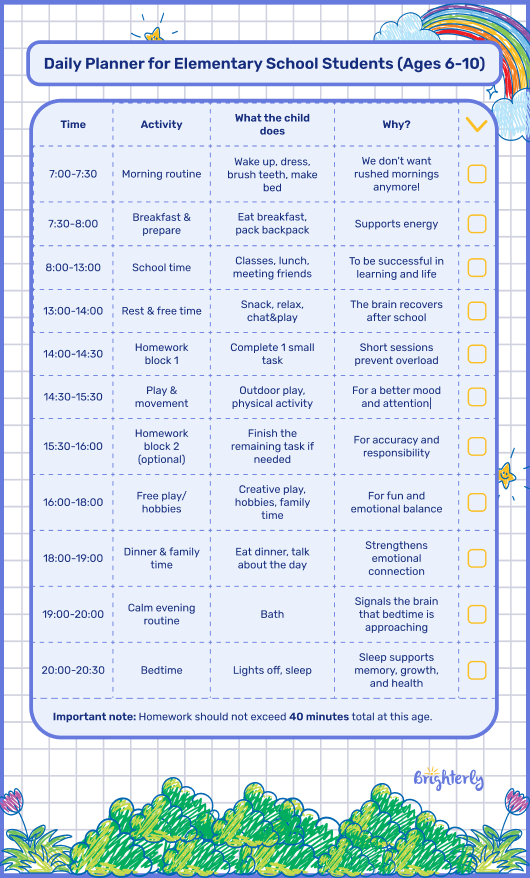
Place it on the fridge or near the study table. You’ll be surprised how this visual support strengthens time management skills for kids.
Time management for middle school students
Middle school is where time suddenly speeds up. More subjects, more homework, more social pressure (reduce TikTok!), and it’s time when kids start planning more independently. Parents should allow them to do it; otherwise, you’ll see your child look at you with ‘that blank face’, stop listening to your advice.
It’s time to revise the planners now:
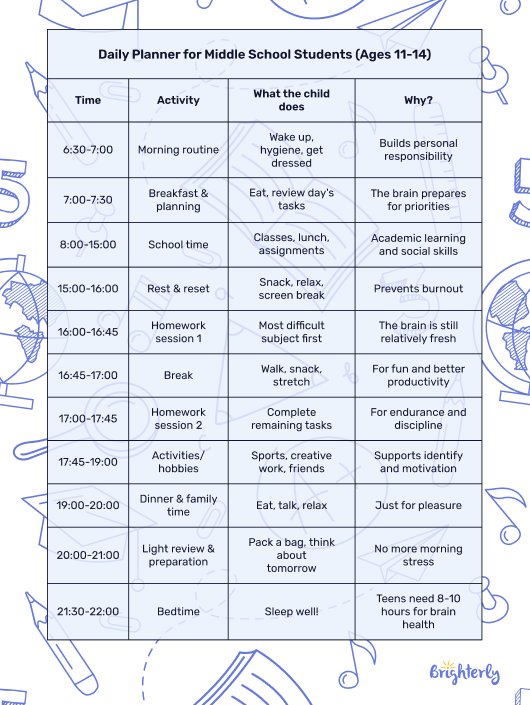
When teens use this planner, they learn how to reflect, which is an essential skill in future academic success.
Finally, let’s not forget that middle school stress is real. For instance, recent student mental health studies show that workload pressure is a major contributor to anxiety at this age, when the brain is too sensitive and the world is moving too quickly. Let’s help our teens reduce it with heartfelt support and well-structured time management.
Conclusion
Time management kids learn early shapes how successful they will be at school and life later on. When kids learn to manage time wisely, they feel calmer, more capable, and more independent, and it has a positive effect on their academic success.
If you’re looking for more guidance to support healthy routines, Brighterly tutors and interactive tools will be handy. Book free lesson and start today!


Choosing the right online curriculum for your kid is a high-stakes decision. I compared Miacademy vs Acellus to help you decide which platform is a better fit for your family. Whether you are shifting schedules or looking for new learning formats, understanding these two options is a great first step. Key Points: Miacademy is an […]

Feb 22, 2026

If you’ve noticed that your child has fallen behind their reading grade, you will want to help with reading comprehension at home. The good news is that there is plenty you can do at home to help your child with their reading comprehension. As an experienced reading tutor, I know what works, so I’m going […]

Feb 24, 2026
Math & reading from 1st to 9th grade
Looking for homework support for your child?

Choose kid's grade

Math & Reading for Grades 1–9
Build real confidence for your child with a Brighterly math or reading tutor.