How Parents Can Help With Reading Comprehension at Home
reviewed by Laila A. Lico
Updated on July 31, 2026
Key Points:
- Understanding how parents can help with reading comprehension at home comes down to creating reading habits — reading together, asking related questions about the story, and having a child try retelling a story in their own words.
- Comprehension and decoding are different skills in reading — a kid can have no problem reading a word correctly but still struggle to understand its meaning and connect it to the story (NWEA, 2025).
- The right reading comprehension strategy depends on the kid’s age — while picture walks and read-alouds can be enough for a kindergartner, a 5th grader will need reading activities like story discussion and asking inference questions.
- If home practice doesn’t help to improve the child’s reading comprehension skill, a professional reading tutor can help detect the issue and guide the kid in the right direction.
According to 2024 NAEP data that analyzes results of kids reading comprehension assessment, only 31% of 4th graders in the U.S. performed at or above the Proficient level, 30% in grade 8. This data shows that most kids struggle with reading comprehension even in middle school. To help your kid improve reading comprehension skills, you can implement grade-level home reading activities ranging from reading together to deep story discussions.
How Can Parents Help With Reading Comprehension at Home?
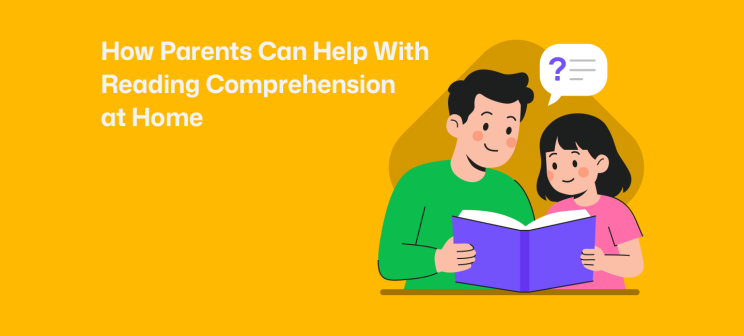
Reading tips for parents to use for helping their kids with reading comprehension at home revolve around turning reading into an interesting two-person activity instead of a solo task. For example, you can read together with your child, ask them open-ended questions before, during, and after each reading session, and ask them to retell the story in their own words.
A quick checklist for a reading session with your kid can look like this:
- Choose a regular time and a comfortable spot for reading sessions
- Preview the book together by asking a kid what they expect from it based on the cover
- Pause to ask story-related questions about what’s happening and why
- End with asking a kid to retell the story they just read while summing it up
You can also use different prompts or a parent handout for reading at home (PDF) with all the steps to guide your reading practice with your kid.


Get professional reading comprehension help online
Brighterly one-on-one tutors personalize reading comprehension lessons for every kid.
Explore Brighterly Learning Experience
Learn exactly how Brighterly helps students thrive through expert sessions, online tools, and proven feedback from thousands of satisfied parents
Signs Your Child May Struggle With Reading Comprehension
Recognizing the signs that signal your child may struggle with reading comprehension is the first step in figuring out how to help a child with reading difficulties. Among these signs are the inability of a kid to explain what they’ve read about, confusion with the plot and struggle to remember important story details, and avoidance of reading in general.
You can use this checklist to see if your kid may have struggles with reading comprehension:
- Has no problem reading words accurately but can’t explain what the story is about
- Loses track of the plot or forgets characters/events while reading
- Avoids reading practice in general or calls reading and books boring or too hard
- Struggles more with reading on their own than with reading aloud together
- Skips unfamiliar words or guesses them instead of sounding them out
If you notice your child showing several of these signs at once, it’s worth considering that they struggle with reading comprehension. However, remember that the causes of these struggles can be different and require different ways of help for struggling readers.
|
Symptom |
May Indicate |
What to Try Now |
|
Difficulty in understanding words and getting letters jumbled up |
Dyslexia |
Integrate audiobooks and text reading / word processing computer programs to support reading (International Dyslexia Association) |
|
Difficulties with taking in and memorizing written text |
ADHD |
Create a reading routine and encourage your child to read in short 10-minute bursts |
|
Struggles with remembering what they’ve read |
Memory problems |
Break text up into small chunks and ask questions before, during and after reading |
|
A lack of focus on reading materials |
A distracting environment |
Remove all distractions from your child’s reading environment, including phones and game consoles |
|
Slow reading |
Not enough practice |
Set a schedule for your child to read consistently and monitor their words per minute results |
Note: The data in this table is not medical advice. If you suspect your child struggling with reading and writing, please consult a specialist.
A Simple 10-Minute Home Reading Routine
When it comes to how to help with comprehension at home, how, where, and what your child reads make a big difference in how well they read, so setting a consistent routine creates the perfect environment for focus and comprehension.
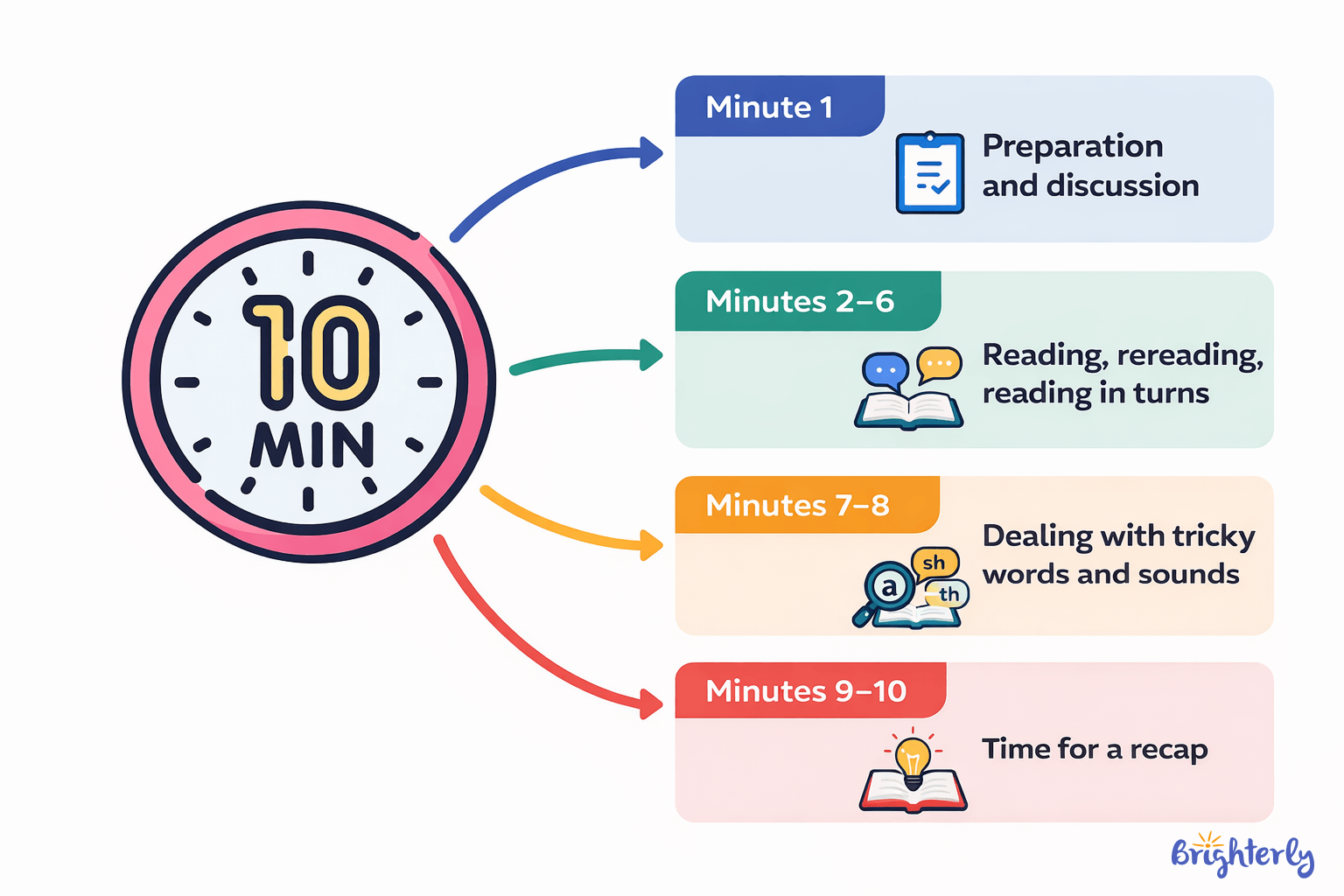
Here’s an example of a 10-minute routine you can begin with:
- During the 1st minute. You may ask your child to look at the book and discuss what they’re expecting from it based on the cover.
- During minutes 2-6. You should start reading aloud and then take turns while reading passages with a kid. Such a practice makes you a reading role model. That’s why you’d better focus on accuracy, pacing, and expression, and reread together if needed.
- During minutes 7-8. During this time, deal with tricky words and confusing parts. You need to lead the way and show how to decode words or use context.
- During minutes 9-10. Finish the routine by asking what happened in a story, so that they learn to organize ideas and remember words.
You can increase the length of the routine gradually, or set longer or more frequent sessions, like in the morning and/or before night.
3 Questions to Ask Before, During, and After Reading
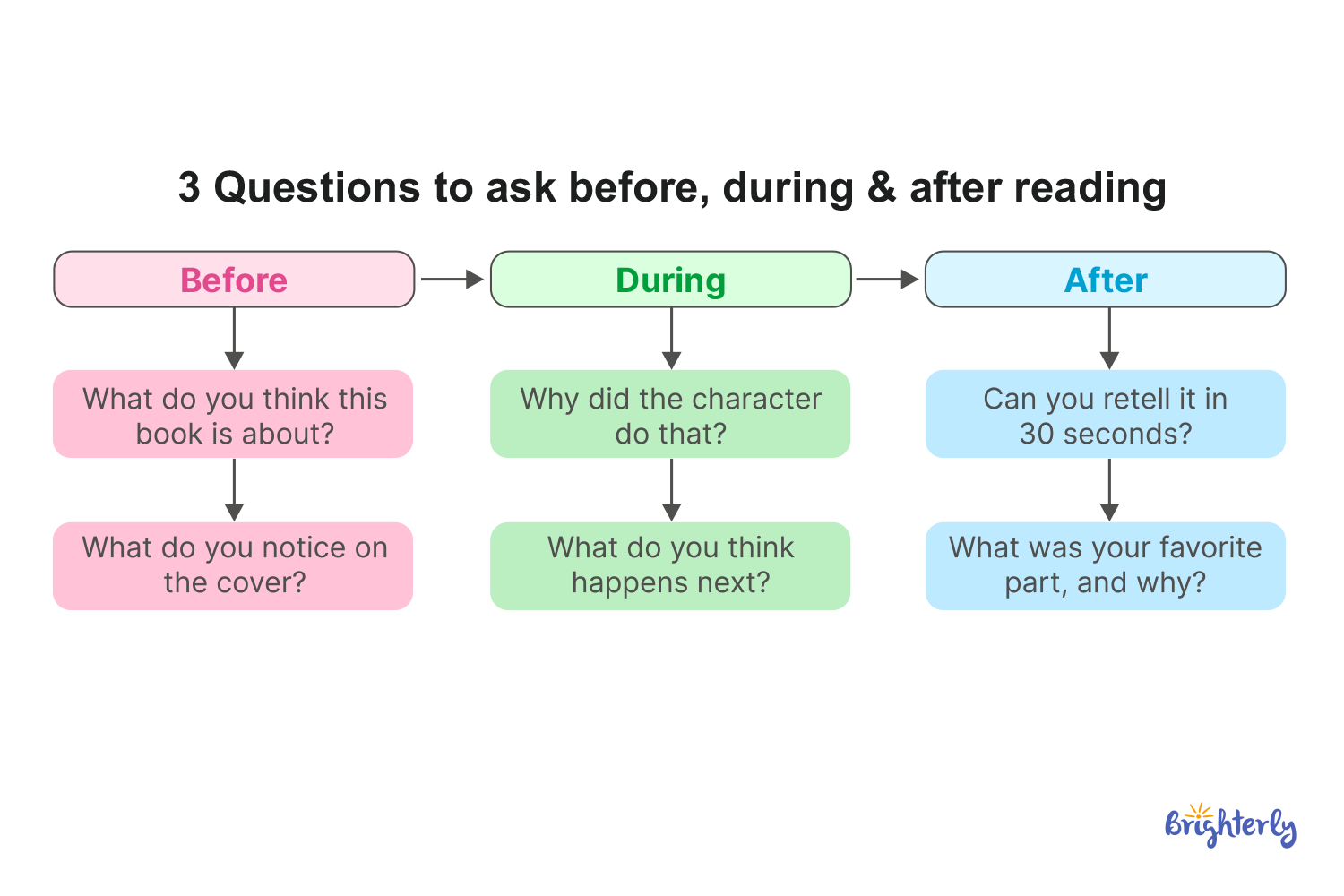
Three simple questions asked before, during, and after a reading session are among the most useful reading strategies for parents to use at home. The questions you ask before reading can focus on predictions, if it’s a new piece of reading material. Thus, a good tip is to look at the book together and get inspiration for the initial questions.
The good questions are:
- What do you think this book might be about?
- What can you see in the picture? Does it give you hints?
If it’s a continuation of reading, try asking about previous chapters and events. This step will help activate kids’ prior knowledge and prepare them to focus on text.
Next, you should ask questions while the kids are reading. These questions can again focus on predictions, but they can also dig deeper into what’s happening. For instance, after reading a few pages, you can take a pause and ask a question about what is happening. Here are some questions to start:
- Why do you think the character did that?
- Does it remind you of something from your day? (you can give a hint to a situation or a feeling)
Such questions would encourage kids to think about cause, emotions, and events in the story.
Finally, after reading, let’s say a chapter, you should ask your child questions that focus on summarizing new knowledge, a story, the questions they have, where they might take it next, and more. Depending on the book, you can try different activities and types of questions:
- After reading an informational piece about turtles or nature, ask questions that explain facts about the world. For instance, “Why do turtles crawl?” or “What will happen to such an oak in a desert?”
- After reading a narrative or a story, ask about the motives of a character or events, their descriptions. For example, “Why do you think the character did that?” or “What else could they’ve done?” Or appeal to their emotions and use the “If you were them, what would you have done?” prompt.
Sample Prompts by Grade
|
Grade Band |
Before Reading |
During Reading |
After Reading |
|
Grades 1–2 |
What do you think this story will be about based on the picture on the cover? |
Is there anything in the book you don’t understand so far, like words or sentence structures? |
Did you enjoy the ending or would you change anything? |
|
Grades 3–4 |
What do you already know about this topic? |
Do any of the events in the story so far relate to your own life? |
What lesson did you take away from this book? |
|
Grades 5–6 |
Based on the cover and blurb, what do you think the genre is? |
What do you think the main character is feeling right now and why? |
What was the theme of the book, and do you think it changed throughout? |
|
Grades 7–9 |
What questions might this book answer? |
What is the main conflict of the book and how do you think it can be resolved? |
What do you think the author’s purpose was, and did they achieve it? |
Quick 2-Minute Comprehension Activities to Try at Home
Another one among reading comprehension tips for parents to use at home without making it feel like too much work is through two-minute comprehension reading activities. These activities include story recapping, playing it out, and practicing with prompts and flashcards.
- Story recap time. Devote 30-60 seconds for the kid to recap what happened in the piece or chapter.
- Show, play out, or write to recap. Ask a kid to show what they read with writing, drawing, or playing out. Apart from other reading games, it’s a fun way to improve comprehension and support engagement.
- Practice via prompts and flashcards. Prepare cards with main ideas and hints beforehand, then hand them out to the kids so that they reflect on the text.
Note: Use a paragraph comprehension worksheets if you want to try microlearning at home.
How to Help When Your Child Gets Stuck
The final method among reading strategies for parents to use at home is developing a toolkit to support their child when they’re struggling with vocabulary or understanding a piece of text. The toolkit includes sounding out words, breaking sentences into smaller parts, using context, and building background knowledge.
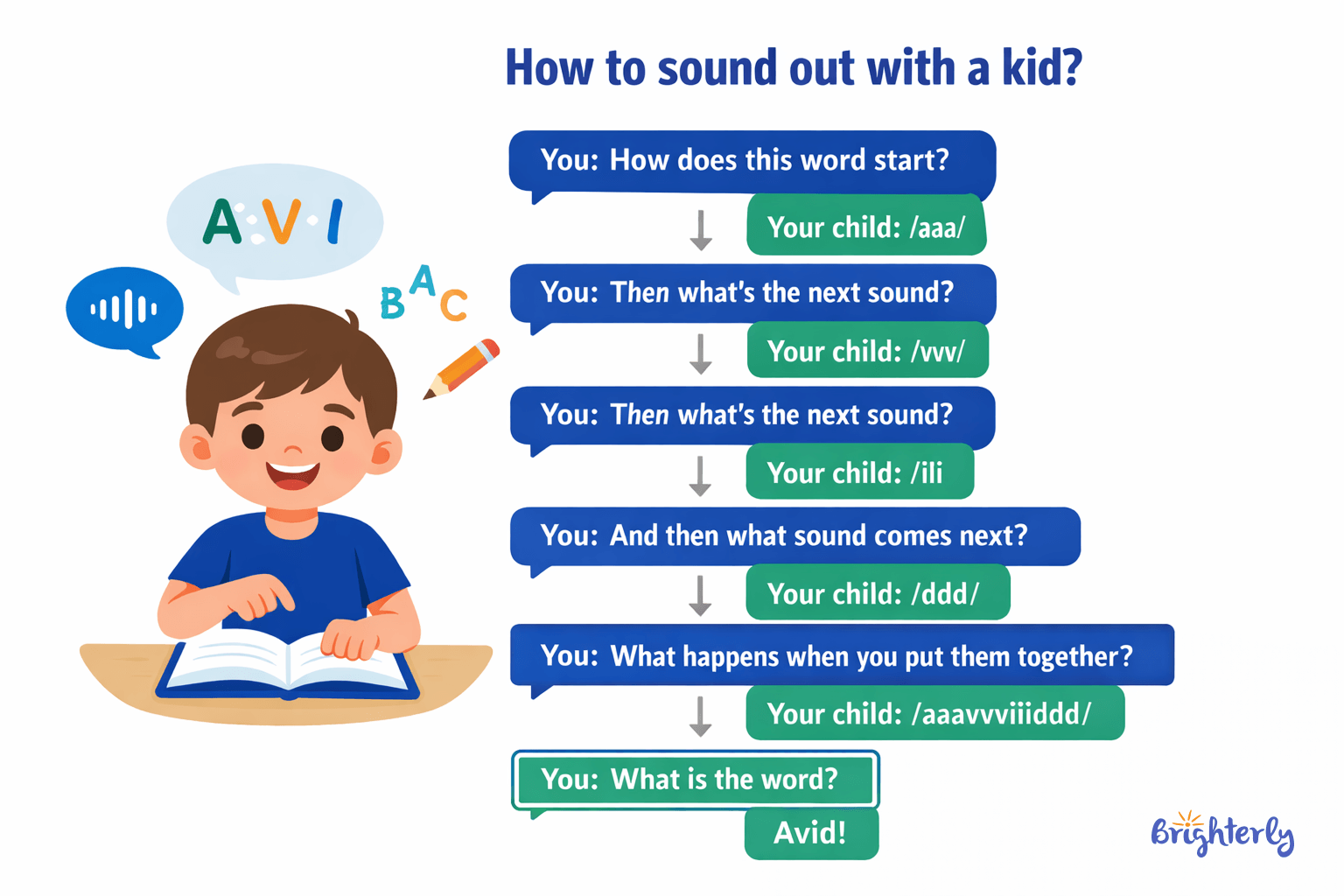
- When a kid doesn’t recognize a word, sound it out or explore it (for higher grades), when reading it together. Ask a kid, “How does the word start?” or “What’s the next sound?” to sound each letter or letter combination until a kid says the whole word or gets the phonemic part.
- If a kid finds a word or sentence too long, help them break it into smaller parts with activities like clapping or finding associations. For instance, for the word “mas-cot”, you can clap after each syllable “mas” and “cot.”
- If you predict that vocabulary is complex, use context. Children might encounter words they’re unfamiliar with. So hint to them to use the surrounding context, like words around it. You can circle or write these words down beforehand on a flashcard and turn them into a quiz.
- If you know the text will be complicated, help them build background knowledge. Consider it a part of a larger knowledge-building approach. The January 2023 EdWeek article contemplates that when kids have background knowledge on subjects, they can comprehend written material on them better — the data a more recent January 2024 EdWeek report reinforces with newer curriculum research.
Age-by-Age Reading Comprehension Tips
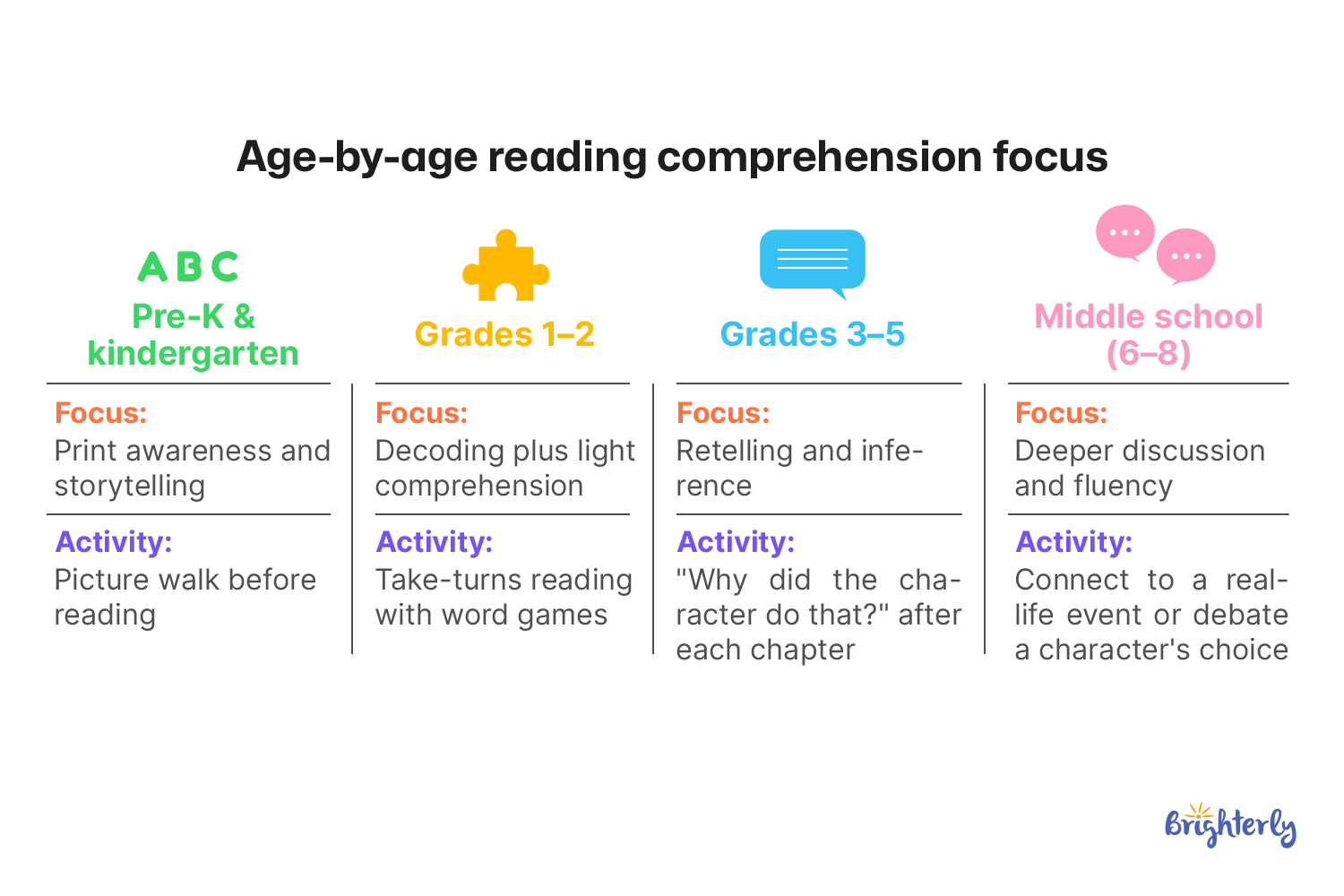
Reading at home tips for parents differ based on the child’s age and grade level. For kids in Pre-K/K simple read-alouds are enough to build reading comprehension, while kids in middle school require deeper discussion to master their ability to understand stories and their meaning.
Pre-K and Kindergarten
Pre-K or kindergarten kids still learn that printed material carries any meaning, so reading comprehension tips for them include building print awareness, practicing storytelling and shared reading. For example, flip through the book together with your kid and ask them what they notice.
Also, practice reading aloud together daily, pointing at words as you read. The benefits of reading aloud include improved vocabulary and creation of a longer attention span — skills that will help with reading later on.
Grades 1–2
Kids in grades 1-2 still learn to decode words, while starting to understand their meaning at the same time, so comprehension support should focus on decoding help. For example, take turns reading page by page, while helping a kid to decode words they struggle with. You can also play word games to teach phonics skills in a fun way.
Grades 3–5
With kids in grades in 3-5 you can focus reading comprehension practice on retelling stories, asking inference questions like “Why did the character do that?”, adding nonfiction literature into reading choices, and building background knowledge.
Middle School (Grades 6–8)
With middle schoolers, you can move on to deeper discussions to improve reading comprehension. For example, connect reading to real-life situations or debate characters’ decisions. You can also use audiobooks, especially if your kid is an auditory learner or if you don’t have access to printed material.
Note: Each of these home comprehension tools may be an essential part of the larger reading comprehension strategies.
How to Create a Reading-Friendly Environment at Home
Among the tips for parents to help with reading at home is to create a comfortable reading environment where a kid can enjoy this activity. To create such an environment, focus on arranging three main elements: space, routine, and materials.
- Setting and management of the space is about creating a cozy corner with appropriate light where a kid would feel comfortable and be focused on reading.
- In terms of routine, inserting daily activities into the family routine will be crucial in supporting order, discipline, and developing habits.
- Lastly, making a small library or bookshelf with various age-appropriate books is also a way to contribute to reading, especially if you plan to update reading materials to keep them fresh.
Mistakes Parents Should Avoid
Even when applying parent tips for reading at home, parents can make mistakes that prevent the kid from improving in reading comprehension, like correcting every word a child reads wrong, choosing wrong books, focusing too much on decoding, or making reading feel like a chore.
- Correcting every single word. Constant corrections and interruptions can break the kid’s focus and reading flow, making them uncomfortable when reading out loud. Discuss errors after the kid is done reading.
- Choosing books that are too hard. A book with too many unfamiliar words can make a kid lose motivation, even if it matches their grade and age level. Choose a book that your child can read with 90–95% accuracy so that the reading doesn’t feel too hard.
- Focusing only on decoding. Decoding words is only half the job — don’t give it more attention than to the actual child’s ability to understand the words’ meanings.
- Turning reading into a chore. Keep reading sessions short and pressure-free so that a kid associates them with something they can enjoy rather than a task they have to get through.
When to Consider a Reading Tutor
If any of the listed techniques don’t feel like enough for your child or you’re unsure how parents can support reading at home on their own, addressing an experienced online reading tutor can be the way to go. Our structured homeschool reading program includes one-on-one reading tutoring adapted to your child’s individual needs, ensuring they only work on content that improves their reading comprehension.
Our reading tutors offer reading comprehension help to K-12 students through personalized, gamified learning and by using additional tools that may not be suitable for parents to use at home. Additionally, kids can access free reading comprehension worksheets to test or cement their knowledge outside of their sessions.
You can also find out more on help for struggling readers on our blog and take a free reading test to see your kid’s current reading level.
Reading comprehension tutors for struggling readers
Our tutors help improve comprehension when home practice isn’t enough.
Conclusion
Helping a kid with reading comprehension at home means creating a comfortable and supportive reading routine for them — keep the reading sessions short, ask questions, and choose books that are not too hard and that your child actually wants to read.
Frequently Asked Questions
Why Can My Child Read Words but Not Understand What They Read?
If your child can read words but can’t understand what they read, it means your kid has different decoding (ability to recognize and sound out words) and comprehension (understanding the words’ meanings) skills. For example, NWEA March 2025 article shows that a kid can have language comprehension skills while struggling with decoding, and vice versa — have no problem deciding, but still struggling to understand word meaning and connecting it to the story.
How Many Minutes a Day Should My Child Read at Home?
For a reading practice at home, 10-20 minutes is usually enough for most kids. Consistency is more important than actual time — a short but daily reading practice is better than one long weekend reading session. Also, you can start with 10 minutes of daily reading and slowly increase this time as the kid becomes a more confident reader.
Do Audiobooks and Reading Apps Improve Comprehension?
Yes, audiobooks and reading apps can help improve comprehension. Audiobooks let kids access books and new vocabulary that they would be unable to decode if these materials were in paper format. Reading apps help kids track what they read, how much, how fast, etc. Just add audiobooks and reading apps as a supplement to reading practice rather than a full replacement for paper books.
How Can I Help with Reading Homework Without Doing It for Them?
To provide your kid with reading homework help, ask them related questions about the story instead of reading it for them. If a kid can’t answer a question, guide them back to the relevant paragraph and ask what it says — don’t explain it yourself.
Can I Improve My Child’s Reading Comprehension at Home Without a Tutor?
Yes, you can help your child improve reading comprehension at home by creating a consistent reading routine and providing necessary support. A tutor’s help can be more useful if you notice that home practice yields no results and the child shows no progress.
What’s the Difference Between Reading Fluency and Comprehension?
Reading fluency is the ability to read accurately, smoothly, and at a natural pace, while comprehension is the ability to understand what the words you just read actually mean. A child can be fluent in reading without having strong comprehension skills, or vice versa.


Kids receive tons of information at school and are exhausted in the afternoons. I see this almost every day, and no surprise that these days, more parents are worrying about how to teach kids time management and at what age to start. Helping children manage time starts small, so let me share some practical life […]

Feb 24, 2026

RTI (Response to Intervention) is a multi-tier framework schools use to spot struggling students early, give them targeted extra instruction, and check their progress every week or two. It’s part of general education, not special education, and it’s most common in elementary school, where it focuses on reading and math. Below, you’ll learn how the […]

Feb 25, 2026
Math & reading from 1st to 12th grade
Looking for homework support for your child?

Choose kid's grade

Math & Reading for Grades 1–12
Build real confidence for your child with a Brighterly math or reading tutor.