How to Write an Essay Step by Step Guide
reviewed by Franz Jerby Delos Santos
Updated on January 21, 2026

As a parent, you must know that writing an essay is not an easy task. A young writer should think of preparation, brainstorming, writing, and revising. If you’re a bit confused by these parts, why not get help writing an essay? At least some helpful tips. Read on to explore how to write an essay, structure the work, and learn some effective essay writing techniques to help your child on learning journey.
Key points
- Essay writing becomes easier when following a clear writing format, consisting of an introduction, body, and conclusion.
- Following a simple and clear structure is half the work done.
- Writing a good essay involves planning, brainstorming, outlining, and turning ideas into structured paragraphs.
- The best writing techniques refer to focusing on the outline, understanding the main question, and reading a lot for inspiration.
What is essay format?
Most essays have an introduction, a main body with several paragraphs, and a conclusion. The essay writing format ensures the essay structure and helps to express the main idea behind it. The short essay format suggests that you first present an idea, then provide the main points, and summarize them in the conclusion.
Essay structure
Formats may vary depending on the grade and complexity. Yet, a common essay format is the following:
- Introduction. It has up to 5 sentences. It starts with a hook, followed by the sentence’s topic relevance. The last sentence is the main idea of the essay, backed by arguments.
- Body of the essay. The common school essay format contains 2-3 paragraphs. Each paragraph has the main sentence related to an argument, evidence that supports this topic, an explanation, and a transition that leads to the next paragraph.
- Conclusion. The concluding part summarizes the main points from the body and connects them to the main idea from the intro. In this part, the child shares their final thought.
Note: The academic essay structure is similar but more complicated, including more paragraphs or layers. Under the essay format, layers require additional sentences to state counterarguments, rebuttal, or explanations of sources or evidence.
How to write an essay?
Writing a good essay involves planning and brainstorming ideas first, then turning them into writing the body of the text, and proofreading the whole piece. The clearer and more organized the paragraphs are, the better the essay will be.
Essay format example
Let’s consider a simple how-to-write-an-essay example with the name “My Favorite Pet”. It can use the following format:
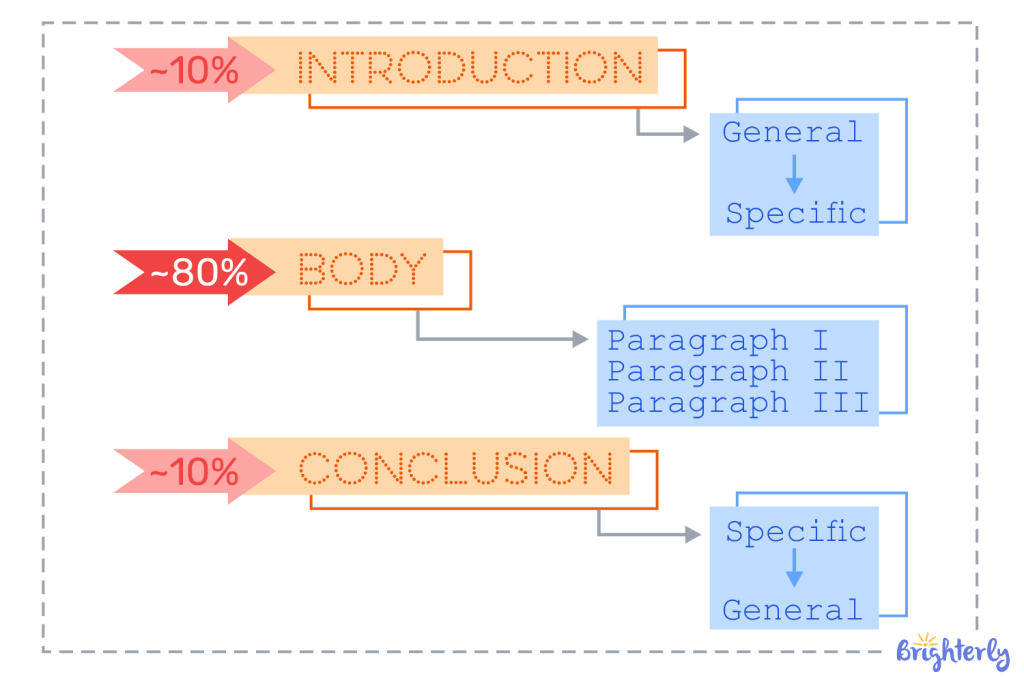
- The intro may start with a hook, “Do you know that pets make us happier?” and end with a main idea similar to “My cat George is a great pet because he’s playful, smart, and cozy.”
- The body would have paragraphs on each reason. One about playfulness, one about being smart, and one about how it shows love. There, each paragraph will have facts and stories about George.
- The conclusion in this essay format example would wrap up all the main points and prove “George is fun and smart as he runs, gets food from closed cans, and sleeps with us.” Then, a student can add some general info or close with why pets are fun.
What makes a good essay?
Writing a good essay means having a clear main idea, a logical plan with solid arguments and relevant evidence, and a coherent conclusion. Each argument should connect to the main idea, while the intro and conclusion should answer the main question.
Core components of any essay writing format and structure
- Clarity. It implies that ideas and topic sentences are clear and set the direction of the essay.
- Relevance. The data and evidence should be relevant and support the key idea.
- Unity. It means that ideas and arguments connect well with each other and the main question.
- Coherence. This is about ensuring that the flow is logical and organized.
Steps in writing an essay
- Prepare and brainstorm the ideas
- Outline the article
- Write intro, body, and conclusion
- Revise each part
Note: If you wonder how to make an essay, the mentioned steps will help you do the job. Yet, be aware that a five-paragraph school essay format will take more time in terms of writing, while an argumentative essay will require more time for researching and brainstorming.
#1: Preparation and brainstorming
Among all essay steps in order, preparation seems to be the main one. Why? Because it sets the direction for the whole essay. The better a child prepares, the easier it is to write and revise the article. First of all, they should understand the question or prompt to define the essay topic and main ideas.

How to prepare?
- Read the task carefully.
- Ask, “What topics are to be discussed?”.
- Based on it, determine the essay writing format and type (it may be a narrative or, if the goal is to compare and contrast something, a comparative type).
- Leave room for questions your child can clarify with you or a teacher.
Note: A good hint is to turn a topic into a question. For instance, if the main topic is “Favorite animal”, make it a question: “Why do you love cats?”.
Brainstorming
Upon understanding the task, it’s time to brainstorm ideas. To help writing an essay, ask a child to write down every thought that relates to the topic. Short phrases and simple ideas work well, too.
From there, pick the strongest idea that a child loves and will feel enthusiastic to write about.
For example, if the topic is an essay reflection with the name “My favorite character,” choose the one that the child feels most positive about and remembers well.
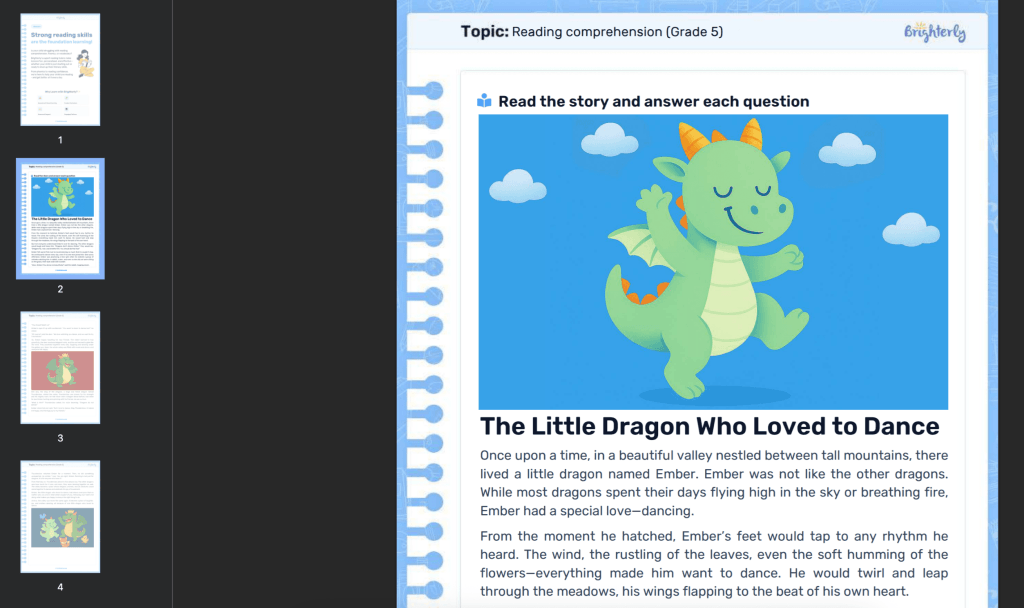
To practice reflection essays, you can download printable reading worksheets, which are powerful for developing thinking and reflection upon reading, laying the foundation for future writing.
Picking the topic
One of the key steps of writing an essay is to decide on a topic or thesis. After brainstorming, your child can answer the main question, which will become the thesis – the main idea of the whole essay.
Note: When the topic is not fixed, it may be harder. So, make sure your child has a clear question and an answer that fits the topic.
In other words, it’s the solution to the concern “How to start an essay?”. Explain that the thesis introduces the reader what to expect from an essay.


Researching
After that, it’s time to research and gather information to write about.
What can help writing an essay?
- Recalling previous lessons.
- Educational videos or other media.
- Teaching them using a book or specific websites.
- Showing them reliable sources.
- Letting them know that they can ask someone (a teacher, librarian, or family members).
It’s all about gathering evidence or facts to support the main points or showing the application of what they know. If a child is writing about their pet, why not add a fun fact about it, right?
#2: Developing an essay outline
Successful student essay writing depends heavily on the outline. Why? It sets the structure.

You can call it a roadmap, and that’s where all the brainstormed ideas are organized into the skeleton of the essay.
An essay structure example for “My favorite pet/animal” paper
- Intro: Question hook + main idea “I like cats because they are smart, fast, and love people”
- Body paragraph #1. Reason 1 + example or story (They are smart as… I remember how a cat stole some tuna from a kitchen).
- Body paragraph #2. Reason 2 + example or story (They are fast because…The book says they have high speed).
- Body paragraph #3. Reason 3 + example (They love people because…Cute experience with the cat).
- Conclusion. Restating why cats are the favorite animals in one or two sentences.
As a parent, to make essay writing for kids easier, you can help them sketch this out and share your notes, points, or drawings.
#3: Writing the body of the text
So, how to write a good essay? Once the outline is ready, start to write the first draft.

Let’s start with writing a strong introduction. The first element of the introduction is a hook. Your kid may start with a question, a fun fact, or a general idea.
To continue, they should show relevance and offer background so that a reader sees the topic.
Lastly, the intro ends with a thesis or main idea backed by arguments (supporting ideas from the main paragraphs)
One of the examples of how to start an essay
“Ever wondered how important pets are for us? They make our lives funnier. I love cats and my cat George, as he is super smart, fast, and loves me.”
What to do next?
- Start with a topic sentence. If one point is that their pet is smart, start with this sentence about it.
“My cat George is very smart and I love him for this.”
- Add details: Add two or three sentences with examples or reasons that refer to the points.
“When he wants to escape the room, he opens a door by himself. And when he is hungry, he can find where we hid it.“
- Use transition words and sentences. Words like first, but, and next are important in such an essay for kids. They allow connecting thoughts and paragraphs organically.
“But how George thinks is not the only great thing about him; he is also a runner.”
After finishing the first body paragraph, help them continue similarly. There, reading aloud can help or simply remind them about the outline.
- Once the previous steps of writing an essay are done, encourage your child to write a decent conclusion.
There, they should summarize key points, restate the main idea/thesis, and end with an additional thought. Look at the example of an essay conclusion:
“In conclusion, you can’t argue that George is great. He’s intelligent, fast, and loves me. That’s why I love him. And I’m sure others will like him too.
Note: Follow an outline and turn each point, supporting idea, into a paragraph. Writing a good essay means keeping the main body clear and structured.
#4: Revising and proofreading the text
You may try several ways to start an essay, but proofreading will always be the last step in the essay writing process.
It’s how you polish the essay, make it follow the structure, and ensure it has all the necessary components.
What should a child do to ensure they are writing a good essay?
- Check it against the assignment and main question.
- Ensure thesis, topic sentences, and evidence connect.
- Proofread and find repetition, spelling, and grammar mistakes.
- Work on sentences that are confusing or too long.
- Check that the conclusion restates the thesis and doesn’t add new information.
Note: As a parent, suggest reading the work aloud; it’s a perfect way to improve writing, or play a game where the one who spots a mistake gets a reward.
How Brighterly lessons help with writing via reading
Starting an essay from scratch can be really stressful for a child, especially if it’s their first attempt. Whether you need help with writing an essay after reading or as part of the curriculum, tutoring can help.
Brighterly math and reading platform offers personalized lessons to kids who struggle with reading and writing based on their needs and grades.
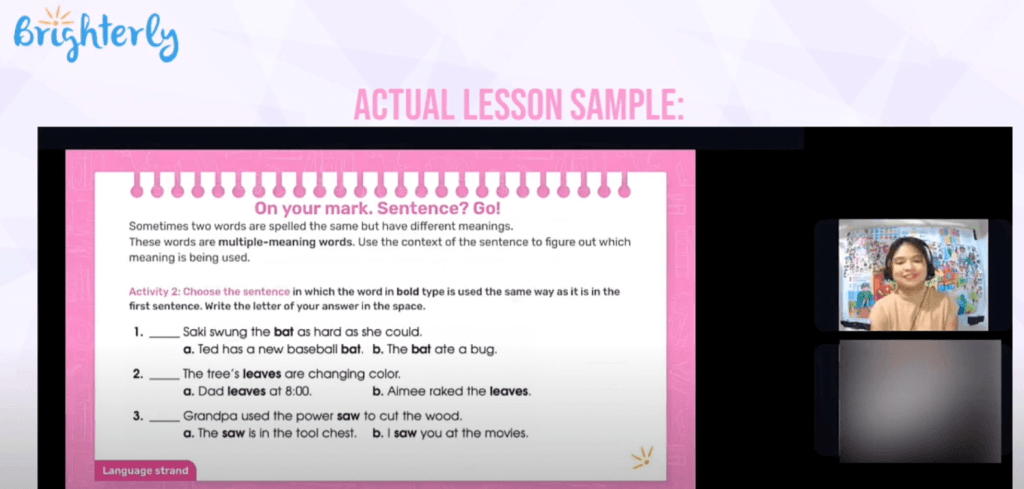
But how does it help?
- Its professional reading tutors provide interactive lessons that teach critical thinking, research skills, and storytelling for students of elementary, middle and high school.
- In one-on-one lessons, they provide reading pieces and review different ways to start an essay together.
- In addition, Brighterly reading program offers progress checks and feedback to kids and parents.
- It helps parents build their kids’ confidence and choose strategies to keep up with their programs at school.
Essay writing tips for K-12 students
- Plan and outline first
- Use simple structure and sentences
- Read a lot to write a good essay.
- Encourage creativity.
- Ask someone to proofread
Note: School students often get lost when they get a task to write an essay. “How to start an essay?” is often the main question. Thus, our tips will focus on planning and structure as they help to start the process.
Focus on planning and outline
Before writing the first words, go through the essay’s goal and ideas. It’s important to make sure that you answer the main question and back it with relevant reasons. There, try to fit everything into a one-page design that has all the points.

One of the essay writing techniques is to have all the notes on a separate paper or in a notebook. There, write the question, then a thesis, and key points why.
Use simple structure and sentences
At the stage of brainstorming, a student may be overwhelmed with ideas. Try to prioritize and simplify them. Later, you can add details and more explanations if needed.
Remember that writing a good essay is about clarity and structure. Therefore, make sure a young student uses one sentence to express one idea.
Read to write well
There are more than enough essay writing techniques, but reading before writing is a primary one.

First of all, it helps to get to know vocabulary, facts, and examples.
Secondly, it introduces how a student can form sentences and explain ideas. Moreover, books and articles are great tools to master hooks and transitions.
Note: You can resort to reading tests to see whether your child needs some improvement or identify which topics are worth exploring.
Encourage creativity
Writing an essay may be a tedious process. So, a parent can help with writing an essay by encouraging the use of creative tools. It can make brainstorming much more engaging and interesting.
In this regard, incorporate digital tools, mind maps, and ask them to think of personal stories or examples. Also, you can use creative prompts to introduce practice and prepare for a school year.
Ask someone to help proofread
Lastly, one of the greatest essay writing techniques is to ask someone to read and proofread your text. Do the final check, ask them to give their opinion, or read the text aloud together.
It’s a great way to polish the text. A peer or a family member can help identify confusing parts and recommend a different word.
How to make an essay: Conclusion
For you, a parent, teaching children ways to start essay writing includes guiding them through each step. You should show them how to understand the question, brainstorm, plan an outline, and write clear paragraphs.
You can be of great help in revising and offering examples or feedback. With patience and these tips, you can make an essay easier and even engaging for a child.
Want to boost your child’s writing and reading with professional help? Book free reading lesson to try Brighterly’s personalized tutoring approach.


It’s truly an art to teach a first grader to write a story. I saw many kids stare at a blank page: how to begin? A fun writing prompt for kids can help them get past this block, spark their creative spirit. As someone who’s been in teaching for years, I’ve collected over 100 1st-grade […]

Nov 21, 2025

When your child struggles with finding the right words, you feel it too. As a math tutor with years of teaching practice for kids, I’ve gathered 15 best vocabulary learning apps that help boost speaking confidence and grades at school. Key points: Customized, adaptive experience with spaced repetition is a must for the best free […]
Nov 25, 2025
Math & reading from 1st to 9th grade
Looking for homework support for your child?

Choose kid's grade

Math & Reading for Grades 1–9
Build real confidence for your child with a Brighterly math or reading tutor.