Is the ACT Easier Than the SAT? Key Differences and How to Choose
reviewed by Laila A. Lico
Updated on March 20, 2026

The ACT and SAT are the two main college entrance exams in the US. Is the ACT easier than the SAT? Neither test is harder; the right choice depends on how a student thinks, manages time, and handles question formats. Picking the wrong exam can waste time and money, so it’s worth knowing the main differences between the two.
Key Points
- All of the major colleges in the US will accept both tests for the 2026 school year.
- The SAT gives you more time to answer each question than the ACT. The digital SAT uses a multistage adaptive testing format to determine how perfect a student is in a particular subject.
- The ACT has a science section that tests how well you can understand data, but it’s not required for the composite score anymore.
- Math counts for 50% of the entire SAT score, while it’s only 25% of the ACT result.
What are the SAT and ACT?
Colleges in the US use the SAT and ACT as standardized tests to compare applicants on a common scale. Both the SAT and the ACT assess whether students are prepared for college. But they do it in different ways:
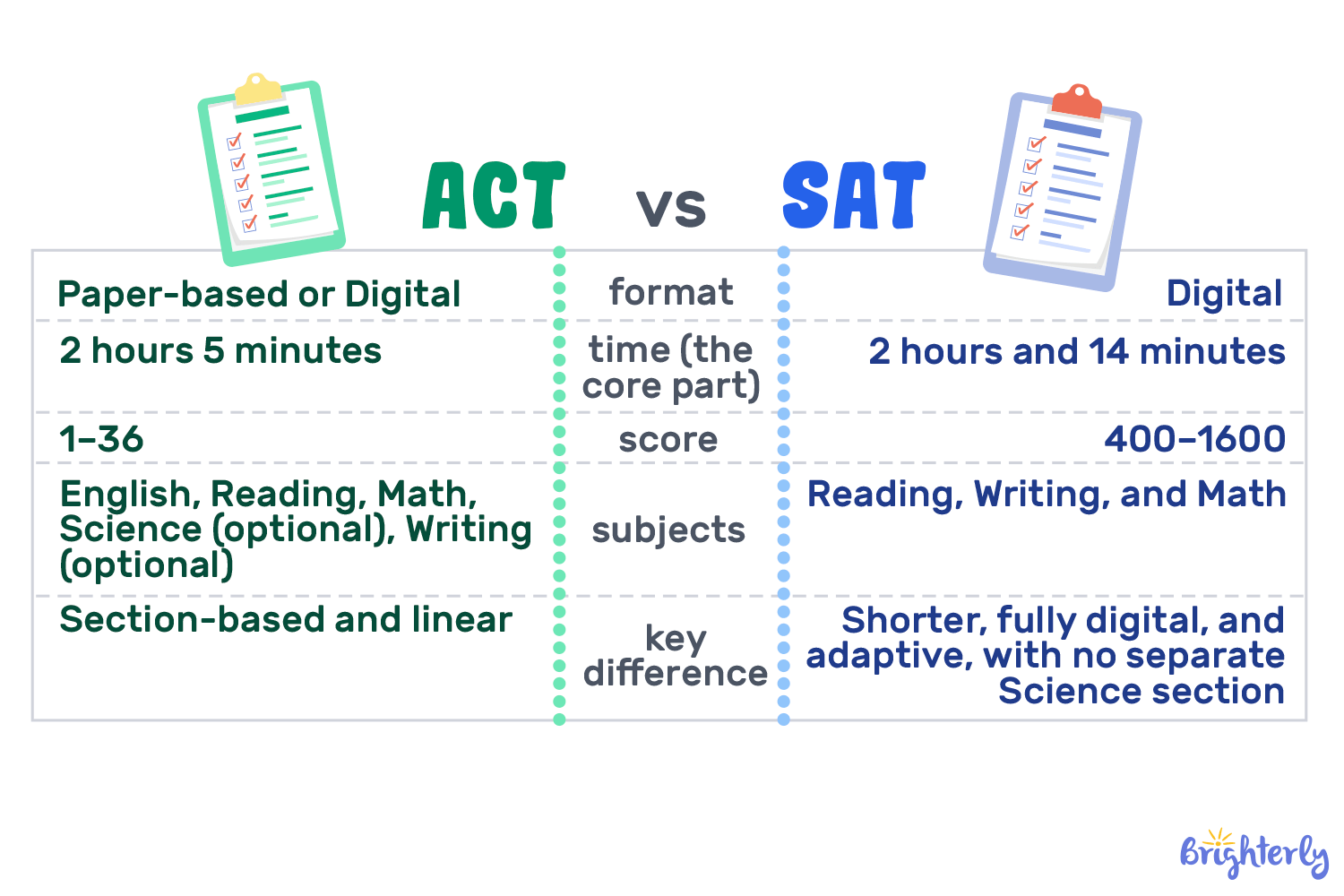
- The Scholastic Assessment Test (SAT) is a digital, adaptive exam provided by the College Board. It runs for 2 hours and 14 minutes and covers Reading, Writing, and Math. Students are scored on a 400–1600 scale. The Math section accounts for 50% of the entire score.
- The American College Testing (ACT) is a paper-based, linear exam by ACT, Inc. It runs for close to 3 hours and covers English, Math, Reading, and, optionally, Science and/or Writing. Students are scored on a 1–36 composite scale. The Math section counts for 25% of the entire score. In recent years, students have also been able to take the ACT exam online.
Whether the ACT or SAT is harder comes down to two things: how fast you read and how strong your math skills are. Understanding standardized testing early gives students a real advantage when planning their prep.
ACT vs SAT: Content, subjects, and question types
The SAT and ACT both test a lot of the same basic skills, but they do so in different ways. That’s why the content, subjects, and question style of one test can make it seem a lot easier than another.
Types of questions and subjects on the SAT
The SAT is divided into:
- Reading and Writing: Short passages with one question each.
- Math: Questions about algebra, advanced math, data analysis, and geometry with trigonometry.
The Reading and Writing section has short passages. You only have to answer one question for each short text. It can help students who have trouble staying focused on long essays understand them more easily. The test includes many different texts from science, history, and literature.
Many wonder if the ACT is more math-based, but the SAT actually places more weight on math skills. Half of your final grade is based on math. You can use calculators for all of the questions in the SAT Math block.
The SAT Math section covers multiple areas:
- Algebra: This includes systems of equations, inequalities, and linear equations.
- Problem solving and data analysis: You will look at graphs, tables, and data arrays to figure out what they mean.
- Advanced math: There are questions about polynomials, quadratic and exponential functions, and more.
- Geometry and trigonometry: These are a smaller part of the test, but you will still see questions about angles, triangles, circles, and basic trig functions.
If you focus your studying on these main topics, you’ll feel more confident and do better on the SAT.
Students who need more structured, comprehensive support can also benefit from this one-on-one math help to enhance their weak areas before test day. Brighterly helps you find math tutors who work with your child on topics across all math grade levels. The online math program for kids covers all the core algebra, geometry, and advanced math topics that appear on both tests.
Types of questions and subjects on the ACT
The ACT is split into:
- English: Tests grammar, usage, and rhetorical skills through long essays.
- Math: Covers precalculus, geometry, and trigonometry.
- Reading: The ability to read quickly long passages from four different genres.
- Science (optional): Tests your ability to interpret data, charts, experiments, and scientific viewpoints.
- Writing (optional): A 40-minute essay in which you explore a topic from multiple perspectives and clearly support your own point of view.
So, how hard is the ACT? Many students find that it depends on their speed. The English section asks you to edit long essays for grammar and punctuation. The reading section consists of four long passages, each with ten questions. You must quickly find facts and main ideas.
The math tests of the ACT cover more topics than the SAT. You will find more geometry and some trigonometry. However, math only counts for 25% of your total score. It’s a key difference between ACT and SAT for students who find math difficult.
The ACT is easy for students who manage their time well and prepare thoroughly for each section.
Note: Kids who struggle with the reading speed the ACT demands can boost comprehension and fluency through reading and writing tutoring. Brighterly helps kids work with long, detailed passages more confidently.
SAT vs ACT differences in timing and pacing
Slow readers might find the SAT harder than the ACT because of its complexity. However, the speed of the ACT exam may provide a bigger challenge.
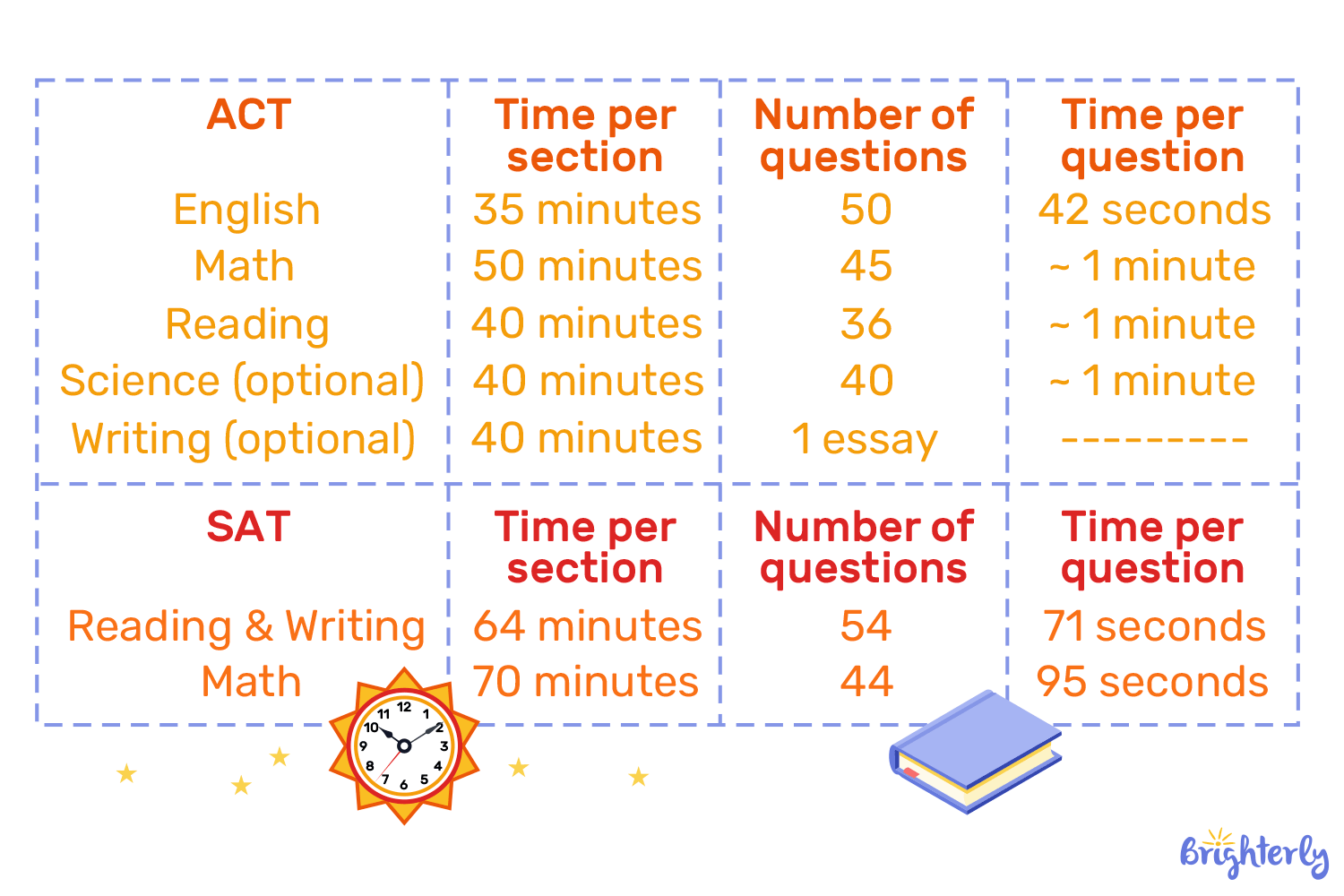
- You have more time to think on the SAT. Reading and writing questions take about 71 seconds each. It takes about 95 seconds per question to complete the Math section. Students who need to recheck their work will benefit from this.
- There is much more pressure on the ACT. Moving fast is essential. You have 42 seconds per question in the English section. Each question in the reading and science sections takes about 60 seconds.
Here are SAT vs ACT timing differences per question:
ACT vs SAT difference in format and test experience
The SAT is an adaptive test: your performance on the first module determines how challenging the second module will be. If you do well, the second module will be harder, but it will result in a higher grade. If you struggle with the first part, the second part is easier, but your score potential is lower. You can take the SAT on laptops or tablets at testing centers.
The ACT is a linear test: everyone in the room gets the same questions in the same order. You can take the ACT on paper or in a digital format at some centers. As of 2026, the “Enhanced ACT” is shorter than it used to be. It takes about 2 hours to complete the core sections. The ACT has become easier than the SAT for those who disliked the 3-hour marathon.
Review the standardized testing statistics in 2025–2026 for the colleges and universities you wish to attend before selecting a test.
Comparison table of the differences between SAT and ACT
The following table summarizes the differences between the exams to help you compare whether the SAT or ACT is harder. This data is current for the 2025–2026 academic year.
| Feature | SAT | ACT |
| Format | Fully digital, computer‑based, multistage adaptive. | Paper and digital formats; linear structure (same questions and order for everyone). |
| Test structure |
|
Optional: Science and/or Writing |
| Test time (the core part) | 2 hours 14 mins | ~2 hours |
| Max score | 1600 | 36 |
| Total number of questions | 98 |
131 171 (with optional Science) + 1 essay (with optional Writing) |
| Pacing | Slower = more time per question | Faster = less time per question |
| Reading style | Short passages | Long, detailed passages |
| Math weight | 50% of the total score | 25% of the total score |
| Math focus | Advanced math | Pre-calculus, geometry, trigonometry |
| Science | Mixed into other sections | Optional separate section |
| Writing | In the core part | Optional separate section |
| Testing dates | Jan, Mar, May, Jun, Aug, Oct, Dec | Feb, Apr, Jun, Jul, Sep, Oct, Dec |
| Cost (US student) |
|
|
| Cost (international student) |
|
|
Conclusion: How to choose the right test
Review the standardized testing requirements for the colleges and universities you wish to attend before selecting a test. Although some schools have higher average SAT scores compared to ACT scores, most colleges don’t specify which test you should take.
The best tactic is to take a full practice exam for both. Students who excel in English classes often find the ACT Reading and English sections familiar. Students who are interested in logic puzzles and math may find it easier to achieve a high score on their SAT.
To increase the chances of passing the exams, the Brighterly online learning platform offers flexible, one-on-one sessions tailored to each kid’s test timeline. You can review our pricing options to find a plan that works best for your child’s preparation schedule.
FAQ: Common SAT vs ACT questions
What is the purpose of the SAT and ACT?
The SAT and ACT create a standardized assessment system that allows admissions officers to compare students’ scores from 40,000 different high schools. Both test scores are considered alongside transcripts, essays, and extracurricular activity information.
Should I take the SAT or ACT?
Take a full practice test for each exam under real-world conditions, calculate your scores on both tests, and compare them using the concordance table. The score gap will usually help to choose. Students who read quickly and are good at working with tables containing large amounts of data typically score higher on the ACT. Students with strong algebra skills and an uneven work pace generally perform better on the SAT.
Is the SAT harder than the ACT?
It depends entirely on the student’s skills and knowledge. The SAT offers more time per question and has optional science and writing sections, making it less stressful for many students. For students who struggle with advanced algebra, the ACT easier than SAT argument makes sense — math only counts for 25% of the total ACT score. However, neither of these tests is easy. The one that best matches a student’s level of knowledge will seem easier to them.
Do colleges prefer SAT or ACT?
Every four-year American university that requires standardized tests accepts both scores. Admissions experts use conversion tables to compare the scores. A score of 34 on the ACT is not considered inferior to a score of 1500 on the SAT at any American college or university.
What’s the difference between the ACT and SAT?
The SAT is a digital adaptive test in which math accounts for half of the total score. The ACT is a paper-based (and now also online) test that includes a 35-minute science section, and math accounts for 25% of the total score. The time to answer a question on the ACT is more limited. The SAT’s adaptive testing means that the results of the first section determine the difficulty level and maximum score of the second section.
Is a 1200 SAT or a 25 ACT better?
According to the correspondence tables compiled by both ACT, Inc. and the College Board, a score of 25 on the ACT scale corresponds to approximately 1200–1220 on the SAT scale. These SAT vs ACT scores are considered equivalent for applicant selection at institutions.
Is a 32 ACT or 1450 SAT better?
A score of 1450 on the SAT corresponds to a score of slightly above 32 on the ACT. A score of 32 on the ACT corresponds to about 1420–1440 on the SAT scale. The difference is minor. At most schools, SAT scores in the 1400–1500 range place students in the same applicant pool. The competitiveness of scores also depends on where the student is applying.


An online platform like Quizlet can be a great learning support. But once it no longer meets your specific requirements, you will most likely be searching for a better fit. As a tutor, I’ve decided to help with that process by creating this Quizlet alternatives guide to help you decide on the one that’s the […]

Mar 12, 2026
Math & reading from 1st to 9th grade
Looking for homework support for your child?

Choose kid's grade

Math & Reading for Grades 1–9
Build real confidence for your child with a Brighterly math or reading tutor.