Saxon Math vs Singapore Math: Which Homeschool Curriculum Fits Your Child in 2026?
reviewed by Jessica Kaminski
Updated on January 26, 2026

Does the homeschooling approach affect your kids’ math results? Sure! And you, as a parent, want to pick the best one. Let’s compare Saxon Math vs Singapore Math methods, and see which one would suit your children’s needs.
Key points
- Saxon Math puts repetition, structure, and reviews into the center of its spiral approach, helping kids build and retain strong calculation skills.
- Singapore Math emphasizes deep understanding, problem-solving, and mental math, using the Concrete-Pictorial-Abstract approach and encouraging discovery.
- Comparing Singapore Math vs Saxon Math, the former is great for curious and advanced learners, while the latter suits students who need routine, clarity, and practice.
- Both programs have flaws, whereas supplement solutions like Brighterly can balance gaps or boost kids’ confidence.
Exploring alternatives?

Saxon Math vs Singapore Math: Quick comparison
| Saxon Math | Singapore Math | |
| Teaching approach | Spiral learning with constant review | Mastery-based, conceptual |
| Main focus | Practice, repetition, procedural skills | Conceptual understanding and problem-solving |
| Learning style | Structured, routine-based, sequential | Visual, analytical, exploratory |
| Common Core compliance | Not quite aligned | Similar principles, some editions aligned |
| Yearly minimum cost | $100-180 | $100-170 |
| Parent involvement | Low to moderate after K–3 | High, especially in early grades |
| Best for | Students who need structure | Curious or advanced learners |
Saxon Math curriculum
The Saxon math program is an incremental approach that parents use to teach math at home.
Under this curriculum, children can start from kindergarten and go all the way to high school math via work on a series of textbooks that build on one another.
Each lesson is about a part of a math concept or skill, followed by practice to review previous ones. That way, a child constantly revisits what they’ve learned.
How is Saxon homeschool math structured?
- Daily lessons include problem sets and frequent assessments.
- For early grades, the Saxon math program provides scripted lessons and uses manipulatives.
- From 4th grade, children can follow the curriculum on their own.
Is Saxon Math good?
Yes. And it comes with the following benefits:
- Continual practice and constant reviews.
- Strong math computation skills and foundations.
- Friendly for parents with no math background.
Note: According to research on homeschooling, Saxon Math is pretty popular among Christian-based groups, with 74% of alumni having used this curriculum.
Singapore Math curriculum
What can I say about another popular math homeschooling approach? Well, the Singapore Math homeschool method is quite different, originating from the national math program of Singapore.
It provides a focus on conceptual understanding and problem-solving. What is Singapore Math method at its core? The main principle here is having a deep dive into one concept at a time to understand “why” behind it.
How is Singapore math structured?
- It contemplates a collection of curricula, like Primary Mathematics or Singapore Dimensions Math, where topics are discussed thoroughly.
- Materials for each grade often have two parts, one for each semester.
- It uses the Concrete-Pictorial-Abstract (CPA) method for a better explanation of concepts.
- Textbooks include challenges that require critical thinking, prioritize a variety of problems rather than drills, and have illustrations and clear examples.
Is Singapore Math good?
Yes, it is good as it allows developing conceptual understanding beyond typical books. Other benefits include:
- Focuses on thoroughness rather than repetition and progression.
- Comes in line with new math concepts that prioritize understanding, real-world application, and not drilling problems.
- As it’s mastery-based, it offers a solid foundation in math reasoning for early students, preparing them for algebra and higher-level math.
Note: The main difference between these curricula lies in the learning approach and the use of learning strategies to teach math.
When Saxon or Singapore Math isn’t enough
Both homeschooling curricula offer great benefits for your child to develop math, but neither is perfect. It means you’re likely to need a supplemental program or solution.
It comes from the drawbacks of each approach:
- The Saxon Math curriculum focuses on repetition and workbooks, meaning lessons feel boring or fail to address specific learning needs.
- The Singapore Math method emphasizes depth, meaning kids can be confused or struggle to keep pace.
There, resorting to additional programs or practicing with specific math worksheets can be of real help. Moreover, a solid curriculum and personalized tutors make a truly great homeschooling recipe.
Brighterly as a supportive tool
Brighterly math and reading platform provides 1:1 personalized sessions with expert reading and math tutors for kids to master skills and build confidence.
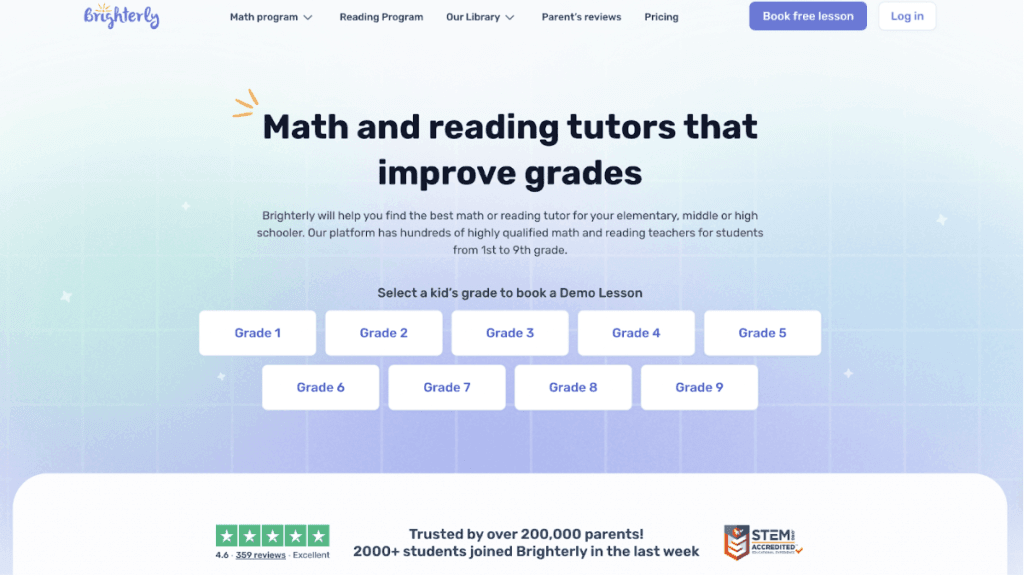
If Saxon math curriculum isn’t clicking or Singapore’s method feels a bit challenging, Brighterly’s math classes can help bridge the gap, tailor learning to their needs and pace, or focus on engagement to build confidence.
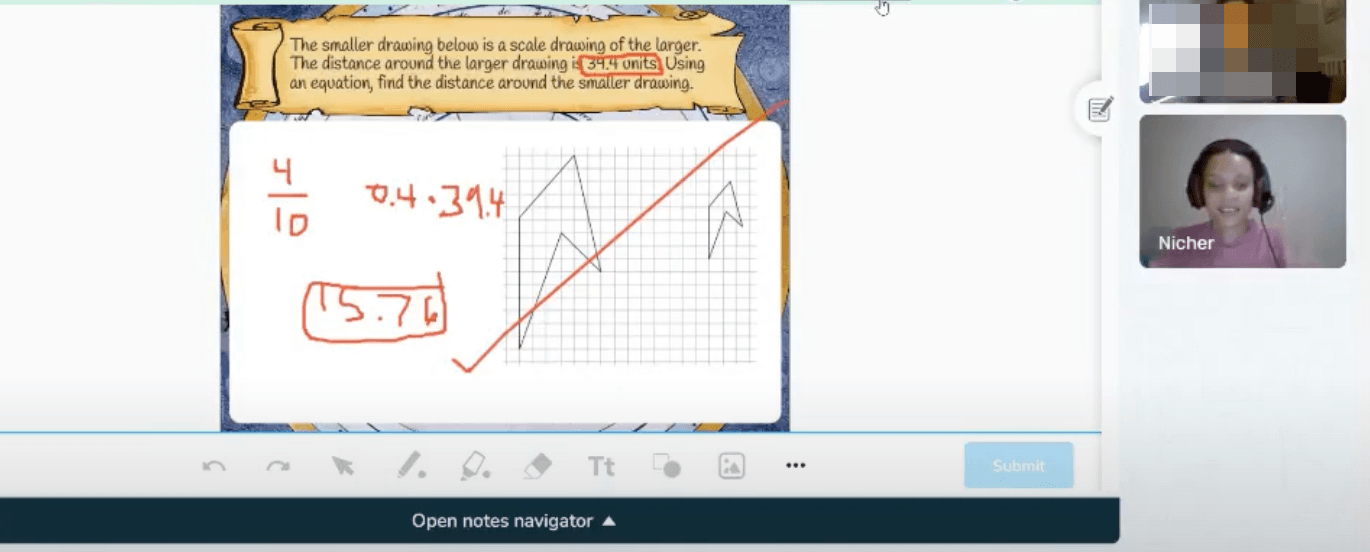
What are the other benefits of this math program?
- Its math tutors use gamified techniques and real-life examples to make learning relatable.
- Brighterly curriculum comes in line with the US state standards and should not bring confusion to Saxon or Singapore math program learners.
- It provides multiple activities after sessions, including interactive worksheets and math tests.
- Provides flexibility, allowing on-demand lessons, a determined pace, and a balance between conceptual and procedural math learning.
If you feel that your child needs a push to breeze through concepts, close a gap, or be more active and confident in solving math problems, Brighterly online tutoring should be a great supplement.


What is Saxon Math?
Saxon Math is a popular incremental and spiral approach to teaching kids math at home. It implies teaching new concepts in small and manageable parts, combining them with regular reviews of old concepts.
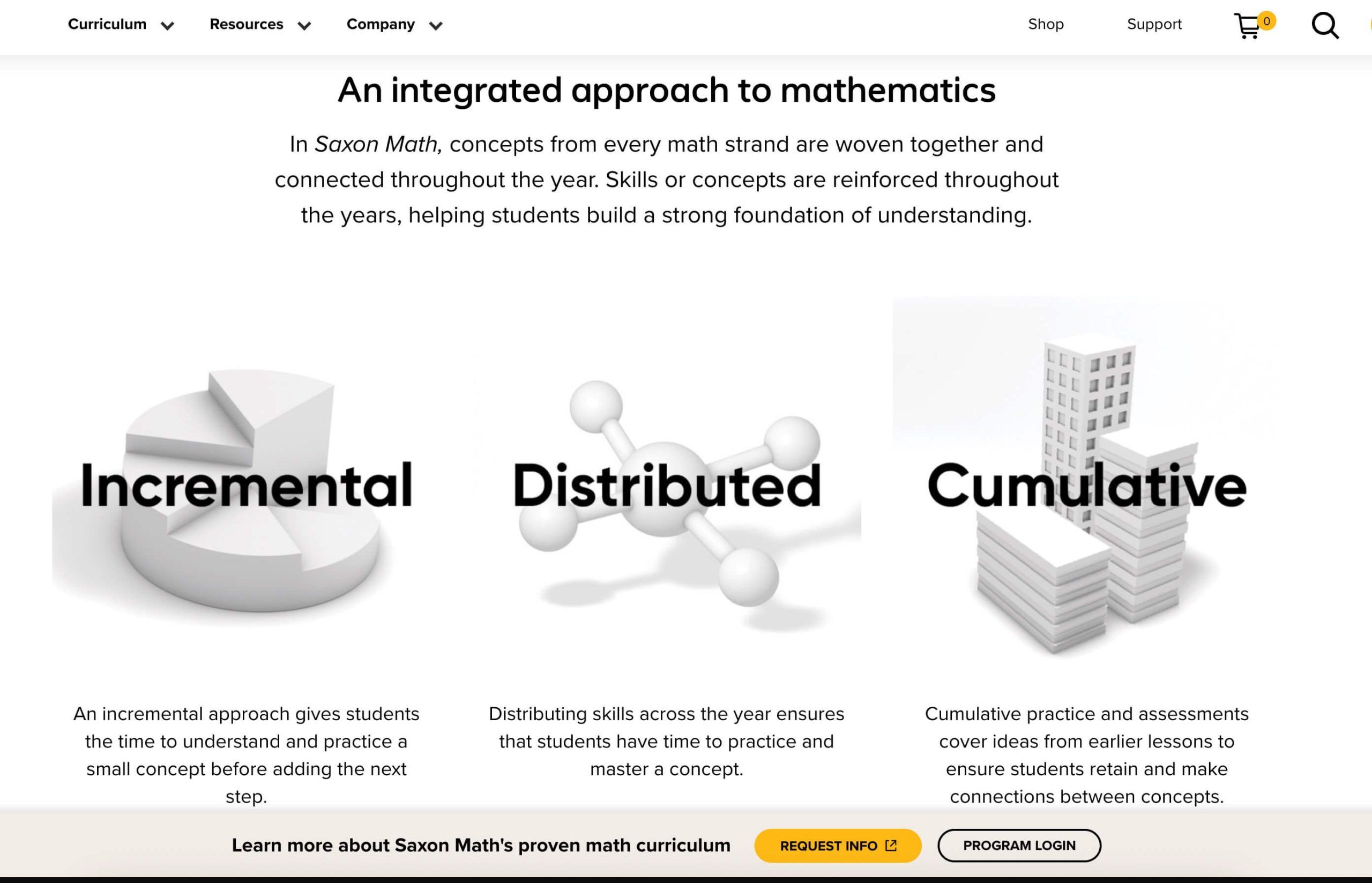
Via textbook practice, a kid can progress gradually with math concepts, reinforce knowledge, and avoid forgetting skills. The Saxon Math program was developed by John Saxon in the 1980s and covers multiple levels from elementary arithmetic to high school calculus.
Is Saxon Math Common Core?
No, the Saxon Math method isn’t; it doesn’t quite align with Common Core State Standards, as the approach was coined before the Common Core development. The topics just may be introduced in a different order there.
It follows a more traditional approach, with cumulative reviews and topics aimed at fundamental skills. Homeschoolers don’t choose the Saxon math curriculum for Common Core compliance but for effectiveness instead.
What is Singapore Math?
Singapore Math is a teaching method, and the curriculum emerged from Singapore’s national math education system, producing successful math students. This way of teaching puts a deep understanding of concepts and problem-solving at the center of the learning.
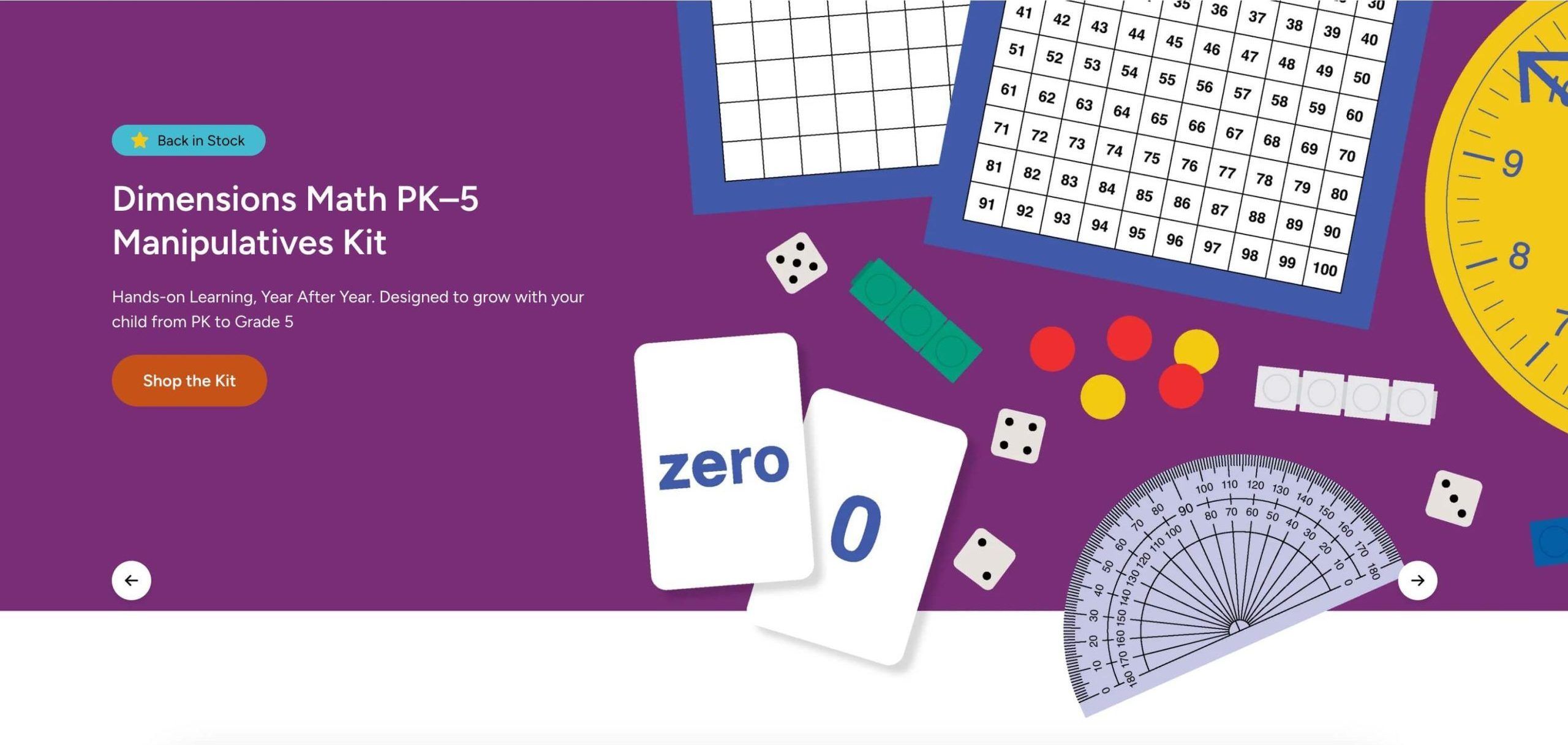
Moreover, it’s a conceptual approach that uses the Concrete-Pictorial-Abstract (CPA) model to teach kids. Under it, they start learning the concept with tangible objects, then switch to visual models or pictures, and after that, use numbers to represent math concepts abstractly.
Is Singapore Math Common Core?
No, Singapore Math is not Common Core, yet if you use the aligned materials, you’re likely to ensure learning meets Common Core standards. As Singapore Math follows similar principles, conceptual understanding, and problem solving, the content is sometimes even more advanced than Common Core requires.
If you seek a better alignment with Common Core, there are versions of the Singapore math curriculum that will fit typical grade expectations and preserve the core teaching style.
Singapore Math vs Saxon Math: Teaching approach comparison
In my Saxon Math vs Singapore Math review, I will cover each of the approaches behind the curriculum so that you can choose the best one for your child’s needs.
Spoiler alert: Singapore Math focuses on teaching “why” via variety and discovery, while Saxon Math makes it about “how” via repetition and instruction.
Singapore Math method
So, let’s begin with Singapore Math. In terms of teaching, it is distinctive for its emphasis on understanding and mastery. Your child will spend a longer time on each concept to really “get” the concept through discussion and exploration before moving on.
Let’s look at how the Singapore math method teaches addition and subtraction:
First, students get chips to physically make or break numbers. Next, they draw pictures to represent these operations. Finally, they proceed with numbers to do calculations.
That’s how the Concrete-Pictorial-Abstract model works.
The curriculum encourages teachers or parents to ask questions and guide a child to figure out patterns.
Another aspect is the emphasis on mental math and number sense. This method teaches multiple ways to apply a concept, expecting kids to think, and making kids flexible thinkers.
Compared to the Saxon Math homeschool program, Singapore Math may:
- feel challenging or tricky in the early stages because of the diverse tasks
- offering fewer drills and reviews,
- cover fewer concepts.
Saxon Math method
Regarding my Saxon vs Singapore Math debate, it’s hard to ignore Saxon’s unique spiral approach. It’s procedural in nature, ensuring mastery through practice, small steps, and constant review.
As kids work with worksheets, the teacher holds each lesson and provides a careful script that introduces a new chunk of information and backs it with a review of previous topics:
First, a kid would learn how to identify the numerator and denominator in a fraction. Next, they will practice several times during a lesson. Then, for the rest of the lesson, the kid will review and do the problems around topics learned previously.
That way, a child will constantly circle back to old topics and keep in mind many topics.
Also, the Saxon Math curriculum is pretty explicit, as children follow textbooks and get clear procedural instructions on how to solve problems based on repetition.
Comparing Saxon Math to other methods, it may feel
- Slower-paced
- A bit intense on the workload
- Unengaging.
However, it provides clarity due to its straightforward and factual tasks, especially for middle grades. Thus, it can benefit busy homeschool families or those less confident in teaching math.
Saxon Math vs Singapore Math: Practice vs conceptual understanding
From my teaching approach analysis, you can see that the balance between practice and conceptual understanding is the core difference. They prioritize these elements differently.
But how may it affect kids’ results?
Singapore Math focus
Singapore Math places heavy emphasis on the concepts and their depth. The main idea here is that if a kid understands the main principles, they don’t need 40 problems to solve to get how it works.
That’s how the cover of texbook looks, indicating that the Singapore math method relies on methods like:
- number bonds,
- bar modelling,
- diagrams,
- heuristic strategies
- word problems.
Via them, children learn to think and comprehend relationships between numbers, not memorizing which operation to apply. It makes kids adaptable to different problems, but requires more time to think about the solutions.
What are the drawbacks? Comparing Saxon vs Singapore Math, the latter leaves less time for repetitive practice and dedicates more to exploring the depth.
Saxon Math focus
In contrast, with Saxon Math, kids are likely to shine in the area of practice. Its main principle is that doing something over and over leads to mastery.
Doing daily or weekly mixed problem sets allows constant practice of a variety of concepts. Some division here, geometry there, arithmetical facts in between.
As a result, kids get very good at executing algorithms, solving standard problems, and calculating. Compared to the Singapore math method, they would be better prepared for tests and grading exams as they constantly review the problems.
What are the disadvantages? If the Saxon Math curriculum is not balanced, kids may fail to grasp the “why” behind the formulas, be less comfortable with novel problems, or fail to solve multi-step problems.
Singapore Math vs Saxon engagement and learning style
Now, let’s compare the Singapore Math vs Saxon approach in terms of the role of engagement in learning.
Singapore Math
Singapore Math can be exciting for children who like to figure things out and are visual and kinesthetic learners. How?
First of all, because of the aforementioned CPA model used. Secondly, many editions of textbooks are colourful and combine different methods that add interactive elements to learning.
However, if your children prefer straightforward practice or are not “math-minded”, then Singapore Math may be frustrating for them.
What can my Singapore Math vs Saxon Math comparison say about the parents’ role? Well, it is key, especially in the early grades, making parents active participants:
- You are to guide a student, explain concepts, demonstrate them with objects, and encourage discussion.
- Even though your kid gets older and more independent, they will still need your help in grasping the conceptual nature.
Saxon Math method
What about engagement under the Saxon Math method? Well, compared to Singapore Math, it is far less engaging for kids.
The textbooks are mostly black-and-white with minimal interactive elements. Besides, the focus on reviewing can be tedious and lead to disengagement.
Nevertheless, it can be very effective for children who prefer a sequential learning style thanks to structure, linear format, consistency, predictable flow, and clear expectations.
What about parent involvement? It varies by grade.
- In K-3, it’s quite high, as the parent uses scripted lessons, instructs kids, determines pace, and does tasks with a kid.
- In higher grades, parents are much less involved, but still participate.
Saxon vs Singapore Math cost and materials
If I compare Saxon and Singapore Math pricing, they are not so different. Saxon Math options are slightly more expensive if using new materials. However, with optional supplements or resources, Singapore Math becomes more expensive.
Singapore Math cost
To teach your kid wth the Singapore Math curriculum, you would leverage different materials for each grade.
Take into account that you will need a Textbook and Workbook for each semester (A and B). Also and the Home Instructor’s Guide (HIG) to guide lessons confidently.
What are optional materials? The official Singapore Math providers offer Extra Practice, Challenging Word Problems, and hands-on alternatives for parents to use.
Here is a full pricing table:
| What for | Typical cost | |
| Textbook (A & B) | To explain new math concepts and show examples | From $13.6 (for each) |
| Workbook (A & B) | For kids to practice problems | From $12.5 (for each) |
| Instructor’s guide (HIG) | To help you teach concepts and guide kids in the right way | From $32.5 |
| Supplementary books and tests | Extra or advanced practice | Starts from $13.6 |
| Manipulatives | Blocks and physical objects for hands-on learning | From $10-20 per small concept kit, from $100 to 985 for comprehensive grade kits. |
| Video subscription | For a better explanation and engagement | $85 per course |
As a result, to handle one of the K-6 grade curricula, you would need to pay around $100-150 for a basic set of textbooks, workbooks, a guide, and some manipulatives. For grades 6-8, the price may be up to $130-170. The placement tests are free.
Note: If you want a more comprehensive experience for your kid, it may cost up to $1000.
Saxon Math cost
In the case of the Saxon Math homeschool curriculum, the use of materials varies by grade level.
In most cases, parents would use a hardcover meeting book, the worksheets and tests book, and a solutions manual.
Note: You can benefit from a strong resale market of used Saxon books, allowing you to find more budget options.
| What for | Typical cost | |
| Homeschool Curriculum Kit | A ready-to-use set of materials to teach kids and offer guidance | $95-200 (depending on grade, bundle, and provider) |
| Student Meeting book | To study new materials | Around $20-30 |
| Tests & Worksheets book | To practice and review concepts | $35-60 (depending on the grade and size) |
| Solutions Manual | Step-by-step guidance for parents (with scripts and dialogues) | $90-140 (depending on the grade and website) |
| Manipulatives kit | For hands-on learning | $70-170 (depending on the grade and size) |
| Digital materials (CD-R) | For video lectures | $50-60 |
In the end, the best option is to buy materials kits. For a pre-school kit, you would need to pay around $100; a K-6 kit would cost $100-180. Yet, you would need to buy manipulatives separately.
Saxon Math program materials come in bundles, and prices may vary depending on the provider (resource centers or book websites).
Saxon Math vs Singapore Math Reddit: Reviews from parents and students
Note: My Singapore vs Saxon Math analysis couldn’t help but mention what homeschoolers say in forums and the comments section, that’s where the best insights are. Spoiler alert: Saxon Math receives more polarized feedback.
Saxon Math Reddit reviews
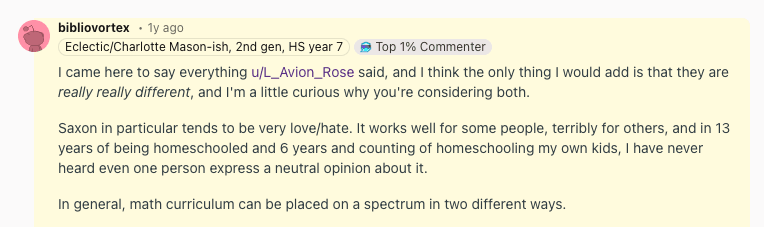
First of all, I found a separate Saxon Math vs Singapore Math Reddit thread. What do people say? One of the Reddit comments implies they are completely different.
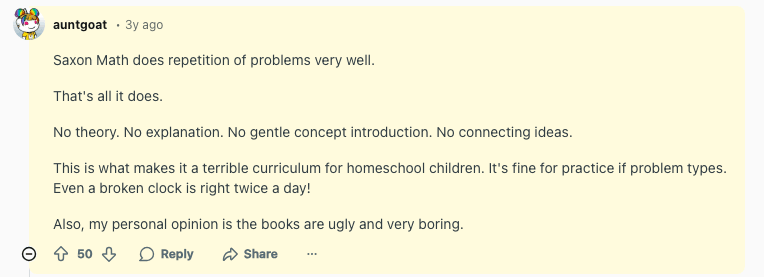
Another Reddit review on Saxon proves the point; some really don’t like the approach.
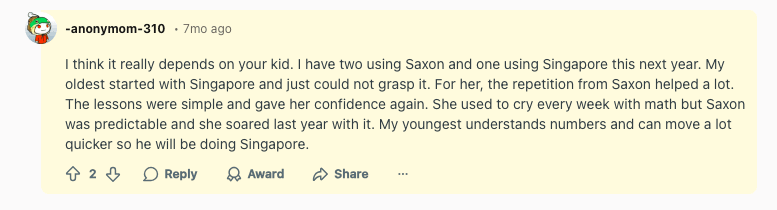
However, despite significant criticism, there are still some Reddit users who find it useful.
Singapore Math forum reviews
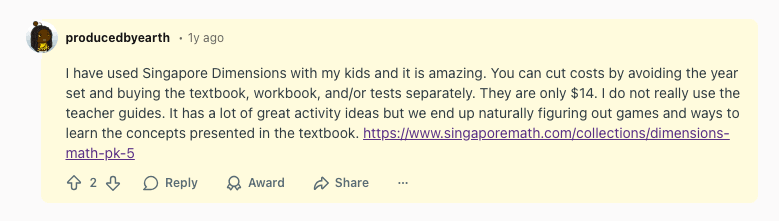
What about the Singapore Math method? A common take in homeschooling communities is that it’s an excellent curriculum for developing strong math thinkers.
Here is what one of the Reddit comments tells us:
Yet, it surely doesn’t fit all kids, as some Reddit users say it can distract, making parents opting a different approach, let’s say a more structured one.
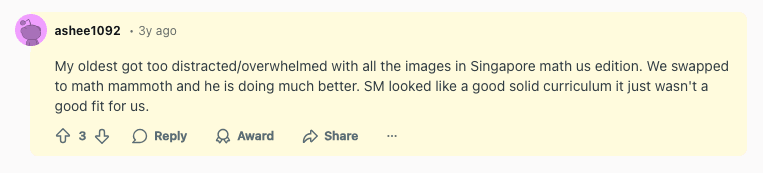
Lastly, this Reddit comment underlines that it truly depends on the kids; learners can feel it to be a bit too much.

What makes Singapore Math different from Saxon Math?
The main difference between Singapore Math vs Saxon Math lies in how students learn and retain concepts. Singapore Math focuses on deep understanding, mastery, and mental math. As kids explore math concepts and models before working with numbers, they think critically and become flexible thinkers.
In contrast, the Saxon Math curriculum follows a spiral approach that is built on continuous reviews. There, practice becomes key to mastery. The repetition at the core allows kids to strengthen retention and procedural skills. However, as it introduces concepts gradually, it’s more spread out in terms of curriculum, while drills can make learning a real challenge for a kid.
Saxon vs Singapore Math: Choosing the right fit
When choosing between Saxon Math vs Singapore one, much depends on your kid’s learning style, confidence, and how they respond to the challenge.
- Singapore Math works great for kids who ask “why”, enjoy visuals, and like solving problems. It feels more engaging and cohesive and offers a deeper understanding. It’s a good fit for advanced learners and to set a math foundation.
- Saxon Math is completely different and suits learners who need structure, clear steps, routine, and consistent practice. It’s simple, comprehensive, and helps to retain skills over time and build confidence through repetition.
In the end, these approaches appeal to different learners and principles, so your kids’ needs are what matter. That’s why you may need a more balanced solution like the Brighterly platform. Book free math lesson now to see how personalized tutoring would help.
Other article on homeschooling



Writing a short story is one of the most exciting ways kids can strengthen their reading and writing skills. Creating their own world with characters and plot points allows your child to be imaginative. It also teaches a lot of important academic skills, like structuring their writing effectively and using new vocabulary. To help your […]

Jan 15, 2026

I know handwriting might seem like an archaic practice in today’s tech-filled world. The thing is, the human brain is still the same as it was decades ago – it still needs fine motor skills for proper development. That is why the question “How to help a child with dysgraphia?” remains relevant for parents. As […]

Jan 16, 2026
Math & reading from 1st to 9th grade
Exploring alternatives?
Take a short quiz!
Choose kid's grade