Alternate Interior Angles – Definition With Examples
Updated on November 28, 2025
Why do some angles in bridges, roads, and floor tiles look the same? That’s where the alternate interior angles geometry definition comes in! At Brighterly, we love making tricky math simple and fun, and understanding these angles is easier than you think. Lines that intersect parallel lines form these angles, which always have an equal measure. What are they, how do you recognize them, and even where can you see them in the real world? Let’s find out in this article!
What are alternate interior angles?
A transversal crosses parallel lines and forms pairs of alternate interior angles, which lie inside the parallel lines but on opposite sides. As the alternate interior angles definition geometry underpins, the angles like these are always equal.
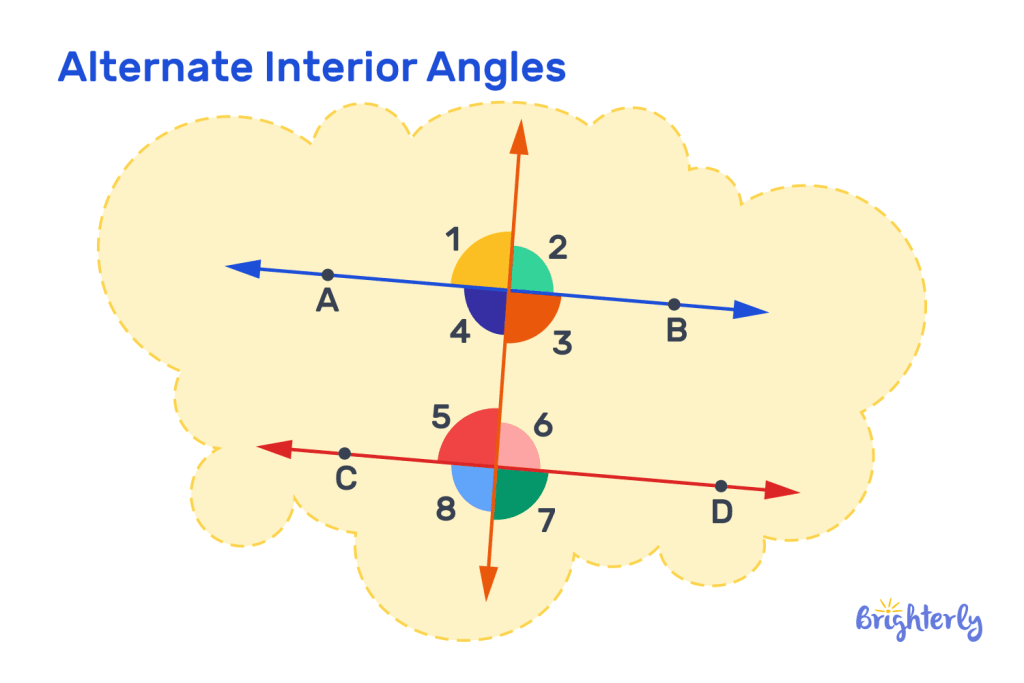
Definition of angles
An angle in geometry is the shape made when two rays meet at a common point called the vertex. Angles can be acute, obtuse, right, or straight, depending on their opening. Having a good understanding of angles helps us recognize more types of angles formed by parallel lines and solve issues with them.
Definition of alternate interior angles
Alternate interior angles definition geometry refers to the angles formed when a transversal crosses two parallel lines. These angles are formed by the parallel lines and lie on opposite sides of the transversal. When the lines are parallel, these angles are always equal. They are mirror images, showing geometric symmetry.
Properties of angles
Angles have unique characteristics that explain how they function:
- Angles that share a side are called adjacent angles.
- Two angles that add up to 90 degrees are called complementary angles.
- Two angles that add up to 180 degrees are called supplementary angles.
With an understanding of these characteristics, it is easier to understand more complicated angles and shapes.
Properties of alternate interior angles
Alternate interior angles are very interesting! Their properties include:
- Equal Measure: If the lines are parallel, the angles are equal.
- Congruence: They have the same size and shape.
- Practical Use: Alternate interior angles real life examples include bridges, roads, rail tracks, and building designs. These angles help engineers and architects make sure structures are aligned correctly.
Alternate interior angles examples
Examples of alternate interior angles are everywhere around us. Angles formed by the intersection of parallel railway tracks, for example, are alternate interior angles. Bridge beams cross parallel supports, and floor or wall tile patterns using straight, parallel lines can also be found. Designing and constructing real-life structures can be made easier using geometry.
Difference between general angles and alternate interior angles
Angles differ from each other! Any angle can be considered a general angle, regardless of how big or small, sharp or wide it is. Positions or rules don’t matter to them. Alternate interior angles, on the other hand, require a great deal of precision. These angles are formed when three lines cross each other, forming a transversal. When the lines are parallel, they always lie on opposite sides of the transversal.
So, which angles are alternate interior angles? In other words, they are the ones “inside” the two parallel lines, on opposite sides of the line that cuts through them. There are special rules for alternate interior angles, while general angles can be located anywhere!
Theorems involving alternate interior angles
The angles geometry rules and theorems, like the Alternate Interior Angles Theorem, basically say this: when two parallel lines are crossed by another line (a transversal), the angles on opposite sides inside the lines are always equal.
The following figure will help us understand this: ∠1 = ∠5 (corresponding angles) and ∠3 = ∠5 (vertically opposite angles). Consequently, ∠1 = ∠3. Likewise, we can demonstrate that ∠2 = ∠4. This demonstrates that the two lines are parallel because their corresponding interior angles are equal.
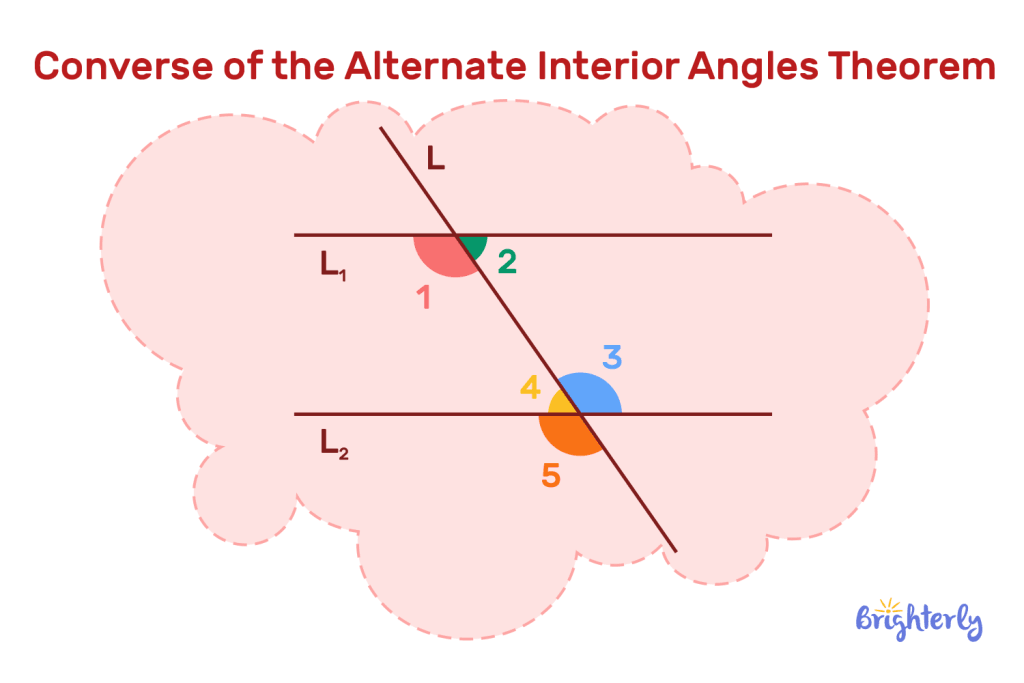
Proving theorems about alternate interior angles
When a straight line crosses two parallel lines, some angles inside the lines sit on opposite sides — these are the alternate interior angles. To prove they are equal, we use simple facts kids already know: opposite angles are equal, and matching angles on parallel lines are equal. Putting these facts together shows that alternate interior angles must match, too. This helps us understand how lines and angles behave when they remain a constant distance apart.
Alternate interior angles in real life
Now that you can define alternate interior angles, let’s move to some real examples. These angles exist between parallel railway tracks and parallel roads wherever they cross. It also applies to bridges, floor tiles, and building designs.
Practice problems on alternate interior angles
The best way to really get examples of alternate interior angles is to try some practice problems. Plus, doing exercises makes it easy to spot those angles anywhere!
Alternate interior angles example #1: Finding the angles
Given two parallel lines cut by a transversal, if one alternate interior angle measures 60 degrees, what is the measure of the other alternate interior angle?
Solution: Since the lines are parallel, alternate interior angles are equal. So, the other angle is also 60 degrees.
Example of alternate interior angles #2: Proving the angles are equal
Given two parallel lines crossed by a transversal, one alternate interior angle is 110 degrees. Show that the angle on the opposite side of the transversal is equal.
Solution: Using theorems in geometry, we know that alternate interior angles on opposite sides of a transversal are equal when the lines are parallel. Therefore, the other angle is also 110 degrees.
Alternate interior angle example #3: Real-world application
Parallel railway tracks are crossed by a road. The road and the first track form a 40-degree angle on one side of the road. Can you tell what the angle is on the other side of the road?
Solution: Because railway tracks are parallel, the alternate interior angle is 40 degrees on the opposite side as well.
Example #4: Alternate interior angles with non-parallel lines
Transversals cut two lines, but they are not parallel to each other. One angle inside the lines measures 70 degrees. In what way can we describe the angle on the opposite side?
Solution: Because the lines are not parallel, the alternate interior angles are not equal. Depending on the slope of the lines, the other angle could be any measure.
Conclusion
Since the alternate interior angles are always equal, they are simple to recognize in geometry problems and in real-world scenarios such as tiled floors, roads, and bridges. Students can develop a solid foundation for comprehending more difficult geometry concepts by learning about alternate interior angles meaning.
Frequently asked questions on alternate interior angles
What does alternate interior angles mean?
Alternate interior angles mean angles that lie on opposite sides of a transversal and between two parallel lines. Crossing two parallel lines will create these lines inside each other.
Are alternate interior angles congruent or supplementary?
Alternate interior angles are congruent whenever a transversal intersects two parallel lines.
How do alternate interior angles help in real life?
Yes, in real life, alternate interior angles can be useful when designing buildings, bridges, roads, or art patterns. During construction, engineering, and navigation, they ensure that parallel lines are properly aligned and enable accurate angle measurement.
Can alternate interior angles be unequal?
An alternate interior angle can only be unequal if the transversal crosses a parallel line. It is then impossible to maintain congruence between the angles inside the lines if their sizes differ.


Math & reading from 1st to 9th grade
Looking for homework support for your child?

Choose kid's grade

Math & Reading for Grades 1–9
Build real confidence for your child with a Brighterly math or reading tutor.