


Reviewed by Jessica Kaminski
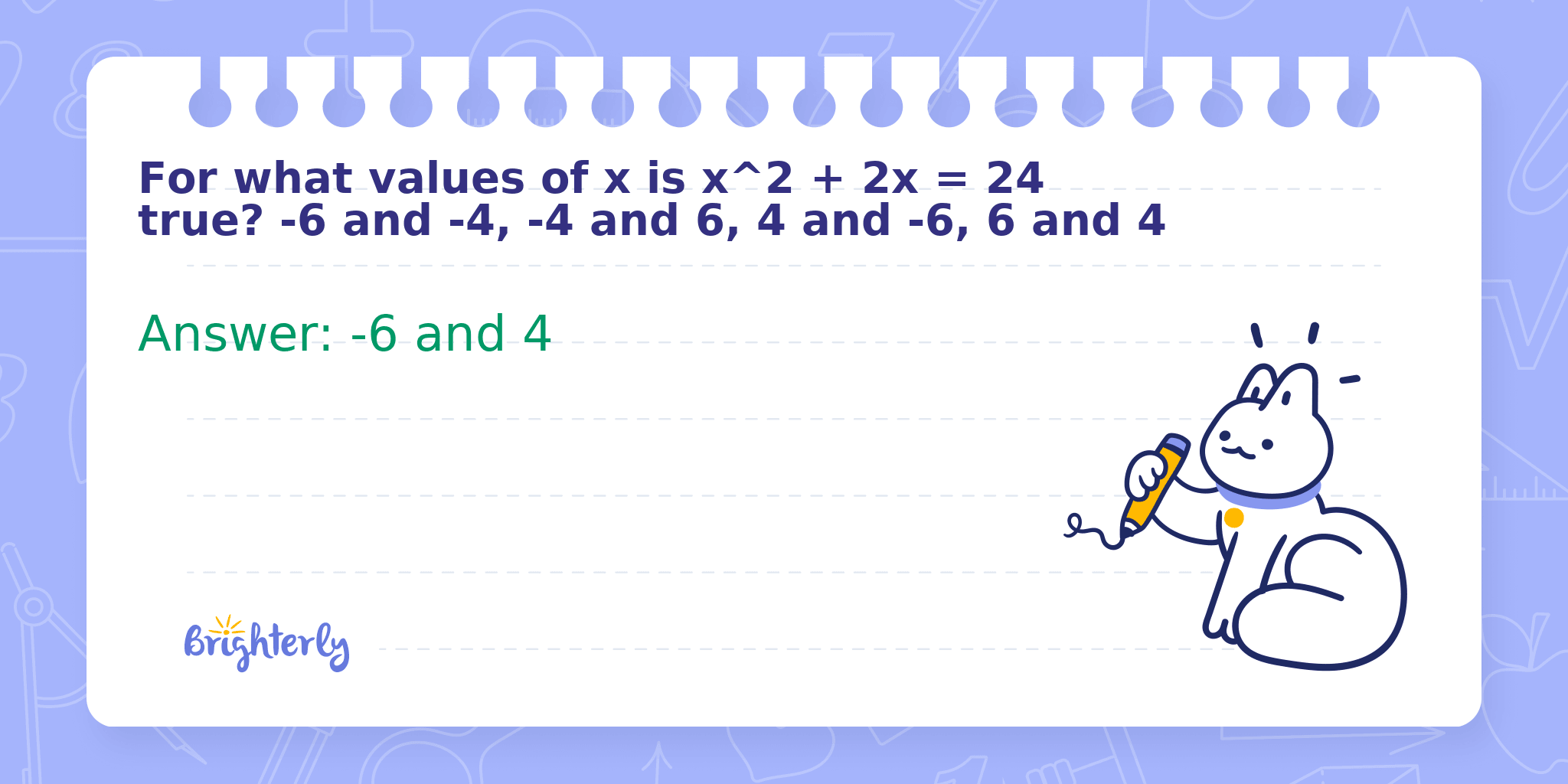
For what values of x is x^2 + 2x = 24 true? -6 and -4, -4 and 6, 4 and -6, 6 and 4
Answer: -6 and 4
To solve the equation x^2 + 2x = 24, you need to find the values of x that make the equation true. This involves moving all terms to one side to set the equation equal to zero and then factoring or using the quadratic formula to find the possible values for x.
Methods
Math Tutor Explanation Using Rearrangement and Factoring
One way to solve this quadratic equation is to rearrange it so that all terms are on one side and then factor the quadratic expression to find its roots.
Step 1: Step 1: Subtract 24 from both sides to get x^2 + 2x - 24 = 0
Step 2: Step 2: Factor the quadratic expression to (x + 6)(x - 4) = 0
Math Tutor Explanation Using the Quadratic Formula
If factoring is difficult, you can use the quadratic formula to solve for x in any quadratic equation of the form ax^2 + bx + c = 0.
Step 1: Step 1: Recognize the quadratic equation form: x^2 + 2x - 24 = 0, with a = 1, b = 2, c = -24
Step 2: Step 2: Plug the values into the quadratic formula: x = [-b ± sqrt(b^2 - 4ac)] / (2a)
Step 1:
Step 2:
Math Tutor suggests: Practice Quadratic Equations and Solutions
Enhance your understanding of solving quadratic equations by exploring these related questions and practice problems.
FAQ on Solving Quadratic Equations
What is a quadratic equation?
A quadratic equation is a polynomial equation of degree 2, typically in the form ax^2 + bx + c = 0.
How do you solve a quadratic equation by factoring?
You move all terms to one side, factor the quadratic expression, and set each factor equal to zero to solve for x.
When should I use the quadratic formula?
Use the quadratic formula when factoring is difficult or the quadratic does not factor easily.
Can a quadratic equation have two, one, or no real solutions?
Yes, depending on the discriminant (b^2 - 4ac), a quadratic can have two real, one real (repeated), or no real solutions.
What are the solutions to x^2 + 2x = 24?
The solutions are x = -6 and x = 4.
Math & reading from 1st to 9th grade
Looking for homework support for your child?
Choose kid's grade

Math & Reading for Grades 1–9
Build real confidence for your child with a Brighterly math or reading tutor.