
Distance and Midpoint Formula Worksheets
Updated on September 4, 2026
Distance and midpoint formula worksheets give 10th-grade students structured practice applying two of coordinate geometry’s most essential tools: the Pythagorean-theorem-derived expression for segment length and the coordinate-averaging rule that locates a segment’s exact center point on a coordinate plane. Working through these problems builds the algebraic precision students need for trigonometry, proofs, and standardized exams. Students who find it tricky to switch between the Pythagorean form and the coordinate-averaging approach build lasting fluency faster with a geometry tutor focused on formula application and spatial reasoning.
Download Distance and Midpoint Formula Worksheet PDFs
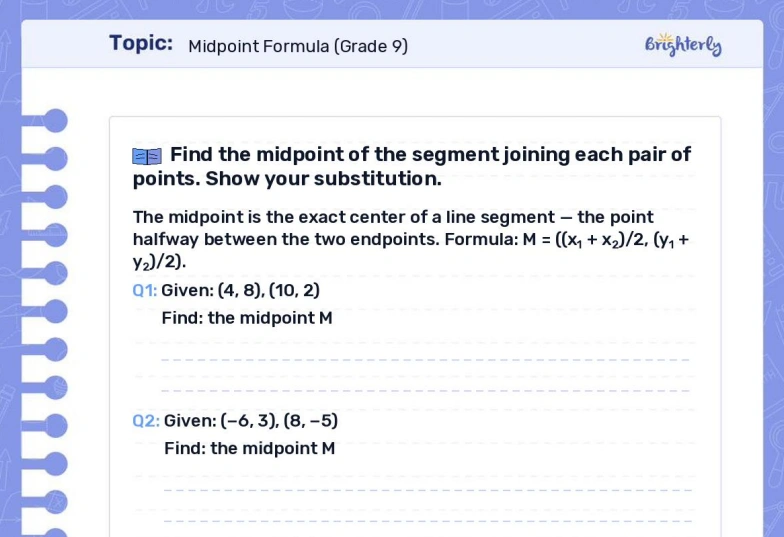
Access our collection of high-quality printable documents designed to reinforce understanding of segment length calculation and coordinate-based midpoint identification through focused algebraic and geometric practice.
More coordinate geometry worksheets
Strengthen your coordinate geometry foundation with these closely related resources — covering slope calculation on the grid, Pythagorean-based distance in right triangles, and linear measurement across the coordinate system.
- special right triangles worksheets
- 8th grade slope worksheets
- area and perimeter worksheets
- trigonometry worksheets
- geometry worksheets


Help your child reach their full potential!
Answer a few quick questions about your child’s learning, and we’ll recommend next steps.
Benefits of Distance and Midpoint Formula Worksheet
Working with distance and midpoint formula worksheets bridges basic algebra and advanced geometric reasoning for 10th-grade students. These exercises reinforce the Pythagorean theorem in a coordinate context, helping learners see how abstract equations translate into measurable segment lengths. By repeatedly calculating squared differences, square roots, and coordinate averages, students sharpen the algebraic fluency needed for trigonometry and pre-calculus. Problems that ask students to find a segment’s bisector, verify a geometric property on a grid, or determine the perimeter of a polygon from coordinate vertices also develop real-world analytical thinking. Consistent practice with these materials ensures students can manipulate coordinate data confidently — a foundational skill for STEM coursework and careers where spatial precision matters.


Math & reading from 1st to 12th grade
Looking for homework support for your child?

Choose kid's grade

Math & Reading for Grades 1–12
Build real confidence for your child with a Brighterly math or reading tutor.