Picture Graph Worksheets
Updated on September 28, 2026
A pictograph for kids in the 2nd grade is a fantastic way to introduce children to data and its visualization, thanks to its readable format and engaging nature. Picture graph worksheets are excellent resources in this regard. These sheets help children learn about data through engaging pictograph visuals.
Pictograph worksheets: Examples
These free picture graph worksheets help children learn more about graphs and data by using a range of puzzles. They also include answer sheets, allowing children to review and assess their own work independently. They also contain different types of graphs — for example, a bar chart or a line graph — and plots on graphs, teaching children about analyzing and presenting data.


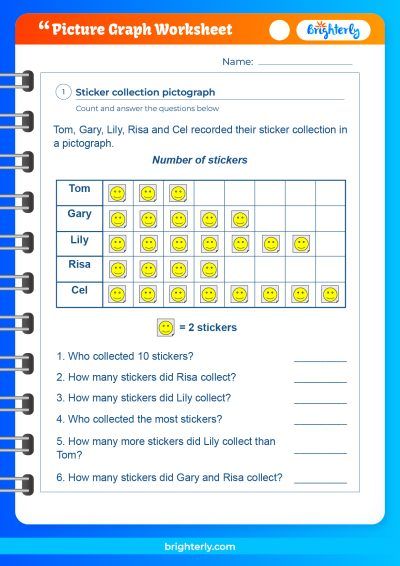
Picture graphs for kids worksheets [free download]
Ready to get your child started on these pictograph worksheets PDF? It couldn’t be easier! All you need to do is download the free printable documents below. Whether you print them off for an engaging, screen-free activity or use their favorite devices for more educational screen time, they will help your child improve their knowledge.
More graph math worksheets
Did you know we have lots more worksheets on graphs? From bar and line graphs to general graph worksheets and the more advanced inequalities tasks, we’ve got the resources to help your child grasp data.


Help your child reach their full potential!
Answer a few quick questions about your child’s learning, and we’ll recommend next steps.
Benefits of graphing picture worksheets
Incorporate visuals
As you might guess, a picture graph for kids uses imagery and symbols to represent data in an engaging way. These worksheets feature visuals that your little student can’t resist, from characters to food, to represent data. They’ll delight in all the different cartoons and illustrations as they begin to build their knowledge!
Note: According to an Educational Research Review journal, using visualizations in math learning has been proven to improve children’s engagement in the subject and their understanding.
Introduce children to graphing
Learning how to work with, create, and read data presented in graphs is key to children’s education and provides vital skills for later in life. Each picture graph worksheet offers the perfect introduction to graphing, as pictographs are so easy to read and interpret!
Support independent learning
By completing these pictographs worksheets, your child will not only improve their math knowledge but also gain essential independent study skills. That’s because these worksheets come with answer sheets, meaning children can assess, grade, and review their own work, building confidence in their mathematical skills.
Note: As revealed in an American Journal of Language, Literacy and Learning in STEM Education paper, independent study, particularly when working with problem-based tasks, has been shown to improve children’s critical thinking and problem-solving skills.
Are multipurpose resources
Parents love Brighterly’s graphing pictures worksheets because they can be used as an after-school activity at home to supplement children’s classroom learning. But they can be used in many other ways, from a homeschooling learning aid to a classroom group task. What’s more, Brighterly’s tutors use them as a collaborative activity in tutoring sessions!
Connect math with real life
Math doesn’t have to feel like an abstract concept to your child. By presenting data on many different real-life subjects and using real-life iconography, these picture graphs worksheets help children to connect their learning with real life. This helps them understand it more deeply and appreciate its importance in their life.
Note: Relating math to real life has been shown to help children understand it more deeply, as they can relate it to their own experiences.
Picture graph worksheets: Practice
Once your child has completed their picture graph worksheets, they can move on to the next stage in their exciting learning journey.
This comes in the form of practice test questions. Children complete the quiz online and receive instant feedback, so they can see how well they’re learning the material.

Start your child on a successful lifelong learning journey in math and explore our full library of 2nd grade math worksheets.
Frequently Asked Questions
What is a picture graph, and why is it a good starting point for teaching data?
A picture graph (or pictograph) uses images and symbols instead of numbers or bars to represent data, which makes it one of the easiest and most intuitive ways to introduce young kids to graphing. Since children can simply count pictures rather than interpret abstract scales, pictographs work as a gentle first step before moving on to bar graphs, line graphs, and other more complex data formats.
What grade level are these picture graph worksheets for?
These worksheets are designed for 2nd grade, right around when kids start learning to read and interpret basic data displays. They also work well as a lead-in for 1st graders getting an early introduction, or as review material for 3rd graders who need a refresher before tackling more advanced graph types.
Do the worksheets include an answer key?
Yes, every picture graph worksheet comes with an answer sheet, so your child can check, grade, and review their own work. This kind of independent self-checking helps build confidence and critical thinking skills that carry over well beyond graphing.
What other types of graphs do these worksheets touch on?
Alongside pictographs, this set introduces children to related formats like bar charts and line graphs, along with basic plotting on graphs. That exposure helps kids start recognizing that different graph types are simply different ways of presenting the same kind of information.
How can I use these worksheets at home?
You can print them for a screen-free activity or have your child work through them on a tablet or other device — whichever fits your family’s routine best. They also work well as an after-school supplement to classroom learning, a homeschooling resource, or even a group activity if your child studies alongside siblings or friends.



Need help with Geometry?
- Is your child finding it hard to grasp the concept of geometry?
- An online tutor could provide the needed support.
Choose kid's grade

Does your child have difficulties with the basics of geometry? Try learning with an online tutor.
Book FREE lesson