AI in Education Statistics: Key Trends and Insights for 2026
reviewed by Laila A. Lico
Updated on February 4, 2026
There is no denying that modern education is experiencing drastic changes as artificial intelligence (AI) weaves into classrooms all over the world. AI in education statistics show that both students and teachers are now using AI for their tasks. As a tutor, I’m sure that although AI can be a helpful hand, it cannot supplement human feedback and special attention a child needs to succeed and not lose enthusiasm for studying.
Key stats:
- The global AI education market is expected to hit the mark of $136.79 billion by 2035.
- 90% of college students reported using AI for coming up with ideas or making sure they understood the concepts they were learning.
- Personalized learning increases by 54% when AI is involved.
- Human connection and personalized approach provided by Brighterly tutors improves child educational performance.
Statistics on AI in education worldwide
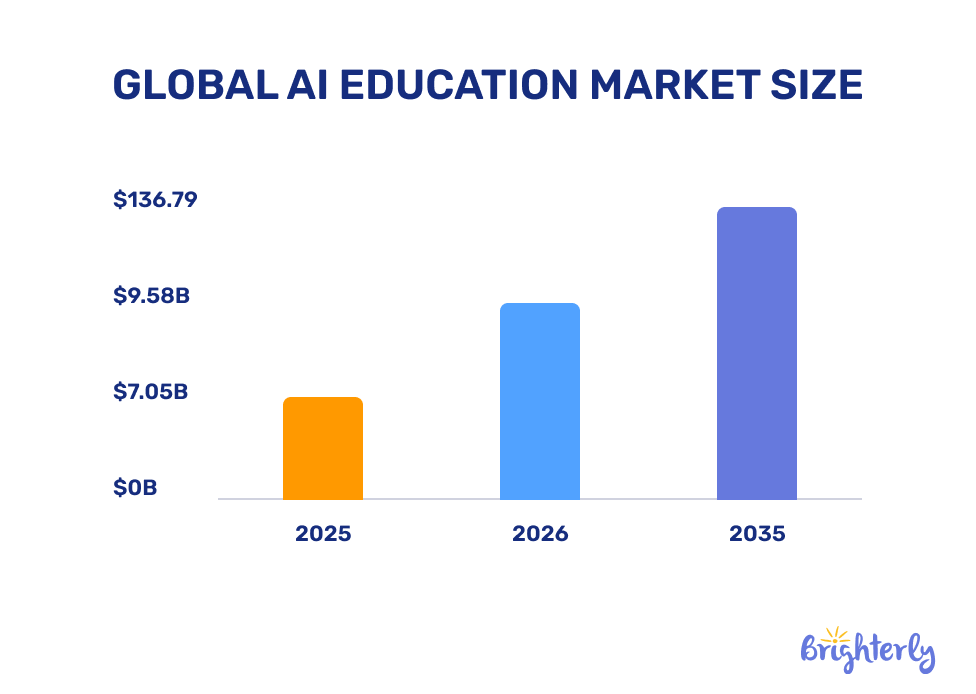
Statistics on AI in education show that as of 2025, the AI education market is valued at around $7.05 billion, and is going to get even bigger by reaching from $9.58 billion in 2026 to a staggering number of $136.79 billion by 2035. This would mean as much as 34.52% growth from 2026 to 2035.
Of course, since AI requires access to technology, the level of its adoption very much depends on where you are on the globe. But as for the most popular AI segment among all, Machine Learning definitely takes the lead, accounting for 64% of the market share, with generative AI being the fastest-growing sub-sector.
AI in education infographic
| Category | Key metric / Data point | Details & Insights |
Market size |
USD 7.05 Billion | Global market value in 2025. |
Projected size |
USD 136.79 Billion | Estimated value by the end of 2035. |
Growth rate (CAGR) |
34.52% | Compound Annual Growth Rate (2026–2035). |
Dominant region |
North America | 38% of the market share in 2025. |
Fastest-growing region |
Asia-Pacific | Expected to witness the highest growth rate due to digitalization. |
Leading component |
Solutions | Generated over 72% of market share in 2025. |
Fastest growing component |
Services | Projected to grow at a CAGR of 37.15%. |
Top technology |
Machine Learning | Accounted for 64% of the market share in 2025. |
Leading application |
Learning platforms | Learning platforms and virtual facilitators held 47% share (2024). |
Primary deployment |
Cloud | Contributed 57% of the market share in 2025. |
Source: Precedence Research
What are the statistics about AI in education in the U.S?
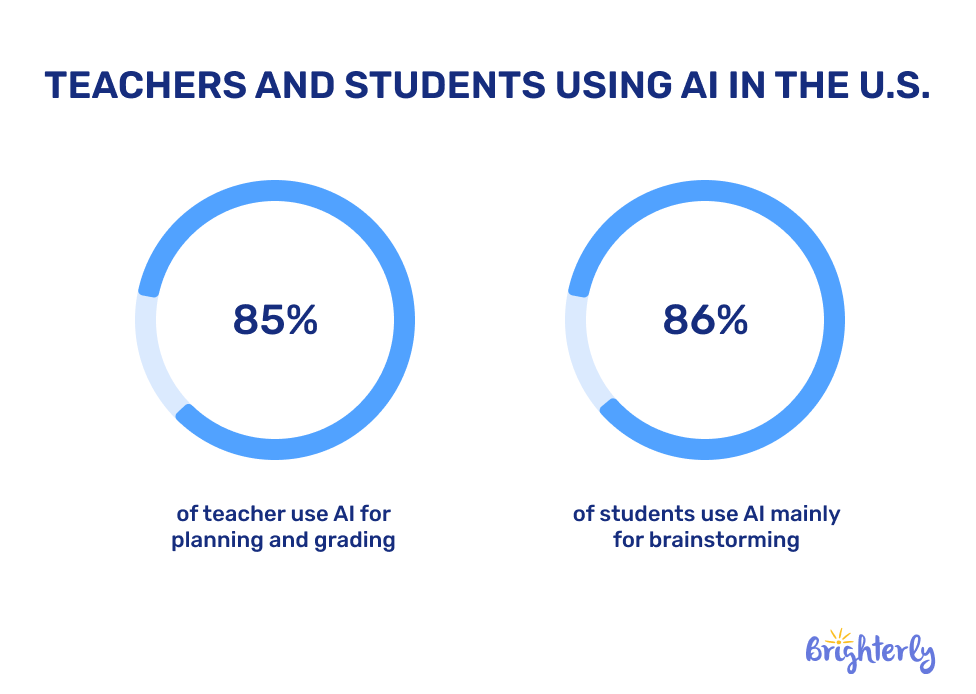
The numbers in AI use in education statistics show AI is being used a lot in schools across the U.S. The report from the Center for Democracy & Technology says that in the 2024-2025 school year, 85% of teachers and 86% of students in the United States used AI tools, which is a serious change from past years when they were used by a limited circle of early adopters. Now, US education statistics and trends suggest that even personalized AI tutors are gaining popularity among learners.
As for the purpose, teachers in North America mainly use AI to help plan lessons and grade papers, while students — for brainstorming. Also, interactive learning statistics show that the role of AI will keep growing. But though many students are using AI, less than half say they have been trained how to use these tools properly.
Check out this AI in education graph for further clarification:
How Brighterly provides personalized human tutoring in the AI era
While statistics on the use of AI in education prove the efficiency of algorithms, they also stress a growing gap in social and emotional learning. Brighterly serves as a solution for parents seeking a balance. In a world where 30% of students may become overly dependent on AI, the Brighterly math and reading platform prioritizes the human connection between math and reading tutors and their students.
Data suggests that while AI can provide information, it often lacks the decision-making capacity to navigate a child’s frustration or unique curiosity. By using math and reading worksheets for kids alongside live, expert instruction, Brighterly professionals make sure that critical thinking remains a priority.


Check the basics behind this term
Take our quick quiz to discover the perfect learning solution based on your child’s needs.
What are the AI in education statistics by state?
The statistics of AI use in education vary across states and districts. For example, a recent report suggests that urban schools are 14% more likely to have a formal AI policy than rural ones, and such a digital divide doesn’t benefit either equity or academic success.
However, based on statistics collected by the Center for Democracy and Technology, states actively implement legislation related to the role of AI in education.
Category |
Number |
| Number of proposed bills | 53 |
| Number of states proposing bills | 21 |
| Number of K-12 specific bills | 51 |
| Number of states that enacted legislation | 4 |
| Broad public sector AI bills (related to education) | 50 bills |
The following statistics of AI in education detail state-specific legislation and outcomes mentioned in the CDT report for 2025.
| State | Action / Status | Focus areas |
Illinois |
Enacted / Proposed HB 2503 |
– One of four that have passed a law about AI in education. – Suggested creating an Advisory Board that would have given advice, watched over, and checked education tech (including AI) while working with the state education agency. |
Louisiana |
Enacted | – One of the 4 states that enacted AI in education legislation. |
Nevada |
Enacted AB 406 |
– Bans AI use for school counselors/social workers (except for admin efficiency) – Requires mental health AI guidance. |
New Mexico |
Enacted | – One of the 4 states that enacted AI in education legislation. |
New Jersey |
Proposed AB 4736 | – Proposed updating harassment/bullying codes to include deepfakes and non-consensual intimate imagery (NCII). |
New York |
Proposed AB 6874A | – Proposed an AI Literacy Digital Equity Competitive Grant Program for teacher/admin training. |
Indiana |
Proposed HB 1296 | – Proposed creating school AI model policies, platform inventories, and surveys for teachers. |
Statistics about AI in education by year
- AI in education statistics 2022
- AI in education statistics 2023
- AI in education statistics 2024
- AI in education statistics 2025
- AI in education statistics 2026
AI in education statistics 2022
Back in 2022, AI was not very common and mostly used for backend administrative systems or natural language processing apps. The market was worth less than $4 billion.
AI in education statistics 2023
According to ACT research, nearly half of all students (46%) resorted to using AI tools, mostly for schoolwork. ChatGPT was the go-to choice for most, yet students didn’t trust the info they got from it, with 63% reporting that the tool made mistakes. Despite such a surge in use, 62% of students said their teachers still hadn’t given them the green light to use AI for assignments.
AI in education statistics 2024
AI adoption in education statistics for 2024 shows that 66% of university students were using AI on a regular basis. And although 71% of teachers lacked formal AI training, 83% were actively using generative tools. This is a clear sign of adoption being far ahead of preparedness.
AI in education statistics 2025
AI adoption in education statistics for 2025 illustrate that the percentage of both students and teachers using AI kept going up. According to research, student and teacher use of AI for school jumped by 26% and 21%, respectively.
AI in education statistics 2026
In 2026, AI use in studying has matured into what Gartner describes as a shift toward “the human edge of AI”. Rather than just using chatbots, two-thirds of educational institutions have now established formal AI guidelines to move from experimental use to governed, daily practice.
AI use in education statistics by country
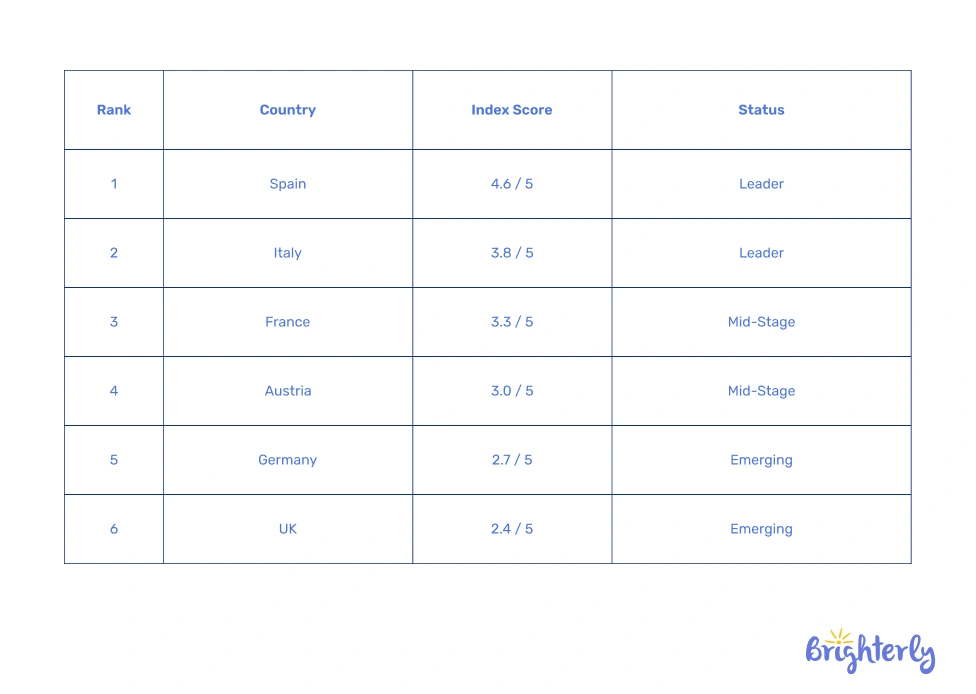
The table below is based on the results of the European Educational AI Index 2025 data. The index evaluates how six major European countries are integrating artificial intelligence into their school systems. The criteria include national strategy, teacher training, ethics, and actual usage in a classroom.
These statistics on AI use in education in EU countries show a clear divide between “leaders” who have strong legal frameworks and “emerging” countries with no formal guidance, despite students using AI quite often.
Now to how Asian countries approach artificial intelligence in the educational sphere. According to statistics on AI use in education, some countries focus on teacher training, while others prioritize government regulations and ethical guidelines to keep the swift rise of these tools under control.
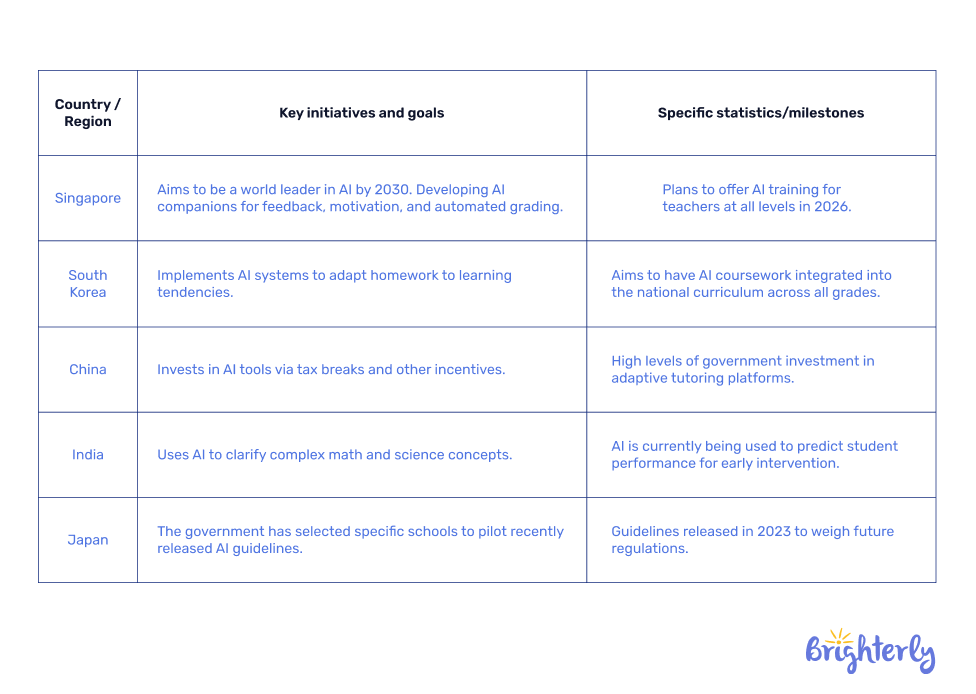
Source: The 74 Million
How does AI affect education?
The effects of AI on education in modern classrooms are mixed. It does make administrative work simpler, which frees up teachers’ time on everyday tasks. Despite this, it also creates challenges for academic honesty and how we judge student achievement.
So, how has AI affected education exactly? It has changed what we focus on when learning. Since computers can now easily find information, classrooms are less about critical thinking and memorizing facts. Instead, they’re more about coming up with good prompts. Knowing the right questions to ask and checking AI-generated work seem to have become more important than just knowing the answer.
Benefits of AI in education statistics
- Personalized learning increases by up to 54% with AI integration.
- Real-time AI feedback and monitoring improve students’ learning results by 70%.
- Use of AI can make learning 30% more efficient.
- Teachers save an average of 6 weeks per school year when using AI weekly for planning and admin work.
- AI-powered assistive technologies improve accessibility and support for neurodiverse students.
These figures of AI in education benefits statistics prove that AI is doing more than just generating responses. It gives teachers their time back and meets students exactly where they are. And while the efficiency gains are quite impressive, the real win is how these tools can lower barriers for neurodiverse learners and turn generic lessons into personal journeys.
Negative effects of AI in education statistics
- 51% of college students believe using AI on schoolwork is cheating
- Half of the students feel less connected to their teachers because of AI.
- Over-reliance on AI for communication results in fewer face-to-face social interactions
- Too much screen time spent on AI tools causes digital fatigue, anxiety, and poor mental health in general.
When thinking about why AI is bad for education it often comes down to social isolation and cheating. Especially in a time when statistics about social media and kids shows teenagers are online almost half the time. Depending too much on AI tools might make learning less human, possibly replacing strong teacher relationships and genuine curiosity with quick, automated answers.
As educational boundaries become more blurred, the debate over “Why should AI be used in education?” is still heated. The main challenge that seems to bother most is making sure AI plays a supporting role in education instead of replacing critical thinking and human interaction.
7 facts about AI statistics in education
- 64% of teens use AI chatbots, 3 in 10 — on a daily basis.
- Nearly half admit to experimenting with AI in teaching, including lesson planning, grading support, and plagiarism detection.
- 90% of college students have used AI for brainstorming or clarifying complex tasks.
- 85% proficiency scores on reading and science benchmarks were achieved by advanced AI models
- 63% of employers believe a lack of AI skills is the biggest barrier holding educational and economic progress back.
- 20% of leaders believe current education systems are effectively teaching the necessary AI and data skills for the 2026 workforce.
- 40% Internet access is the limit for primary schools in developing regions, meaning a massive disparity in AI use across different locations.
AI in education statistics: Conclusion
While we can’t ignore the huge market growth and clear benefits AI provides, the negative implications for critical thinking and social interaction have to be addressed when speaking of AI impact on education. In 2026, the best ways of teaching will likely mix AI with real-world learning and caring teachers.
If you want a learning experience that combines the best of modern technology with the guidance of a live mentor, the best choice is Brighterly. Book free lesson and make sure your kid develops critical thinking skills they will definitely need in an increasingly automated world.

When it comes to homeschooling, the first real step is choosing a platform that truly fits your child, because that choice affects real results. Many parents hesitate between Power Homeschool vs Miacademy. Both programs are popular, but their approaches are very different. So which one will work better for your family? In this article, I […]

Feb 04, 2026

You probably wonder whether Thinkster Math is the right solution for your kid. While there aren’t many Thinkster Math reviews, any insight may help, right? So, here I am, an experienced tutor, with a deep dive into the platform, covering the methodology, user experience, effectiveness, and cost. Key points Core features 8/10. Thinkster combines an […]

Feb 06, 2026
Math & reading from 1st to 9th grade
Looking for homework support for your child?

Choose kid's grade

Math & Reading for Grades 1–9
Build real confidence for your child with a Brighterly math or reading tutor.