How to Help a Child with Dyscalculia: Top 8 Strategies for Parents
reviewed by Jessica Kaminski
Updated on December 26, 2025

If your kid has dyscalculia, you shouldn’t despair. I’ve put together 8 strategies on how to help a child with dyscalculia that I’ve seen work most effectively during my career as a math teacher. They’re easy to implement at home and will definitely make math more accessible to your little learner.
Key points
- Dyscalculia affects children’s ability to learn numbers and perform arithmetic operations.
- Effective teaching strategies for dyscalculia at home require a combination of practical steps (using manipulatives, storytelling, and everyday situations) and ongoing emotional support to build skills and self-esteem.
- Personalized tutoring by professional teachers – like Brighterly – can help immensely teach math and improve confidence.
What does a child with dyscalculia struggle with?
Dyscalculia makes children struggle with math concepts and operations. They have problems understanding numbers, recognizing quantities, making sense of arithmetic, and performing even basic math calculations. They also find it hard to remember math facts (like multiplication tables) and tell time.
Dyscalculia, present in about 6% of the population, affects the ability to learn math in very much the same way that dyslexia affects reading. If your child has this math learning disability, they need targeted help from an early age through dyscalculia teaching strategies.
How to learn math with dyscalculia?
Teaching students with dyscalculia requires a structured, multi-sensory approach to math. You should apply step-by-step explanations, physical manipulatives, visual aids, real-life connections, math games, and tech tools. Working with a professional tutor with dyscalculia-specific knowledge also helps immensely. It’s also important to take care of the child’s emotional state.
Dyscalculia is frequently associated with other neurodivergent conditions, such as ADHD, dyslexia, dysgraphia, and autism. That’s why you should adopt an integrated teaching approach that addresses all your child’s struggles.
Best 8 dyscalculia strategies
- Study with a dyscalculia tutor
- Use manipulatives to make math tangible
- Break down math problems into small steps
- Make real-world math connections with storytelling
- Try a multi-sensory math learning approach
- Benefit from technology tools
- Incorporate math games in the learning process
- Build confidence and manage anxiety
Study with a dyscalculia tutor
One of the most effective ways on how to help a child with dyscalculia at home is to hire a professional math tutor with this specialized knowledge, especially if you have no idea how to proceed or struggle with math yourself. This tutor knows exactly how to present math concepts to make them comprehensible for neurodivergent students.
But where can you find targeted dyscalculia support?
Dyscalculia tutoring with Brighterly
The Brighterly math and reading platform offers 1:1, online, real-time tutoring from the comfort of your home, at times convenient for your child. The math program is designed to help children with different learning needs and challenges, including dyscalculia.
How does Brigherly provide dyscalculia interventions?
First of all, the Brighterly math tutors are actual teachers with a Bachelor’s degree (or higher) and an average of 5-10 years of experience in the subject. Additionally, they are trained to work with students with learning disabilities. In other words, they know how to help students with dyscalculia.
Tutors not only deliver the knowledge in a comprehensible way but also offer the emotional support and confidence-building that kids need for short-term and long-term progress. Moreover, they have excellent personal skills and qualities, as parents always describe them as kind and patient on Trustpilot.
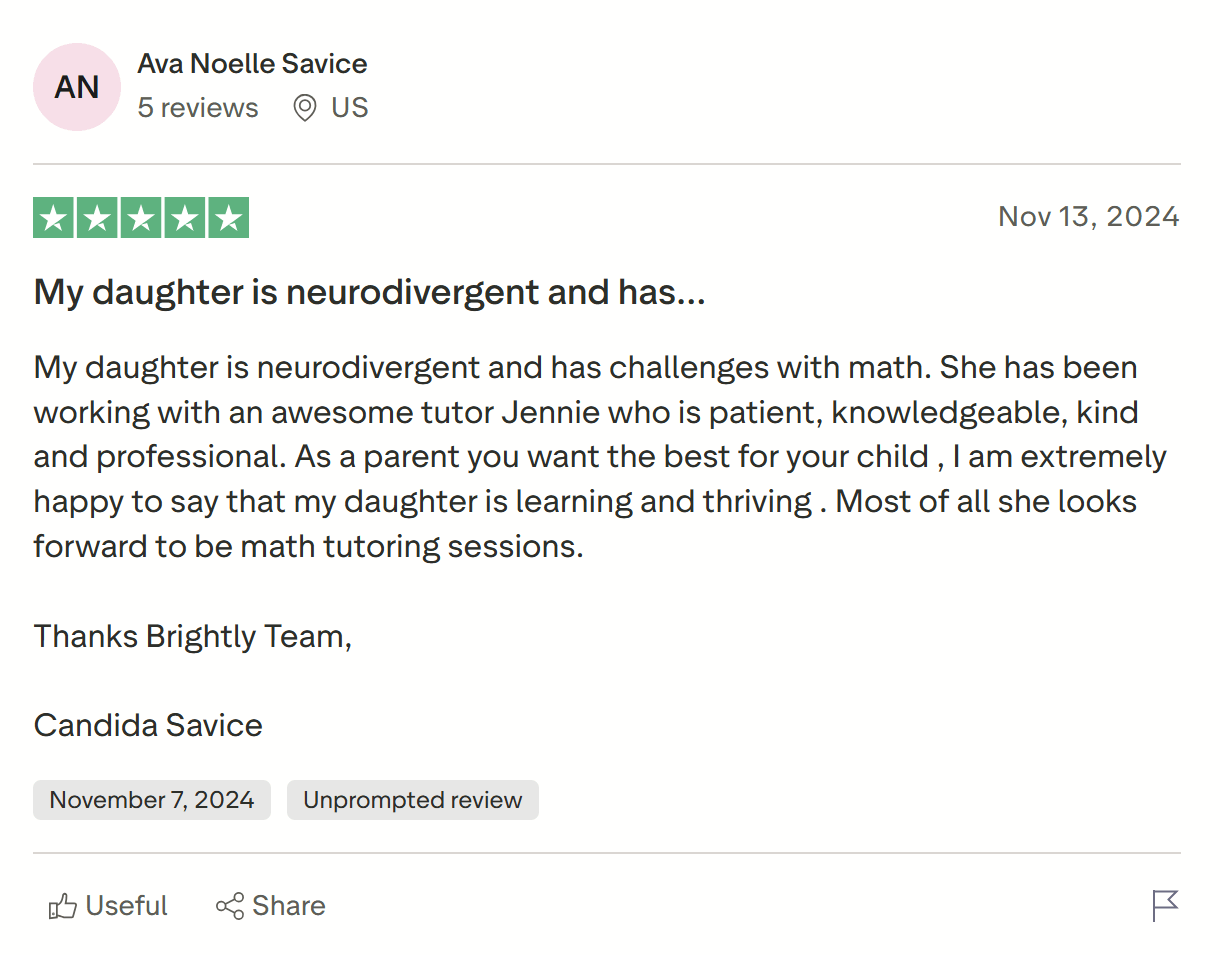
Second, the math learning plan and materials are individually tailored to the concrete requirements of each child. Instruction is delivered with the help of manipulatives, visuals, and real-world examples to make math more tangible. Gamification is used to take off the pressure that kids with learning challenges usually feel and make studying more engaging and desirable. Math homework help is available to support your child’s school preparation.
Furthermore, the Brighterly website offers free math worksheets, organized by grade level and math concept. The problems here feature strong visuals and real-life situations to help the understanding of children with dyscalculia.
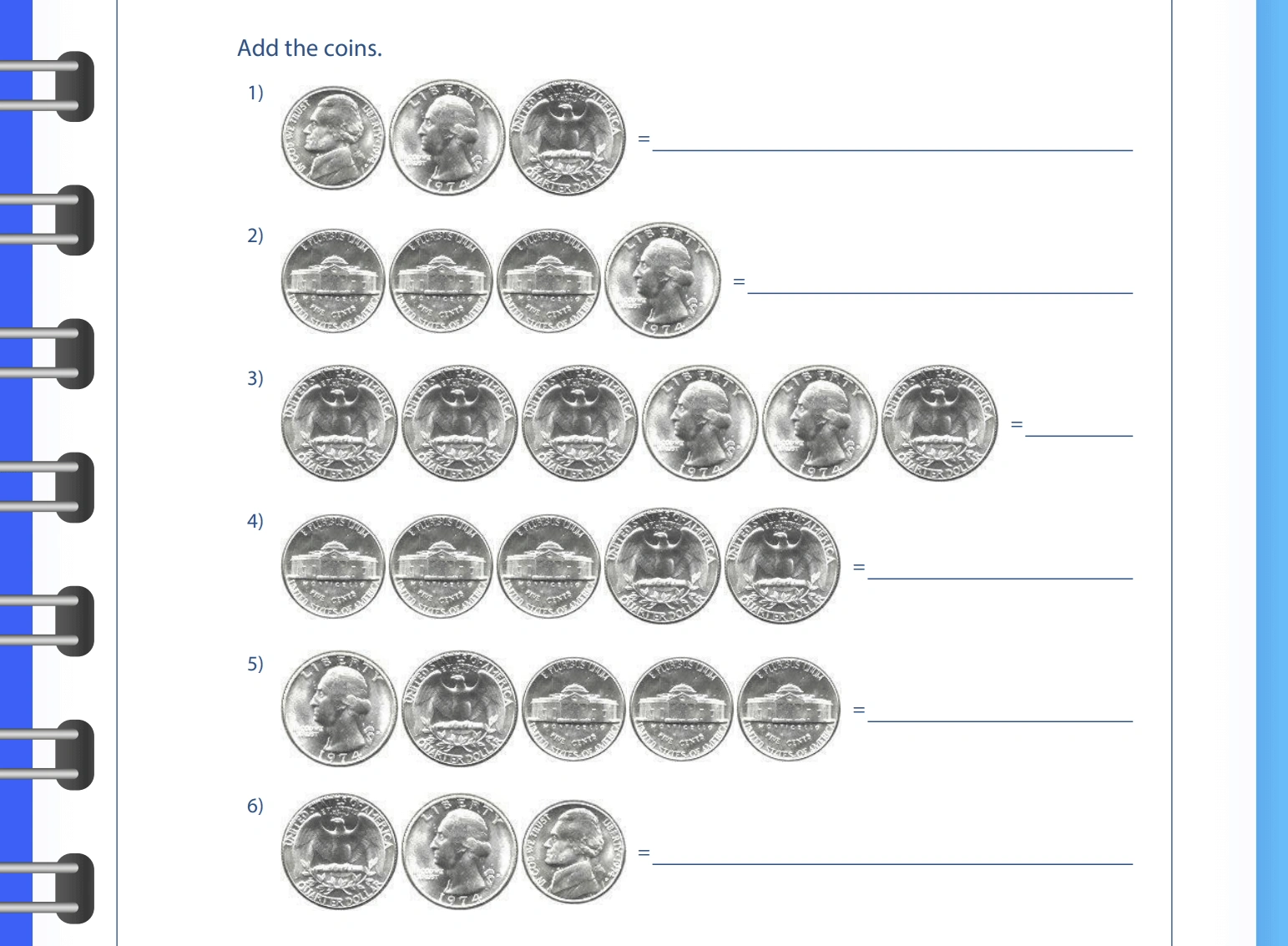
You can try Brighterly with a free first lesson and no commitment.


Use manipulatives to make math tangible
While there’s no treatment for dyscalculia, you can help your struggling child make more sense of numbers and mathematical operations by using physical objects. For this, you don’t have to buy any specific materials. You can turn anything in your surroundings into a teaching aid, like:
- Use buttons, beads, and rice grains to practice counting and teach addition and subtraction.
- Turn Cuisenaire rods into physical manipulatives that represent numbers when you teach multiplication and even division in a highly visual way that helps children with this specific disorder.
- Make use of dienes, or base-ten blocks, and graph paper to teach place value and arithmetic.
- Utilize circles and fraction bars, and even everyday objects like pizza or pie, to teach how fractions are simply parts of a whole.
- Use geoboards to demonstrate shapes, angles, symmetry, and the transformation of geometric shapes.
- Show math in nature to help your little one start seeing initially challenging concepts in a very real-world manner.
- Have your child weigh things around the kitchen or in their room on the scales to get a sense of how heavy everyday objects are.
- Let them count money and add it up, as all kids love playing with money.
When helping your child with dyscalculia, start with basic physical objects, then move on to more sophisticated manipulatives, and finally transition into abstract concepts. This will allow them to gradually build math skills, even if it takes more time than their classmates.
Break down math problems into small steps
Among all dyscalculia teaching methods, one that has proven impact is turning every math problem, no matter how complicated, into a series of smaller, digestible steps. Math is really overwhelming for a child with learning difficulties, and it’s your responsibility as a parent to make things simpler and more manageable for your little one.
For example, if your kid has to solve an equation, write down this step-by-step process:
- Simplify both sides
- Use inverse operations to move all variables to one side and all constants to the other
- Isolate the variable
- Solve for the variable
- Check your answer

Once you have this series of simple steps figured out, show your child how they can work for every equation they ever have to solve. You can even turn them into graphic organizers.
Make real-world math connections with storytelling
Another way on how to help dyscalculia children is to make math relatable and show the relation to their everyday life. You can do that by incorporating math concepts and operations into engaging narratives through storytelling. Every child loves a good story, especially if they’re the hero.
For instance, use your imagination to create fun stories where your child goes to the market to buy 5 apples, 7 oranges, and 10 bananas. Ask them to calculate how many fruits they need to get to show how addition works in real life. Then ask them to calculate how much money they need to pay by coming up with a price for each type of fruit. Finally, give them real money to show you how they’ll pay and ask how much change they need to be given back to apply subtraction.
Try a multi-sensory math learning approach
If your child shows signs of dyscalculia, work on applying a teaching method that uses a few of their senses at the same time. This whole-body engagement makes it easier for neurodivergent kids to comprehend and retain information.
Try incorporating the 4 primary senses in your accommodations:
- Sight: Use visual manipulatives to get your child to start making associations between numbers and how they actually look in life.
- Hearing: Listen to and sing together math songs that use repetitive patterns to teach counting, skip counting, adding, subtracting, multiplying, and dividing.
- Touch: Manipulating objects, such as blocks, and feeling textures, like fraction strips, your child learns to use their kinesthetic and tactile senses to understand numbers, shapes, and spatial relationships.
- Movement: Simple actions, like jumping, waving, or even pairing socks, can apply your kid’s vestibular system to make math engaging and improve memory.
Dr. Nick Bach, Clinical Psychologist and Owner at Grace Psychological Services, highlights the importance of this method of teaching children with dyscalculia.
“Incorporate visual aids like number lines, diagrams, and blocks into your study session.”
Integrate math into daily situations like shopping or cooking. Let them touch food and other ingredients that they are counting.
My experience with dyscalculic students shows that contextual learning boosts their mathematical abilities and increases confidence in using math in daily life.


Stimulating a number of senses simultaneously allows the brain to code information through different pathways for deep understanding and long-term memorization.
Benefit from technology tools
Dyscalculia help can also be received from various tech-based tools, such as scientific and graphing calculators. You can even look for a talking calculator. This grabs your child’s attention and lets them focus more on numbers and calculations. Using a calculator can be especially powerful when combined with the step-by-step approach I discussed a bit ago.

Additionally, there are plenty of math apps that are specifically designed for neurodivergent kids. You can augment your teaching method with them while still emphasizing the human element.
Incorporate math games in the learning process
Your teaching strategies for dyscalculia can benefit a lot if you play math games. First of all, this makes math tangible and concrete through the application of manipulatives and daily life situations. Second, it makes studying less stressful and more enjoyable.
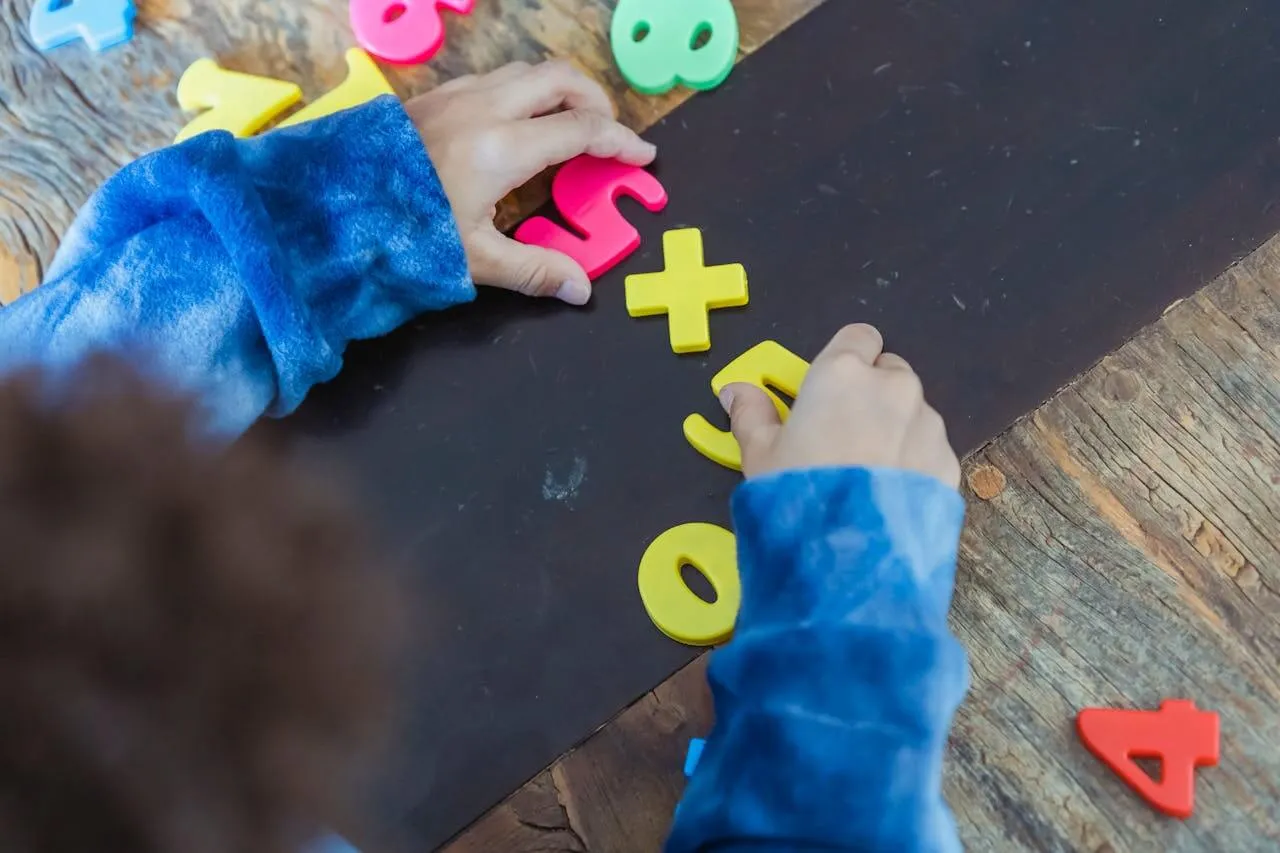
You can also try suggesting to your child’s math teacher some classroom math games. They will improve the learning process not only for your kid but also for their peers.
Build confidence and manage anxiety
Finally, dyscalculia is not only a learning disability. It causes serious emotional and psychological effects, including stress, anxiety (especially math anxiety), and lack of self-esteem. To address this issue and truly support your child with dyscalculia, you have to teach them how to control anxiety and establish confidence.
Needless to say, you have to be very patient and encouraging. Mark, reward, and celebrate each small success. Show your kid how to break complex problems into simple steps. Give them regular breaks and highlight other school subjects where they excel.
How to help a child with dyscalculia at home?
To help a child with dyscalculia at home, create a stress-free, supportive environment and focus on progress and open communication rather than speed and strictness. Keep learning sessions short, with regular breaks in between. Use everyday objects and activities to make math part of life so that it’s tangible.

And most importantly, work simultaneously on math skills and confidence-building. If you don’t have the right skills or enough time, you can consider hiring a professional dyscalculia tutor to help your family.
Conclusion: Supporting your child with dyscalculia in the most efficient way
With these 8 proven strategies for dyscalculia, you can support your child in their struggle with math concepts, facts, calculations, and overall learning. While there’s no dyscalculia treatment, you can make studying significantly more effective and less stressful with the use of physical objects, visual aids, step-by-step problem solving, and real-life examples. Meanwhile, don’t underestimate the importance of the emotional support you offer to your little one.
And if you need some professional help to augment the impact of your own efforts, you can try the Brighterly platform with specialized math tutors.
With the Brighterly math tutoring program, your child with dyscalculia benefits from:
✅ 1:1, personalized tutoring focused on the most challenging topics for them
✅ Professional, trained math tutors
✅ Free, visual, additional math learning resources
Ready to start? Book free lesson to see if this approach works for your family.


Is your high school graduate wondering how to get a good score on the SAT? For many, it is a challenging, thought-provoking exam. But no worries, with some solid preparation, your schooler is good to go. So how should they prepare? In this guide, we’re about to decipher a good SAT math score code. How […]

May 23, 2024

Adults who are well-versed in math live happier and more fruitful lives. Isn’t that what we all want for our children? However, children, just like adults can experience anxiety around studying mathematics. Today we equip you with some strategies to make learning math fun for your child. Here’s how to help your child develop a […]

May 31, 2024
Math & reading from 1st to 9th grade
Looking for homework support for your child?

Choose kid's grade

Math & Reading for Grades 1–9
Build real confidence for your child with a Brighterly math or reading tutor.