How to Help Kids with Homework: Practical Tips for Parents
reviewed by Laila A. Lico
Updated on December 8, 2025

If you think back to your school time, chances are, you can remember plenty of moments when homework felt overwhelming or just plain boring. In this guide on how to help kids with homework, I’ll share some strategies and tips that can make it easier for you and your child.
Key points
- You can make homework time more manageable and even enjoyable for your child through a consistent routine and a safe environment.
- Kids stay motivated when they understand the purpose of homework and feel supported, not pressured by a parent helping with homework.
- It’s important that you guide your child’s thinking, but don’t do the work for them, to help them become confident and independent learners.
- Personalized help from a tutor can make homework less stressful and much more fun, clarifying the challenging topics.
What is the best time for kids to do homework?
The best time for kids doing homework is after they come back from school and have a short break. This way, children will have time to recharge while still in a “learning mode”. For younger kids, late afternoons may work well, while older students may prefer early evenings.
Why should parents help their child with homework?
Parents should help their children with homework to make them feel supported, stay motivated, and build good study habits. And to parents, helping with homework can give insights into what the child is doing and where they may need extra work.
10 homework tips for parents
- Get homework help from qualified tutors
- Create a predictable homework routine for kids doing homework
- Explain why homework is important
- Make sure your kid struggling with homework understands the assignment
- Plan and prioritize the process when helping with homework
- Use timers for focus and breaks
- Utilize technology strategically during homework help
- Help kids develop a growth mindset
- Help with homework, but don’t do it yourself
- Create a positive environment during homework help
Get homework help from qualified tutors
Best for: Families looking for personalized homework and study help for their children.
When a kid is struggling with homework, they often don’t know where to start. That’s when help from a qualified tutor can come in handy. Through homework help websites and tutors, your child will receive the individual support they may not be getting in the busy classroom. With a tutor’s help, they can understand confusing topics better, be done with the homework in less time, and learn problem-solving strategies and skills. All these factors make future assignments less stressful and much easier to handle.
Why address the Brighterly homework help website?

The Brighterly math and reading platform is known for its highly personalized approach. Here, top-quality tutors can provide children from elementary through middle and high school with ELA and math homework help. What’s notable is that tutors create a personalized reading and math program for each child based on their learning style and needs. Additionally, they can compose a schedule that fits your daily routine.
Brighterly offers free materials for children to practice, including math worksheets and reading worksheets, as well as interactive math tests and reading tests for additional learning and to check how your child is doing.
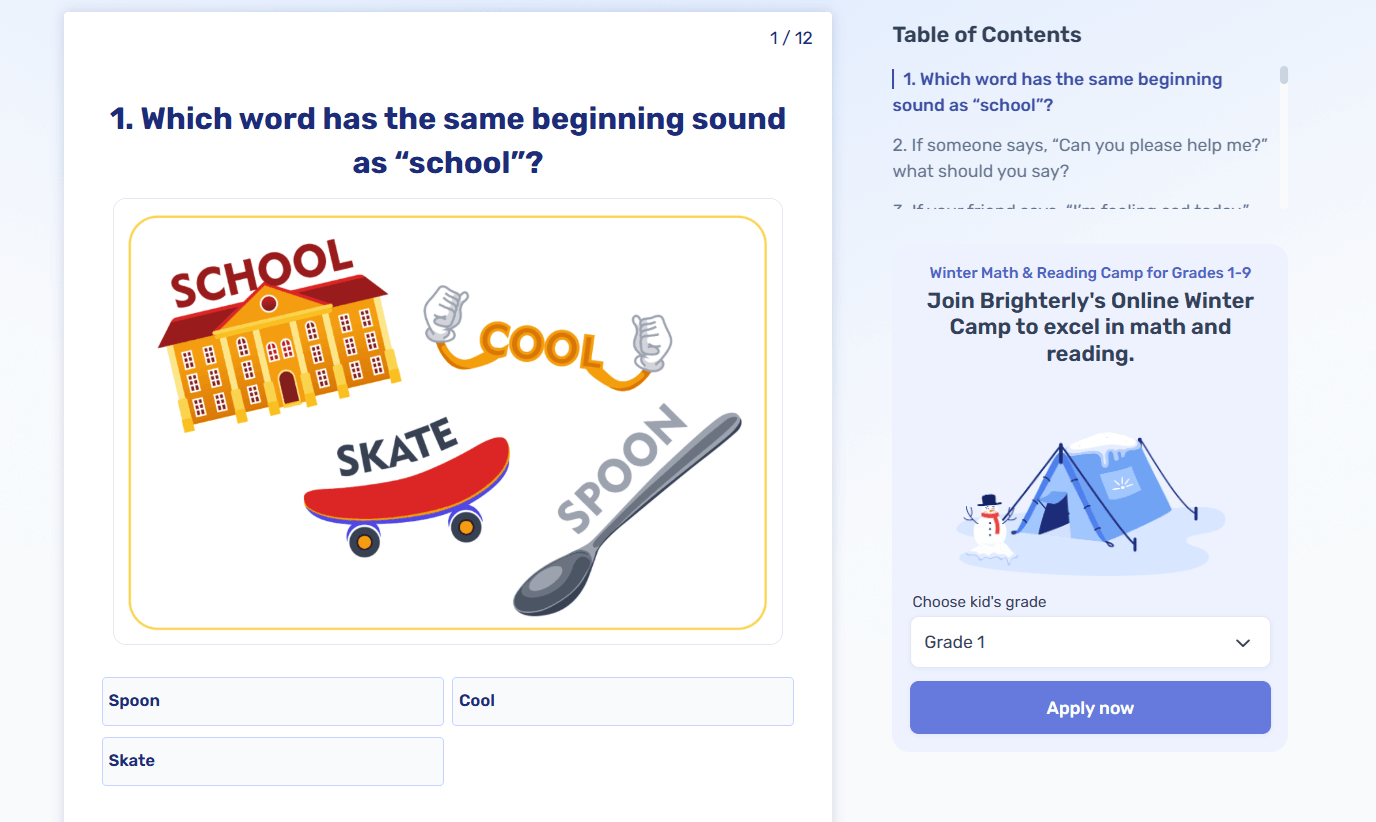
Once your child starts learning with Brighterly, they will:
- Immerse in a positive environment with a teacher ready to support them at every step
- Receive step-by-step explanation based on their actual homework, as well as help to approach problems independently
- Get a clear breakthrough of challenging topics and tricky concepts in a child-friendly language, so they understand the subject from all angles


Create a predictable homework routine for kids doing homework
If you’re a parent wondering how to help child with homework, try creating a predictable homework routine. For many kids, homework can be a source of anxiety. If that’s the case, a predictable routine can make everything feel calmer and more manageable (not only for your child struggling with homework, but also for you!)
Start by choosing a specific time each day when your child will be doing homework. Ideally, this will be after your kid comes back from school, has a short break, and a healthy snack to recharge. Setting up a schedule and keeping it consistent is important because, as a parent helping child with homework, you need to make the “homework time” a non-negotiable part of your kid’s daily routine.
Next, create a dedicated space where your kid can focus. It doesn’t have to be anything fancy. A quiet corner with good lighting and all the supplies and materials is a good place to satisfy a child doing homework.
Note: If you’re homeschooling, this helpful article on how to make a homeschool schedule can be a strong tool to set up your routine.
Explain why homework is important
One mistake parents helping kids with homework often make is assuming that kids know why the homework matters. In reality, unless they hardly do, especially if no one has ever explained it to them.

So, it’s important that you show your kid that doing homework is not about keeping them busy. Connect the homework to moments when they improved their skills. For example, remind them of a time they struggled with a math problem in class but then understood it better after practicing at home.
Also, make sure to note that doing the homework helps them avoid falling behind in school, giving them the chance to catch up and review what they have learned. Homework is critical for their academic achievement, and it’s your responsibility as a parent to explain its role to your kid.
Note: If, for any reason, you’re struggling with providing your kid with proper homework help, these 12 best homework help websites can come in handy.
Make sure your kid struggling with homework, understands the assignment
Another important one in my list of how to help your child with homework is making sure your child understands what their assignment is actually about. Many homework battles happen because children are confused about the homework or unsure where to start.
One simple tactic you can use is asking your child to explain the task in their own words or to share the teacher’s instructions in a way they understand. If your child hesitates, it’s a clear sign that they either didn’t understand the assignment or need a quick lesson recap.
You can then quickly break the task down and ask them to guide you, thereby increasing their involvement. If the task seems a bit too complex, you can even start with the first example and explain it step by step. This demonstration will further clarify the homework and make the process less overwhelming for the child.
Note: But what if your kid understands the task but doesn’t want to tackle it? That’s called procrastination. This article shares proven methods on how to stop procrastinating on homework.
Plan and prioritize the process when helping with homework
Getting your kid working on homework feels much easier when they have a simple action plan. That’s why I often recommend that parents helping with homework start by identifying which task is most interesting for their kid.
A good rule of thumb is to begin with the simplest, quickest, or most familiar task. Think of this as a warm-up as your kid builds momentum before moving on to more challenging assignments. Plus, when they complete it successfully, they feel an extra motivational boost to take up other tasks.

Alternatively, you can show them how to break large projects into smaller steps, such as outlining the paper before they start each section. If you need to do homework for several subjects in one day, I’d recommend working together with your kid to estimate how much time each task will take, and ask them to set a realistic goal. This strategy will not only make assignments more manageable but also teach your kid valuable time management skills.
Use timers for focus and breaks
Another way for helping kids with homework is to use timers. It works particularly well if your kid struggles with focus. Try using a simple timer or the Pomodoro technique, which consists of 20–25 minutes of focused work followed by a short 5-minute break.
You can adjust the times based on your kid’s age and the complexity of the task, but make sure to include some breaks. This will help keep your child’s mind fresh. During the breaks, offer them a healthy snack, stretch together, or have a quick walk. These short circles will help your kid stay focused on the task during work stretches without burning out or losing motivation.
Utilize technology strategically during homework help
Screens are very stimulating, as so much happens there at once. So, once your kid gets absorbed, it becomes much harder to return to homework. That said, if used correctly, technology can be incredibly helpful for any parent helping kids with homework.

Through educational video tutorials, interactive tests, and free practice materials, you can give your child more ways to understand challenging concepts. The key is that you don’t over-rely on technology, but rather use it as an additional supplement during the homework sessions. Keep an eye on the screen time, and make sure the resources you choose are genuinely learning-oriented.
Help kids develop a growth mindset
A growth mindset can change not only how your child approaches homework, but also how they approach learning as a whole. When wondering should parents help with homework, remember that the most valuable support you can offer is encouraging effort rather than doing the work for them. In other words, praise the process, not just the result. Here’s how it can work:
- Point out when your child stays focused, experiments with a new strategy, or gets even one step right.
- Share stories from your own school years about times when you struggled at first but succeeded through practice.
With this kind of guidance, your child shifts from thinking “I can’t do this” to “I can’t do this yet, but I will get there.” In the end, they learn to view homework as a pathway to progress, not a chore.
Help with homework, but don’t do it yourself
The next strategy on my list of how to get kids to do homework is probably among the most important. And it is the reminder that, in an attempt to help, you shouldn’t do the homework yourself. Sometimes, especially when both you and your kid are tired, it can be tempting to give them the answers or do the most challenging tasks yourself. But doing this will take away your child’s chance of learning through doing the work.

Instead of completing the assignments, think of yourself as a coach. Ask guiding questions like “What do you think the first step should be?” or “Do you find any similarities between this and any of the previous exercises?” This way, your kid will feel that they have a support system willing to help, but, at the same time, know that their homework is still their responsibility.
Create a positive environment during homework help
Last but not least, the atmosphere around homework matters just as much as the work itself. A positive, supportive atmosphere will create positive associations, and your kid will fight the process less. And they are also more likely to try solving even more challenging assignments if they don’t think they will be judged.
To this end, it’s important that you keep your tone light and encouraging, noticing their effort, and make the physical space comfortable. When homework feels safe, kids are less afraid of making mistakes and more open to doing homework.
What to do when your child refuses to do homework?
If your child refuses to do their homework, stay calm and try to understand their reasons. Suggest a short break, explain the assignments, and ask whether they need more thorough homework help. Agree to start with a few exercises, and then move on from there. And remember: forcing doesn’t work!
Conclusion: How to help a child with homework
“How do I help my child with homework?” is a question most parents ask themselves at some point. In this article, I went over some tricks and strategies that, in my experience, work well. Just remember that a mix of good organization, positive mindset, and gentle guidance through the topics can go a long way toward not only getting your kid to do the homework, but to actually enjoy it.
If you are looking for additional study help from a qualified tutor, the Brighterly platform is the perfect choice. There, the friendly teacher will help your kids with their studies through personalized learning plans and undivided attention.
To get a glimpse into how these classes work, make sure to book free lesson.



If you’re looking for an honest and easy-to-understand review of Adventure Academy in 2026, you’re in the right place. As a teacher who knows these learning apps pretty well, I collected real Adventure Academy reviews from parents. This will help you see what’s good, what’s not, and how the platform really works. Here you’ll find […]

Dec 05, 2025
Every child learns differently. This, coupled with the wide selection of writing programs available, makes choosing the best homeschool writing curriculum a big task. To help you decide, I’ve looked into some of the most popular platforms, and in this blog post, I’ll go over them in detail. Key points There are many writing homeschool […]

Dec 08, 2025
Math & reading from 1st to 9th grade
Looking for homework support for your child?

Choose kid's grade

Math & Reading for Grades 1–9
Build real confidence for your child with a Brighterly math or reading tutor.