
Homeschool Schedule: Examples, Tips And How To Build One That Works
reviewed by Jo-ann Caballes
Updated on April 15, 2026
A good homeschool schedule combines a solid structure with flexibility, allowing for regrouping activities based on each child’s needs. The good news is, if done correctly, the whole process can be easier than you think. If you are starting homeschooling or looking to improve your existing program, the comprehensive guide below will cover all the nuances.
Key Points / TL;DR:
- Homeschooling is highly efficient, and 1-2 hours per day are usually enough to get started
- To build an effective homeschool schedule, you need to identify your child’s most active and alert hours and keep them for core subjects
- For the electives, you can use the loop strategy or other flexible schedule types to keep the child entertained and engaged
- As a working parent, you can use checklists, visual boards, and 1:1 tutoring at platforms like Brighterly to both make sure your child is on track and that you have time for your work
How Many Hours A Day Should You Homeschool?
Depending on your child’s age and grade level, you may need to homeschool them between 1 hour and 6+ hours per day. For elementary school students, 1-2 hours per day is usually enough. For middle school students, 3-4 hours a day will help them make noticeable progress (as per 2024 research by
Steven Duvall, published at HSLDA). And for high schoolers, 5+ hours a day is recommended to keep up with required standards.
When deciding on how long and when to homeschool your child, the first thing you need to do is let go of the classroom habit. The learning window doesn’t have to be between 8 AM and 3 PM, the usual classroom times. Homeschool day schedule is a lot more flexible and efficient, since you don’t have to manage a 30-student classroom, with all of its logistics. As a result of this more flexible routine, many families find that they can cover a day’s worth of curriculum in a few hours.
Kindergarten – Grade 2
At this age, one of the main goals is to avoid overwhelming the child. Ideally, a typical homeschool schedule for the day will be between 1 and 2 hours. This will be enough for K-2 students to make meaningful progress, while also making sure your kid isn’t too tired after. Make sure to have short breaks in between as well.
For kindergarten to grade 2 students, your focus should be on foundational phonics and literacy skills, basic counting, and fine motor skills. And most importantly, remember to add some playful elements and hands-on activities to keep the students engaged.
Grades 3-5
At this grade level, your child will transition from learning to read to reading to learn. In addition to changing what they learn, their stamina increases, and they can keep their attention on for longer. When making a third grade homeschool schedule, you can increase the learning time to 2-3 hours per day. Planning-wise, you can go for 30-minute blocks with short breaks between them.
In grades 3 to 5, your child will still need significant guidance, especially with new math concepts, but they are also ready for more independent learning. The focus areas should be math concepts such as multiplication and division, reading comprehension, and introductory writing.
Grades 6-8
Homeschool daily schedule for middle-schoolers can be significantly longer than for their younger counterparts, since by this age, your child will be ready for more complex material and deeper critical thinking. Most middle-schoolers can benefit from 3-4 hours of homeschooling as part of the daily rhythm.
The focus at this stage should be pre-algebra, essay structures, and some introductory science. During the first 1-3 hours, you should heavily focus on the academic side of the core subjects, leaving the rest of the time for projects, extracurriculars, and additional reading.
Grades 9-12
You can think of high school homeschooling like a college schedule. At this grade level, homeschooling typically requires 4-5+ hours per day. This is the time you and your child will need to address the rigorous academic requirements of high school for math, science, reading, and social sciences. As your kid is now older, they will spend a lot of this time doing independent research and study sessions for advanced math, lab sciences, and specialized electives.
| Grade | Recommended Hours | Core focus | Break Pattern |
| Kindergarten – Grade 2 | 1-2 hours daily | Phonics, basic counting, fine motor skills, and some play | 15-minute study, 30-minute play |
| Grades 3-5 | 2-3 hours daily | Multiplication, division, reading comprehension, and introductory writing | 30-40 minutes of studying, 10-15 minutes of movement |
| Grades 6-8 | 3-4 hours daily | Pre-algebra, introduction to sciences, and essay structures. | 50 minutes of study, 10-minute break |
| Grades 9-12 | 4-5+ hours daily | Advanced math, lab sciences, specialized electives | Deep work blocks of 60-90 minutes |
Explore Brighterly Learning Experience
Learn exactly how Brighterly helps students thrive through expert sessions, online tools, and proven feedback from thousands of satisfied parents
Types of Homeschool Schedules
The types of homeschool schedules include:
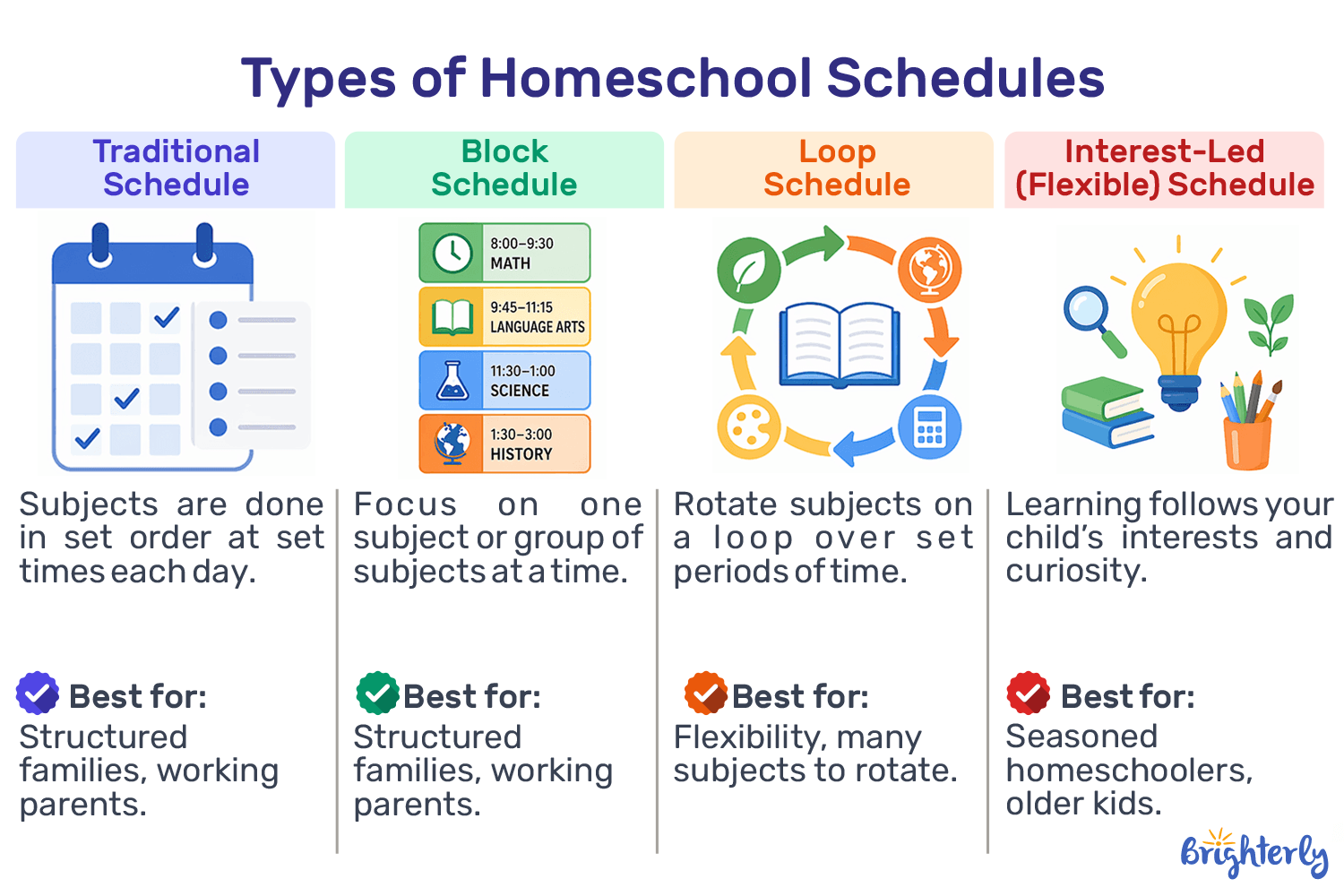
Block Schedule
Best for: Structured families, working parents
If you want to understand the block schedule, you can think of college-style learning. Instead of going through every subject every day for 30 minutes, do longer study blocks for specific subjects each day. For example, Monday and Wednesday are for Math and Science, while on Tuesday and Thursday, you can focus on ELA and History.
Note: In case you are looking for some additional homeschool support, Brighterly’s homeschool math and reading programs can be a great help. You can count each lesson as a single 1:1 block of 45 minutes, 3 times a week, and seamlessly integrate it into your daily routine homeschool schedule.
Loop Schedule
Best for: Flexibility, many subjects to rotate
If you have a hectic schedule and feel guilty about missing a subject, a loop schedule may work great for you. You create a list of secondary subjects (geography, music, logic), and work through the list in order. If you stopped at music on Tuesday, you can continue with logic on Wednesday. This way, no matter how busy you are, nothing gets neglected.
Daily Rhythm / Chunk Method
Best for: Early years, mixed-age families
In the case of the chunk method, the sample homeschool schedule is even more flexible. Instead of looking at the clock, you look at the flow of your day. You chunk your time into Morning time, when everyone learns the same subject, and Table time for core subjects. If the math lesson takes longer, the specific time may change, but your daily rhythm doesn’t.
Relaxed / Interest-Led Schedule
Best for: Seasoned homeschoolers, older kids
This relaxed, interest- and delight-directed learning is better suited for older kids or seasoned homeschoolers. It is often associated with deschooling or unschooling, and you need to build the schedule based on your kid’s interests and passions. If your kid is interested in history that month, for example, you can make the schedule around field trips to museums and documentaries about specific periods in history. Homeschooling statistics indicate that for many parents, this personalized approach is one of the main reason for choosing homeschooling.
How to Build A Homeschool Schedule Step by Step
Now, let’s look at how you can create an example homeschool schedule that works for your family step by step. But before diving in, one important note for you: when creating a schedule, you don’t have to (and in fact, you shouldn’t) try to fill every minute of the day with schooling. This will quickly overwhelm and exhaust your child. Instead, you need to create a sustainable flow that works for your entire family and gives everyone time for a school-free life.
Step 1: Map Your Fixed Commitments First
The very first step of making a daily homeschool schedule is to decide what your non-negotiables are. These shouldn’t be only about the classes. Work calls, regular doctor appointments, sports practice, or even local co-op classes can all be non-negotiables. Think of them as anchors that will guide the development of your routine.
When you note all the important recurring activities right at the start, you avoid a situation when a science experiment or a field trip fails because of an important work call. When you know the time blocks you have available beforehand, you can build a homeschool schedule that will work with your life, not one you’ll be fighting against.
Step 2: Identify Your Child’s Peak Focus Times
Next up, you need to understand when your child’s peak focus times are. Some kids learn well early in the morning, while others are still sleepy until 11:00 AM. Some lose quite a bit of energy after 3:00 PM. This is critical information you need to ensure your child gets the most out of homeschooling.
Observe them for a few days, as well as try conducting the lessons at different times each day for a week. When are they the most alert and perceptive? It’s your child’s focus window.
Here’s what Kacie Barlow of the Honeyroot blog has to say about scheduling at peak focus times:
““From 9:00 AM to 12:00 PM, we focus on core subjects like Math, Science, and Language Arts since my kids are most alert in the morning.”


Step 3: Place Core Subjects In The Learning Window
Once you know when your child is the most active and “awake”, it’s when you schedule the core subjects. If your child is an early bird, don’t leave math for the evening, when everyone is tired. Instead, tackle it at the most optimal time for your child.
Note: If you are looking to start a homeschool math program or are using one already, make sure to also schedule it during the right learning window for your kid.
Step 4: Add Enrichment, Electives, And Movement Breaks
You need to make the classes fun, engaging, and diverse to keep the kids interested over long stretches. The best time to do this is once the core subjects are done, and it’s time for the electives like history, art, and science labs. You can handle these classes with a loop schedule, interest-led projects, field trips, little math games for kids, and so much more.
Additionally, don’t forget to schedule movement breaks, as mentioned earlier. These breaks will help you “reactivate” your child when they start to zone out. Including some movement in the schedule is also a great way on how to make the school day go by faster during the harder days.
Step 5: Write It Down And Post It Visibly
A schedule that only exists in your head is not a schedule. It’s a surprise, and chances are, no matter how many times you tell your kid the schedule, they will forget it. So, what you need to do is make a homeschool routine chart for that week or the upcoming two weeks, and hang it somewhere where they can see it. You can also add the schedule to their homeschool planner. This way, they’ll know what’s coming next and transition between activities and subjects more easily.
““The best way to create a routine is to start with a brain dump of everything you want included in your homeschool routine.”

Step 6: Run It for Two Weeks, Then Adjust
Your first homeschool schedule is a draft. It will have flaws, and you will probably edit it quite a bit. Start by running it for two weeks, and see what happens. If, for example, you always skip science because it’s in the evening and everyone is sleepy, move it earlier. Then, adjust your schedule until it fits your family rhythm and doesn’t feel like a chore.
Sample Homeschool Schedule Ideas by Age
Here are some simple homeschool schedule examples for different grade levels that you can use or refer to.
Daily Homeschool Schedule For Elementary School(Grades 1–5)
In the early grades, you need to keep the learning windows intense, but short, and follow them with physical activities. Playing or running around helps kids to reset.
| Time | Activity |
| 8:30 – 9:15 AM | Morning time, togetherness (shared subjects, read-alouds) |
| 9:15 – 10:00 AM | Core subject math (This is a high-focus block) |
| 10:00 – 10:30 AM | Outdoor play or snack time for a movement break |
| 10:30 – 11:15 AM | Core subject ELA (homeschool reading program) |
| 11:15 – 12:00 PM | Science or History (alternating days) |
| 12:00 PM+ | Chores, hobbies, and interest-led play |
But if you’re homeschooling an elementary kid, remember about this crucial remark:
““Regular breaks are really important.”
Sample Homeschool Schedule For Middle School (Grades 6–8)
This is the stage when children are starting to become more independent, and their homeschool schedule should reflect that.
| Time | Activity |
| 9:00 – 9:30 AM | Morning meeting to go over the daily goals |
| 9:30 – 10:30 AM | Math deep study block (Independent with parent nearby) |
| 10:30 – 10:45 AM | Stretch, snack, or water break |
| 10:45 – 11:45 AM | Humanities block for history, literature, and essay writing |
| 11:45 – 12:30 PM | Science lab or elective for subjects like coding, foreign language, or art |
| 12:30 PM+ | Volunteer work, sports, personal projects, and rest |
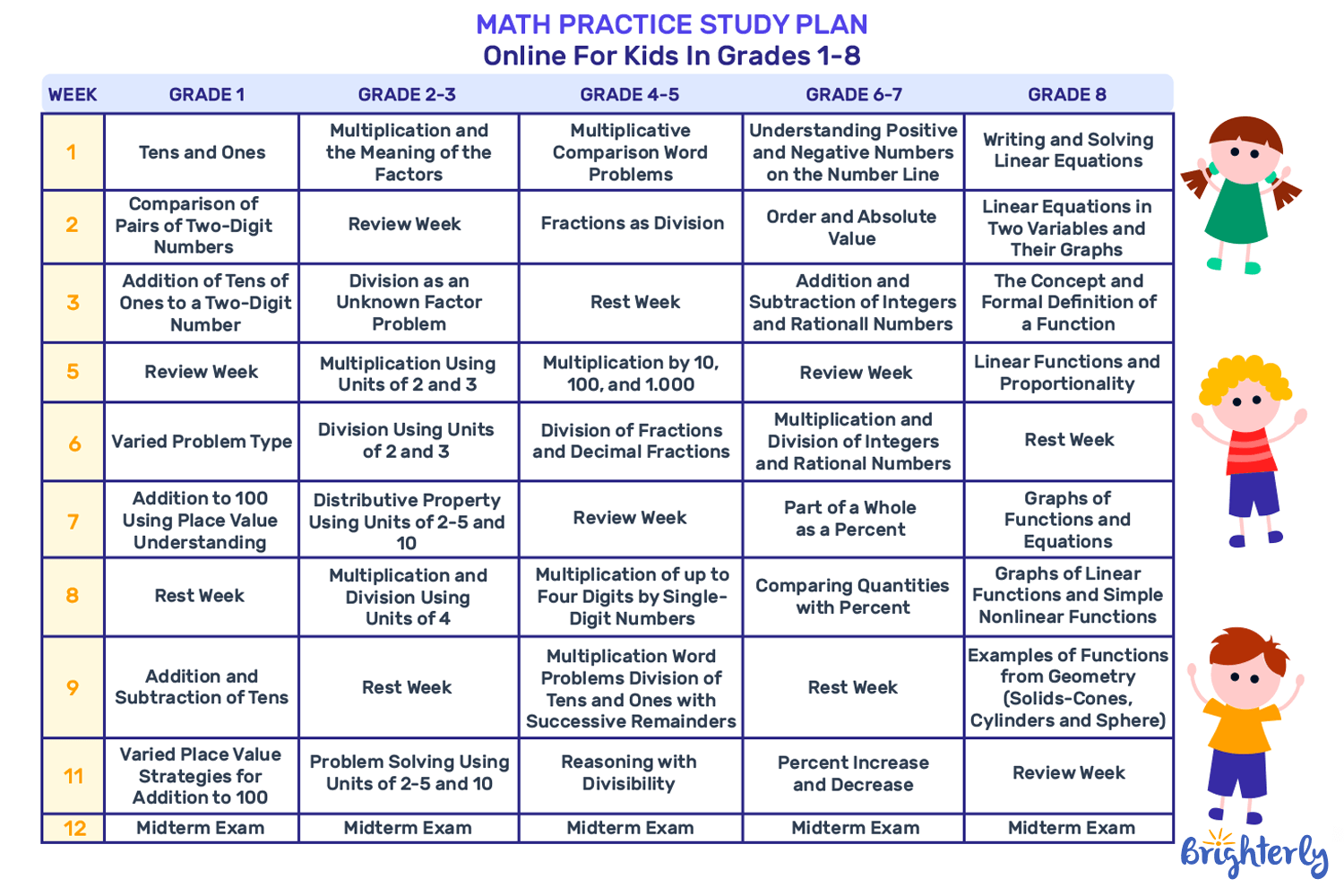
For some other homeschool practice variants for math, please check our this image:
Simple Homeschool Schedule For High School (Grades 9–12)
The schedule for high schoolers gives them more independence and revolves more around deep work rather than activities and breaks.
| Time | Activity |
| 10:00 – 11:30 AM | Block 1 on advanced Math or science |
| 11:30 – 12:30 PM | Research, SAT prep, or dual-enrollment as part of an independent study |
| 12:30 – 1:30 PM | Cooking, household tasks, and a short stretching session |
| 1:30 – 3:00 PM | Block 2 in history, government, or foreign language |
| 3:00 – 4:00 PM | Science lab, internship, part-time job, or fine arts |
| Evening | Reading for literature assignments or interest |
Need further help with homeschooling, or are you looking for an effective way to prepare for exams? Try online tutoring.


Take the stress out of homeschool math!
Let Brighterly's expert tutors reduce the homeschooling load with 1-on-1 classes.
Homeschool Schedule Ideas To Keep Things Fresh
No matter how well you design your homeschool schedule, after a few months, even the best homeschool programs can start feeling repetitive, especially if you are doing year-round homeschooling. When you feel that your child is in a bit of a slump and is less energetic during classes, you don’t need to redo your entire schedule. Instead, you can bring the excitement back with a little variety. Here are a few homeschool schedule ideas you can implement.
Start Every Day With Morning Time
The morning time, as we discussed earlier, is when the family learns together. If you don’t have this in your schedule, make sure to add it. Start with a shared story, a quick geography game, or a simple conversation in the language your child is learning. It sets the focus on learning.
Use A Loop Schedule For Secondary Subjects
You don’t have to stick to only one type of homeschool schedule. If you have the block type for core subjects, add the loop schedule for electives. Going with two or more schedule types will add variety and help you avoid the “all or nothing” trap.
Build In A Weekly Project Day Or Field Trip
Field trips and weekly projects are incredibly important during homeschool. Going out to a museum or a hike to document the local flora, this will spice up your kid’s week and also show them that learning isn’t only confined to home.
Use A Visual Schedule Board Or Planner
A visual schedule board is especially useful for younger kids, as for them, the concept of time is still a bit abstract. When you have a visual board with movable icons and colorful pens, the schedule written on it is more tangible.
Common Homeschool Schedule Mistakes (And How To Fix Them)
| Mistake | Why It Fails | Better Approach |
| Replicating school | Your child doesn’t need to sit at a desk for 7 hours; it will only exhaust them. | Focus on the learning, not the hours. Don’t make the blocks unnecessarily long. Once your child has learned the material, school can be over. |
| Ignoring bio-rhythms | A night owl teen won’t be a productive learner at 7:00 AM. | Identify your kid’s peak focus window, and align core subjects with it. |
| Over-scheduling electives | If you have too many outside classes like co-ops, sports, or music, your kid will not have time for rest. | The “one out, one in” rule is a good way to make sure you are not overwhelming your child with extracurriculars. |
| Rigid time-stamping | Panicking because Math started at 9:15 instead of 9:00 creates unnecessary stress. | Follow your daily rhythm instead of a strict clock-based schedule, and allow for some leeway. |
| No free time | If you fill every minute of your kid’s day, they will not have time for independent play and daydreaming. | Leave children with at least 1–2 hours of unstructured time every afternoon. |
Simple Homeschool Schedule For Working Parents
Balancing career and homeschooling is no small feat, but with the right strategy and schedule, it’s entirely possible. The most important step here is to move away from the 9:00 AM-3:00 PM perfect study schedule many have in mind.
As a working parent, when making a daily homeschool schedule, you need to break your day into manageable chunks. For example, you can help your child handle a particularly hard math topic for 45 minutes in the morning or before a work call, and then leave them some independent study time to practice that topic, or watch a documentary or educational videos for other subjects you are covering.
Note: Don’t forget about the weekends! There is no law saying you can’t teach writing on a Saturday.
Next, before you build your schedule, you need to know exactly where to start so you don’t waste time on concepts your child already knows. Your children can take this free diagnostic math test and a free reading placement test to see at which grade level they are, so that you can assign them independent work that is challenging enough.
Among the many pros and cons of homeschooling, feeling alone is something you may experience. So, it’s important to remember that you are not alone. You also don’t have to be the primary teacher at all times. You can reclaim time in your schedule by enlisting experts for core subjects. Using a 1:1 online tutoring service like Brighterly will help your child to receive personalized math and reading instruction and stay on track while you focus on your work.
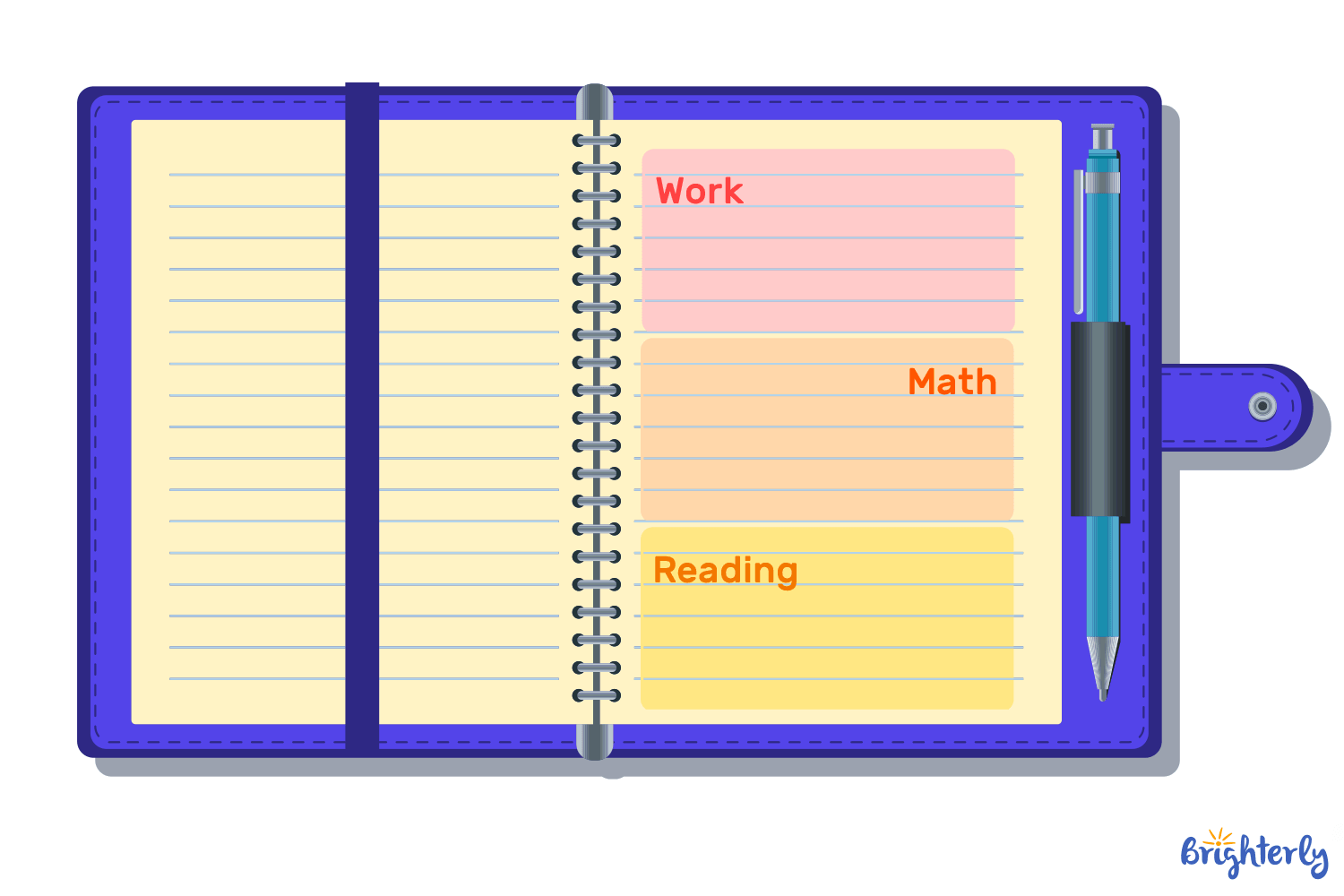
And lastly, as a working parent, you need to instill independence into your child. You can create must-do checklists for their learning and assignments. Once they finished the list, they got some personal time for rest and hobbies. In the meantime, you have the time to manage your workflow and come back with feedback once both you and the kids are done.
Exploring better ways to learn reading?
Get personalized reading and ELA tutoring for your kid with experienced teachers.
Conclusion
Homeschool schedules are diverse, and that’s their beauty, as this allows them to fit the needs of kids with unlimited imaginations and varied requirements. When building a plan for your little ones, mix core subjects with electives appropriate for your child’s level, establish a routine, offer frequent breaks, and provide free time for experimentation and play. You can also try homeschooling programs to have a professionally structured schedule outside a formal educational institution.
With Brighterly tutoring for homeschooling, your family benefits from:
✅ Access to professional math and reading teachers away from school
✅ Free math and reading worksheets to build strong skills and develop confidence through practice
✅ Free math and reading tests to make sure they’re up to state standards while being homeschooled
Ready to test the power of 1:1, professionally delivered tutoring? Book free lesson now to set up your child for success.
Frequently Asked Questions
What Is The Best Homeschool Schedule?
The best homeschool schedule is the one that fits your family’s daily life, doesn’t overwhelm your child, and keeps them interested. But most importantly, the best homeschool schedule is the one that you will use consistently. There is no single best option here; you need to find what works best for you.
How Many Hours A Day Should I Homeschool?
How many hours each day you should homeschool your child will depend mainly on their age and grade. For kindergarten kids through K-2, 1-2 hours per day is enough. From there, you need to add hours and adjust the brakes. For high schoolers, you can expect to spend 5+ hours homeschooling per day.
What Is A Daily Rhythm In Homeschooling?
The daily rhythm in homeschooling refers to the type of homeschool schedule, where, instead of having fixed hours and durations, you adjust the learning to the flow of the day. For example, if you decide that kids do the core subjects in the morning, the duration and exact time can vary day to day. This is also known as the chunk method.
How Do I Make A Simple Homeschool Schedule?
You can make a simple schedule by identifying your child’s peak learning time and scheduling the core subjects at that time. Before that, you need to identify your non-negotiables for that week or month, and account for them when making your schedule. Do the electives with the loop or another, more flexible, homeschooling schedule type.
Can I Homeschool With A Flexible Schedule?
Yes, you can absolutely homeschool with a flexible schedule. In fact, flexibility and adaptability are two of the most important benefits of homeschooling. Depending on your kids’ preferences and your to-do list, it’s not always possible to maintain a fixed schedule. However, you need to make sure that with all that flexibility, the learning remains consistent.
How Do I Homeschool As A Working Parent?
As a working parent, you need to schedule learning chunks more flexibly, often outside the traditional 9-to-3 classroom schedule. Make the deep study blocks shorter when there is a need, and leave kids with more independent study time. You can also enlist the help of professional tutors.



To succeed in math, students should steadily build on their knowledge of math concepts. Inevitably, one-to-one correspondence is that skill that creates the ground for mastering counting and number sense. In this article, we explain what it is, provide the best one-to-one correspondence activities, and show why you and your child should take time to […]

Aug 21, 2024

For those who feel stuck with Khan Academy, self-study mode, or notice a dip in motivation when the learning style doesn’t match their kid’s energy, here are the top 13 Khan Academy alternatives. You’ll find out their user-reported strengths and drawbacks, as well as features that Khan Academy lacks. Disclaimer: This list of top 13 […]
Aug 29, 2024
Math & reading from 1st to 12th grade
Looking for homework support for your child?

Choose kid's grade

Math & Reading for Grades 1–12
Build real confidence for your child with a Brighterly math or reading tutor.