How to Teach Summarizing for Kids: What Parents Should Know
reviewed by Marvi M. Andres
Updated on January 28, 2026

Ever seen a kid trying to retell their favorite two-hour movie but refusing to leave out a single line? Every detail spills out, and pretty soon, the whole story just turns into noise. That is why knowing how to teach summarizing is essential. As a tutor, I’m ready to share several strategies that can be used to help kids spot the main parts of any story.
Key points
- Summarizing means ditching the background noise and cutting through the details to grab the main idea.
- Effective summarizing strategies help with long-term memory and comprehension.
- The ability to summarize is needed in both literacy and math problem-solving.
- The key to a good summary is knowing the difference between informational and narrative structures.
- Reading worksheets and summarizing activities have proven to yield positive results.
- Brighterly tutors help kids identify the main message of a text with confidence.
What is summarizing?
Summarizing is creating a short version of a big piece of work (text, movie, book, or story) by picking out the most important parts and leaving out the rest. Basically, it’s a process that requires you to ignore supporting details and focus strictly on the key information found within the text or whatever you’re summarizing.
If you wonder how to explain it the easiest way, a highlight reel of a movie or a book could be a good “summarize” definition for kids. Instead of going through every single event, the highlight usually focuses on the beginning, middle, and end.
When a child learns how to summarize text, they are simultaneously learning to manage cognitive load. In an age of information saturation, being able to pull the “signal” from the “noise” is a great skill to have. It allows kids to move from passive word consumers to active meaning processors.
But “What does “summarize” mean in reading?” In fact, they go hand in hand. Even the study shows that summarizing strategies that are used for reading comprehension are among the most effective ways to increase a student’s ability to retain information over time, understand its purpose, and why it flows the way it does. So, summarizing the text improves reading comprehension, and reading comprehension improves summarizing skills right back.
How to teach summary for your child: 20 strategies to use at home
- Get a tutor: Professional reading tutors provide immediate feedback and have an arsenal of effective summarizing techniques for students.
- Use worksheets: Worksheets give kids a chance to physically circle or highlight the main idea, which really helps it stick.
- Try the “Somebody, Wanted, But, So, Then” method: This one’s a classic for stories. It helps kids follow who wanted what, what got in their way, and how everything turned out.
- Ask the 5 W’s: Who, What, Where, When, and Why. Just answering these covers all the summary basics in one go.
- Try the GIST (Generating Interaction between Schemata and Text) technique: Here, your child gets only 20 words to sum up what they read. It’s a fun way to challenge them to focus on what really matters.
- Get graphic: Ask a child to draw a Story Pyramid or Main Idea Umbrella to help visualize the structure of a story.
- Try reverse outlining: Take a finished piece and make an outline to see how someone else put it together.
- Create headlines: How do you teach summarizing in a fun way? Make it creative. Have your child pretend they’re an editor and come up with a five-word headline for an article.
- Map a story: Draw the path of the plot from start to finish. It helps kids see how everything connects.
- Try the “Movie trailer” Method: Ask your child to pitch the book like they’re making a trailer for it. See how they can make it interesting without giving plot spoilers.
- Sort keywords: Pick out 5-10 important words from the text and have your child explain why they are the ones that matter.
- Summarizing first-person: Have your child retell the story as if they were the main character. It helps with both understanding and empathy.
- Focus on nonfiction features: Use features like headings, photos, graphs, and captions to help with summarizing informational text.
- Picture summaries: If a kid is a visual learner, ask them to sketch three pictures, representing the beginning, middle, and end of the story.
- Pitch it: Tell your child they only have 30 seconds to explain the story. What do they say?
- Cut the extras: Have your child use a highlighter to mark what to keep and a black marker to cross out what’s not so important.
- Web a concept: Draw a web with the main idea in the middle and supporting facts branching out of it.
- Combine sentences: Take three simple sentences and merge them into one tight summary.
- Record summaries: Record your child explaining the story so they can hear if they’re adding too much.
- Think-Alouds: Show your child how you summarize by talking through what you’re thinking as you read.
Teaching summarizing through tutoring sessions
Students usually learn to summarize better when they’re working one-on-one with someone they trust. It’s just easier for them to take risks and even mess up a little when there is no big crowd watching. When teaching summary in a group, there’s often this pressure to get things right on the first try. But with a tutor, the pace slows down. The tutor can break summarizing into smaller steps, so it doesn’t feel overwhelming, and kids build up their confidence little by little.
One of the best things about working with a tutor? They figure out exactly what stands in the way of your kid’s learning. Some kids remember every tiny detail but can’t pick out the central idea. Others keep it so short that the important stuff gets lost, usually because they don’t have the words to describe the middle parts. A good tutor spots this stuff and works on it with the right strategies. That way, every student learns how to write a summary in 4th grade and after.
Why address Brighterly tutors?
Tutors at Brighterly math and reading platform, are professionals in teaching how to summarize by adapting to your child’s specific learning style. By using real-world summarizing examples, they show kids that these skills aren’t just for class — they are actually useful in real life.
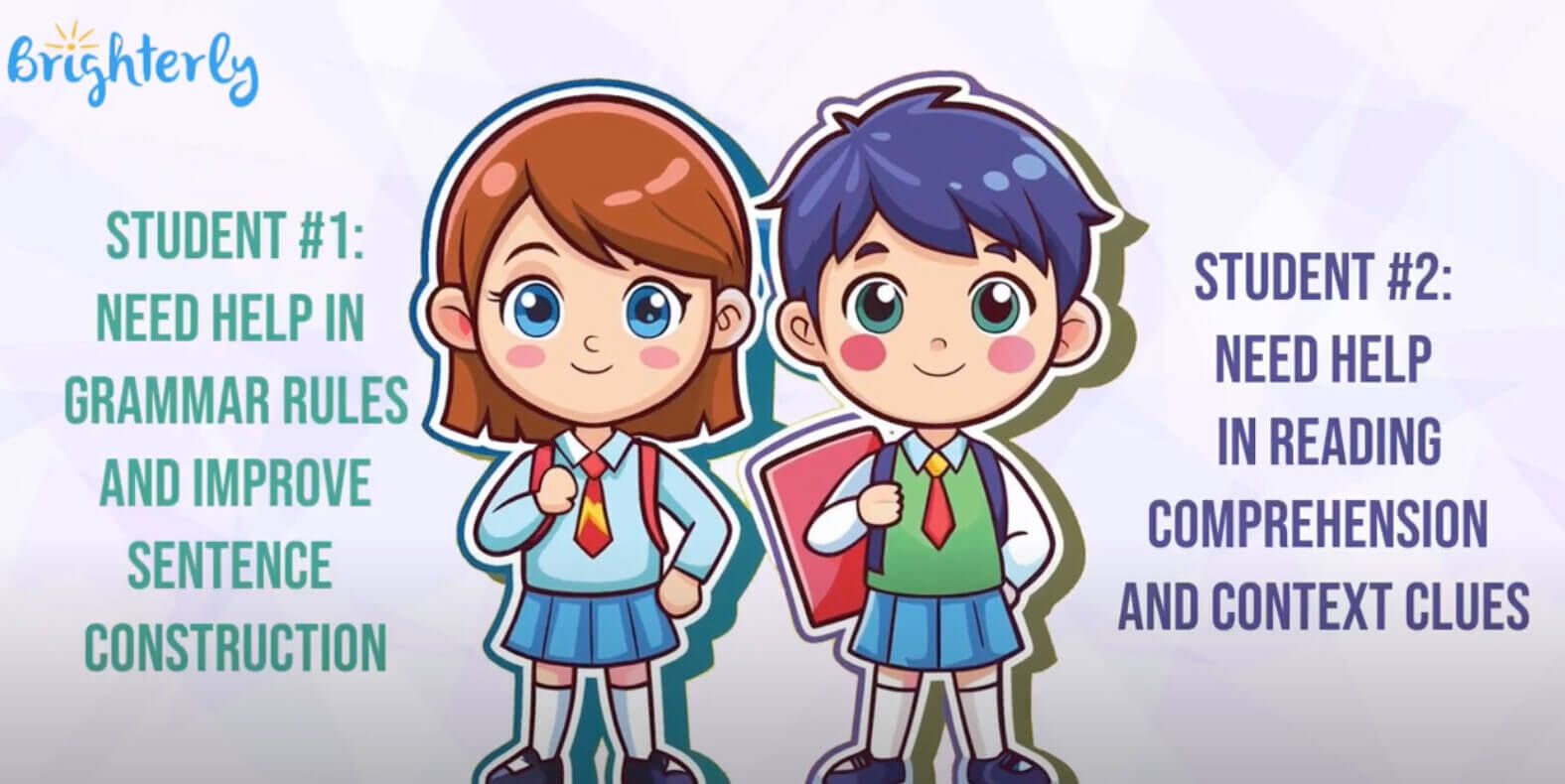
Whether your child is a visual or a verbal learner, the Brighterly reading program makes sure they feel comfortable and supported. Their educators also focus on how to master close reading, which is a prerequisite for accurate summarization.


Check the basics behind this term
Take our quick quiz to discover the perfect learning solution based on your child’s needs.
Mastering summarizing in reading with worksheets
Staying consistent is key to teaching summary. And summary worksheets give kids a chance to practice over and over, which helps their brains get used to picking out the main points quickly. Usually, these worksheets include a short reading and some prompts to steer the child toward the main idea.
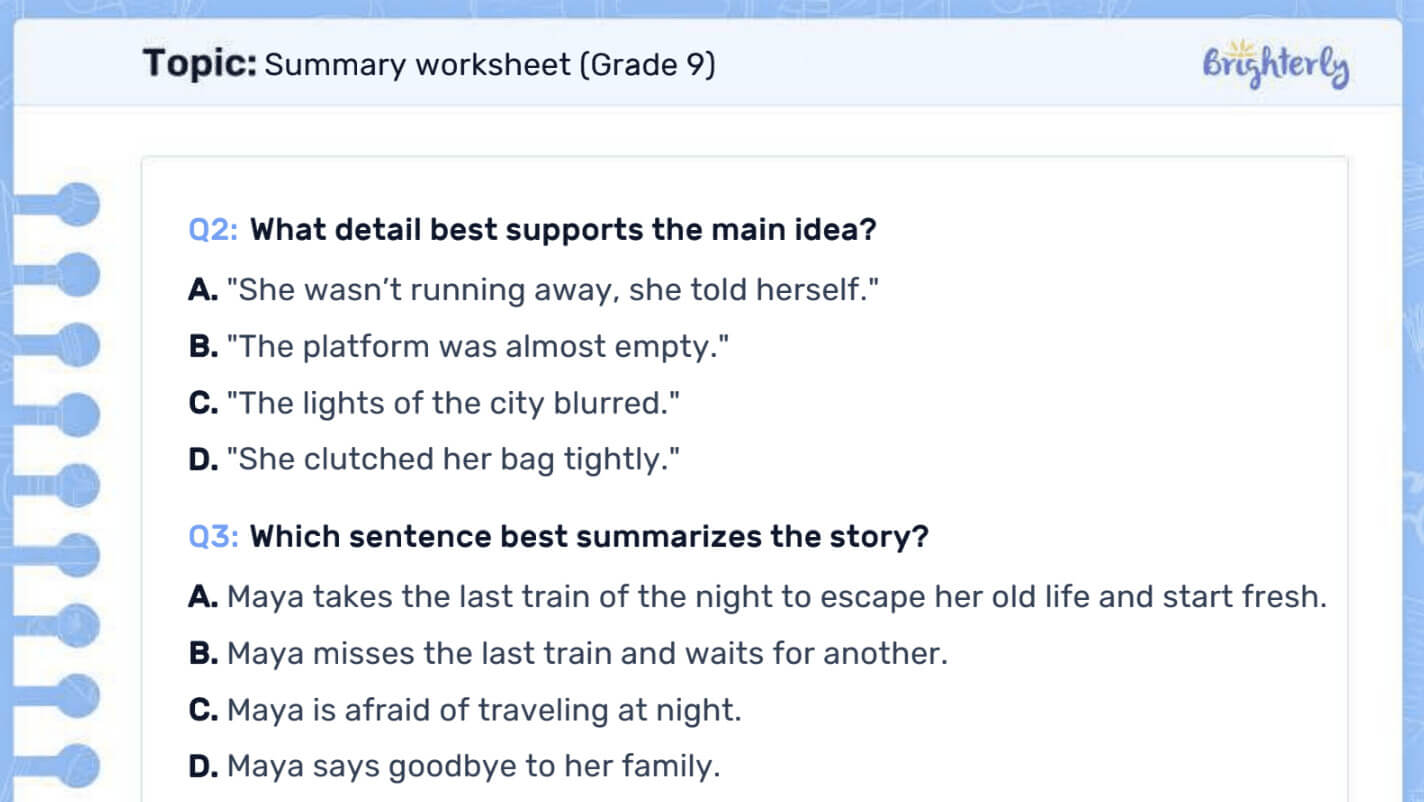
If you are wondering how to teach summarizing in 4th grade or beyond, try worksheets. They can ask kids, for example, to circle the best title or spot a sentence that doesn’t fit. This kind of hands-on work actually helps way more than just reading quietly and hoping something sticks.
Brighterly reading worksheets for summarizing
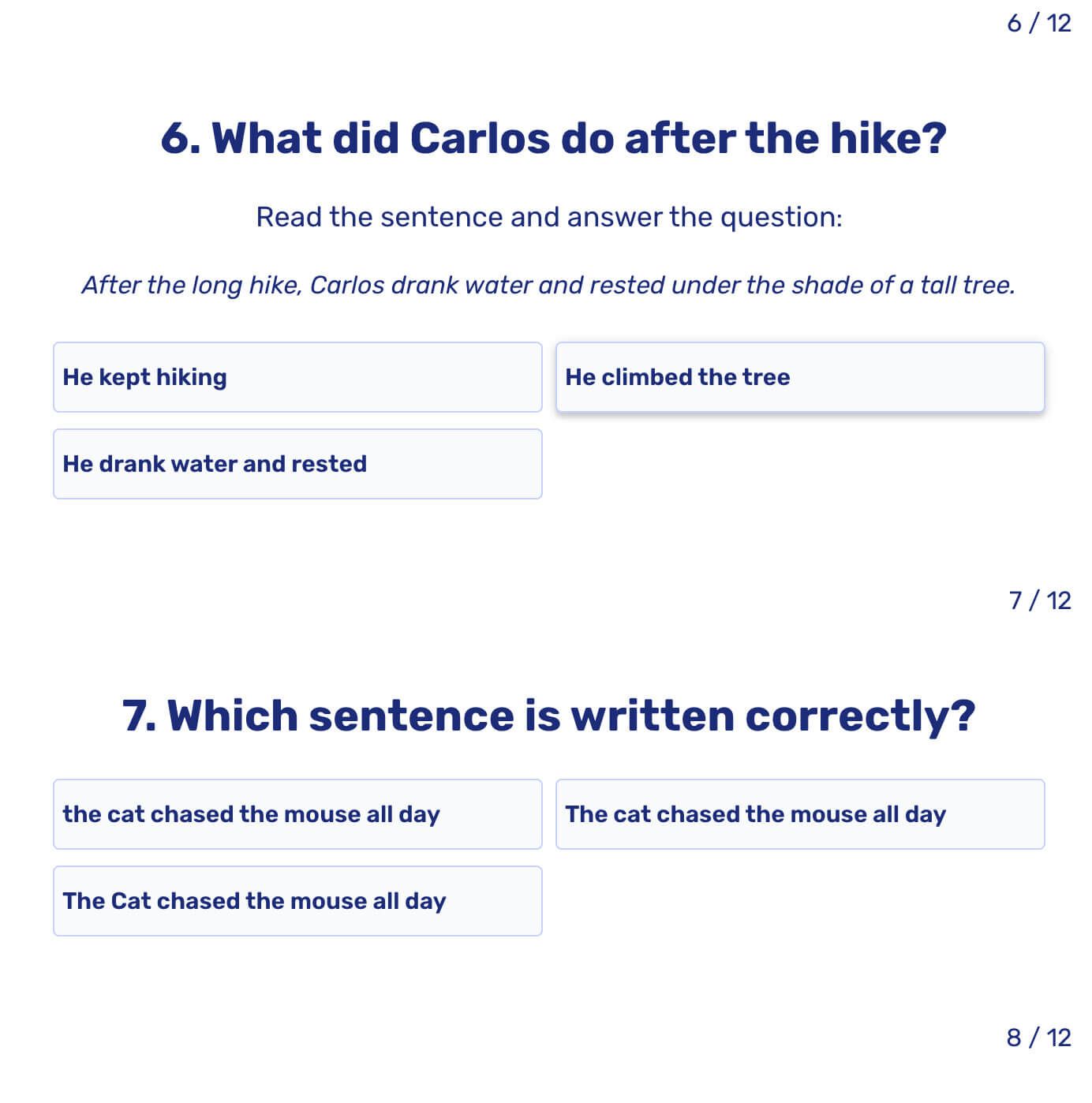
Brighterly offers specialized reading worksheets developed to help understand summarizing for kids. If you use such worksheets and reading tests regularly, you can get a clear picture of your child’s progress and see if they need more assistance. Plus, these worksheets are bright and fun, so kids actually want to pay attention instead of getting bored as they do with most tasks.
Summary types: Narrative vs. informational
If you want to help your child learn how to summarize, it helps to know the difference between the main types of texts they see at school. Take a look at this table and use it to tweak how you practice summarizing, depending on what your kid’s reading right now. The way you teach summarizing should change with each genre. Otherwise, things can get pretty confusing.
Narrative summary |
Informational summary |
|
| Focus | Plot, characters, and conflict | Thesis, facts, and evidence |
| Goal | Retell the story’s arc | Explain the topic’s main point |
| Key elements | Beginning, middle, end | Introduction, body, conclusion |
| Strategy | Somebody, Wanted, But, So, Then | Main idea and supporting details |
Summarizing informational text
Summarizing informational text isn’t the same as summarizing a story. Instead of searching for characters or plot, you need to spot the main point and the proof that backs it up. Here’s how you can help your child do that:
- Show them bold or italicized words, which usually signal important information.
- Remind them to always check out the table of contents and headings. They are basically a giveaway for the main ideas of each part.
- Show them charts or maps and how they illustrate data in a simple way.
Once kids pick up on these clues and tie them together, they can handle even tough nonfiction with a lot more confidence. That pays off later, especially when middle and high school start piling on the nonfiction. So, when the time comes to think of how to write a summary in 5th grade and later they will be ready.
Writing a summary for kids: A step-by-step guide
If you are wondering how to write a summary for kids without making their heads spin, just follow this proven four-step process to keep it simple and as easy as possible.
Step 1: Read and identify keywords
First, get them to read the whole text once. No pencils, no highlighting, just reading. In the second round, ask them to pick out five to seven important words. Preferably, the ones that answer “Who?” and “What?” questions in the story.
Step 2: Use a graphic organizer
Have them write the main idea in the center, while key details go in little bubbles around it. Suddenly, the summary’s structure is clear and not so scary.
Step 3: Write the first sentence
The first sentence of a summary for kids should always mention the title of the work and the main idea. Something like: “In the ‘Hansel and Gretel’ story, two siblings abandoned in the woods try to find a way home.”
Step 4: Add the “But” and “So”
Finally, add the “But” (the conflict) and the “So” (the resolution). Skip the dialogue and don’t get lost in small details or background characters. Once these steps are done successfully, you can be sure you know how to summarize for kids.
Summary activities for middle school
As students go from grade to grade, summarizing activities becomes harder. Now, it’s about picking up on subtle details and noticing bias. Here are the top 3 summarizing activities for middle school you can try:
- Perspective shift: Have a child read a news story and then write two different summaries, each from a different point of view. It really shows them how a summary can change depending on what details you decide are important.
- “The $2.00 Summary”: Here’s how it works: every word they use costs 10 cents, and they can’t go over two dollars. So, since every word matters, they have to get straight to the point.
- The “Plot Rollercoaster” analysis: Don’t let a kid just rattle off events. Have them map the story onto a narrative arc, picking just one sentence for each stage: Exposition, Rising action, Climax, Falling action, and Resolution. When they squeeze the whole story into these five “seats” on the rollercoaster, they start to see the difference between extra details and the real backbone of the plot.

These summarizing techniques push them to think critically and write better summaries, skills they’ll keep needing as they move forward down their educational path.
Why is summarizing important?
Knowing how to summarize text matters because it helps kids actually understand what they’re reading, remember it later, and think more clearly about it. Without this skill, kids hit a wall with tough texts, especially as they move up into middle or high school.
Close reading ties right in. Knowing how to master close reading means knowing how to unpack complex, narrative-based information. When a student cannot summarize the plot or core logic of a passage, they struggle to identify the critical relationships and essential data points embedded within the text. That makes the whole thing feel confusing, like you’re stuck in a maze with no map.
Besides all that, the teaching summary also has a positive impact on children’s writing. Once they learn how to write a short story, they start to see how stories are built from the ground up. Now, writing their own short story isn’t such a foreign concept.
Common challenges when teaching summarizing
Kids run into trouble when they try to summarize, no matter how good their summarizing strategies are. Knowing these problems early helps them learn how to fix them. Here are the most common of such issues, along with tips on how to solve them:
- The retelling trap: If a child still tells the entire story again and again, try using the GIST method.
- The opinion trap: If a kid keeps adding their own opinion about the book, offer them to map the story and remind them that a summary needs to be objective by showing where personal opinion doesn’t fit on a map.
- The detail trap: If a child picks one tiny detail they love and ignores the main idea, use graphic organizers to show hierarchy.
The role of vocabulary in summarizing
You cannot really summarize for kids if the child doesn’t understand what some words mean. That is why expanding a child’s vocabulary is a hidden but critical requirement for effective summarizing. When teaching to summarize, get them to think about umbrella words. Instead of listing everything, they can use a word that covers a whole bunch of things. Like, instead of saying apples, oranges, and bananas, they can just say fruit. That way to get to the point is what summarizing is all about.
Conclusion
Whether you are using summarizing strategies for reading comprehension at home or working with a tutor, the goal is to give your child the instruments they need to make sense of things in the world full of information. Think of summarizing as proof that they really get it. It turns seeing information into knowing it.
If you want to make sure your child gets professional assistance in developing their summarizing skills, Brighterly offers a personalized learning path and expert tutors so that your child achieves a successful desired outcome. Book free reading lesson, and every summary activities session will be a step toward the academic excellence of your kid.



Looking for something more exciting than Kahoot in 2026? Kahoot is great for quick quizzes, but it doesn’t always help kids master material step by step. Many children are already craving something new. In this article, I share 15 websites like Kahoot that make learning personalized, fun, and a little magical – perfect for young […]

Jan 28, 2026

You may’ve heard that phonics is the key to reading. But phonemic awareness plays a big role, too. Let’s figure out the difference and how to stop your kid from struggling with reading by improving phonemic awareness in particular, or phonics in general. Key points Phonemic awareness is listening for and practicing with the tiny […]

Jan 29, 2026
Math & reading from 1st to 9th grade
Looking for homework support for your child?

Choose kid's grade

Math & Reading for Grades 1–9
Build real confidence for your child with a Brighterly math or reading tutor.