How to Write a Thesis Statement: Steps & Examples
reviewed by Franz Jerby Delos Santos
Updated on April 13, 2026

A thesis statement is not just an opener. It’s a clear sentence that shapes the direction for the whole essay. It may sound simple — but for many children, this is where writing becomes confusing. If your kid doesn’t know how to write a thesis statement, this guide is for you. We’ll explain what a strong thesis statement is and how to write it step-by-step.
Key Points
- A thesis statement is a key part of academic writing that helps structure the entire piece, introducing the main idea, explaining what the essay is about, and what the author is trying to prove.
- Students usually begin to work with thesis statements in late elementary through middle school.
- According to the writing statistics, students in the US still struggle with core writing skills, including forming clear thesis statements.
- Not all thesis statements are the same — they all serve different goals and depend on the writing task. Students should ask themselves what they’re trying to achieve with their essay before they begin to write it.
- Learning and practicing writing thesis statements with Brighterly tutors can help kids build a solid foundation in academic writing and literacy skills.
What Is A Thesis Statement?
A thesis statement is a key part of academic writing that helps structure the entire piece. It introduces the main idea and tells the reader what the essay is about and what the author is trying to prove. This is the standard thesis statement definition.
Students usually begin to work with thesis statements in late elementary through middle school. This is when they start to make their first steps toward more formal, structured writing.
Interestingly, if we look at the US 2026 writing statistics, the average English score is down to 18.4. It’s at least 11.6 points lower than what universities are looking for. This may suggest that many US students struggle with the very basic writing skills, including forming clear thesis statements.
What Is The Purpose Of A Thesis Statement?
The purpose of a thesis statement is to give the reader an idea of what the essay’s main argument is and what the author is trying to prove. It summarizes the essay and acts as a roadmap, making sure your piece is focused, structured, organizes and introduces a strong argument.
Types of Thesis Statements
Note: Not all thesis statements are the same — they all serve different goals and depend on the writing task. Before writing the thesis statement, students have to ask themselves what they are trying to achieve.
Analytical Thesis Statement
An analytical thesis statement breaks down an issue or an idea into smaller parts and explains how or why something works.
In simpler terms, this type explains how or why something happens. This statement looks at each part of an idea to understand it better.
Weak: “Dogs are good pets.”
Strong: “Dogs are good pets because they are friendly, loyal, and love to play.”
Expository Thesis Statement
An expository thesis statement is the simplest type for most kids. It basically explains an idea or an issue to the readers.
It’s easier since there’s no need to present evidence, take a position, and it focuses on facts or steps rather than on assertions.
Simply put, the expository thesis statement:
- Explains, not argues
- No need to take a side
- Focuses on facts
Strong thesis statement: “Recycling is good.”
Weak: “Recycling helps reduce waste and protect the environment.”
If you want to boost your kid’s writing skills, exploring descriptive writing techniques for students is a good idea.
Argumentative Thesis Statement
An argumentative thesis statement makes a claim about a topic and finds supporting evidence to justify this claim.
This claim could be an opinion, proposal, or evaluation. The main goal is to convince the readers that the claim is persuasive and there’s strong evidence supporting it.
This type of thesis statement is often the most difficult for students because it has to be supported with clear evidence and reasons.
Here are some argumentative thesis statement examples:
Weak: “Homework should be limited.”
Strong: “Homework should be limited because it causes stress, reduces free time, and hinders kids from gaining real-world experiences.”
On another note, writing a strong conclusion can make your child’s argumentative thesis statement even better as it ties all the ideas together.
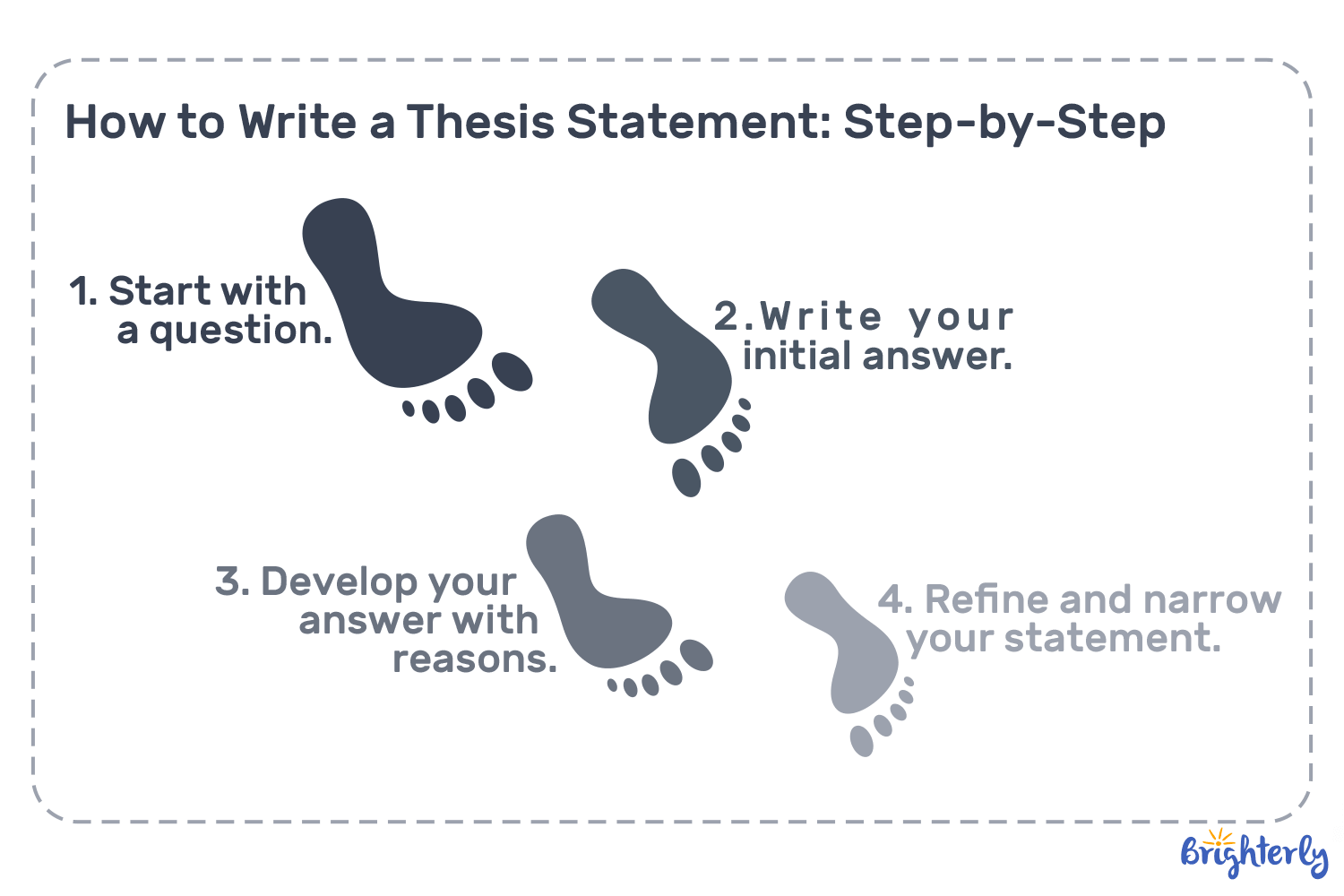
How to Write a Good Thesis Statement Step-by-Step
- Start with a question
- Write your initial answer
- Develop your answer with reasons
- Refine and narrow your statement
Note: Writing a thesis statement can be tricky, but following a thesis statement template makes it much, much easier. Below is a simple way kids can approach their first thesis statement (whatever the type).
Step 1: Start with a question
You can start your thesis statement with an introduction question. It’s not strictly required, but it can help kids form a strong statement.
The question must come from an assignment or the topic your kid wants to write about. Starting with a question helps focus on the topic and predict what the essay will be about
Example: Why are dogs good pets?
Step 2: Write your initial answer
Next, let your child write their initial answer. This is one of the parts of a thesis statement — it helps students reduce the overwhelm of writing their statement all at once.
Example: Dogs are good pets.
It may seem short and simple, but it helps kids structure their essays without getting too scatterbrained.
Step 3: Develop your answer with reasons
At this step, let your child add a couple of reasons to support this answer. This is where their thesis statement becomes more detailed and on-point.
Example: “Dogs are good pets because they are friendly, loyal, and love to play.”
Including reasons is crucial — without the supporting evidence, there’s no thesis statement.
Step 4: Refine and narrow your statement
At the last step, let your child read their thesis statement aloud and decide if it’s specific and clear. What is extra important is removing extra words, cutting the fluff, and checking if the thesis answers the question or the assignment.
Example: “Dogs make great companions because they are friendly to people, loyal pets, and love to play with children.”
So, how to write a thesis statement for an essay? Follow these 4 steps and don’t make your sentences too wordy — make sure they’re clear and to-the-point.
Not knowing how to start a thesis statement is normal, even for adults. Learners often struggle with organizing their ideas and expressing a clear point. Brighterly helps with exactly that. Tutors help with breaking down ideas into smaller steps and building structured, to-the-point sentences.
Brighterly is a math and reading program for K-12 learners, built on a foundation-first approach. Tutors adapt lessons to each child and help kids build stronger academic foundations and expand their skills to other subjects, as well.

Our online writing classes start at $17.7 per session if you choose a longer plan with 2 lessons/week. This flexible pricing makes it easier for parents to find a plan that fits both their child’s learning needs and their budget, while still getting consistent support and progress.
Brighterly helps struggling learners become confident students. 

Simple and effective writing lessons!
| Topic | Weak Thesis Statement | Strong Thesis Statement |
| Friendship | “It’s important to have friends.” | “It’s important to have friends because you have someone to share your joy with.” |
| Working out | “Working out is good for you.” | “Working out is great for everyone because it strengthens your body, reduces stress, and helps improve overall health.” |
| Mental health | “Taking mind breaks is important.” | “Taking mind breaks is important because it helps improve productivity and focus.” |
| Reading | “Students have to read every day.” | “Students have to read every day because they develop imagination and creativity, and improve vocabulary and comprehension.” |
| Online learning | “Online learning is convenient.” | “Online learning is convenient because you can manage your own time, learn with experts, and improve your skills from home.” |
| Pets | “Having pets is good for you.” | “Having pets is good for you because they reduce stress, provide companionship, and they’re fun to play with!” |
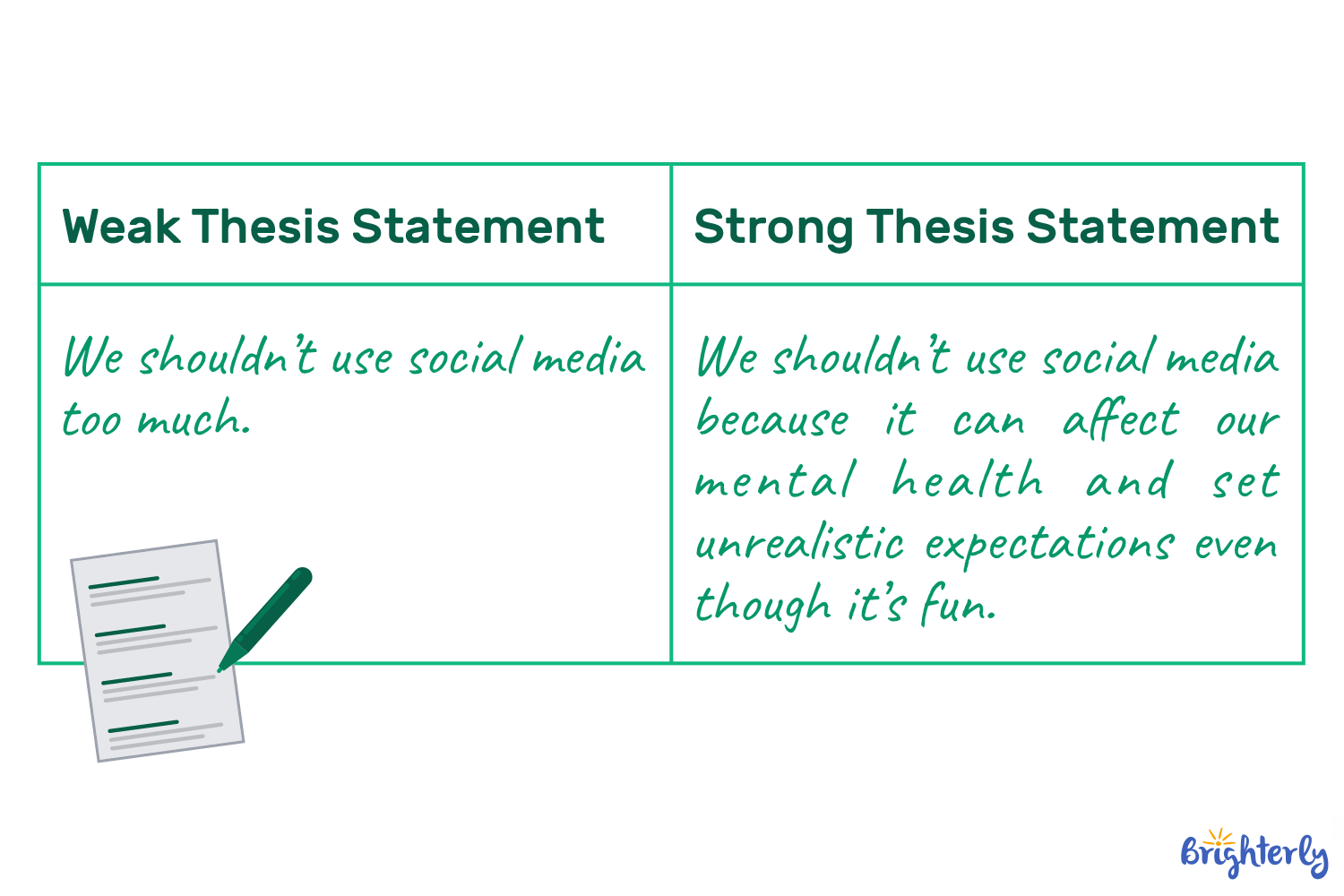
Strong vs Weak Thesis Statements: How to Tell the Difference
The features of a strong thesis statement are:
- Clear main idea: Make sure the reader knows what the essay is about
- No watery sentences: Avoid wordy essays.
- Take a stance: Show your opinion and defend it.
- Be specific: Say why something is good/bad/effective, etc.
- Focused on the main idea: Avoid going off subject.
Wayne Lowry, Interim Chief Executive Officer at Sunny Glen Children’s Home, says:
“The big mistake students make is being too vague.”


So, what makes a good thesis statement? Clear main idea, focused sentences, strong position, and specificity are what educators usually look for in a thesis statement.
A weak thesis leaves ideas scattered and unclear.
Common Thesis Statement Mistakes to Avoid
- Stating the facts instead of opinion
Wayne Lowry explains what exactly that means:
“The most common thesis mistake I see students make is writing a statement that is just a fact or observation rather than an arguable claim.”
- Trying to say too much
When kids wonder what is a thesis statement in an essay, they usually think that saying a lot is good. Quite the opposite — brevity is the soul of wit!
- Being unclear or confusing
Making a clear statement with supporting evidence is important — and you don’t have to do anything else. Staying on point and presenting your opinion is key!
Conclusion
Finally, how to write a good thesis statement? It’s not that hard, but it can be confusing. In this article, we discussed the 4-step plan and the most common mistakes.
In short: stay on point, express your opinion and feature supporting evidence, and your thesis statement will be clear, strong, and ready to guide the rest of the essay.
And if you need some support, our tutors are here. Book free lesson and see that thesis statements and overall literacy can be fun and easy!
FAQ
How Do You Start A Thesis Statement For An Essay?
Start with a question about your topic, then answer it in full. Add supporting evidence and cut the fluff when refining your essay.
What Are The 5 Rules Of A Thesis Statement?
The top 5 rules of a thesis statement are:
- Clear main idea – Make sure the reader knows what the essay is about
- No watery sentences – Avoid wordy essays.
- Take a stance – Show your opinion and defend it.
- Be specific – Say why something is good/bad/effective, etc.
- Focused on the main idea – Avoid going off subject.
What Are The 5 Questions To Strengthen A Thesis Statement?
Here are the 5 questions that strengthen a thesis statement:
- Does it answer the topic of the essay?
- Is the main idea clear?
- Are there reasons to support it?
- Can someone disagree with my opinion?
- Is it focused on the main idea?
How Do You Know If Your Thesis Statement Is Strong?
If your thesis statement is focused on the topic, has supporting evidence, and its main idea is clear, you have a strong thesis statement.



The 24 best multiplication apps for kids range from free gamified tools like Khan Academy Kids to more structured options like IXL and Mathletics. This guide covers the main features, pros and cons, and prices of the 24 best multiplication apps to help you choose the one that is most fitting for your kid. Key […]

Apr 11, 2026
Math & reading from 1st to 9th grade
Looking for homework support for your child?

Choose kid's grade

Math & Reading for Grades 1–9
Build real confidence for your child with a Brighterly math or reading tutor.