How to Write an Introduction Paragraph? Guide
reviewed by Laila A. Lico
Updated on November 20, 2025

One of the trickiest challenges in writing a text is coming up with the beginning. As a teacher, I see how much time students spend trying to write it. And it’s no wonder the introduction paragraph format gives the tone and flow of the text. To help you write quickly and effectively, I’ll share some tips on how to make your intros interesting and meaningful.
Key points
- Starting an introduction paragraph means beginning with something short that hooks the reader and gives them an idea of what your text is about. You can use a question, a surprising fact, a short story, or even a bold statement.
- A strong introduction usually includes a hook, some context, a clear thesis statement, and a sentence that guides the reader into the rest of your text.
- If you’re stuck, just start writing whatever comes to mind. It’s always easier to work with a draft than a blank page.
- If you need extra guidance, Brighterly can teach you how to work with your text step by step, improve your writing in structured ways, and show you how to write a good intro paragraph.
What is an introduction paragraph and why does it matter?
An introduction paragraph is the first part of your text that grabs the reader’s attention. It should be short, fun, and include a small “hook” to make people want to keep reading. It’s important because if your intro is boring or off-topic, people might stop reading. On the other hand, a good introductory paragraphs makes it much easier to write the rest of the text.
Note: Writing the perfect intro on the first try probably won’t happen but don’t worry! Each time you try, you’ll get a little closer and better.
How Brighterly helps kids master writing structure
Brighterly is an online platform that offers one-on-one lessons for 1st-9th graders. The Brighterly reading program focuses on reading skills that directly impact writing, too. When a child can understand a text, see how paragraphs work, and notice the main idea and structure, it becomes much easier to use the same logic in their writing.
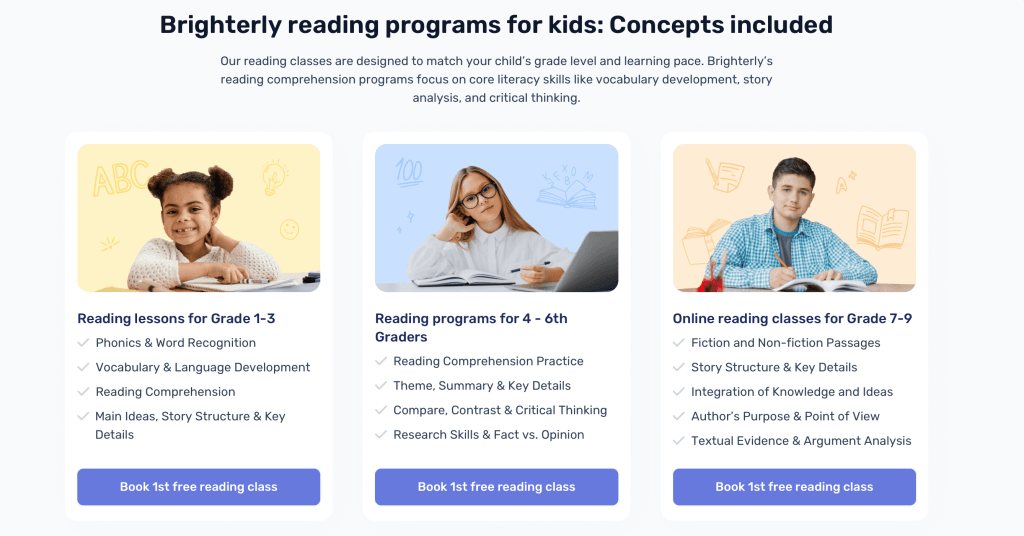
At Brighterly, kids work with professional reading tutors who teach them to analyze and create clear, logical texts and explain how to structure an introduction paragraph better. Besides the lessons, you can download free reading worksheets on the site and take reading tests to check your strengths and weaknesses.


How to start an introduction paragraph?
- Start with a question
- Use an interesting statistic or fact when you write an introduction paragraph
- Share a short story or example
- Start with a quote
- Present a problem or a painful truth
- Use contrast
Start with a question
Starting an introduction paragraph means launching with something short that would grab the reader’s attention. The main goal of an intro, as I said, is to hook, make people want to keep reading, and show that your text fits. Ask something that makes the reader pause and think. For example: “Why do some startups grow so fast while others disappear within a few years?” Such a question will instantly spark curiosity and make people want to find the answer in your text.
Use an interesting statistic or fact when you write an introduction paragraph
Numbers and facts add credibility and keep attention right away. For example: “In the last five years, the number of AI users has grown by over 300 percent, and transformed not only technology but the very way people work.”
Share a short story or example
People love stories, and even a small one can make your intro more touching. For example: “Imagine a startup that began in a tiny garage and is now valued at over a billion dollars.”
Start with a quote
If you’re not sure how to write an introduction paragraph, try to start with a relevant quote. It is an easy way to hook your reader. For example: “As Steve Jobs once said, innovation is what separates a leader from a follower.”
Present a problem or a painful truth
These types of hooks work well as they hit an emotion. For example: “Most companies still fail to use their data effectively, losing millions of dollars every year because of it.”
Use contrast
Introductions with a contrast create an instant interest. For example: “Modern smartphones can outperform computers from ten years ago, yet we still struggle with the simplest daily tasks.”
Note: If you’re stuck, you can start writing anything that comes to mind. Please, jot down your ideas and try two or three imperfect intros, then choose the better one. To start is the hardest part.
What to include in an introduction paragraph?
A strong introduction paragraph usually includes a hook, some context, a clear thesis statement, and one sentence that guides the reader to the rest of your text.

What are the 5 parts of an introduction paragraph?
- Think about your reader. Before you write anything, ask yourself a few simple questions: “What do I want to say in this text?” and “What should the reader take away after reading it?” They’ll be your little roadmap when you write. If you’re working on a full article, imagine who your readers are and what their interests are. Then select the most appropriate tone to follow – serious, fun, or casual.
- Choose your hook. The hook is your very first sentence, which is a short, attention-grabbing line that pulls the reader in.
- Write introduction paragraph with context. Just after the hook, briefly introduce the topic. Namely, give your reader a bit of background so they understand what you’re going to talk about and why it matters.
- Add your thesis statement. The thesis is the main idea you want to communicate and your introduction should clearly explain what the text will cover. Everything that comes after needs to support this.
- Finish with a clear topic sentence. End your introduction with one sentence that shows what the reader will learn next. Try to think about it as a little promise that guides them to the rest of your text.
Note: Know your tone and your audience. Set that tone right from the first sentence, and writing the rest of the paragraphs would feel much easier.
How to write an introduction paragraph for an essay?
Start with a simple hook that grabs attention and add a context to help the reader understand the topic. Then, finish with a thesis statement that precisely explains what is the focus of this essay. The introduction paragraph in an essay must show what your topic is about and guide the reader toward your main argument.
Below are some handy phrases to use and combine when writing an intro paragraph of an argumentative essay.
Phrases for opening the topic
- “To understand this topic, it’s important to look at…”
- “One of the key issues surrounding this topic is…”
- “When discussing this subject, several factors need attention.”
Intro paragraph template phrases for giving context
- “In recent years, this topic has become increasingly relevant because…”
- “Historically, this issue has been shaped by…”
- “This question is especially important today due to…”
Phrases for leading into the thesis
- “This essay will explore…”
- “The purpose of this essay is to show that…”
- “In this essay, I will argue that…”
- “This essay aims to highlight…”
- “The main point of this essay is…”
Phrases for guiding the structure
- “To do this, the essay will first examine…”
- “This argument will be developed by…”
- “The following sections will focus on…”
These phrases are only simple templates, still they help to set the proper tone. They organically shape the structure of your paragraph and make your writing easier to create and smoother to read. Try some different combinations, and most importantly, do keep practicing.
Introduction paragraph examples for students
Next, I present a few simple intro paragraph examples that will show how you can start your writing. These examples are based on common topics that students write about often, and you can adapt them to your own essay.

How to start an introduction paragraph in general writing
Example #1: Article about technology
Imagine that your phone knows about your needs before you ask it. While it may sound strange, but we’re not that far from it. In a couple of years, technology improved so fast that AI is now part of our everyday life. In this article, I’ll discuss how AI is changing the way we work, find information, and make decisions.
Example #2: Article about lifestyle
Each of us has sometimes those hectic mornings when everything feels chaotic and with little time. In contrast, to start your day properly can totally change the mood and productivity of a person. This essay will cover a few simple morning habits that will help you feel full of energy and ready for whatever the day brings.
Example #3: Article about travel
Try to picture yourself walking through colorful streets in a place you’ve never been before. To travel means not only to visit places physically – but about really experiencing them. In this article, I’ll give you tips on how to make your trips unforgettable, from finding hidden spots to connecting with the locals.
Parts of introduction paragraph for an essay
Example #1: Essay about education
Education shapes the world we live in. To understand this subject, several factors need attention, such as access to resources, teaching quality, and student motivation. In this essay, I will argue that improving education requires better funding and innovative teaching. To support this argument I will analyze the case studies from different countries and explore successful educational programs.
Example #2: Essay about the environment
Climate change is one of the biggest problems that we face today. To understand it, we need to look at what people are doing that contributes to global warming. This essay will discuss the main causes and offer some ideas on how we can fix problems. I’ll cover topics from industrial pollution to deforestation and renewables.
An example #3 of an introduction paragraph for an essay about health
Every morning when we wake up, our body sends us a message: pay attention. Good health is not just the absence of illness – it’s the foundation of everything we do. In this essay I will explain why adopting healthy habits matters, what challenges we face today in staying well, and how simple daily choices can lead to a more energetic life.
Example #4: Essay about book and education
Without knowledge, people would be confused and lost with the decisions to make in life. I believe that many people, including myself, are seeking to be interested in education and become more successful in life. In “Against School,” Gatto argues that in our current school education system, boredom is a major component. I agree with him from my own experience.
What makes a good introduction paragraph: Conclusion
Writing a strong introduction paragraph can seem tricky at first, but the key is consistent practice. As a teacher, I can assure you that the more you write, the easier it becomes not just with introductions, but with the entire text.
If you or your child need extra support, consider Brighterly math and reading platform. Its teachers can make every step of working with a text much simpler and will guide you through the process in a structured way. The platform offers:
- A personalized program tailored to your needs
- One-on-one lessons with a teacher
- Progress tracking
- Structured, easy-to-follow lessons
If you’re unsure whether it’s right for you, book free reading lesson first and see for yourself before making a decision.


We should all admit that, even with AI tools and gadgets, writing is still crucial for our development, affecting our communication, confidence, and thinking. Decades ago, I asked myself, “How can I improve my writing skills?”. Today, as an experienced ELA tutor, I can answer it. So, how to get better at writing, especially with […]

Nov 18, 2025
Trying to choose between Leapfrog Academy vs ABC mouse for helping your kid build foundational skills in core subjects? As an experienced math teacher, I compare the key features of the two platforms to help you select the right one for your child. Meanwhile, it’s worth noting that learning apps can deliver significantly better results […]

Nov 21, 2025
Math & reading from 1st to 9th grade
Looking for homework support for your child?

Choose kid's grade

Math & Reading for Grades 1–9
Build real confidence for your child with a Brighterly math or reading tutor.