Udemy vs Khan Academy: Complete Comparison 2026
reviewed by Florence Khitsane
Updated on January 24, 2026
I often hear parents comparing Udemy vs Khan Academy after their kid tries a course that doesn’t quite click. If you’re unsure which one actually fits your learner, keep reading. In this guide, I’ll break down their key differences, strengths, and gaps.
Key points
- Udemy vs Khan Academy serve different roles: Udemy focuses on all kinds of hobbies and career skills, and Khan Academy specializes in free, structured academics.
- Udemy suits teens and adults. Khan Academy supports preschool through early college.
- Udemy uses instructor-created video courses. Khan Academy relies on practice work and lessons tied to school standards.
- The best alternative for kids is Brighterly. It offers 1:1 tutoring with certified teachers, structured learning paths, and trackable progress in math and reading.
- Khan Academy is free, and Udemy is mostly paid and goes on sale a lot.
Exploring alternatives?

Khan Academy vs Udemy: Comparison chart
The main difference between Khan Academy vs Udemy comes down to what they’re built for. Khan Academy is a free, non-profit platform focused on core academic subjects and mastery. Udemy, on the other hand, is a paid, open marketplace for professional, in-demand skills and diverse personal hobbies.
Udemy |
Khan Academy |
|
| Perfect fit for | Individuals seeking diverse personal hobbies or career-related help. | Helping students close learning gaps and get ready for standardized exams. |
| Age range | 13+ with parental supervision and up | Preschool – early college |
| Core focus | An open marketplace for user-generated video content focusing on professional and personal skill development. | A mastery-based platform with video lessons and practice activities across many subjects. |
| Teaching formats | On-demand video content (screencasts, lectures), quizzes, practice tests, and downloadable resources. | Video lessons, written explanations, and a wide range of interactive practice tasks (tests, quizzes, etc.) |
| Free trial info | A 7-day free trial is offered for the Personal Plan subscription. | 100% free to use |
| Progress tracking | Tracks progress by video/lecture completion status, quizzes, and practice tests. | Tracks progress through quizzes, unit tests, and challenges (course and mastery). |
| Highlights | Lifetime access to purchased courses, a massive course library, and impressive discounts. | Global availability, Khanmigo (an AI tutoring tool), and official test preparation (SAT, AP, PSAT). |
Udemy vs Khan Academy for kids price
To make a long story short, Khan Academy is free but limited in support. Udemy offers variety, but costs add up. Brighterly provides structured, measurable learning at a pretty affordable rate.
Khan Academy cost |
Free | Unlimited access, fully nonprofit, aligned with the US curriculum |
Udemy cost |
$10-$200 per course or $12.08/month | Pay-per-course model; parents must vet content for kids |
Brighterly cost |
$17.30 per 1:1 session (with an annual plan and 3 classes/week) | Live tutoring with certified teachers, worksheets, and tests |
Brighterly: The best alternative for your kid’s core academics
If you consider Khan Academy vs Udemy and want something most relevant for your kid, Brighterly is a top-tier alternative. In contrast to big video marketplaces or purely academic sites, Brighterly offers a learner-specific reading and math program with one-on-one support, real school-aligned lessons, and checkable progress.
Responsive tutors
Brighterly tutors are experienced educators who guide students individually. Each tutor’s primary task is to examine your child’s current level and develop a custom plan. Afterward, they ensure lessons move at a pace that actually works. This one-on-one approach goes way beyond any generic video class, agree?
Practice with worksheets
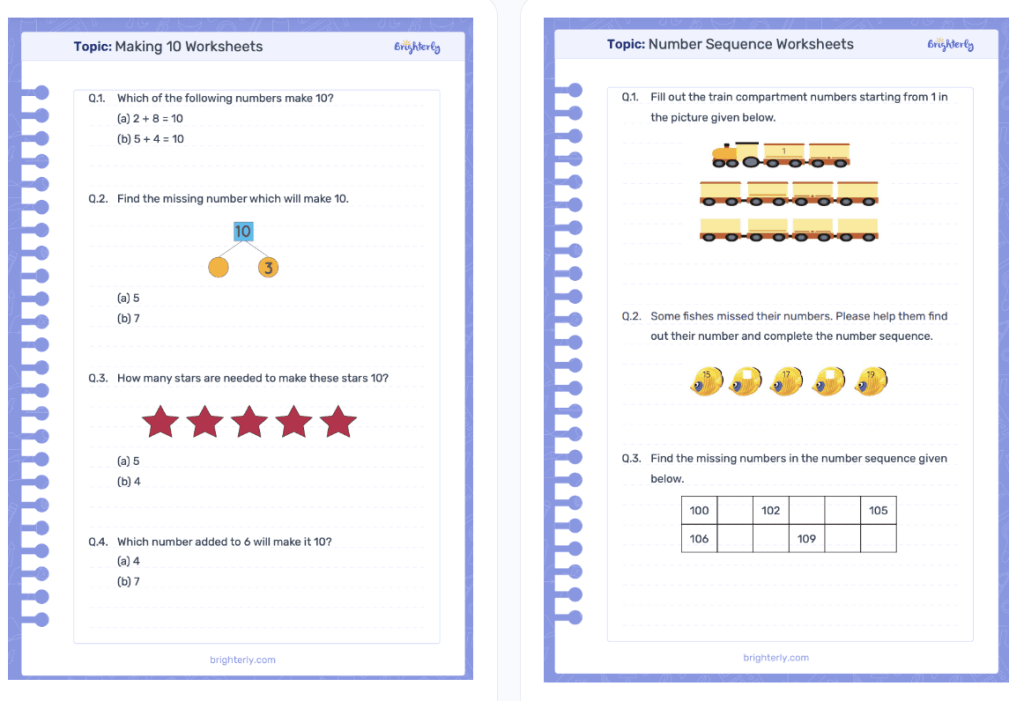
In addition to live tutoring, Brighterly offers a variety of math worksheets and reading worksheets. These fun, standards-aligned worksheets enable kids to practice important skills, be it at home or between sessions. They help them master what they learn in class.
Progress tracking with tests
Furthermore, Brighterly employs math tests and reading tests to keep track of progress. These assessments spot gaps and track growth. Plus, they tweak the program for each kid individually. Regular tests make sure that learning is not just getting done, but does stick.
Price & value
Khan Academy is free. Udemy gets cheaper during sales. However, neither of them gives the live human support every kid needs for solid learning. Brighterly sessions start at $17.30 a class. And that’s way cheaper than the usual $25-$80 per hour for in-person tutors.


How does Udemy work?
Udemy is an open marketplace where instructors and learners connect. Instructors upload video-based courses. Then, students can either buy them one by one (and, thus, receive lifetime access) or via subscription. In such a way, you or your kid can learn at your own pace, on demand, across (literally!) thousands of topics.
What does Udemy stand for?
Open marketplace for all
Udemy is a global marketplace where professors as well as independent experts put up courses themselves. That’s why courses pop up pretty fast. And that’s what keeps Udemy online learning for kids and adults up-to-date with real-world trends quicker than traditional school programs.
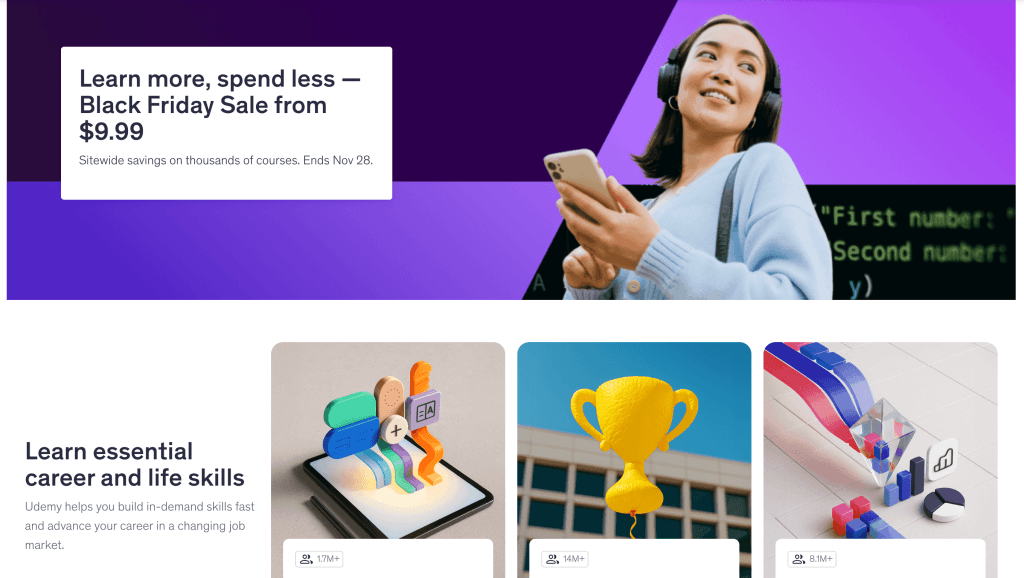
For parents, this provides a transparent system to vet education. Before buying anything, you can use the site’s reviews and 5-star ratings to check out thousands of instructors first. This enables you to pick the teaching style that works best. Be it for your own certificate or your kid’s first coding lessons.
Self-paced, forever access
Another core feature is ‘lifetime access.’ It actually answers the question: Can kids use Udemy? Yes (spoiler: If you manage to find courses for them!) Unlike subscriptions, where you lose access once you stop paying, buying a Udemy course means you own it forever. That refers to any updates or new lectures the instructor further adds as well.
This is great for parents with unpredictable schedules. You can watch lessons on demand. Then, you may take months off for summer or family stuff. And afterward, you may go back to complex parts years later. Thus, neither semester deadlines nor expiring access.
Loads of content, no matter your budget
Udemy hosts one of the world’s largest course libraries in the world. It features over 250,000 courses in 13 categories. This massive volume covers, well, everything. I mean, from advanced IT and marketing courses to extracurricular topics like guitar, drawing, and SAT prep for students.
To first understand what is Udemy and how does it work, you can start with a pay-per-course system. It offers discounts frequently enough. During sales, courses often drop to the $10-$20 range. So, it translates to getting top-notch, expert-led lessons for way less than private tutors, bootcamps, or college classes.
How does Udemy pricing work?
Udemy uses a mixed model. You can buy courses one by one for lifetime access ($9.99-199.99). Or, you may subscribe to the Personal Plan for curated access. Crucially, the platform is known for heavy, frequent sitewide sales. They drop most courses to $10-$20.
How much is Udemy? If you go the subscription route, the Personal Plan for individuals starts at $12.08 a month (when billed yearly). This plan gives you access to a hand-picked set of over 26,000+ top courses, along with certification prep and AI-powered coding exercises. For bigger teams or business, Udemy also provides the Team Plan and Enterprise Plan. Both give you useful content, analytics, and dedicated support in particular.
Note: Because of all the frequent discounts, people see the value of courses based on the sale price. So most users skip paying the full cost.
What is Khan Academy used for?
- Accessible education at zero cost
- Direct support for the US school curriculum
- Active practice for skills mastery
Accessible education at zero cost
Even though it’s a non-profit, for parents, that basically means saving money and knowing your kids are learning in a safe space.
- Why it’s great for families. Khan Academy gets rid of the paywall hassle. Unlike Udemy’s course-by-course purchase model, your kid can jump right in and has access to the whole library forever. I mean, from Pre-K through early college. No subscription, no credit card, no one-time payment needed, either.
- Keeping kids safe and private. So, is Khan Academy good for children? As a non-profit, they indeed are all about teaching, not making money off your info. This translates to a place with no ads and no selling of your info.
Direct support for the US school curriculum
Instead of basic, one-size-fits-all practice, Khan Academy’s content is directly mapped to official US education benchmarks. That, in particular, includes the Common Core and specific state-level standards (e.g., TEKS in Texas).
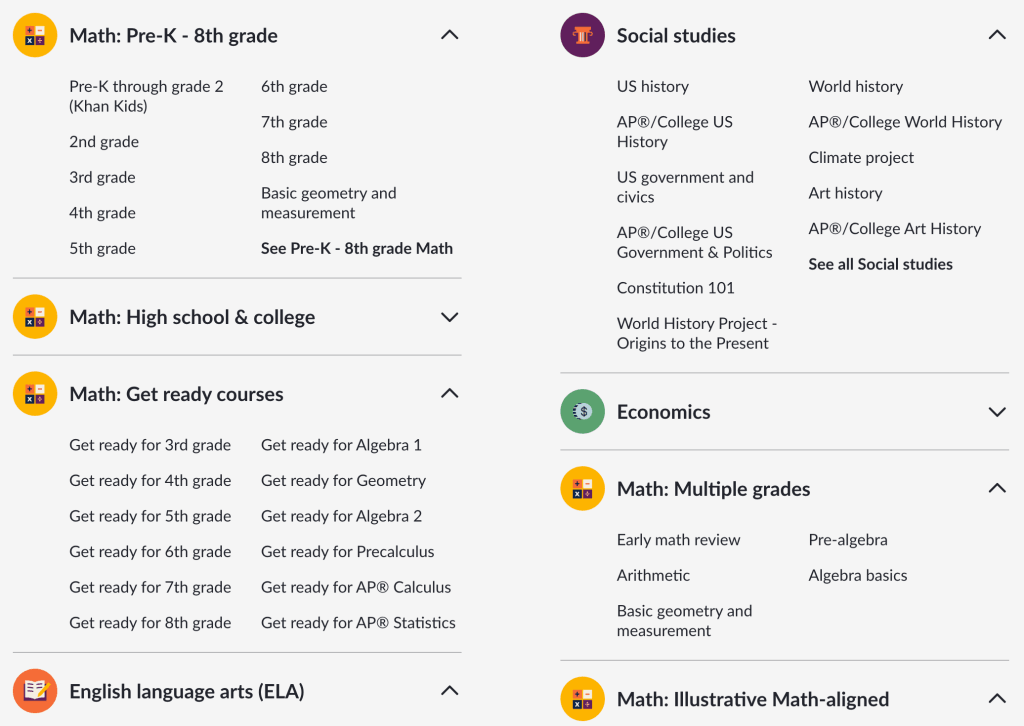
Therefore, as a parent, you can look up a lesson that lines up exactly with your child’s homework or school topic. That way, the practice your kid does at home will actually matter. Moreover, since its materials are structured around these standards, teachers use Khan Academy a lot to spot gaps and assign work.
In other words, parents may use the same, trusted platform as the school for focused extra practice. And, thus, help your kid catch up on stuff they missed or get ahead in what they’re learning now.
Active practice for skills mastery
Instead of seeing this as just ‘practice problems’, the real benefit for parents is how the Mastery System can spot what your kid needs. Is Khan Academy a good source? Let’s see what it offers in that regard:
- Real gap-fixing tech. The platform’s primary use is to make sure kids actually understand the material. The adaptive tech automatically figures out where a student is getting stuck (even if the gap is from a much earlier grade) and provides personalized learning paths for every student.
- Built-in tutorial support. When a student gets an answer wrong, the system doesn’t just say it’s wrong. Instead, it immediately offers a system of progressive hints, a step-by-step worked example, and a direct link to the exact video for that skill. Sounds pretty freeing up for parents who don’t have time or knowledge to teach the subject themselves, doesn’t it?
What subjects does Khan Academy offer?
Khan Academy offers a super wide range of academic subjects covering everything from core math and science to humanities, test prep, and real-world skills, from early childhood (ages 2+) to advanced college-level material.
Early childhood learning (ages 2-8) |
Available in the separate Khan Academy Kids app. Content focuses on play-based learning. It includes social-emotional development, creative play (drawing/storytelling), and integrated non-fiction books from partners like National Geographic. |
Core K-12 |
Uses illustrative mathematics and the Next Generation Science Standards (NGSS) frameworks for math and science. |
University & graduate prep |
Courses that extend into advanced college math (e.g., multivariable calculus and differential equations). It also provides free prep for LSAT (Law School) and MCAT (Medical School) exams. |
Humanities & Arts |
Content is enriched by specialized resources from museum partners like the Met and the Asian Art Museum. |
Modern skills & Finance |
Has up-to-date, in-depth courses on personal finance and money skills. They cover real stuff like budgeting, saving, investing, taxes, buying a car, and banking. |
Applied technology |
Features practical courses on coding and programming tools, like an intro to computer science with Python, plus SQL and HTML/CSS modules. |
As for the subjects BTW and their age spectrum, Khan Academy does stand out. If you look through ABC mouse vs Khan Academy, you’ll learn that things might differ a lot from platform to platform.
Khan Academy price
Khan Academy runs completely on donations. Therefore, all the main educational content is totally free. As an official US non-profit, the platform’s community keeps its full library going with support from its board, big donors, and contributions from regular people.
Comparing Udemy vs Khan Academy, the latter stays transparent with a public annual report. In it, they show exactly how the money is spent on tech, content, and educational programs. The organization also makes sure the site stays ad-free and never sells your info.
Note: New stuff that costs a lot to run, like the AI tutor Khanmigo, might come with a separate, cheap subscription.
Khan Academy vs Udemy Reddit & TrustPilot reviews
Khan Academy for kids reviews
Pros to know
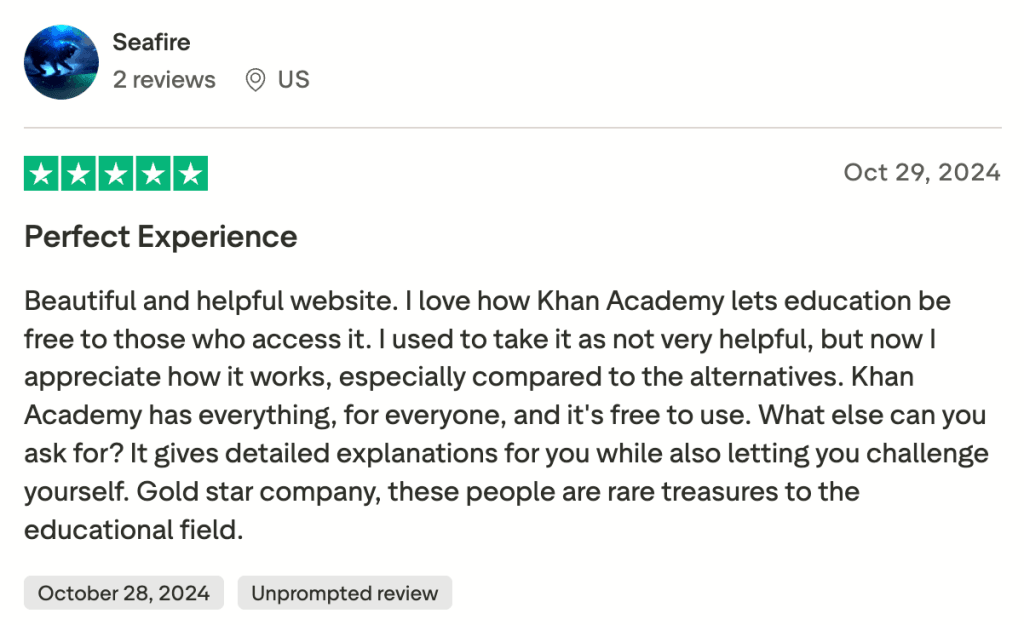
First and foremost, hardly anyone will be surprised to find out that what people love about Khan Academy the most is that it’s free. Lots of reviewers on Trustpilot, in particular, rave about Khan Academy’s totally free, high-quality resources:
Even more attention is paid to the official test preparation. Users point out that Khan’s test prep is made with the College Board. Lots of students say the full-length practice tests and adaptive lessons actually helped boost their scores. And some of the learners even say they’ve found out about Khan Academy in the first place, precisely in their educational establishments:
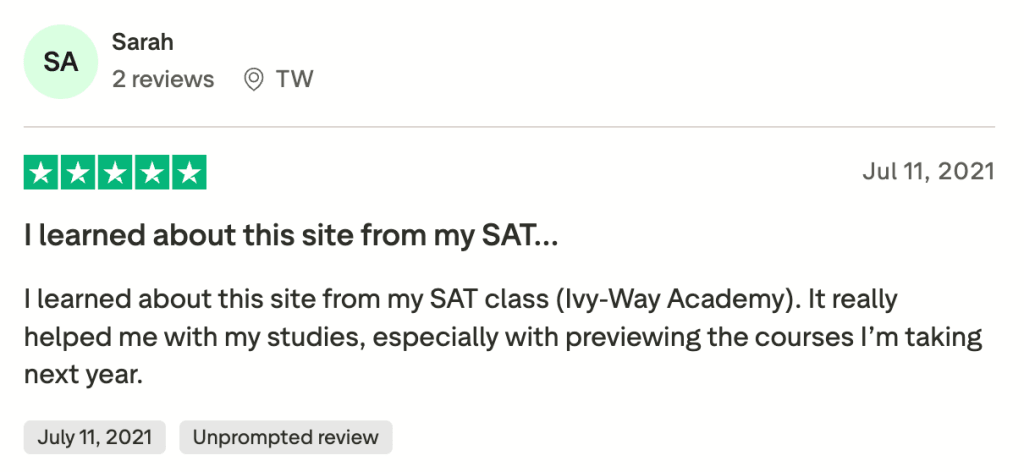
To learn more about what people think of this platform, read the Khan Academy review that features far more details and focuses.
Khan Academy reviews: Cons to consider
Udemy vs Khan Academy Reddit list of complaints seems a bit longer. In brief, far too many users claim that Khan Academy is
- not deep,
- not enough,
- non-interactive.
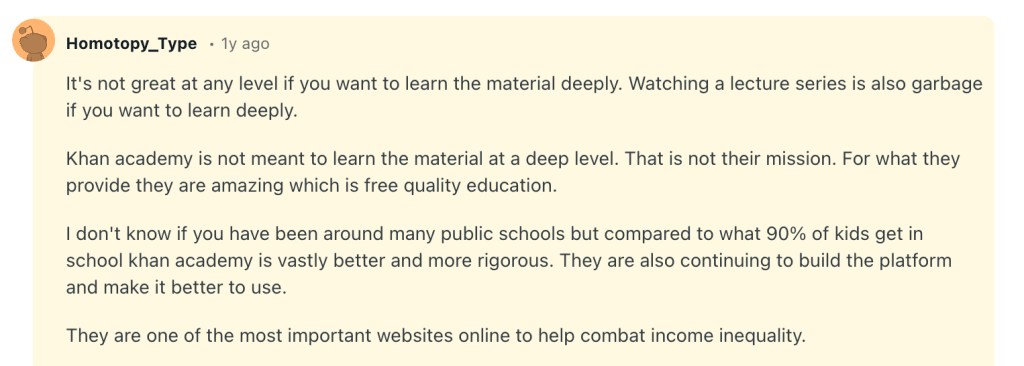
A lot of people, on Reddit in particular, say Khan Academy isn’t made for deep learning. It’s rather about giving broad, easy-to-get explanations than mastering topics fully. Just watching the videos usually isn’t enough to really understand the material.
Users agree it’s great for catching up and filling gaps. Or one may prefer it for self-paced practice. However, it can’t replace tougher or advanced lessons. Khan’s goal is free, solid education that’s easy to access. So, we’re definitely not talking here about deep, college-level stuff.
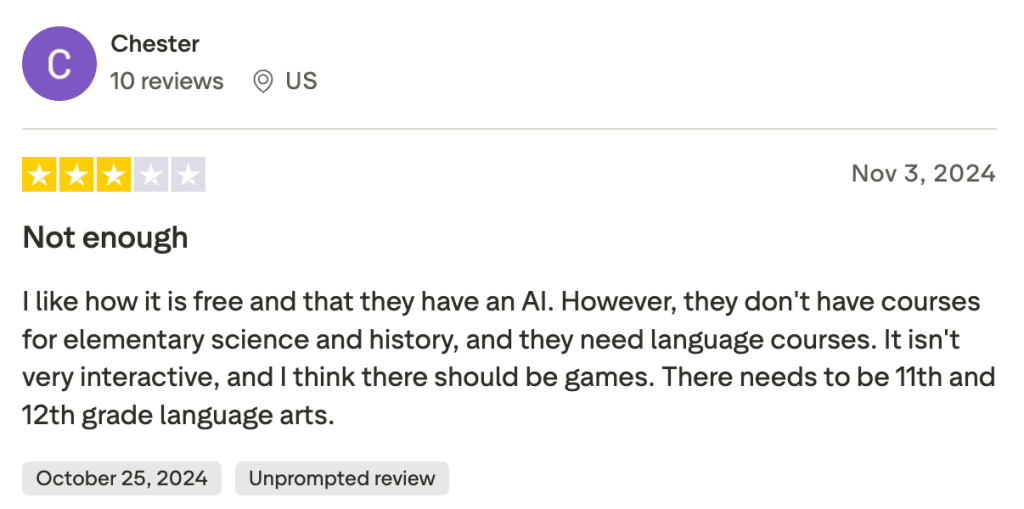
On TrustPilot, as well, people feel Khan Academy doesn’t cover all subjects. It especially relates to elementary science, history, and high school language arts (11th-12th grade).
It doesn’t have enough language courses, either. So it’s tough for students who want foreign language practice. It’s not very interactive. People really want more fun stuff, like games or hands-on activities.
Overall, even though it’s free and has useful AI tools, lots of learners see it as incomplete for a full, well-rounded education.
Udemy online learning for kids reviews
Strengths to note
It’s not that this feature is unique for Udemy, but people still mention they like being able to learn at their own pace from home. The platform is seen as super useful for actually learning stuff.
In response to multiple complaints, though, satisfied Udemy users recommend first checking out courses and reading the fine print. They also say the support responds quickly and fixes problems when needed.
Udemy CAN be cheap and convenient, and a lot of people on TrustPilot recommend it.
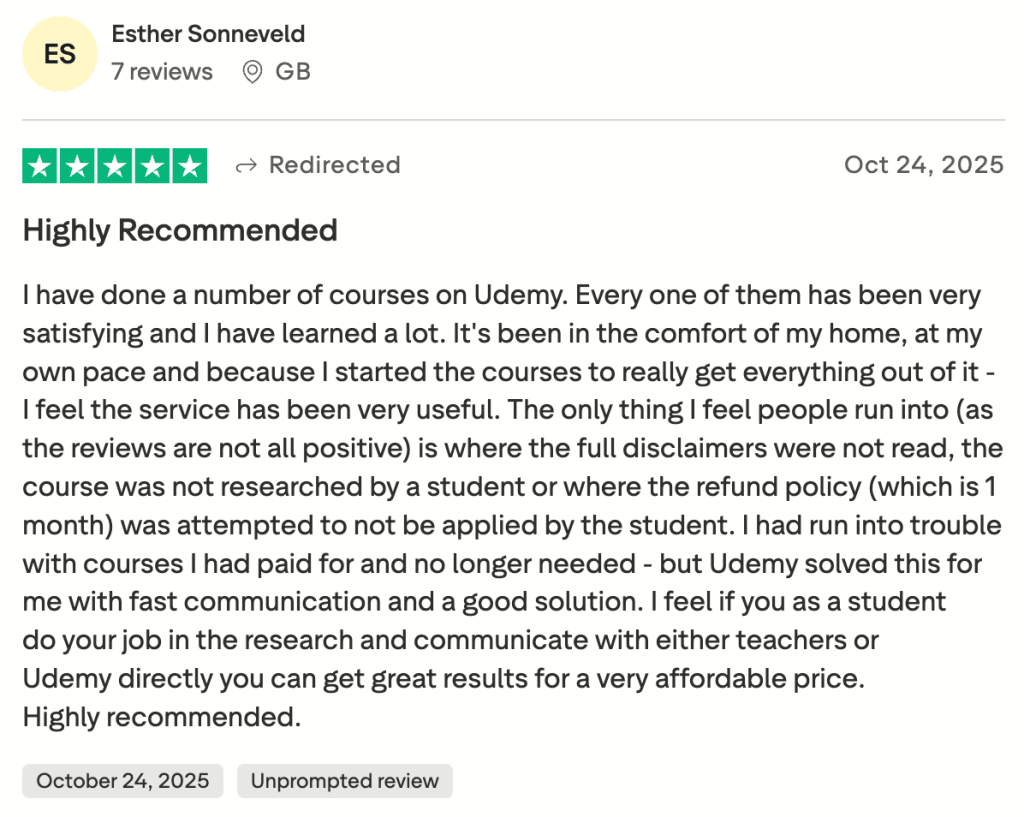
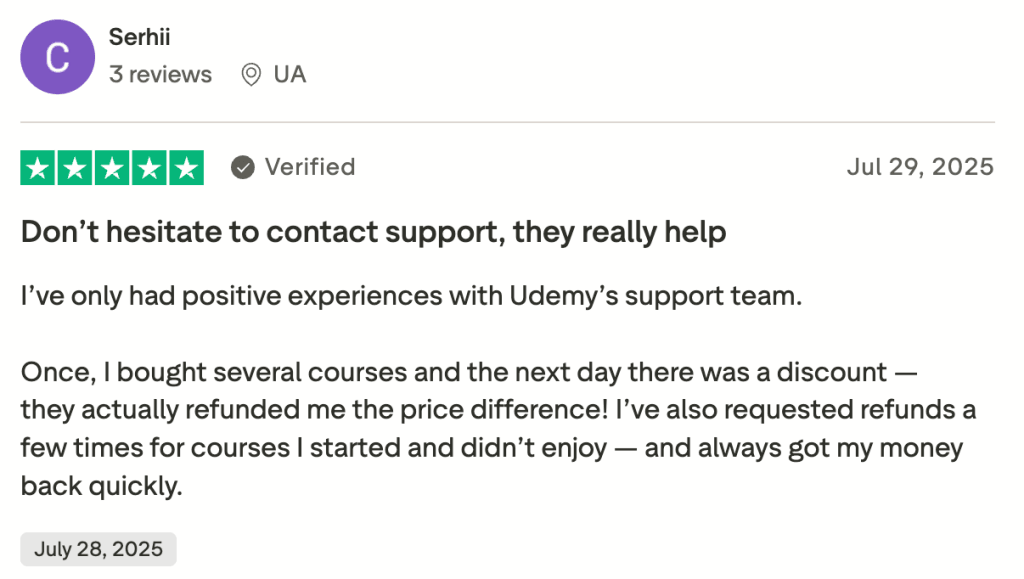
Other users find Udemy’s support team really helpful and quick to respond. Refunds and price changes get handled fast and fairly. Good experiences described on TrustPilot do make people trust the platform’s customer service.
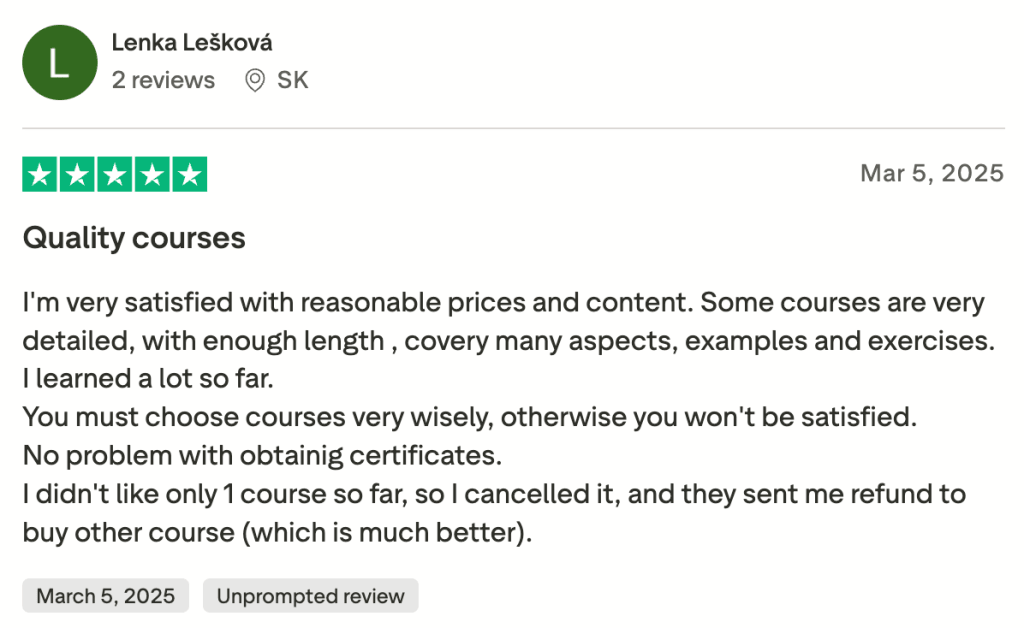
Many folks are also happy with how clear and detailed many Udemy courses are. They usually have examples, exercises, and cover topics in detail. Picking courses carefully helps get the most value. Plus, certificates are easy to get. Some Trustpilot reviews even say you can get a refund if a course doesn’t work out.
Is Udemy good? Weak spots
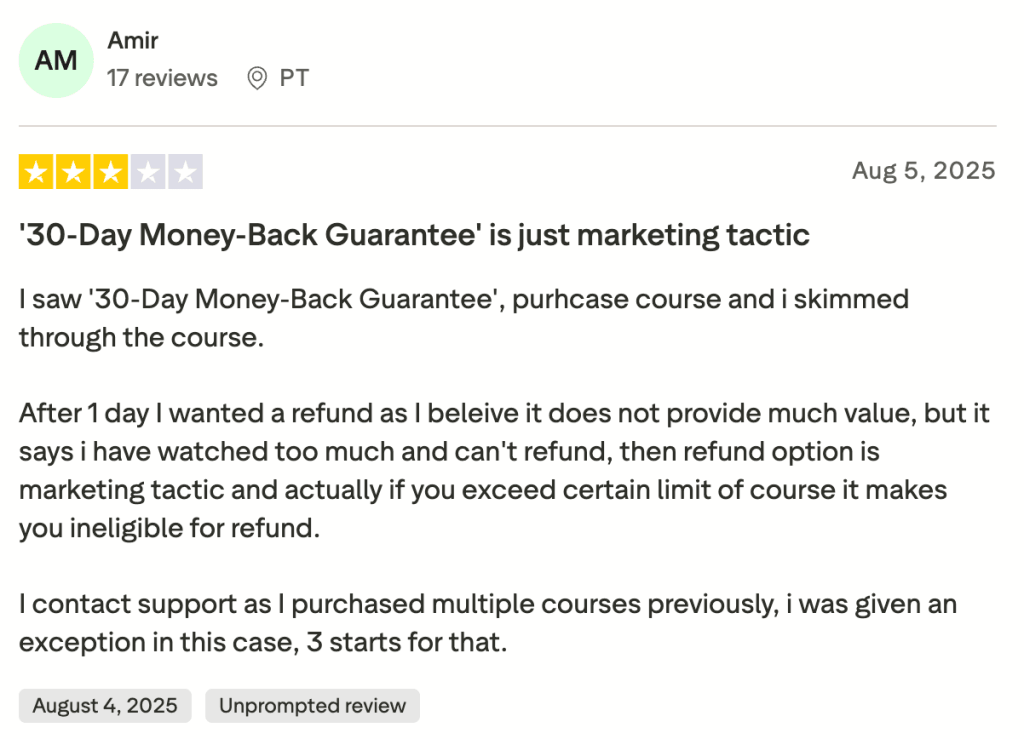
Some users claim the 30-day money-back guarantee can be somewhat misleading. Even after buying a course, watching parts of it can make you ineligible for a refund. Support sometimes does make exceptions. However, this still frustrates people who expect full flexibility. On TrustPilot, users see the guarantee more as a marketing move.
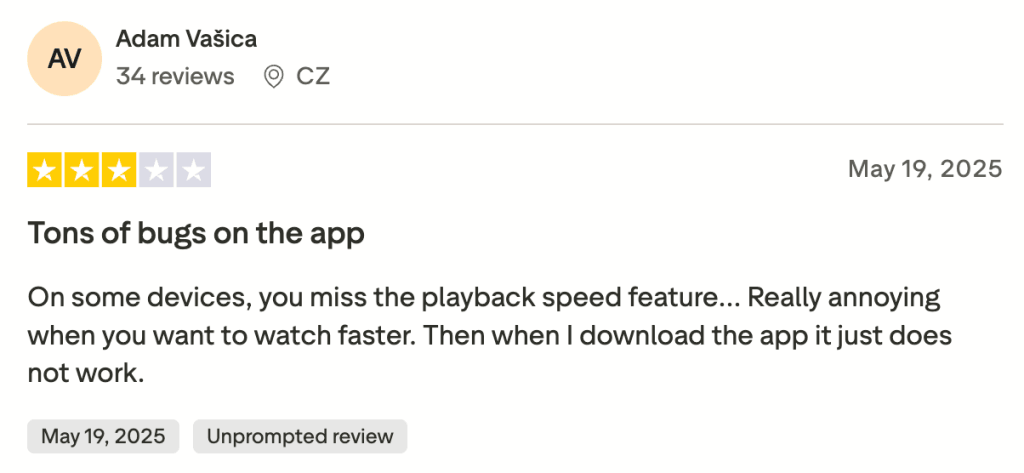
People also report frequent technical issues with the Udemy app. Missing stuff, like playback speed control on some devices, makes learning annoying.
Downloaded courses don’t always work right. These glitches mentioned on Trustpilot mess up learning. They also make the app less reliable for learning on the go.
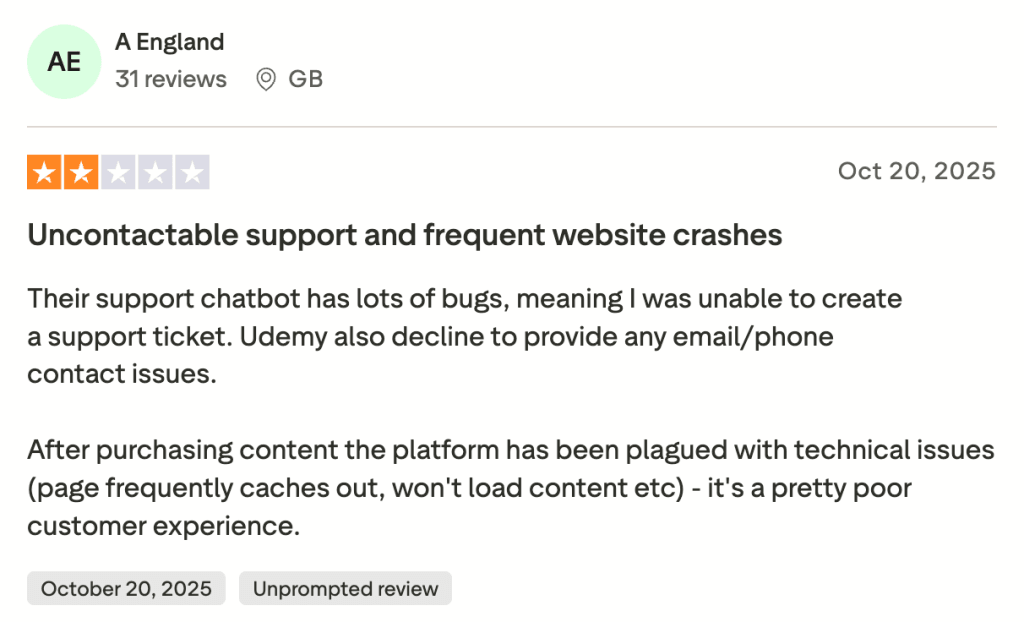
Other people have trouble reaching Udemy support. I mean buggy chatbots, no email or phone options, etc. Add in frequent website crashes and loading problems, and it makes for a frustrating experience, doesn’t it?
Technical problems described on TrustPilot and slow support are big downsides.
However, my own – as a tutor – main complaint about Udemy is the lack of courses for kids! I mean, yeah, they do offer one reading course for 2-year-olds and one coding course for ages 6-16. Featuring over 250,000 other options, 2 courses for kids don’t sound enough to opt for the platform and learn. What do you think?
Therefore, no surprise Udemy online learning for kids reviews leave room for improvement.
What is the weakness of Khan Academy and Udemy?
For kids’ learning, Khan Academy’s main weakness is its limited subjects and no live teacher interaction. Udemy – well – in fact, isn’t made for kids in the first place. Its course quality varies a lot; many classes are paid, and there’s no real curriculum or anything official for parents to trust.
Besides, Khan Academy doesn’t provide any certificates or deeper advanced tracks many older kids might need. Its content is strong but not as flexible or guided as some Khan Academy alternatives, for instance.
Udemy’s drawbacks, on the other hand, are even more noticeable for families. It’s even more so if you need to Udemy help your child to read and write: it’s not really a kids’ learning platform.
Moreover, its course quality is all over the map because anyone can publish content. That’s why parents have to dig through tons of options to find something kid-appropriate. Most courses also cost money, and there’s no real structured curriculum or official recognition.
Which platform is better than Udemy and Khan Academy for your child?
- If you’re looking for free, solid lessons, then try Khan Academy.
- If you value flexible, paid courses on a wide variety of topics, go with Udemy.
- But if you want 1:1 support, certified tutors, and real progress in reading and math, then pick Brighterly math and reading platform – professional services made for kids.
Not sure which platform’s gonna be the best fit for your kid? The easiest way to find out is to see it in action. So, go ahead and book free lesson at Brighterly!
Other platforms comparison
In the meantime, other comparisons here may give you a full picture. I mean, from what each program excels at to where it may fall behind:
- ABCmouse vs Starfall: Pros, Cons, and Key Differences
- Khan Academy vs Kumon – Comparison
- IXL vs ABCmouse vs Brighterly: Which Online Learning Platform Is the Best?


Wyzant is a good, legitimate online tutoring platform, but sometimes parents look for Wyzant alternatives because of differences across tutor qualifications, technical problems, and expensive fees. As a math teacher, I’ve compiled a list of the top 10 Wyzant competitors for different academic subjects and personal requirements. They are so diverse that I’m sure you’ll […]

Dec 04, 2025
If you’re looking for an honest and easy-to-understand review of Adventure Academy in 2026, you’re in the right place. As a teacher who knows these learning apps pretty well, I collected real Adventure Academy reviews from parents. This will help you see what’s good, what’s not, and how the platform really works. Here you’ll find […]

Dec 05, 2025
Math & reading from 1st to 9th grade
Exploring alternatives?
Take a short quiz!
Choose kid's grade