16 Fun Word Games for Kids by Age, Skill Level, and Setup (2026)
reviewed by Marvi M. Andres
Updated on April 26, 2026

Your child doesn’t have to sit with a workbook to build reading skills if you have word games for kids on hand. From no-prep verbal challenges for preschoolers to complex puzzles for older elementary students, check out this comprehensive, age-sorted list of 16 word games, complete with a detailed skill breakdown for each.
Key points
- No-prep verbal games build phonemic awareness, deductive reasoning, help kids recognize sounds in spoken words, and apply logic to categorize information without using physical materials.
- Paper-and-pencil games improve spelling accuracy, pattern recognition, fine motor skills, and teach kids to visualize word structures.
- Group & classroom games enhance communication skills, teamwork, observation, and teach kids how to articulate ideas.
- Sight word games particularly target fast visual recognition and reading fluency.
- Vocabulary games focus on descriptive language, alphabetical order, and alliteration, and encourage kids to figure out synonyms, enabling them to express complex ideas.
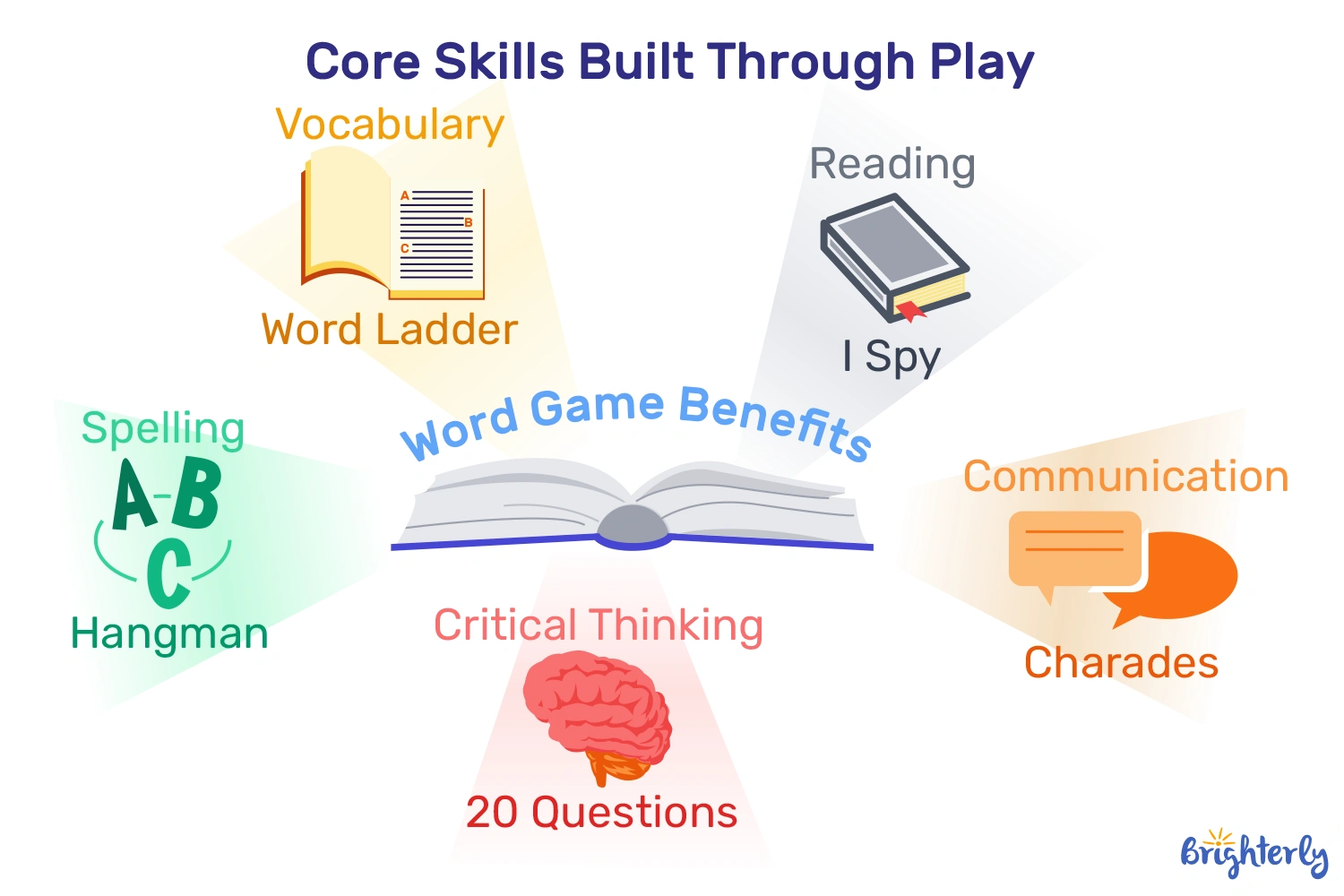
What Skills do Word Games Build in Kids?
- Vocabulary growth. Word games with kids expose them to new words in context.
- Spelling and reading. Word games improve spelling accuracy and reading fluency.
- Communication skills. Children learn to articulate ideas, listen actively, and build confidence when speaking.
- Cognitive skills. Word games can involve strategy, quick thinking, or pattern recognition.
- Stronger bonds. Playing with family members teaches emotional intelligence and creates stronger bonds with peers.
Affordable, effective, and kid-friendly tutoring!
Brighterly — where kids thrive, learn faster, and parents see real results. 

Explore Brighterly Learning Experience
Learn exactly how Brighterly helps students thrive through expert sessions, online tools, and proven feedback from thousands of satisfied parents
How to Choose the Right Word Game for Your Child
To select the ideal word game, match the activity to your child’s current stage and setting:
- By age. For preschoolers, choose oral games to build phonemic awareness. Kindergartners thrive with interactive guesses. Word games for elementary students can already contain more complex challenges (such as Word Ladders or Crosswords).
- By setup. Opt for no-prep verbal games for travel and use paper or digital puzzles for focused solo practice.
- By group size. Check games like Charades or Pictionary to make learning more social and high-energy.
By Age Group
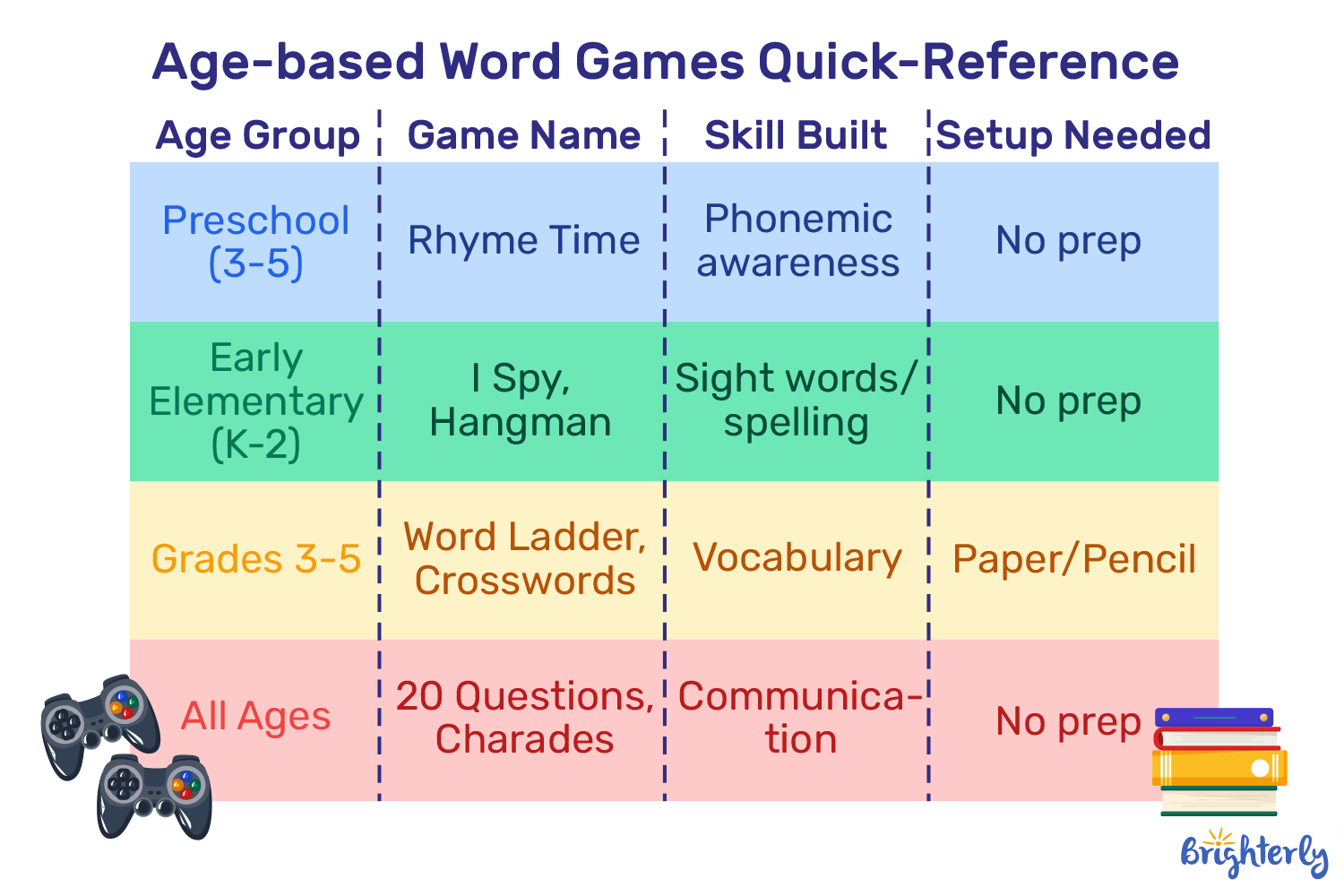
| Preschool | Oral rhyming games and simple ‘see-and-say’ identification |
| Grades K-2 | Guessing educational word games, letter-by-letter puzzles, and word associations |
| Grades 3-5 | Themed word searches, crosswords, and competitive group acting |
By Setup (No-Prep vs. Paper & Pencil)
- For travel and wait times, no-prep verbal games are the best fit because they require no materials and keep children engaged.
- When you have a dedicated workspace, paper-and-pencil games provide a tactile way to practice spelling and fine motor skills.
- For a more structured approach, you can use Brighterly’s free reading worksheets – they offer professionally curated word puzzles and printable games, and deliver a mix of fun (of a traditional setup) and targeted educational goals.
Word Games by Category: Quick Overview
No-prep games are good for car rides and waiting rooms. Paper-and-pencil games work well for focused after-school practice or quiet time. Group and classroom games make learning a high-energy team experience that builds confidence.
| No-prep verbal games |
Rhyme Time. Players take turns finding words that rhyme with a starter word. I Spy. One of the word guessing games for kids that uses letters or sight words to identify objects. 20 Questions. One player thinks of a word while others narrow it down with yes-or-no questions. The Minister’s Cat. An alphabetical adjective game to describe the ‘Minister’s Cat.’ Human Thesaurus. Kids compete to find the most synonyms for a common, ‘overused’ word. Hink Pink. Rhyming riddles for kids to find a two-word pair to match a clue. |
| Paper & pencil games |
Hangman. A spelling challenge for players to guess a hidden word letter by letter. Word Ladder. Players transform one word into another by changing a single letter at each step. Crosswords. Clue-based puzzles that strengthen vocabulary and problem solving skills. Unscramble. Jumbled letters must be rearranged to form a correct word. Word Bingo. Kids mark off specific words on a grid as they are read aloud or found. Puzzles/Word Search. Grid-based challenges for kids to scan for hidden words or letter patterns. |
| Group & classroom games |
Pictionary. A fast-paced game in which players draw a word while teammates guess what it is. Charades (word edition). Acting out a word or phrase silently to help the group identify it. Alphabet Word Game. A race to name items starting with a specific letter. Word Within a Word. A challenge to see how many small words can be found inside a longer one. |
Word Games for Preschoolers (Ages 3-5)
Rhyme Time
Among the word games for preschoolers, Rhyme Time challenges kids to think of as many rhyming words as possible for a given word. For instance, if you start with a “cat”, your kid might say “hat”, “bat”, or “mat”.
This game helps form phonemic awareness – at ages 3-5, phonemic awareness means the ability to hear, identify, and play with sounds that make up spoken words. For example, if the starter word is “sun,” your child might shout “run,” “fun,” or “bun.” This game boosts vocabulary and sparks creativity. It also works well as a family game — no rules, no guesswork.
Note: To extend literacy practice at home, consistency is more effective than intensity. Brighterly’s online reading program for kids demonstrates how exactly interactive play can lead to academic progress when structured learning is incorporated into a gamified experience.
I Spy
“I spy” is a fun and interactive game that helps children practice sight words and vocabulary. This game sharpens visual discrimination and letter-sound association as kids connect spoken clues to physical objects. One player can say: “I spy with my eye something that starts with…” and say the letter or a sight word. The other searches for the object that matches the description. To play, simply pick a visible item – like a ‘red’ chair – and give a clue: e.g., ‘I spy something that starts with the sound ‘R’.’
The Minister’s Cat
The Minister’s Cat is among classic vocabulary word games for children. Aimed at mastering alphabetical order and alliteration, it enables kids to consider descriptive adjectives, working through the alphabet from A to Z.
Players take turns describing the cat using the next letter of the alphabet. For example:
- ‘The Minister’s cat is an Adorable cat.’
- ‘The Minister’s cat is a Brave cat.’
- ‘The Minister’s cat is a Clever cat.’
The game continues until you reach the letter Z – quite a challenge for kids to find creative words for difficult letters like Q or X!
Looking for a reading tutor with a gamified approach?
Brighterly will connect you to the best tutors online to teach your kid to read!
Word Games for Early Elementary (Grades K-2)
20 Questions
20 Questions is a great game for kids aged 5-6! In it, one player thinks of a word, and the other tries to guess this word by asking yes-or-no questions. This game is a fantastic introduction to deductive reasoning, because kids must use logic to narrow down broad categories into specific answers.
Players essentially need to narrow down possibilities by asking, “Is it an animal?”, “Kitchen utensils?”, “Something you can eat?” Continue up to 20 questions until you find the word you’re looking for. When kids learn to ask ‘big picture’ questions first, they develop critical thinking skills that help them categorize the world around them.
Hangman
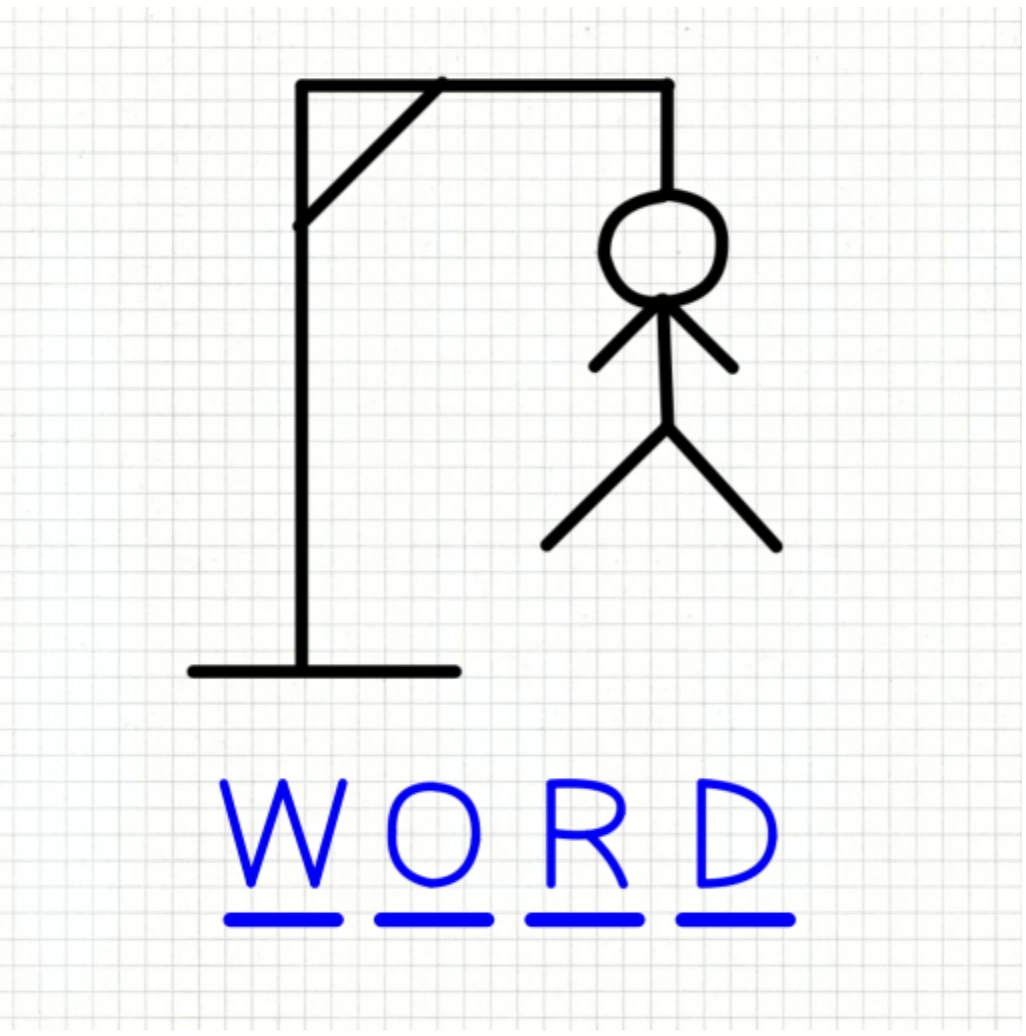
Hangman is one of the classic, commonly used kids word games for 6-7 year-olds, in which one player thinks of the word and the others try to guess it letter by letter. This game encourages spelling practice, vocabulary, and strategic thinking. Hangman also provides direct spelling practice by forcing kids to visualize word structures and recognize common letter patterns or vowel placements.
This is a great game for the whole family to play! Get a pen and paper, or download one of the apps if you want to play solo – each wrong guess draws part of the “hangman” figure. If you want to keep the game more positive for younger learners, try drawing a ‘snowman’ or a ‘flower’ instead – each correct guess adds a part, and the goal is to finish the drawing before you run out of guesses!
Word Bingo
Word bingo is an easy game where each player gets a bingo card with words. When the word is read aloud, kids mark the matching words on their cards and complete a row or a column, which can also be played online.
Word Bingo is an exciting way of mastering sight words – those frequently used words that kids should recognize instantly without needing to sound them out – because it intensifies fast visual recognition via repetitive play.
Alphabet Word Game
The alphabet word game is easy — 7-8-year-old players have to pick letters and try to name as many words starting with that letter as possible. This game enhances phonetic confidence and mental processing speed since kids race to retrieve words from their internal ‘dictionary.’ Categories are also fun, think animals, foods, and places! To add a layer of challenge, though, try a ‘timed sprint’ – players have 30 seconds to name five objects in a particular category starting with the letter ‘B’ (like bear, banana, ball, boat, and blue).
Note: When self-guided play isn’t enough, consider Brighterly. 1:1 reading tutor provides personalized attention, real-time correction, and identifies if your kid is struggling with a particular skill, further individually selecting the exact word games and exercises needed to overcome that trouble.
Word Games for Grades 3-5
Word Within a Word
This is one of the simple word games to play with kids, where your child has to find as many words as they can within a longer word you’ve written down for them on paper. For example, the word “Monday” — how many words can your child make out of Monday? New, money, done are the 3 possible words, but the game lasts as long as imagination does. To run Word Within a Word effectively, pick a long ‘base word’ (like ‘information’) and set a timer for 3 minutes to see who can find the most hidden combinations.
Word Ladder
Another exciting word game for 8-11-year-olds — players start with a simple word and change one letter at a time to create a new word. For example, “seem”-”seek”-”seen”. To play, follow these steps:
- Start with a word like ‘TALL.’
- Change one letter to make a new word, like ‘TELL.’
- Change another letter to reach a target word, like ‘FELL.’
Each step must result in a real, correctly spelled word.
Pictionary (Word Edition)
Pictionary is a fun drawing game for 6-year-olds to play. It has a vocabulary and word recognition aspect to it, so it’s a great word game too. Basically, with Pictionary, one player draws a word or a phrase, and the other one has to guess it. This version stimulates children to visualize definitions and think about the essential characteristics of a word. Perfect for classroom or family time and encourages observation and teamwork.
Charades (Word Edition)
Charades (Word Edition) is a no-prep group game for all ages where one player silently acts out a word while others guess. You can play out a cat, or a car — wherever your imagination goes is great! You can also adapt this game for different ages and challenge older kids with action verbs or compound words, which require breaking down complex ideas into silent movements.
Note: Brighterly has been named one of the top educational platforms, and parents stand by it. Our pricing plans start at $17.70/session (with 2+ lessons per week on an annual basis, with 20% discount applied). However, we also offer free printable reading tests designed to evaluate your child’s skills without any pressure or commitment.
Crosswords
Crossword is one of the great word games kids for any age — it strengthens vocabulary, spelling, and problem-solving skills, and it’s also available online! Crosswords challenge children to fill in a blank square with words that match given clues. For a more organized and ed-targeted way to practice skills at home, you can use Brighterly’s free reading worksheets, which feature themed puzzles and grade-appropriate crossword challenges.
More Word Games to Try (All Ages)
Human Thesaurus
Human Thesaurus helps children expand their descriptive vocabulary and realize there are many ways to express a single idea. To play, pick a common, overused word – ‘said,’ ‘good, ‘happy,’ or another. Players then compete to come up with as many sophisticated synonyms as possible – ‘exclaimed,’ ‘exceptional,’ ‘jubilant’, etc. The game ends when no one can think of a new word – time to crown the player with the last unique synonym as the winner.
Hink Pink
Hink Pinks challenge kids to find a two-word rhyming pair that matches a given clue and, ultimately, look at language as a series of playful patterns to be decoded. For example, if the clue is ‘a large feline,’ the answer is a ‘fat cat,’ or for ‘a chilly plaything,’ the answer is a ‘cool tool.’
This game forms critical thinking and phonemic awareness by requiring kids to solve a puzzle and find a rhyme simultaneously. As children get better, they can move to ‘Hinky Pinkies’ (two-syllable rhymes like ‘funny bunny’) or ‘Hinkity Pinkities’ (three-syllable rhymes).
Puzzles/Word Search
Puzzle boards are fun word games for kids to practice spelling, vocabulary, and pattern recognition. All you have to do is download a themed puzzle board and search for hidden words in the grid or letters. That’s how children can develop ‘scanning’ skills – indispensable for reading fluency and locating information quickly in a text.
Many online versions include hints, times, and difficulty level — kids live for that interactivity! To add a competitive twist, though, have two players search for different words on the same board to see who can find their list first.
Word Unscramble
Word Unscramble is a tactile or paper-based game that helps children master spelling by rearranging jumbled letters to form a correct word. One player writes down a set of scrambled letters – like, ‘P-P-L-E-A’ – and the other must decode them to find the hidden word, ‘APPLE.’
This game strengthens a child’s ability to recognize common letter clusters and improves their overall reading speed. It’s also highly adaptable: you can use magnetic letters for younger kids or themed vocabulary lists for older students. For an even more interactive experience, you can use a timer to see how many words they can solve in one minute.
Frequently Asked Questions
What are the Best Word Games for Kids who Struggle with Reading?
For children who find reading difficult, the best games are oral-based or highly visual to reduce ‘text anxiety.’ Focus on:
- Rhyme Time. Builds phonemic awareness without requiring the child to look at a page.
- I Spy. Uses physical objects to connect sounds to the real world.
- Pictionary. Allows kids to express their understanding of a word through drawing.
- Word Bingo. Helps with fast recognition of sight words in a fun and repetitive format.
Can Word Games Replace Reading Practice?
No, word games are just a supplement. Word games for students are good for building phonemic awareness, spelling, and vocabulary, but they do not replace the experience of connected text. Reading a book requires durability and comprehension of narrative arcs. Kids also need an understanding of complex grammar. All this is best developed through actual reading practice.
What Word Games can Kids Play Without any Materials?
‘No-prep’ games are the best for car rides and waiting rooms. The top material-free options include:
- 20 Questions. Develops logic and categorization.
- The Minister’s Cat. Practices alphabetical adjectives and alliteration.
- Human Thesaurus. Encourages the search for synonyms.
- Hink Pink. Combines riddle-solving with rhyming skills.
Are Word Games Effective for Kindergarteners?
Yes, word games are highly effective for kindergarteners because it’s a great way to master phonemic awareness. At this age, games help connect spoken language with written symbols. Simple games like I Spy or 20 Questions teach them that words are made of parts (sounds/letters) and belong to categories – this is the foundation of literacy.
How Long Should a Word Game Session Last for Kids?
Keep sessions of word game for kids short and frequent, but the duration depends on your child’s developmental stage (NSSA, 2023):
- For ages 3-6 – 5-10 minutes. At this age, kids focus on quick bursts of play.
- In grades 1-3 – 15-20 minutes. These children can handle slightly more structured play and longer spelling challenges.
- For grades 4-5 – 20-30 minutes. Older kids can deal with complex puzzles and competitive group games.
What’s the Difference Between Sight Word Games and Vocabulary Games?
- Sight word games focus on speed and recognition, and are meant for kids to see a word like ‘the’ or ‘where’ and know it instantly without sounding it out.
- Vocabulary games center around meaning and usage. Their goal is to understand what a word means, how it differs from a synonym, and how to use it correctly in a sentence.


IXL is best for adaptive independent practice, Miacademy for families seeking a customizable homeschool curriculum, and Brighterly for students who need live 1:1 math or ELA instruction. This comparison examines their curriculum coverage, personalization, diagnostics, pricing, and learning formats to help families choose the better fit. Miacademy vs IXL vs Brighterly: Comparison The main difference […]

Aug 20, 2025
Pricing at Sylvan Learning Center typically costs $50+, though the exact rate depends on which local franchise you visit, the program you choose, and the length of commitment you sign up for. This guide covers the Sylvan cost, its free features that may be available, user reviews, and provides some excellent alternatives for parents in […]

Aug 21, 2025
Math & reading from 1st to 12th grade
Looking for homework support for your child?

Choose kid's grade

Math & Reading for Grades 1–12
Build real confidence for your child with a Brighterly math or reading tutor.