Formula for Acceleration: Explained with Examples
Updated on April 29, 2026
Acceleration is a fundamental concept in physics that describes the rate at which an object changes its velocity over a specific period of time. It measures how quickly an object is speeding up, slowing down, or changing its direction of travel. Because velocity includes both speed and direction, any change in either of these components results in acceleration, making it a vector quantity.
The formula for acceleration provides a mathematical way to determine the intensity and direction of this change. In its most basic form, acceleration is calculated by dividing the total change in velocity by the time interval during which that change occurred. This allows students and scientists to predict future motion or analyze the forces acting upon an object based on how its movement evolves over time.
In the physical world, acceleration is experienced daily, from the moment a car pulls away from a stoplight to the sensation of a roller coaster dropping. Understanding the specific formulas used to calculate acceleration is essential for mastering mechanics in science. These formulas range from simple velocity-time relationships to more complex equations involving force, mass, and displacement.
What is the formula for acceleration?
The primary formula for acceleration is a = Δv / Δt, which translates to acceleration equals the change in velocity divided by the time it took for that change to happen.
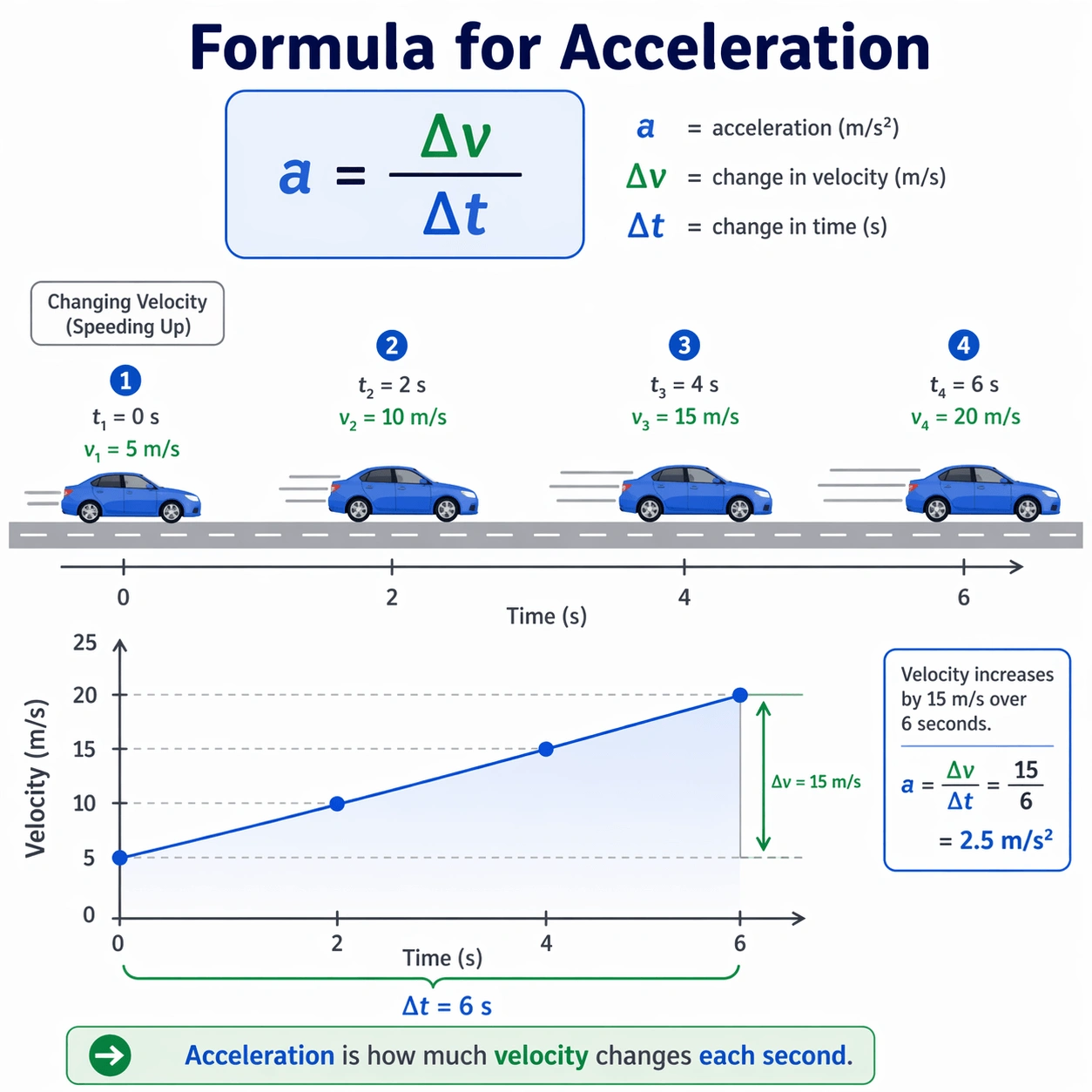
This core equation establishes that acceleration is directly proportional to the change in velocity and inversely proportional to the time taken. When an object undergoes a significant change in speed in a very short amount of time, it experiences a high rate of acceleration.


Help your child reach their full potential!
Answer a few quick questions about your child’s learning, and we’ll recommend next steps.
Expert Math Tutors for Every Level
Connect with professional and certified educators who provide specialized support for every grade level, from elementary school basics to advanced algebra
The Basic Acceleration Formula: Change in Velocity over Time
The most common way to represent acceleration is through the kinematic equation a = (v_f – v_i) / t, where the difference between the ending and starting velocities is measured against the duration of the movement. This formula is used when you know how fast an object was moving at the beginning of an observation and how fast it was moving at the end. It effectively averages the rate of change over the entire time period, providing what is known as average acceleration.
Understanding Final and Initial Velocity
To use the acceleration formula correctly, it is necessary to distinguish between final velocity (v_f) and initial velocity (v_i). The initial velocity is the speed and direction of the object at the exact moment the time measurement starts, while the final velocity is the speed and direction at the moment the measurement ends. If an object starts from a complete standstill, its initial velocity is zero. If an object comes to a full stop, its final velocity is zero. The direction is also critical; for example, if an object reverses direction, one of the velocities must be treated as a negative value in the calculation to ensure the resulting acceleration accurately reflects the change in the motion vector.
SI Units for Acceleration
The standard unit of measurement for acceleration in the International System of Units (SI) is meters per second squared, written as m/s². This unit can be thought of as “meters per second, per second.” It describes how many meters per second the velocity changes during every single second of motion. For instance, if an object has an acceleration of 5 m/s², its velocity increases by 5 meters per second every second. Other units like feet per second squared (ft/s²) or kilometers per hour per second (km/h/s) are sometimes used in specific contexts, but m/s² remains the universal scientific standard for consistency in calculations.
Alternative Formulas for Acceleration
Acceleration can also be determined using other physical properties such as force, mass, and distance when velocity or time values are not directly available. These alternative formulas allow for the calculation of acceleration in various scenarios, such as determining how much a specific engine can move a heavy load or finding the rate of speed change based on the length of a skid mark on a road. Mastering these different perspectives provides a more complete understanding of how motion is governed by physical laws.
Newton’s Second Law: Acceleration from Force and Mass
One of the most famous formulas in physics is Newton’s Second Law of Motion, which is expressed as F = ma. When rearranged to solve for acceleration, the formula becomes a = F / m. This equation shows that the acceleration of an object depends on two variables: the net force acting upon the object and the mass of the object itself. According to this law, as the force acting upon an object is increased, the acceleration of the object is increased. Conversely, as the mass of an object is increased, the acceleration of the object is decreased for a given amount of force. This explains why a lighter car can accelerate faster than a heavy truck even if they use the same amount of engine force.
Acceleration and Displacement
When the time of travel is unknown, acceleration can be calculated using the displacement (distance) and the initial and final velocities. The kinematic formula used for this is v_f² = v_i² + 2ad. By rearranging this equation to solve for acceleration, we get a = (v_f² – v_i²) / 2d. This formula is particularly useful in forensic science and engineering. For example, if investigators know the speed a car was traveling before a crash and can measure the distance of the tire marks left on the pavement, they can use this formula to calculate the rate of deceleration that occurred during braking. It relates the energy change of the object directly to the distance over which that energy was lost or gained.
Solved Examples on formula for acceleration
Practicing with real-world scenarios helps solidify the understanding of how to apply acceleration formulas in different contexts. By identifying the known variables and choosing the correct equation, students can solve complex motion problems with ease. The following examples demonstrate the use of the basic velocity-time formula, the force-mass formula, and the displacement-based kinematic equation. Each example follows a logical progression from identifying the “givens” to performing the final subtraction and division required for the answer.
Example 1: Calculating Average Acceleration of a Moving Car
A car is traveling at an initial velocity of 10 m/s. The driver presses the gas pedal, and after 5 seconds, the car is traveling at 30 m/s. To find the acceleration, we use the formula a = (v_f – v_i) / t. First, identify the variables: v_f = 30 m/s, v_i = 10 m/s, and t = 5 s. Plugging these into the equation: a = (30 – 10) / 5. This simplifies to a = 20 / 5, resulting in an acceleration of 4 m/s². This means the car increased its speed by 4 meters per second for every second that passed.
Example 2: Finding Deceleration When a Biker Stops
A cyclist moving at 15 m/s applies the brakes and comes to a complete stop in 3 seconds. In this case, the final velocity (v_f) is 0 m/s because the biker stopped, and the initial velocity (v_i) is 15 m/s. Using the formula a = (v_f – v_i) / t, we get a = (0 – 15) / 3. This results in a = -15 / 3, which equals -5 m/s². The negative sign indicates that the object is slowing down in the direction of motion, which is often called deceleration. The magnitude of the deceleration is 5 m/s².
Example 3: Solving for Acceleration with Constant Net Force
An engineer is testing a small robot that has a mass of 10 kilograms. If a constant net force of 50 Newtons is applied to the robot, what is its acceleration? For this problem, we use Newton’s Second Law: a = F / m. Identify the variables: F = 50 N and m = 10 kg. Plugging the numbers into the formula: a = 50 / 10. The resulting acceleration is 5 m/s². This example shows how the physical properties of the object and the environment determine the rate of change in motion.
Example 4: Determining Acceleration from Distance and Time
An object starts from rest (v_i = 0) and travels 100 meters in 10 seconds with uniform acceleration. We can find the acceleration using the displacement formula d = v_i(t) + 0.5(a)(t²). Since v_i is 0, the formula simplifies to d = 0.5(a)(t²). Identify the variables: d = 100 m and t = 10 s. Substitute the values: 100 = 0.5(a)(10²), which becomes 100 = 0.5(a)(100), or 100 = 50a. Dividing both sides by 50, we find that a = 2 m/s². This allows us to find the acceleration even without knowing the final velocity reached at the end of the distance.
FAQ
What is the SI unit of acceleration?
The official SI unit for acceleration is meters per second squared (m/s²). This unit represents the change in velocity (meters per second) that occurs during every second of time. It is derived by taking the unit for velocity (m/s) and dividing it again by the unit for time (s). This mathematical relationship is why the “seconds” unit is squared in the denominator. Understanding this unit is essential for performing accurate physics calculations and ensures that results can be shared and understood by scientists and engineers globally, regardless of the specific language they speak or the country they are in.
Can acceleration be negative?
Yes, acceleration can be negative, and this usually indicates that an object is slowing down or moving in the opposite direction of the defined positive axis. In many textbooks, negative acceleration is referred to as deceleration. For example, when a car approaches a red light and the driver applies the brakes, the acceleration vector points in the opposite direction of the car’s movement, resulting in a negative value in the calculation. It is important to remember that the sign of acceleration depends on both the change in speed and the direction of the object’s motion relative to the chosen coordinate system.
How do you calculate acceleration from force?
To calculate acceleration from force, you use the formula derived from Newton’s Second Law of Motion: a = F / m. In this equation, “a” stands for acceleration, “F” represents the net force acting on the object (measured in Newtons), and “m” represents the mass of the object (measured in kilograms). This formula tells us that acceleration is the result of a force being applied to a mass. To find the answer, you simply take the total force and divide it by the total mass. If multiple forces are acting on an object, you must first find the “net force” by adding or subtracting them based on their direction.
What is the difference between velocity and acceleration?
Velocity and acceleration are related but distinct concepts. Velocity describes the rate at which an object changes its position; it tells you how fast an object is going and in what direction. Acceleration describes the rate at which an object changes its velocity; it tells you how the speed or direction of the object is evolving over time. If an object is moving at a constant speed in a straight line, it has a high velocity but zero acceleration. Only when the object speeds up, slows down, or turns does it experience acceleration. Velocity is the “speed of travel,” while acceleration is the “rate of speed change.”
How do you find acceleration without final velocity?
You can find acceleration without knowing the final velocity by using the displacement kinematic formula: d = v_i(t) + 0.5(a)(t²). In this equation, “d” is the displacement, “v_i” is the initial velocity, “t” is the time, and “a” is the acceleration. By rearranging this formula, you can isolate “a” and solve for it using the known distance and time. This is particularly useful for objects starting from rest, where v_i is zero, simplifying the math to a = 2d / t². This allows you to determine the rate of acceleration simply by measuring how far an object traveled and how long it took to get there.


Math & reading from 1st to 12th grade
Looking for homework support for your child?

Choose kid's grade

Math & Reading for Grades 1–12
Build real confidence for your child with a Brighterly math or reading tutor.